Quick Answer
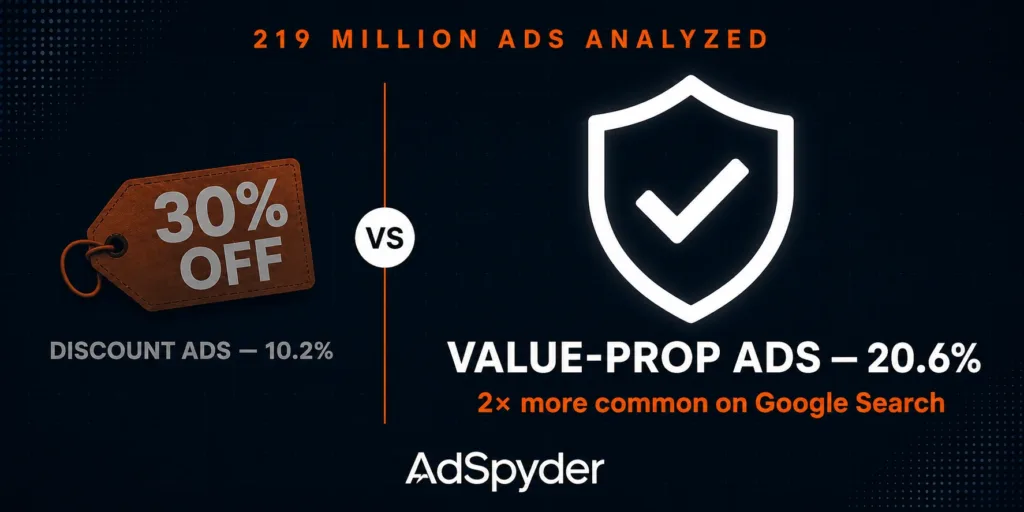
On Google Search, value-prop language appears in 20.6% of ads vs just 10.2% for discounts — a 2-to-1 ratio across 164 million ads. On live Meta ads, value-prop also leads (23.3% vs 16.2%). Value-prop-only ads also outlive discount ads on Meta: 11.6% survive past 30 days vs 6.5% of offer-only ads. See what angle your competitors are running in the AdSpyder Ad Library. Source: AdSpyder platform data, May 2026.
The assumption baked into most ad briefs is that discounts drive clicks. “30% off”, “Limited time offer”, “Sale ends Sunday” — the mental model is that price cuts are the default weapon in paid advertising.
The data says otherwise. We ran a full-index keyword classifier across 219 million ads — Google Search (164M+) and Meta historical + real-time (55M+) — and counted how many use discount/offer language versus value-prop language. The findings flip the conventional wisdom on two counts: value-prop framing is more common, and it lasts longer.
Here’s exactly what we found, broken down by platform — and what it means for how you write and research ad copy.
In This Report
The Platform Split: Value-Prop Wins on Every Current Ad Surface
Full-index keyword classifier across 219M ads · AdSpyder Ad Library, May 2026
Across all three current ad surfaces we measured, value-prop language outpaces discount language. The gap is widest on Google Search.
20.6%
Google Search — Value-Prop
33.8M of 164M+ ads
10.2%
Google Search — Discount
2× less than value-prop
23.3%
Meta Live — Value-Prop
of 11M+ active ads
16.2%
Meta Live — Discount
of 11M+ active ads
Source: AdSpyder platform data, May 2026. Full-index keyword-based classifier on ad title + body copy.
The Google Search gap is the headline finding: 33.8 million search ads use value-prop language vs 16.7 million with discount signals — exactly 2-to-1. Search ads are character-constrained. Saying “trusted by 50,000 customers” or “guaranteed results” delivers more per word than “20% off”, and the data reflects that advertisers know it.
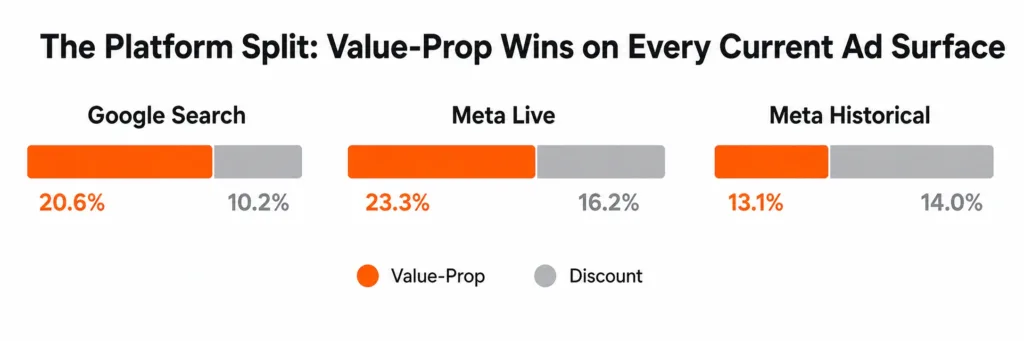
The Meta historical archive — 43.9M ads going back to 2018 — tells a different story: near parity (14.0% offer / 13.1% value-prop). That was the older era of e-commerce-heavy Meta creative. The live feed has already moved on. The shift from parity to a 1.4× value-prop advantage in current Meta ads tells you exactly where the industry has moved.
| Platform | Ads Scanned | Discount % | Value-Prop % | VP:Disc Ratio |
|---|---|---|---|---|
| Google Search | 164M+ | 10.2% | 20.6% | 2.0× |
| Meta Real-Time (live) | 11M+ | 16.2% | 23.3% | 1.4× |
| Meta Historical (2018–2026) | 44M+ | 14.0% | 13.1% | ≈1.0× |
Source: AdSpyder Ad Library — full-index keyword-based classifier, May 2026. See methodology section for signal definitions.
What the historical vs. live shift tells you
The older Meta archive shows discount and value-prop at near parity — that was the 2018–2026 era of promotion-heavy DTC advertising. The live feed shows value-prop pulling ahead at 1.4×. The industry has already shifted. If your Meta creative strategy is still discount-first, you’re working from an outdated playbook.
See exactly what copy angle your competitors are running
Search 360M+ ads by domain, keyword, or CTA phrase — across Google, Meta, YouTube, LinkedIn and 6 more platforms.
The Hybrid Ad: Pure Discount Copy Is Disappearing
Ads containing both an offer signal AND a value-prop signal · AdSpyder Ad Library, May 2026
The platform-level split above counts any ad with a discount signal or value-prop signal. What it doesn’t show is how many of those “discount ads” also carry a credibility claim on top. We tracked this “hybrid” cohort separately — and the numbers are significant.
55%
Meta Live offer ads that are hybrid
also include a value-prop signal
42%
Google Search offer ads that are hybrid
also include a value-prop signal
32%
Meta Historical offer ads that are hybrid
older era — less overlap
Source: AdSpyder Ad Library — ads containing both a discount signal AND a value-prop signal, May 2026.
On Meta’s live feed, the majority of discount ads are no longer pure discount ads. 55% of them bolt a credibility claim on top — things like “30% off + trusted by 50,000 customers” or “Limited time deal — guaranteed results.” That figure was only 32% in the older archive, which means the shift to hybrid copy has happened within the last few years.
On Google Search, 42% of offer ads also include a value-prop word. Advertisers have figured out that letting a discount stand alone on a search result — with no signal of why you should trust the brand — leaves credibility on the table.
Practical implication
Running a bare “30% off” ad without any trust signal now puts you below what the majority of Meta advertisers do by default. The hybrid pattern — offer + credibility — is no longer a creative choice. It’s table stakes.
Which Type of Ad Lives Longer?
26,469-ad random sample from Meta historical archive · AdSpyder, May 2026
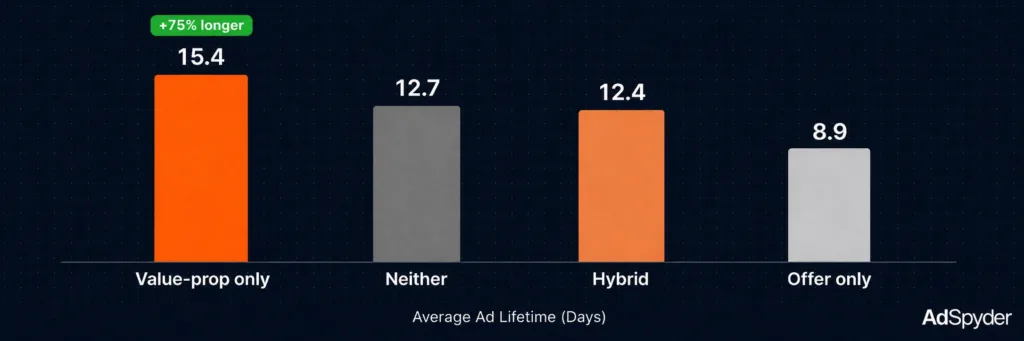
We split 26,469 Meta historical ads into four cohorts by copy type and measured how long each group ran. The result is unambiguous.
15.4 days
Value-prop only — avg lifetime
11.6% survive past 30 days
8.9 days
Offer only — avg lifetime
6.5% survive past 30 days
Source: AdSpyder Meta historical archive longevity analysis, May 2026. n=26,469 ads with observable first-seen/last-seen dates.
| Ad Cohort | Sample (n) | Mean Days | P90 Days | Survive 30d+ |
|---|---|---|---|---|
| Value-prop only 🏆 | 1,670 | 15.4 | 40.4 | 11.6% |
| Neither signal | 21,125 | 12.7 | 27.0 | 9.3% |
| Hybrid (both signals) | 897 | 12.4 | 20.0 | 8.2% |
| Offer only | 2,777 | 8.9 | 17.2 | 6.5% |
Source: AdSpyder Meta historical archive longevity analysis, May 2026. Longevity = days between firstSeen and lastSeen. “Year-2038” active sentinels filtered out.
Value-prop-only ads run 75% longer on average than offer-only ads and are 1.8× more likely to survive past 30 days. The reason is structural. Discount ads are tied to a sale, a deadline, a promotional window — when the sale ends, the ad gets killed. Value-prop ads don’t have expiry dates. “Trusted by X customers”, “fastest in category”, “no contract required” — these claims run as long as they stay true.
One finding worth flagging explicitly: adding a value-prop to a discount ad does not save it from dying early. Hybrid ads average 12.4 days — barely better than offer-only at 8.9 days. The offer’s time-bound nature caps the run regardless of how you frame it. A “30% off — trusted by 50k customers” ad still gets paused when the sale ends.
Important caveat
Longevity is a proxy for performance, not a measurement of it. An ad that kept running was almost certainly working well enough to keep paying for — but AdSpyder does not observe spend, impressions, or conversions. These numbers come from Meta historical only; Google Search longevity by copy type is a separate analysis not yet run.
What This Means for Your Ad Copy
On Google Search, value-prop is the default — not the exception
2-in-10 Search ads use value-prop language. Only 1-in-10 use discount language. Your competitors have already made this shift. The question is which specific claims they use — “guaranteed”, “#1 rated”, “trusted” — and whether there’s one your category overuses enough that a different angle stands out.
On Meta, if you’re running a discount, pair it with a credibility claim
55% of live Meta offer ads already do this. Running a standalone “30% off” now puts you below the market norm. Use the AdSpyder Facebook Ads Spy to see how your direct competitors combine offer and credibility language — and specifically what trust signals they’re using.
Build some of your ad set around always-on value-prop creative
Discount ads are short-cycle by design — 82% expire within a week. If your entire Meta ad set is sale-driven, you’re rebuilding creative every few weeks. Value-prop ads that survive 30+ days at 1.8× the rate of offer-only ads are the part of your creative that carries between sale windows.
How to Research What Copy Angle Your Competitors Are Using
Platform-level data tells you what the market looks like in aggregate. What you actually need is what your specific competitors are doing in your category. Here’s how to find it using the AdSpyder Ad Library.
Search by competitor domain
Enter a competitor’s domain and pull every ad they’ve run on Google or Meta. Look for whether they lead with a price point, a feature claim, or social proof — and how they combine them. This takes two minutes and gives you a direct read on their copy strategy.
Filter for long-running ads
Check first-seen and last-seen dates in the results. Ads running 30+ days are the ones the advertiser kept paying for. That’s your strongest signal of what works — not what they launched, but what survived. The creative that’s been running for 60+ days is almost certainly profitable.
Check LinkedIn separately if you’re B2B
LinkedIn has its own copy norms — and its own longevity patterns. The AdSpyder LinkedIn Ad Library covers 857,000+ ads. On LinkedIn, image ads survive past 30 days at 91.1% — the highest of any format on any platform in AdSpyder’s entire archive. What works there looks nothing like Meta copy.
Set up ongoing competitor tracking
A one-off search gives you a snapshot. If you want to catch the moment a competitor shifts from discount-heavy to value-prop copy — or launches a new offer — set up a competitor tracking project. AdSpyder users are currently tracking 3,687 competitors across 1,104 active projects (AdSpyder platform data, May 2026).
Methodology
This analysis used a keyword-based pattern classifier run across the full AdSpyder Ad Library index. The percentage counts are exact full-index figures (not sampled); only the longevity section uses a sample.
| Signal Type | Keywords Matched |
|---|---|
| Discount / Offer | % off, save, discount, sale, deal, offer, clearance, limited time |
| Value Proposition | best, trusted, guaranteed, #1, award-winning, rated, proven, no contract, free shipping, easy, fast, instant |
Fields scanned: ad title, ad body/description text, and (Meta only) CTA title + CTA content. Case-insensitive matching. An ad can match both signals and is counted in the “hybrid” cohort separately.
Accuracy note
The value-prop keyword list includes broad terms (“easy”, “fast”, “instant”) that may match ads where those words appear in a non-value-prop context. Treat value-prop percentages as an upper bound. Discount/offer keywords are narrower and more precise. Longevity analysis: 26,469-ad random sample of Meta historical ads with observable first-seen and last-seen dates; year-2038 “still active” sentinel values filtered out.
Frequently Asked Questions
Stop guessing what’s working in your category
The AdSpyder Ad Library indexes 360 million+ ads across 10 platforms — Google, Meta, YouTube, LinkedIn, TikTok, Amazon, Bing, Display, Twitter, and more. Search by competitor domain, keyword, or CTA phrase. See exactly what copy angle is running in your market — and which ads are surviving.
23,000+ registered users · 10 platforms · 100+ countries · AdSpyder platform data, May 2026
Data source: AdSpyder Ad Library — original keyword-rule classifier analysis run May 2026 across 219M+ ads on three platform archives (Google Search 164M, Meta historical 44M, Meta real-time 11M). Discount/offer signals: % off, save, discount, sale, deal, offer, clearance, limited time. Value-prop signals: best, trusted, guaranteed, #1, award-winning, rated, proven, no contract, free shipping, easy, fast, instant. Longevity data from a 26,469-ad random sample of Meta historical ads with observable first-seen/last-seen dates. All counts are indexed ad creatives, not impressions or spend.