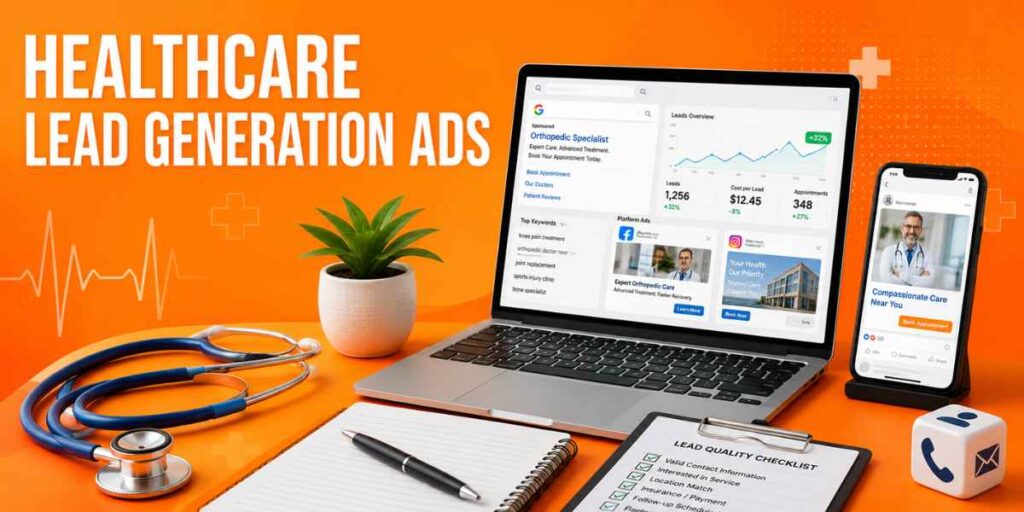
Healthcare Advertising · Lead Generation
Quick Answer
Effective healthcare lead generation ads connect a specific care need with a clear, credible next step. The campaign should match patient intent, avoid exaggerated medical claims, send each ad to a relevant service page and measure booked appointments rather than form submissions alone.
- Use Google Search for urgent, local and specialty-care demand.
- Use Meta and video channels for education, trust and service awareness.
- Build campaigns around services and patient intent instead of one broad healthcare campaign.
- Use credentials, access, location and process clarity as trust signals.
- Research current ads through
AdSpyder for Healthcare
before creating your campaign.
Healthcare lead generation is not simply a matter of collecting more names and phone numbers. A useful campaign must attract people who need the service, live within the provider’s service area, understand the next step and feel confident enough to book. At the same time, the advertiser must protect patient privacy, support every medical claim and follow rules that vary by platform, service and country.
AdSpyder Market Signal · May 2026
AdSpyder’s Meta dataset recorded 916,651 Healthcare & Beauty ads from 67,306 advertisers. Indira IVF alone appeared with 9,585 active ads in the rolling live feed.
916,651
Indexed healthcare and beauty ads
67,306
Distinct advertisers in the category
9,585
Active Indira IVF ads in the cited feed
Ad volume is a competitive-activity signal. It does not prove spend, conversions or campaign profitability.
Why Healthcare Lead Generation Is Harder
Healthcare buyers are often anxious, time-sensitive and cautious. The same person may compare symptoms, doctors, insurance, distance, appointment availability and treatment options before making contact.
Trust comes before conversion
Patients need evidence that the provider, doctor, service and location are credible.
Intent varies widely
A preventive-checkup search should not enter the same campaign as urgent or specialty care.
Lead volume can hide poor quality
A low-cost form fill has limited value when the person is outside the service area or never books.
Rules differ by market
Policies can change by country, treatment, insurance category, pharmacy status and targeting method.
Target Audiences and High-Intent Moments
Build each campaign around the decision the patient is currently trying to make. Avoid assuming or declaring that an individual has a medical condition in the ad copy.
| Audience | High-Intent Moment | Useful Offer | CTA |
|---|---|---|---|
| Local care seeker | Looking for a nearby doctor or clinic | Location, hours and availability | Check Availability |
| Specialist researcher | Comparing doctors and treatment expertise | Doctor profile and consultation | View Specialist |
| Preventive-care planner | Planning an annual screening or checkup | Tests included, preparation and price | See Package Details |
| Convenience-focused patient | Needs evening, same-day or virtual access | Booking options and response time | Book an Appointment |
| Caregiver or family decision-maker | Evaluating care for a family member | Care pathway and support information | Talk to the Care Team |
Best Ad Channels and Campaign Structure
Google Search: capture active demand
Create separate campaigns for specialty, location, urgent access, doctor names and preventive services. Send each ad group to the closest matching page.
Meta: educate and build familiarity
Use broad local audiences, educational videos, doctor introductions and facility content. Avoid copy that states or implies the viewer has a particular condition.
YouTube: reduce uncertainty
Explain consultation processes, doctor expertise, facility access and what patients can expect before an appointment.
LinkedIn: reach professional buyers
Use LinkedIn for employer health services, hospital partnerships, medical technology, diagnostics and other B2B healthcare offers.
Recommended Campaign Structure
Account → service line → intent group → keyword or audience → matching ad → service-specific landing page → booking or call conversion.
Keyword, Offer and Creative Examples
| Intent | Keyword Examples | Safer Ad Angle | Landing Page |
|---|---|---|---|
| Local clinic | clinic near me, family doctor in city | Location, opening hours and online booking | Local clinic page |
| Specialist | neurologist in city, orthopedic specialist | Specialist credentials and appointment access | Specialty or doctor page |
| Urgent access | walk-in clinic open now, same-day doctor | Actual availability, distance and contact options | Urgent-care page |
| Preventive care | annual health checkup, screening package | Included tests, eligibility and pricing clarity | Package details page |
| Telehealth | online doctor consultation, virtual appointment | Process, availability and service limitations | Telehealth booking page |
Better Copy
Neurology consultations in Dubai
View specialist credentials, clinic location and available appointment times.
Avoid
You have a serious neurological problem
This assumes a personal condition and creates unnecessary fear.
Avoid
Guaranteed cure with the best treatment
Absolute outcome and superiority claims require strong, relevant substantiation and may still be inappropriate.
Trust and Compliance Guardrails
Healthcare rules are not identical across services or countries. Review the latest platform requirements and obtain legal or compliance approval before launch.
Platform certification
Google restricts several healthcare categories, including prescription services, telemedicine, health insurance, addiction services and restricted drug terms. Certification and location rules vary.
Sensitive targeting
Do not build personalized advertising audiences around sensitive health conditions. Use service intent, geography and permitted contextual signals instead.
Claims and testimonials
Health-related claims must be truthful, not misleading and appropriately supported. A patient testimonial cannot communicate a claim that the advertiser could not make directly.
Patient information
Do not use protected health information for marketing without the required authorization. Review forms, CRM fields, call recordings and advertising integrations with the privacy team.
This section is general marketing guidance and is not legal advice. Read the detailed
healthcare advertising compliance guide
before launching regulated campaigns.
Landing Page and Lead-Quality Checklist
Landing-page essentials
- Headline matching the ad and keyword
- Doctor qualifications and specialty
- Location, hours and contact options
- Service scope and eligibility
- Insurance or pricing information where available
- Visible privacy notice
- Simple mobile booking flow
- Emergency-care clarification where relevant
Lead-quality essentials
- Campaign and source recorded
- Requested service identified
- Service-area eligibility confirmed
- Preferred appointment time captured
- New or existing patient status recorded
- Lead contacted within the agreed response time
- Appointment and attendance outcome tracked
- Unnecessary medical details excluded from the first form
Measure More Than Cost per Lead
Track cost per qualified lead, contact rate, lead-to-appointment rate, cost per booked appointment, appointment show rate and patient acquisition cost. A campaign producing fewer leads may be more valuable when more of those leads become attended appointments.
Real Competitor Pattern: Adam Vital Hospital
AdSpyder’s publicly accessible domain report for Adam Vital Hospital reveals a clear specialty-and-location pattern. Full creative history and deeper campaign details require an AdSpyder account, but the public report provides enough information for a useful first-pass teardown.
| Observed Element | Public AdSpyder Signal | Strategic Lesson |
|---|---|---|
| Keywords | Headache treatment, neuro doctor, neurologist in Dubai, appointment booking | Combine service, specialty, location and action intent. |
| CTAs | Book Now and Contact Us | Use direct next steps instead of vague brand CTAs. |
| Landing page | Neurology service information, specialist profile, credentials and appointment action | Continue the same intent after the click. |
| Competitor set | Cleveland Clinic Abu Dhabi, Mediclinic City Hospital and other regional providers | Benchmark against providers competing for the same geography and specialty. |
What to take from the pattern
Reuse the structure, not the wording or creative: specialty keyword, local relevance, credible doctor information and an immediate appointment path. Independently validate every medical claim and build original brand assets.
Competitor-Ad Research Workflow With AdSpyder
List five local or specialty competitors and search their domains using
URL Domain Analysis.
Use
Google Ads Spy
to study service keywords, headlines, locations, CTAs and ad-to-page alignment.
Use
Facebook Ads Spy
to group creatives by doctor, facility, education, convenience, package and testimonial angle.
Review each post-click experience with
Landing Page Analysis.
Build a message matrix recording audience, intent, offer, proof, CTA, landing page and compliance risk.
Create original variations and send every healthcare claim through brand, medical and legal review before launch.
For channel-specific implementation, read the
healthcare PPC and SEM guide
and the
patient acquisition funnel guide
.
30-Day Healthcare Lead Generation Action Plan
Days 1–7 · Research
Confirm services, locations, patient eligibility and compliance requirements. Analyze five competitors in AdSpyder. Save at least 20 relevant ads and record their keywords, offer, proof, CTA and landing page.
Days 8–14 · Build
Create service-specific campaigns, negative-keyword lists, three creative angles per service and matching landing pages. Configure call, booking and qualified-lead tracking.
Days 15–21 · Launch
Launch controlled budgets by service and location. Check search terms, policy status, lead routing, response time and mobile booking every day. Pause irrelevant queries rather than judging only by clicks.
Days 22–30 · Improve
Compare cost per qualified lead, booking rate and show rate by campaign. Improve weak landing pages, shift budget toward stronger service lines and prepare the next compliant creative rotation.
Research healthcare ads before spending your budget
Use AdSpyder to compare competitor keywords, ad angles, CTAs and landing pages across healthcare platforms and locations.
Frequently Asked Questions
What is healthcare lead generation?
It is the process of attracting prospective patients or healthcare buyers and moving qualified inquiries toward consultations, appointments or sales conversations.
Which channel is best for healthcare leads?
Google Search is usually the strongest starting point for active service demand. Meta and YouTube are useful for education, trust and awareness, while LinkedIn is better suited to B2B healthcare buyers.
What makes a healthcare ad trustworthy?
Useful trust signals include verified credentials, transparent service information, real locations, clear appointment steps, accurate pricing information and claims supported by appropriate evidence.
Can healthcare advertisers use patient testimonials?
Testimonials require appropriate authorization and must not communicate misleading or unsupported outcomes. Applicable privacy, advertising and professional rules should be reviewed before use.
Which metric matters more than cost per lead?
Cost per booked appointment and cost per attended appointment provide a stronger view of campaign value than form-fill cost alone.
How does AdSpyder help healthcare advertisers?
AdSpyder helps marketers research competitor ads, domains, keywords, creative patterns and landing pages across multiple platforms before developing original campaigns.
Research and Policy References
AdSpyder Healthcare Use Case
|
AdSpyder May 2026 Data Study
|
Google Healthcare Advertising Policy
|
Google Health Targeting Policy
|
FTC Health Claims Guidance
|
HHS HIPAA Marketing Guidance