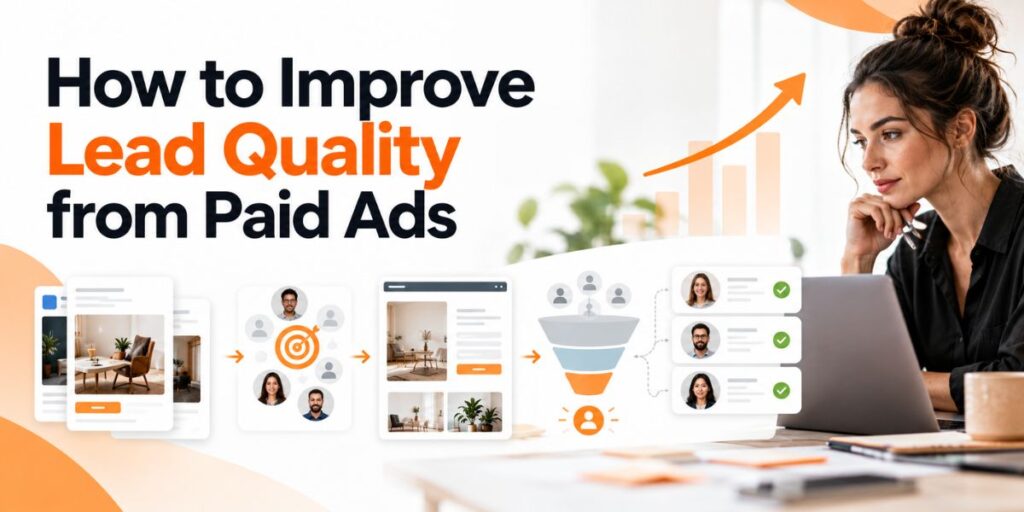
Lead Quality · Landing Pages · CRM Feedback
Quick Answer
- Start by choosing the right conversion path using our lead form ads vs landing pages guide
- Target buyer intent instead of optimizing for the cheapest possible click or form fill.
- Make the ad promise specific enough to discourage poor-fit prospects.
- Use qualifying fields only when the answer changes how sales handles the lead.
- Feed qualified and converted lead outcomes back into the ad platform whenever possible.
Improving lead quality from paid ads is not mainly about generating fewer leads. It is about teaching the campaign which people are genuinely likely to become customers.
That requires alignment across targeting, ad promise, form questions, landing-page content, sales qualification and CRM feedback. Fixing only the ad rarely solves the full problem.
The Lead Quality Rule
A cheap lead is expensive when sales cannot use it.
Judge paid acquisition using qualified-lead rate, opportunity creation and revenue rather than form volume alone.
What Does Lead Quality From Paid Ads Actually Mean?
A quality lead matches enough of your commercial criteria to justify the next sales action.
Problem Fit
They need something your product or service genuinely solves.
Customer Fit
Their company, location, budget or use case fits your business model.
Intent Fit
Their current level of purchase intent matches the campaign offer.
Sales Fit
Your team can realistically move the lead toward a sale.
8-Step Framework to Improve Paid Lead Quality
Define a Qualified Lead Before Changing the Ads
Write down the conditions that make a lead useful. Include company type, geography, budget, service requirement, purchase stage or another factor your sales team actually uses.
Move Budget Toward Higher Intent
Prioritize audiences and searches that signal evaluation, comparison, pricing, demo, quote or purchase intent rather than broad interest alone.
Exclude Obvious Non-Buyers
Use search negatives, location controls and relevant audience exclusions to remove traffic you already know does not convert into customers.
Make the Ad More Specific
Mention the audience, price position, use case, requirement or commitment level when those details help unsuitable prospects self-select out.
Match the Landing Page to the Ad Promise
Repeat the same problem, offer and use case on the page. Do not make a high-intent visitor decode a generic homepage after clicking a specific ad.
Add Only Useful Qualifying Questions
A field should help route, prioritize or disqualify a lead. If sales does nothing differently based on the answer, the field may be unnecessary.
Respond Before Intent Decays
Route good leads quickly and automate the first useful response when appropriate. A qualified prospect can still become a lost lead when follow-up is slow.
Send CRM Outcomes Back to the Ad Platform
Teach the platform which leads became qualified opportunities, converted leads or customers instead of treating every submission as equally valuable.
Fix Intent Before You Fix the Form
Bad leads often start before the visitor reaches the landing page.
| Search or Audience | Likely Intent | Paid Strategy |
|---|---|---|
| What is CRM software? | Learning | Usually weak demo intent |
| Best CRM for 20-person sales team | Comparison | Strong evaluation opportunity |
| CRM pricing for 25 users | Commercial | High-intent pricing or demo page |
Use Exclusions to Protect Lead Quality
Exclusions should remove known bad-fit demand without shrinking the campaign blindly.
- Add negative keywords for jobs, training, free resources, DIY or other irrelevant search intent.
- Exclude service locations you cannot support.
- Separate existing customers when the campaign is designed only for new acquisition.
- Exclude internal employees and test traffic from performance analysis.
- Review placements or audiences that repeatedly generate spam or zero sales acceptance.
- Do not exclude broad segments only because one week produced weak leads. Use enough data to identify a consistent problem.
Your Ad Can Qualify Before the Form Does
Specific advertising can reduce clicks while improving the percentage of useful prospects who continue.
| Generic Ad | Quality-Oriented Ad |
|---|---|
| Grow Your Business Today | B2B CRM for Sales Teams With 10–100 Reps |
| Get a Free Quote | Commercial HVAC Quotes for Multi-Site Properties |
| Book a Demo | See Inventory Software Built for 3PL Warehouses |
Use Form Friction Deliberately
The shortest form is not always the best lead form.
The goal is to collect the minimum information required for the next useful business action.
Low-Friction Offer
Guide or Newsletter
Name and email may be enough.
Sales Offer
Demo or Consultation
Company, role or use case may improve routing.
Complex Purchase
Quote or RFQ
Requirements, volume or project details can save sales time.
For a deeper form framework, see Lead Generation Form Best Practices.
Landing Pages Should Filter and Persuade at the Same Time
Good landing pages do not simply maximize form submissions. They help the right visitor understand the offer while giving the wrong visitor enough information to leave.
☐ Match the ad’s main promise.
☐ State who the offer is for.
☐ Explain the use case clearly.
☐ Show credible proof early.
☐ Clarify price or commitment when relevant.
☐ Use one clear primary action.
☐ Ask qualifying questions only when useful.
☐ Remove vague promises that attract everyone.
The CRM Feedback Loop Is Now Essential
The ad platform sees a form submission immediately. Your sales team sees what happened next.
Connect those two datasets so the platform can learn from deeper outcomes.
| Lead Stage | What It Tells the Platform |
|---|---|
| Form Lead | Someone completed the acquisition action |
| Qualified Lead | Sales confirmed meaningful fit or interest |
| Opportunity | The lead progressed into a real sales process |
| Converted Lead | The lead reached your chosen completed business outcome |
2026 Google Ads update: enhanced conversions for web and leads now use a unified setting. Google also recommends enhanced conversions for leads and offline outcome imports when advertisers need bidding and measurement to learn from deeper CRM events.
Lead Quality Does Not End at the Form Submission
Current managed paid-growth systems are increasingly treating follow-up and filtering as part of acquisition rather than a separate sales problem.
For example, Gushwork’s current Paid Boost workflow combines targeting, creative, landing pages, lead delivery, automated follow-up and filtering. The useful lesson is not to copy that product. It is to treat the complete lead path as one system.
Metrics That Reveal Lead Quality
| Metric | Formula | Why It Matters |
|---|---|---|
| Qualified Lead Rate | Qualified leads ÷ total leads × 100 | Shows whether acquisition is attracting useful prospects |
| Cost per Qualified Lead | Ad spend ÷ qualified leads | More useful than CPL when lead quality varies |
| Lead to Opportunity Rate | Opportunities ÷ leads × 100 | Connects marketing with actual pipeline |
| Cost per Opportunity | Ad spend ÷ opportunities | Shows acquisition efficiency further down the funnel |
There is no trustworthy universal qualified-lead benchmark across industries. Define a baseline from your own sales data, then compare campaigns, audiences and offers against that baseline.
Three Lead Quality Examples
B2B SaaS
Replace a generic “Book Demo” campaign with use-case ads, employee-size qualification and CRM-qualified lead feedback.
Local Service
Tighten geography, remove DIY search intent and state service minimums before the form where appropriate.
High-Ticket B2B
Use a detailed landing page with proof, requirements and qualification rather than an instant low-friction lead form.
What AdSpyder’s Landing Page Data Adds to the Process
Competitor research becomes useful when you connect the ad with what happens after the click.
429
Domains
With landing URLs captured
466
Unique URLs
Captured in May 2026 data
4
URLs
At the 90th percentile
AdSpyder’s May 2026 dataset found a median of one captured landing-page URL per analyzed competitor domain, while the 90th percentile had four. This does not prove more pages convert better. It does show that more active advertisers often segment post-click destinations instead of sending every campaign to one page.
How AdSpyder Helps Improve Paid Lead Quality
Use competitor intelligence to find better hypotheses before spending more budget.
Find Comparable Competitor Ads
Choose advertisers selling to the same audience and compare similar funnel stages.
Record the Qualification Signals
Look for audience language, pricing, requirements, proof, offer type and commitment level.
Open the Destination Page
Compare headline match, CTA, proof, form friction and objections addressed on the page.
Identify the Gap
A competitor may have strong creative but weak message match, generic proof or an over-simple form.
Build an Original Test
Turn the observation into one hypothesis and validate it using your own qualified-lead and pipeline data.
Use AdSpyder Landing Page Analysis to compare competitor ads with their destination pages. For the complete methodology, see Competitor Ads for Lead Generation.
Study the full ad-to-page journey
Compare competitor promises, CTAs, forms and landing pages before deciding what to test in your own lead-generation campaigns.
Common Paid Lead Quality Mistakes
Optimizing for CPL alone
Cheaper leads can reduce pipeline if qualification rate falls faster than CPL.
Using vague ads
Broad promises attract people who like the outcome but do not fit the actual offer.
Adding too many form fields
Questions that sales does not use create friction without improving qualification.
Sending all ads to one page
Different audiences and offers may require different proof, language and conversion paths.
Keeping CRM outcomes private from ads
The platform continues learning from form completion rather than deeper sales quality.
Paid Lead Quality Checklist
☐ Qualified lead definition is documented.
☐ High-intent campaigns have priority.
☐ Negative keywords are reviewed.
☐ Geographic exclusions are correct.
☐ Ad copy identifies the right buyer.
☐ Landing page matches the ad promise.
☐ Form questions change the next action.
☐ Lead routing is fast.
☐ Qualified lead rate is measured.
☐ Cost per qualified lead is tracked.
☐ CRM outcomes return to the ad platform.
☐ Competitor post-click journeys are reviewed.
Stop paying the algorithm to find the easiest form fillers
Connect targeting, qualification, landing pages and sales outcomes so your campaigns can optimize toward the people who actually create pipeline.
Frequently Asked Questions
How do I improve lead quality from paid ads?
Improve intent targeting, remove known non-buyers, make ads more specific, qualify appropriately and send deeper CRM outcomes back to the ad platform.
Why am I getting cheap but low-quality leads?
The campaign may be optimized for easy form submissions instead of qualified outcomes. Broad targeting, vague ads and low-friction forms can amplify the problem.
Should I add more fields to improve lead quality?
Only when the answers help sales qualify, route or prioritize the lead. More fields alone do not guarantee better prospects.
What is a good qualified lead rate?
There is no reliable universal benchmark. Build a baseline from your own sales criteria and compare campaigns using the same qualification definition.
Can AdSpyder show which competitor landing page converts best?
No. It can show ads, destination pages, historical page changes and visible conversion strategies, but private competitor conversion rates and revenue are not available.