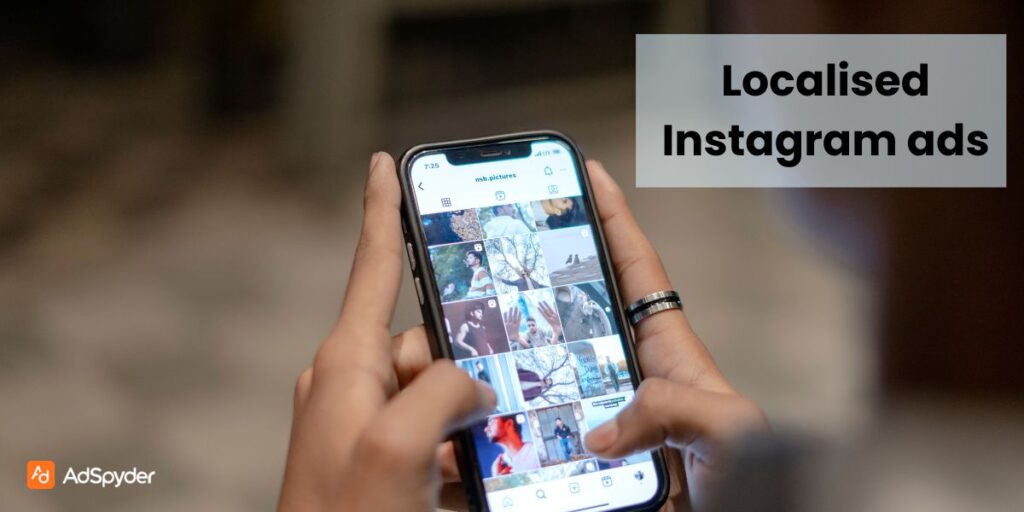
Most local businesses waste 30–50% of their Instagram ad budget targeting people who will never walk through their door or place an order. Localised Instagram ads fix that: instead of casting a wide net, you combine precise Instagram ads location targeting with creative that feels genuinely made for that city, neighbourhood, or delivery zone — so every rupee (or dollar) works harder.
This guide covers exactly how to set up location targeting on Instagram, which creative formats win locally, how to spy on what competitors in your area are already running, and how to measure whether your local Instagram campaigns are actually driving calls, bookings, and walk-ins — not just cheap clicks.
- Definition: Paid Instagram campaigns that combine geo-targeting (city, radius, ZIP/postal code) with locally relevant creative and offers.
- Where to set it up: Meta Ads Manager → Audience section → Locations (works for Instagram Feed, Stories, Reels, and Explore).
- Targeting options: City, radius (1 km–80 km), ZIP/postal code clusters, or multi-pin combinations.
- Best for: Restaurants, clinics, gyms, salons, real estate, retail, home services, coaching institutes — any business where “near me” intent drives conversions.
- Key difference from broad ads: Both the targeting AND the creative are localised — area names, local proof, location-specific offers, and landing pages that confirm availability.
- Cost signal: Instagram advertising cost varies by market — in India, average CPMs for localised campaigns typically run ₹40–₹150; in the United States, localised Instagram ad CPMs range from $8–$25 depending on city competition.
Key Statistics
Use Case Quick Reference
Why Geo-Targeting Works
City vs Radius vs ZIP: Decision Table
How to Set Up Location Targeting
AdSpyder Intelligence: What Local Advertisers Do
How to Research Competitors Using AdSpyder
Best Practices
Creative Ideas + Industry Examples
Retargeting for Local Conversions
Measurement & Optimization
Common Mistakes
FAQs
Conclusion
What Are Localised Instagram Ads?
Local Instagram ads are paid campaigns on Instagram (set up via Meta Ads Manager) that restrict delivery to a specific geography — a neighbourhood, city, postal code cluster, or radius around a store — and pair that targeting with creative that feels made for that area. The goal is not just to reach nearby users; it is to convert them because the ad feels unmistakably relevant to where they live, work, or spend time.
- Targeting: Use Instagram ad location targeting in Meta Ads Manager to narrow delivery by city, radius, or ZIP — and exclude zones you don’t serve.
- Creative: Use area names, recognisable local landmarks, local offers, and local social proof (reviews, UGC clips, neighbourhood shout-outs).
- Post-click: The landing page must confirm local availability — a branch page, delivery zone page, or “Book in [City]” page, not a generic homepage.
Instagram location based ads work best for businesses where geography directly drives purchase decisions: restaurants, dental clinics, gyms, salons, real estate developers, retail stores, home service providers, coaching institutes, and travel agencies.
Unlike broad Instagram advertising, localised campaigns give Meta’s algorithm a tighter signal — which means faster learning, lower wasted spend, and cleaner performance data per zone.
Key Statistics for Local Instagram Advertising
Based on ad creatives tracked across Meta platforms in AdSpyder’s database, local service businesses (restaurants, clinics, gyms, salons) running geo-targeted Instagram campaigns in India most frequently use Reel-format ads with a delivery/availability hook in the first 3 seconds — the single most repeated creative pattern in high-run-duration local campaigns. Campaigns that combined a city-name mention in the first frame with a local offer (e.g., “Free delivery in Koramangala tonight”) showed significantly longer active run durations compared to generic creative variants for the same advertisers — a strong signal of higher performance in Meta’s auction.
Use Case Quick Reference: Which Local Instagram Ad Setup Fits Your Business?
Before you open Meta Ads Manager, match your business type to the right local Instagram campaign setup using this table.
Why Geo-Targeted Localised Instagram Ads Work (When Done Right)
The biggest conversion killer in Instagram advertising is irrelevance. When someone in Pune sees an ad for a clinic in Bangalore, your budget burns and your results become noisy. IG advertising with location targeting removes that irrelevance at the source — Meta only shows your ad to users in the geography you specify.
- Higher CTR: local hooks like “Delivery in 30 minutes in Indiranagar” earn more taps than generic offers.
- Higher conversion rate: fewer “not available in my area” bounces from the landing page.
- Cleaner data: performance metrics become meaningful when geography is controlled — you know exactly which zone converts.
- Lower wasted spend: impressions only reach people who can actually buy from you.
- Faster algorithm learning: Meta’s system learns your ideal customer faster when the signal pool is geographically consistent.
One important nuance: “local” does not always mean a tiny radius. Many businesses perform better by targeting a cluster of nearby ZIPs or a metro area and then building localised creatives for each cluster — rather than going hyper-narrow with a 1 km radius and starving Meta’s algorithm of volume.
City vs Radius vs ZIP vs Multi-Location: Which Instagram Location Targeting Should You Use?
Meta Ads Manager gives you four primary location targeting on Instagram modes. Here is when to use each, what the tradeoffs are, and which business types they suit best.
How to Set Up Location Targeting for Localised Instagram Ads (Step-by-Step)
Instagram ads location targeting is configured inside Meta Ads Manager — even if your ads run exclusively on Instagram. According to Meta’s official advertising guidance, location targeting is set at the ad set level under Audience → Locations. The exact UI labels can change, but the workflow below is consistent across accounts.
- Know your exact service area — delivery zone, neighbourhood radius, or city list.
- Decide your primary conversion goal: calls, DMs, bookings, store visits, leads, or purchases.
- Have at least 2 localised creatives ready before launch — one for cold awareness, one with local proof.
- Prepare a local landing page or local profile that confirms availability in the targeted area.
Step 1 — Choose the right campaign objective
For local businesses, the strongest objectives in Instagram Ads Manager are Leads (for bookings and enquiries), Sales (for e-commerce or delivery), Engagement (for DM-based businesses), and Traffic (when you have a high-converting local landing page). If you have a physical store and your account supports it, Meta’s store traffic objective can also be effective.
Step 2 — Set placements to Instagram (or use Advantage+)
If your goal is purely local Instagram ads, manually select Instagram placements: Feed, Stories, Reels, and Explore. If you are optimising for results at scale, Meta’s Advantage+ placements can work — but monitor the placement breakdown in reporting to confirm conversions are actually coming from Instagram, not just Audience Network.
Step 3 — Configure location targeting
In the Audience section, find Locations and select one of these patterns based on your business type (refer to the decision table above). After selecting your included locations:
- Add exclusions immediately — any area you cannot serve should be excluded before the campaign goes live.
- Use the “People living in this location” option for most local campaigns (versus “recently in” or “travelling in” — these pull in tourists who won’t become regulars).
Step 4 — Layer one additional targeting signal
Location alone is often sufficient with Meta’s AI, but a light second layer can stabilise early results:
- Demographic fit: age brackets that match your actual buyers.
- Custom audiences: website visitors, engaged profile followers, or customer lists — these are the highest-efficiency layer for local campaigns.
- Interest proxy: use lightly and keep broad — over-stacking interests narrows the audience too quickly.
Step 5 — Build local creatives and a local post-click path
If your targeting is local but your creative is generic (no area name, no local proof, no local offer), your results will plateau within the first week. The next sections cover exactly how to fix that — including what AdSpyder’s data shows about which creative patterns hold up longest in local campaigns.
AdSpyder Intelligence: What Local Instagram Advertisers Actually Do
Most localised Instagram ads guides tell you what you should do. AdSpyder’s ad intelligence database shows you what advertisers in your category are actually doing — which creative formats run longest, which messaging angles repeat most, and which landing page patterns dominate in local campaigns. Here is what the data shows.
Across local Instagram and Facebook campaigns tracked in AdSpyder’s database, short-form video (Reels) accounts for the dominant share of high-run-duration local ads in food, beauty, and home services categories. Among these, the most repeated ad structure is: area-specific hook in the first 3 seconds → offer or proof → direct CTA (call/DM/book). Static image ads with location callouts in the overlay text remain common in real estate and clinic categories, where trust signals matter more than immediacy.
In local service categories tracked by AdSpyder, the three most-repeated messaging angles in active campaigns are: (1) delivery/availability promise with a time window (“same day,” “within the hour,” “today”), (2) local social proof (area-name + number of customers served or star rating), and (3) urgency + scarcity tied to local context (“slots filling fast this weekend in [Area]”). Campaigns that rotate across these three angles consistently show longer active run durations than those that rely on a single angle.
Using AdSpyder’s domain-level ad analysis, local advertisers with the longest-running campaigns consistently send traffic to pages that confirm local availability above the fold — the delivery zone, the specific branch address, or a “Book in [City]” heading. Generic homepages with no local confirmation are disproportionately common in campaigns that stop running within 14 days — a strong signal of poor post-click quality.
How to Research Competitor Local Ads Before You Spend a Rupee
One of the most avoidable mistakes in local Instagram campaigns is launching without knowing what your competitors are already running. If a rival has been running a particular local offer or hook for 60+ days, it is almost certainly working — and you can use that insight to build a smarter, differentiated variant. Here is the workflow using AdSpyder’s Facebook Ads Spy and Instagram Ads Spy.
- Search by competitor domain or brand name in AdSpyder’s ad library to pull all their active and historical Instagram/Meta ads.
- Filter by platform (Instagram) and ad format (video/image/carousel) to focus on what is live right now.
- Sort by run duration — ads that have been active the longest are generating positive ROI. These are your baseline benchmarks.
- Note the creative hooks — what does the first frame say or show? Is there an area name, a local offer, a time-based urgency, or a social proof element?
- Check the landing pages — where does the ad send traffic? Use AdSpyder’s domain analysis to see the full landing page context and what other ads drive traffic to the same URL.
- Identify repeated offers — if a competitor has been running “Free consultation in [Area]” for 3 months, that offer converts. Find a way to match or beat it.
- Build 3–5 localised variants — one that mirrors the proven structure, one with a different hook angle, one with stronger local proof. Track which variant runs longest after launch.
Best Practices for Geo-Targeted Localised Instagram Ads (That Don’t Waste Budget)

1. Don’t go too narrow too early
Hyper-local targeting works — but only when there is enough audience volume. If your geography is too small, delivery becomes unstable and CPM spikes. Start with a reasonable cluster (city or 5–8 km radius), then tighten once you see consistent conversions over at least 7 days.
2. Build campaigns around service areas, not administrative boundaries
Customers think in commute time and delivery time, not in municipal districts. Design your targeting around real-world behaviour: “within 20 minutes,” “deliverable zones,” or “near this landmark.” How to target local audience on Instagram effectively starts with mapping your real service geography first.
3. Use local proof as your primary persuasion asset
The single most effective trust signal in local advertising is proof from people who are geographically nearby. Google rating screenshots, local customer testimonials, neighbourhood shout-outs, and UGC clips all outperform polished brand creative in local conversion contexts.
4. Localise the offer — not just the headline
“10% off” is generic. “Free delivery in Koramangala tonight” is a local offer. Winning Instagram local ads almost always include a logistics-level detail: a delivery window, same-day availability, branch-specific pricing, or a locally exclusive deal that makes the ad feel time-sensitive and place-specific.
5. Match creative format to placement
Stories and Reels need a strong hook in the first 2–3 seconds, on-screen captions (most local users watch without sound), and a single clear CTA. Feed ads can carry more detail. Do not recycle the same creative across all placements — a Feed static image rarely converts as a Story without reformatting.
6. Use interactive mechanics for micro-commitments
Local buyers often have one blocking question before they act: “Do you serve my area?” “What are the hours?” “Which branch is closest?” Interactive Instagram ads with poll-style prompts or tap-to-reveal patterns can resolve these objections inside the ad unit and push users toward a DM or click.
7. Always include exclusions and negative geo logic
Exclude areas you cannot serve. If you are getting wrong-location leads (the Instagram ads wrong location problem), add exclusions first — before changing creative or bids. Run separate ad sets for high-value versus low-value zones so budget flows to your best geographies.
8. Use local landing pages to reduce drop-off
If your ad promises “Book in Andheri,” the click must land on a page that says “Andheri branch — available today.” A generic homepage breaks the location promise and destroys conversion rate. Even a simple page with branch address, hours, and a WhatsApp/call CTA will outperform a homepage for local campaigns.
9. Run a two-layer test: geo × message
Do not just test creatives in isolation. Test the same creative in different zones to see if the message lands differently. Price sensitivity, cultural context, and competitive intensity can vary dramatically between adjacent neighbourhoods — a two-layer test reveals this quickly.
10. Run a weekly local learnings loop
Every week, record: which zones converted best, which local hooks earned the highest CTR, and which offers reduced drop-off. Local campaigns compound when treated as a system — not one-off promotions. If you cannot find new angle inspiration, use AdSpyder’s Ad Library to see what competitors have tested and what is currently running in your category.
Localised Instagram Ads: Creative Ideas with Industry-Specific Examples
You do not need 50 ads. You need a few repeatable local templates and the discipline to test one variable at a time. Below are the six most effective creative frameworks for Instagram location based ads, each with real-world copy examples by industry.
- Hook: area name, landmark, commute-time promise, or local trend — within the first 3 seconds
- Value: what you do + why it is better than the alternative
- Proof: local review, UGC clip, or customer count from that area
- CTA: call, book, DM, get directions, or order now
Idea 1: “We deliver here” (logistics hook)
Show a map-like visual or simple text overlay confirming delivery to a specific area. Add delivery time, rating, or number of orders.
Idea 2: “Local problem → local solution” (service businesses)
Open with an instantly relatable local situation, then show your fix, local availability, and one local testimonial.
Idea 3: “Neighbourhood faces” (UGC + community trust)
Customer or creator clips filmed in your area — a taste test, try-on, walkthrough, or before/after. Keep it authentic; polished brand ads underperform locally in trust-sensitive categories like clinics and coaching. Use UGC ads on Instagram as the primary creative asset for these.
Idea 4: “How it works” (friction reduction in 20 seconds)
Local ads fail when users are unsure about process. Make a short “how it works” Reel answering the top 3 objections — then reuse it across zones with a localised hook at the start.
Idea 5: “Local countdown” (time-based urgency)
Urgency tied to a real local operational constraint: “Last seating at 10PM,” “Same-day delivery ends at 6,” “Weekend appointments filling up.” Keep it operationally honest — manufactured urgency kills trust in local markets where word-of-mouth travels fast.
Idea 6: “Choose your nearest” (interactive prompt)
For multi-branch brands, run creatives that prompt a micro-action: “Which location is closest — Andheri or Bandra?” Then route clicks to the right branch page or prompt a DM. These interactive ads on Instagram create a natural first engagement that reduces cold-audience resistance before the conversion ask.
Retargeting in Localised Instagram Ads
Most local buyers do not convert on first view — they compare, check reviews, ask someone, or simply get distracted. Retargeting ads on Instagram keep you in the consideration set while the intent is still warm. The critical rule for multi-city brands: make sure your retargeting audiences are also filtered by geography, or your local campaign budget will leak to non-local warm audiences.
- Warm video viewers (50%+): showed your local Reel — serve proof + local offer ad.
- Profile engagers: visited your Instagram profile — serve a “how it works” + CTA ad.
- Zone-specific landing page visitors: landed on your local page but did not convert — serve FAQ/objection-handling ad.
- Leads not closed (form starters / DM starters): started but did not finish — serve reassurance + availability + urgency ad.
For a deeper retargeting workflow and audience recipes, see our guide on retargeting ads on Instagram. Always add a location filter to your retargeting audiences — especially for brands running campaigns across multiple cities.
Measurement and Optimization for Localised Instagram Ads
Local performance improves fast when you diagnose the right layer. The funnel logic is simple: low CTR = weak local hook or proof. High CTR, low conversion = weak landing page or location mismatch. Decent conversion, poor ROI = targeting too broad or offer margin too thin.
Track these metrics by zone (not just overall)
- CTR — local message strength and hook quality
- CPC / CPM — delivery efficiency; rising CPM can signal audience exhaustion in a small geo
- Conversion rate — post-click clarity and location page relevance
- Cost per lead / purchase — profitability by zone
- Lead quality — wrong-city leads are a targeting or exclusion problem, not a creative problem
- Pause zones with high spend + poor lead quality, or tighten exclusions for those areas.
- Duplicate the best-performing zone and test one new local hook.
- Add one new proof asset — a fresh review, UGC clip, or updated rating — to your top-running ad.
- Fix post-click friction: update local page hours, pricing clarity, or availability confirmation.
To find new creative angles when you are stuck, use AdSpyder’s domain-level ad analysis to see how long competitors’ specific ads have been running — then build a better-structured variant of whatever is performing for them.
Common Mistakes in Localised Instagram Ads Targeting

Most failures in Instagram location targeting are avoidable. Here are the four most damaging mistakes — and how to fix each one.
Mistake 1: Broad location + generic creative
Fix: Localise at minimum two elements — (1) the hook with an area cue, and (2) the proof with a local review or UGC clip. If you cannot localise the creative, narrow the geography less aggressively until you can invest in local assets.
Mistake 2: Not excluding areas you cannot serve
Fix: Build a “do-not-serve” exclusion list before launch. If Instagram ads wrong location leads keep arriving, add those areas to exclusions and reduce expansion radius — do not try to solve it with creative changes.
Mistake 3: Sending clicks to a generic homepage
Fix: Build even a simple local page — branch address, hours, local availability confirmation, and a direct CTA (call/WhatsApp/book). According to the landing page patterns in AdSpyder’s campaign data, ads sending traffic to local-confirming pages run significantly longer than those sending to homepages.
Mistake 4: Optimising for cheap clicks instead of real outcomes
Fix: Optimise for calls, booked appointments, store visits, orders, or qualified leads. A cheap click from 30 km outside your service zone is not a win — it is a signal that your targeting or exclusions need adjustment.
FAQs: Localised Instagram Ads and Location Targeting
Can Instagram ads target a specific city?
Can Instagram ads target a radius around my store?
How do geo-targeted Instagram ads improve performance?
Should I use city targeting or radius targeting?
What is the minimum audience size for local Instagram ads?
Should I create separate ads for each location?
How do I stop getting leads from the wrong locations?
How do I analyse competitors’ local Instagram ads?
Conclusion
Winning with localised Instagram ads is not about shrinking your map. It is a system: the right Instagram ad location targeting method for your business type, geographic exclusions that protect budget from wrong-location leads, creative that names the area and proves local relevance, and a landing page that confirms availability the moment someone clicks. Add a weekly optimisation loop — pause weak zones, test new hooks, refresh proof assets — and your local campaigns compound over time rather than fading after the first week.
Before your next campaign, spend 20 minutes in AdSpyder’s ad intelligence platform to see what your local competitors are already running — which hooks repeat, which offers run longest, and which landing pages they trust with their budget. That research alone can save weeks of testing and thousands in wasted Instagram ads cost per day.
Sources
- Reuters — Instagram reaches 3 billion monthly active users, September 2025
- DataReportal — Digital 2025 Global Overview Report (Instagram ad reach, January 2025)
- McKinsey & Company — The value of getting personalisation right or wrong (2021)
- Rio SEO — Local search behaviour statistics
- Meta Business Help — Location targeting in Ads Manager
- AdSpyder platform data — Instagram and Facebook ad creative patterns, run duration analysis, CPM ranges (India and United States), 2025–2026