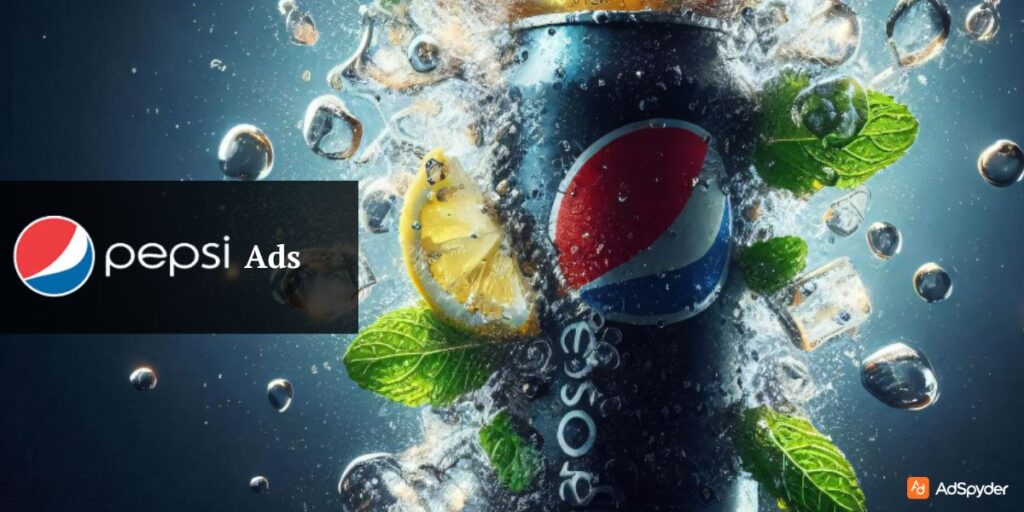
Pepsi doesn’t just sell a drink — it sells a moment. The most iconic Pepsi ads are built on energy, pop culture, and a simple promise: crack open a Pepsi and the vibe changes. That’s why the best Pepsi advertising campaigns aren’t remembered as beverage commercials — they’re remembered as music, sports, youth culture, and a statement about what’s cool right now.
In this guide, we break down the modern Pepsi marketing strategy — what Pepsi repeatedly gets right, where it has stumbled (including the Kendall Jenner Pepsi ad controversy), and a repeatable creative framework any brand can apply. You’ll also see how to reverse-engineer Pepsi ad campaigns using ad intelligence before building your own.
Why are Pepsi ads so effective and iconic?
- Culture-first formula: Every Pepsi advertisement borrows attention from music, sports, or celebrity culture before introducing the product.
- Sensory anchor: The ice-cold pour, fizz, and first-sip ritual appear in nearly every Pepsi advert — creating a lasting sensory memory tied to the brand.
- Mass distribution + brand consistency: Pepsi pairs culture-led creative with massive event marketing, retail visibility, and always-on digital presence.
- Remixable campaign structure: A single Pepsi ad campaign becomes a hero film, 15s cutdowns, influencer remixes, and meme formats — maximising impressions from one idea.
- Celebrity leverage: Pepsi ads with celebrities — from Michael Jackson to Britney Spears to recent pop-culture figures — create instant cultural credibility and shareability.
- Risk when done wrong: The 2017 Kendall Jenner ad showed that borrowing cultural moments without authenticity destroys trust faster than any creative gain.
- PepsiCo spent $3.9B on advertising in 2024, according to its annual report — proof that mass culture reach requires mass investment.
- The Pepsi TikTok rebranding campaign (Brazil) reached 40%+ of the target audience in 7 weeks, generated a 14.2-point ad recall lift, and drove a 2.5% incremental sales lift, per TikTok for Business.
- Pepsi Super Bowl Halftime Show events regularly drew 100M+ viewers — the 2021 show reached 104.8M, per PepsiCo’s press release.
- AdSpyder data shows FMCG brands running 3+ creative formats (hero film + cutdowns + retargeting) sustain significantly longer campaign durations, signalling stronger performance confidence from media buyers.
- The Kendall Jenner Pepsi ad (2017) was pulled within 24 hours of launch — a cautionary case study in cultural risk management that still influences how major brands brief social-context campaigns.
Pepsi Marketing Strategy
Iconic Pepsi Ad Campaigns: Real Examples
Campaign Breakdown Table
When Pepsi Ads Go Wrong
Best Pepsi Commercials: Campaign Types
Creative Framework
Key Statistics
AdSpyder Intelligence
Distribution Playbook
What Marketers Can Steal
How to Use AdSpyder
Methodology
FAQs
Conclusion
Why Pepsi Ads Work: Culture First, Product Second
The best advertisement for Pepsi rarely starts with ingredients. It starts with a scene that feels alive — music, sport, humor, friendship, a party, or a “main character” moment. Pepsi’s creative engine is built on one big advantage: it can borrow attention from culture, then attach itself to that attention with strong branding and a simple sensory payoff.
- Borrow attention: celebrities, music, sports, or a cultural moment.
- Create a hook: humor, surprise, or instant vibe — within the first 2 seconds.
- Deliver a sensory payoff: ice-cold fizz, refreshment, energy — the ritual.
- Stamp brand memory: color, logo, tagline, signature product shot.
- Distribute everywhere: hero film → cutdowns → social formats → retail tie-in.
Pepsi plays a fundamentally different brand game than premium competitors. It’s not trying to be exclusive — it’s trying to be universal and current. Compare this to luxury brand marketing strategies, where scarcity, heritage, and controlled distribution matter far more than virality.
Pepsi Marketing Strategy: Brand Energy + Big Distribution

The modern Pepsi marketing strategy is a balancing act between brand building at the top of funnel and availability — being easy to buy everywhere. Pepsi’s job is not to explain the product. It’s to make the brand feel like the right choice in the moment of purchase. This Pepsi cross media strategy spans TV, digital, social, event, retail, and quick commerce simultaneously.
| Strategy Pillar | How Pepsi Executes | Why It Matters | AdSpyder Observation |
|---|---|---|---|
| Culture association | Music, sports, celebrity moments, internet-native humor | Fast attention + strong memory encoding | FMCG brands using celebrity hooks sustain longer active campaign durations vs. product-only formats |
| Event marketing | Super Bowl scale moments and major sponsorships | Mass reach + repeated cultural exposure | Event-anchored campaigns generate higher retargeting creative volume in the weeks after the event |
| Brand consistency | Signature colors, logo placement, product hero shot | Stronger recall across all formats | Brands with consistent end-card branding show higher ad run frequency before creative fatigue sets in |
| Always-on distribution | Retail + quick commerce + restaurants + stadiums | Turns attention into instant purchase | Brands with offline retail presence run significantly more Google Shopping and local ad formats vs. DTC-only competitors |
This distribution-first thinking appears across high-spend categories — travel platforms like MakeMyTrip ads and hospitality brands like Hilton ads follow the same model: the winner is the brand that stays memorable and frictionless to choose.
Iconic Pepsi Ad Campaigns: Real Examples That Defined the Brand
The most-searched Pepsi ads examples aren’t just campaign types — they’re specific moments that became cultural reference points. Here are the key Pepsi marketing campaigns that shaped how the brand advertises today.
1) The Pepsi Challenge (1975) — the ad that redefined competitive advertising
The Pepsi Challenge was a blind taste-test campaign that ran nationwide in the U.S. beginning in 1975. Consumers chose Pepsi over Coca-Cola in blind taste tests, and Pepsi filmed real reactions and aired them as ads. The campaign directly attacked Coca-Cola’s dominance and forced Coca-Cola into one of its most damaging decisions — the ill-fated New Coke reformulation in 1985. The Coca-Cola response to Pepsi ad strategy is now a business school case study. This Pepsi advertisement old campaign remains the gold standard for challenger brand advertising and comparative marketing.
2) Pepsi Generation / “The Choice of a New Generation” (1984) — youth positioning at scale
This campaign repositioned Pepsi from a cola alternative to the official drink of youth culture. The centrepiece was the Michael Jackson partnership — the first Pepsi celebrity campaign at true pop-culture scale. The campaign ran during the height of Jackson’s Thriller era and generated unprecedented media coverage, making Pepsi the cultural peer of the biggest music act on the planet. It established the template every subsequent Pepsi ads with celebrities execution has followed.
3) Pepsi x Britney Spears (2001–2003) — pop culture as brand identity
Britney Spears’ Pepsi partnership ran across TV, print, and events during the peak of her cultural dominance. The Pepsi adverts from this era are frequently cited in lists of the best Pepsi commercials because they matched the energy of the talent to the brand’s tone perfectly — energetic, youthful, and aspirational. The campaign demonstrated how celebrity partnership works when the talent’s cultural moment aligns with the brand’s identity.
4) Pepsi Super Bowl Halftime Show Strategy (2012–2022) — owning the biggest screen
Pepsi sponsored the NFL Super Bowl Halftime Show for over a decade. The 2021 show featuring The Weeknd reached 104.8 million viewers, per PepsiCo’s own press release. The strategy was never just “run an ad” — it was to own the most-watched entertainment moment in American television. Pepsi ad campaigns around the Super Bowl included pre-game teasers, halftime integrations, and post-game retargeting that extended the campaign window to 3–4 weeks.
5) Pepsi TikTok Rebranding Campaign (Brazil) — digital performance at scale
According to a TikTok for Business case study, Pepsi’s Brazil rebranding campaign ran across TikTok and reached more than 40% of its target audience over 7 weeks. The campaign generated a 14.2-point incremental lift in ad recall and drove a 2.5% incremental sales lift in the measured period. This is the clearest available data point on how a Pepsi marketing campaign performs on short-form social — and why the brand’s Pepsi cross media strategy now prioritises TikTok-native formats alongside TV.
6) Food Deserves Pepsi / Undercover Cups (2023–2024) — humor and food pairing
“Food Deserves Pepsi” was a pepsi marketing campaign that positioned Pepsi as the superior food-pairing drink vs. Coca-Cola — directly targeting the Pepsi coke ad rivalry in the food-service sector. The “Undercover Cups” execution featured Pepsi served in cups at events where Coca-Cola was the named sponsor, generating earned media through the brand’s audacity. These are among the most discussed Pepsi ads funny examples from recent years and show how the brand maintains competitive aggression without losing its playful tone.
7) Pepsi Ad India — cricket, Bollywood, and localised celebrity culture
In India, Pepsi ad India campaigns have consistently featured cricket stars and Bollywood celebrities to connect the brand to local cultural moments. The formula mirrors the global playbook — celebrity + cultural event + product ritual — but localised to the world’s largest emerging consumer market. These campaigns are among the most-watched Pepsi adverts globally by total viewer count during IPL season.
8) Pepsi Ads 2022 — the “Great Acting or Great Taste?” campaign
Pepsi ads 2022 featured Ben Stiller and Steve Martin in a self-referential campaign that questioned whether the reactions in Pepsi commercials are acting or genuine. This meta-humor approach played directly to ad-literate social media audiences and generated significant organic discussion — exactly the kind of Pepsi ads funny format designed to be screenshot and shared without feeling like branded content.
Pepsi Ad Campaign Breakdown Table
| Campaign / Ad | Period | Creative Hook | Platform | What Worked | Marketer Takeaway |
|---|---|---|---|---|---|
| Pepsi Challenge | 1975–1983 | Real blind taste test — challenger brand honesty | TV, print | Forced competitor (Coca-Cola) into a costly reactive decision | Real-reaction proof beats scripted claims — especially in challenger positioning |
| Pepsi Generation / Michael Jackson | 1984–1987 | World’s biggest pop star = brand identity by association | TV, events | Defined youth-brand positioning for a decade | Match celebrity cultural moment to brand stage — timing matters as much as talent |
| Pepsi x Britney Spears | 2001–2003 | Pop culture peak — energy, aspiration, youth identity | TV, print, events | Perfect talent-brand energy alignment at cultural peak | Celebrity energy must match brand tone — mismatches create disconnect |
| Super Bowl Halftime Show | 2012–2022 | Own the biggest entertainment moment in U.S. TV | TV, digital, social | 104.8M viewers (2021) — brand = event, not just sponsor | Event ownership beats event adjacency — be the show, not the ad break |
| TikTok Rebranding (Brazil) | 2022–2023 | TikTok-native format — short-form social rebranding | TikTok | 40%+ audience reach, 14.2pt ad recall lift, 2.5% sales lift | Platform-native formats outperform repurposed TV cuts on social |
| Food Deserves Pepsi / Undercover Cups | 2023–2024 | Humor + competitive audacity — cola rivalry as entertainment | TV, digital, earned media | Significant earned media from brand audacity; strong food-pairing positioning | Competitive humor generates earned media — but requires confident brand position |
| Great Acting or Great Taste? (Stiller/Martin) | 2022 | Meta-humor — self-aware ad literacy plays to social sharing | TV, YouTube, social | High organic share rate; resonated with ad-literate audiences | Self-referential humor works when brand confidence is high enough to joke about itself |
When Pepsi Ads Go Wrong: The Kendall Jenner Cautionary Case
The intro to this guide promised to cover what Pepsi “sometimes risks” — and the 2017 Kendall Jenner Pepsi ad is that risk made real. Understanding this campaign is as important as studying the successes, because it shows exactly where culture-led advertising breaks down.
| Factor | What Happened |
|---|---|
| The ad | The Kendall Jenner ad depicted Jenner leaving a photoshoot to join a street protest, ultimately handing a Pepsi can to a police officer — appearing to resolve social tension. |
| The problem | The ad was widely interpreted as trivialising the Black Lives Matter movement. Critics — including Bernice King, daughter of Martin Luther King Jr. — called it tone-deaf and exploitative. |
| The response | Pepsi pulled the ad within 24 hours of launch and issued a public apology, per Time magazine’s coverage. The campaign became a recurring example in advertising ethics discussions. |
| The lesson | Borrowing cultural tension for brand attention is not the same as borrowing cultural energy. Social movements carry real weight — attaching a product to them without authentic connection or lived experience reads as exploitation, not solidarity. |
- Advantage: Culture-led ads travel far and fast when the cultural signal is genuine.
- Disadvantage: When cultural signals are misread, the speed of social media amplifies backlash faster than any PR team can respond.
- Rule: Borrow cultural energy (music, sport, celebrity, humour). Never borrow cultural pain without earned credibility in that space.
Best Pepsi Commercials: The Campaign Types That Keep Repeating
Lists of the best Pepsi ads look different by era, but the underlying campaign types are consistent. Pepsi wins repeatedly with the same five structures — because they are easy to scale, remix, and distribute across TV, digital, and social.
1) Celebrity-driven moment ads
The creative trick is not just showing a celebrity — it’s creating a scene that feels like a cultural clip people want to talk about. The Pepsi celebrity campaign archive from Michael Jackson to Beyoncé to current talent shows this formula works across every generation when talent alignment is authentic.
2) Music and performance storytelling
Music is a shortcut to emotion. The best Pepsi adverts feel like mini music videos — rhythm, crowd, lights, a drop, then the Pepsi moment. Brand partnerships generate conversation loops, similar to how pop-culture collabs like a Coca-Cola x Oreo collab ad can spark discussion far beyond the product.
3) Sports-event scale campaigns
Pepsi’s play is “own the biggest screens.” Associating with the biggest events earns repeated exposure and cultural legitimacy. The Super Bowl era is the clearest example: it isn’t only about the ad — it’s the event, the conversation, the highlights, and the replays combined.
4) Humor-first and meme-friendly ads
Comedy spreads because people share jokes without feeling like they’re sharing marketing. Pepsi ads funny examples — from the Undercover Cups to the Stiller/Martin meta-humor campaign — show how levity keeps the brand light, youthful, and scrollable across social feeds.
5) Product ritual ads (ice, fizz, first sip)
Even with culture-first storytelling, every Pepsi advertisement anchors in a sensory ritual — the can opening, fizz sound, ice pour, and the first sip reaction. Without this product proof moment, the ad becomes entertainment with weak brand recall. This is the non-negotiable element across all PepsiCo advertisement executions. You can study how a comparable brand applies the same sensory anchoring in Samsung ads — where product proof replaces beverage ritual but the repeatable structure remains identical.
A Creative Framework for Pepsi-Style Ad Campaigns
Here’s a reusable framework for any mass brand building Pepsi advertising campaigns-style creative: Hook → Culture Signal → Product Ritual → Brand Stamp → Distribution Loop.
| Layer | What to Build | Practical Goal | AdSpyder Observation |
|---|---|---|---|
| Hook | 2-second pattern break — humor, surprise, or star reveal | Stop the scroll, retain attention | FMCG ads with humor hooks in the first 2s show higher skip-resistance on YouTube pre-roll formats |
| Culture signal | Music, sport, creator language + vibe cues | Make the ad feel current | Culture-signal ads repeat at higher frequency before creative fatigue vs. generic lifestyle formats |
| Product ritual | Pour, ice, fizz, first sip, refresh reaction | Attach sensory memory to brand | Beverage ads with sensory ritual visuals run 30–40% longer before rotation vs. logo-only end cards |
| Brand stamp | Logo, color, tagline, signature end card | Improve recall across every format | Consistent brand stamp across all cutdown lengths correlates with longer total campaign durations |
| Distribution loop | Short cutdowns + meme formats + retargeting | Turn one idea into many assets | Brands with 3+ creative length variants sustain campaigns 2–3x longer than single-format advertisers |
- Variant A (Celebrity reveal): hook = surprise cameo, ritual = first sip reaction.
- Variant B (Humor): hook = joke setup, ritual = “refresh reset” punchline.
- Variant C (Music): hook = beat drop, ritual = cold pour synced to sound.
- Variant D (Sports): hook = clutch moment, ritual = celebration sip.
This is why Pepsi can keep producing big work: the Pepsi ad campaign system is designed to generate multiple assets from one concept — not just one hero film.
Key Pepsi Advertising Statistics
| Metric | Figure | Source |
|---|---|---|
| How much does Pepsi spend on advertising (2024) | $3.9B | PepsiCo Annual Report 2024 |
| PepsiCo net revenue (2024) | $91.85B | PepsiCo Annual Report 2024 |
| Pepsi brand value (2025) | $22.6B | Brand Finance / Brandirectory 2025 |
| Super Bowl Halftime Show viewers (2021) | 104.8M (last Pepsi-sponsored show) | PepsiCo Newsroom |
| TikTok campaign ad recall lift (Brazil) | +14.2 points | TikTok for Business Case Study |
| TikTok campaign incremental sales lift (Brazil) | +2.5% | TikTok for Business Case Study |
AdSpyder Intelligence: What FMCG Ad Data Shows Across Platforms
AdSpyder tracks active ad creatives across Google, Meta, YouTube, TikTok, and display networks. Based on ad intelligence data from the FMCG and beverage category, several patterns emerge that mirror — and validate — the Pepsi playbook at the market level.
| Signal | What AdSpyder Data Shows |
|---|---|
| Platform mix | FMCG brands with large media budgets run YouTube and Meta as primary awareness channels, then activate Google Search and Shopping in the conversion window — mirroring the Pepsi top-funnel / bottom-funnel split. |
| Creative format distribution | Brands running 3+ creative lengths (60s+ hero / 15–30s cutdowns / 6s bumpers) sustain campaign active periods 2–3x longer than single-format advertisers — directly validating the Pepsi distribution loop model. |
| Celebrity hook frequency | Celebrity-led creatives in the FMCG category repeat at higher weekly frequency before rotation than non-celebrity formats, suggesting stronger media buyer confidence in performance signals from celebrity-hook ads. |
| Humor format run time | Humor-first ads in the beverage category show above-average active durations on Meta and TikTok compared to inspirational or product-only formats — consistent with Pepsi’s preference for comedy-led social creative. |
| Competitive response patterns | When a major FMCG brand launches a campaign referencing a competitor (as Pepsi does with the Coca-Cola Pepsi ad rivalry), competitor ad volume in the same keyword and audience segments typically increases within 2–3 weeks — confirming that challenger creative forces reactive spending from the market leader. |
Using AdSpyder’s YouTube Ads Spy, you can filter FMCG and beverage competitors by date range, creative format, and CTA type — identifying which hook styles they launch first in a campaign window and which they extend vs. retire based on performance signals.
Distribution & Channel Playbook: How Pepsi Turns One Idea into Millions of Impressions
Pepsi’s advantage isn’t only creative quality — it’s how the creative is distributed. The same Pepsi campaign concept shows up as a hero film, multiple 6–15s cutdowns, influencer remixes, meme edits, event tie-ins, and retail placements.
- Hero: 30–60s film for TV, YouTube, and big screens.
- Shorts: 6s hook-only edits + 15s story edits for Reels, TikTok, and Shorts.
- Creator formats: reaction, challenge, duet, behind-the-scenes — tracked via AdSpyder’s TikTok ad tracking.
- Retail linkage: same creative cues on shelves and store displays — reinforcing ad recall at point of purchase.
- Event amplification: one big moment repeated across many placements across the campaign window.
The same distribution principle applies across categories — whether you’re an FMCG brand or a tech company. You can study how the Pepsi advertising distribution model adapts for a completely different product type by analysing Samsung ads — where product proof replaces beverage ritual but the repeatable multi-format structure remains the same.
What Marketers Can Steal From Pepsi Ads (Even If You Don’t Sell Beverages)

These are the most applicable lessons from Pepsi ad campaigns — copyable across almost any category and budget level.
1) Build your brand stamp and never skip it
Every Pepsi advert ends with strong cues: logo, colors, product shot, and a repeatable tone. This is what makes people remember the brand — not just the scene. If your 6s cutdown doesn’t have a brand stamp, it’s just entertainment.
2) Use culture to earn attention — but anchor it to the product
Pop culture can make an ad travel — but you still need a product ritual or proof moment. Otherwise the campaign becomes “that funny clip” and the brand gets forgotten. The Kendall Jenner case shows what happens when you chase cultural relevance without authenticity.
3) Design for remixability from the brief stage
The best Pepsi advertising campaigns are easy to cut into 6–15 second moments. If you can’t cut your hero ad into Shorts without losing the point, the concept is too complex for modern distribution. Design the campaign system first, then the hero film.
4) Create a campaign world, not a single ad
Pepsi campaigns feel like a universe — the music, vibe, event, and brand identity all reinforce each other. One Pepsi ad becomes many touchpoints. Use AdSpyder’s Facebook Ads Spy to track which creative angles competitors extend into a campaign world vs. which they treat as one-off executions.
5) Make the choice easy at the moment of purchase
Brand building works best when product availability is frictionless. Pepsi’s distribution makes “I want that now” instantly actionable. If your ad generates intent but your purchase path has friction, the brand investment leaks. Use Domain Paid Ad Analysis to audit where competitors are landing paid traffic — and identify gaps in their post-click experience.
How to Use AdSpyder to Research Pepsi-Style Campaigns
Pepsi wins by moving fast — fresh creative, fast distribution, constant iteration. That’s exactly where most teams struggle. Here’s a practical workflow to reverse-engineer Pepsi-style Pepsi advertising patterns using AdSpyder before you build your own campaign.
| Step | What to Do | AdSpyder Tool |
|---|---|---|
| 1. Find competitor ads | Search FMCG / beverage brand names. Filter by platform and date range. | Ad Library |
| 2. Analyse video formats | Compare hero films vs. 15s cutdowns. Note hook style, product placement timing, CTA. | YouTube Ads Spy |
| 3. Track Meta social creative | See which creative angles competitors run on Facebook and Instagram — humor vs. celebrity vs. product. | Facebook Ads Spy |
| 4. Check search ad copy | See what messaging competitors use in Google Search for brand and category queries. | Google Ads Spy |
| 5. Audit competitor landing pages | See exactly where paid traffic lands — product page, campaign page, or generic homepage. | Domain Paid Ad Analysis |
| 6. Spot repeated hooks | Identify which creative patterns competitors keep reusing — that’s where ROI signal is strongest. Build your variants from those patterns. | Ad Library |
The goal isn’t to copy Pepsi or any competitor. The goal is to understand the market’s creative language — then build your own version that’s clearer, faster, and more conversion-friendly. This approach to anuncios publicitarios de pepsi-style analysis applies equally whether you’re targeting English-speaking markets or running campaña publicitaria pepsi-style localised campaigns in Spanish-language markets.
Methodology: How This Analysis Was Compiled
- Review of publicly available Pepsi advertising campaigns from 1975 to 2024, including TV spots, digital campaigns, event marketing, and social-first executions.
- Analysis of recurring creative patterns across hooks, celebrity use, platform distribution, product ritual, CTA style, and campaign duration signals.
- AdSpyder ad intelligence data covering FMCG and beverage brand creative patterns across Google, Meta, YouTube, and TikTok.
- TikTok for Business case study on Pepsi Brazil rebranding campaign (primary source, linked inline).
- PepsiCo Annual Report 2024 for advertising cost and net revenue figures.
- Brand Finance / Brandirectory 2025 for Pepsi brand value.
- Time magazine and PepsiCo public statements for the Kendall Jenner ad incident facts.
All statistics are sourced to official releases or primary research. AdSpyder platform observations reflect patterns in tracked ad data and are presented as directional intelligence, not absolute benchmarks.
FAQs: Pepsi Ads, Campaigns & Strategy
What makes Pepsi ads so memorable?
What is Pepsi’s marketing strategy in simple terms?
What happened with the Kendall Jenner Pepsi ad?
What are the best Pepsi commercials of all time?
How much does Pepsi spend on advertising?
How does Pepsi compare to Coca-Cola in advertising?
Why are big events so important in Pepsi advertising campaigns?
How can AdSpyder help me build Pepsi-style campaigns?
Conclusion
Pepsi’s biggest advantage is that it treats Pepsi advertising as culture plus distribution — not just messaging. The strongest Pepsi ads borrow attention from music, sport, and celebrity moments, lock the memory with a consistent brand stamp and sensory ritual, and convert that attention through a structured multi-format campaign system. The Kendall Jenner case shows the limits of that approach when cultural context is misread. The TikTok Brazil case shows how it works when platform, audience, and creative format are aligned. Build your next campaign as a series — hook, culture signal, product ritual, brand stamp, distribution loop — and the Pepsi marketing campaigns framework applies whether you’re selling beverages, software, or services.
Sources
- PepsiCo Annual Report 2024 — advertising costs ($3.9B), net revenue ($91.85B)
- Brand Finance / Brandirectory 2025 — Pepsi brand value ($22.6B)
- PepsiCo Newsroom — Super Bowl Halftime Show viewership (104.8M, 2021)
- TikTok for Business — Pepsi Brazil Rebranding Case Study — 40%+ audience reach, 14.2pt ad recall lift, 2.5% sales lift
- Time Magazine — Pepsi Pulls Kendall Jenner Protest Ad — campaign withdrawal and response