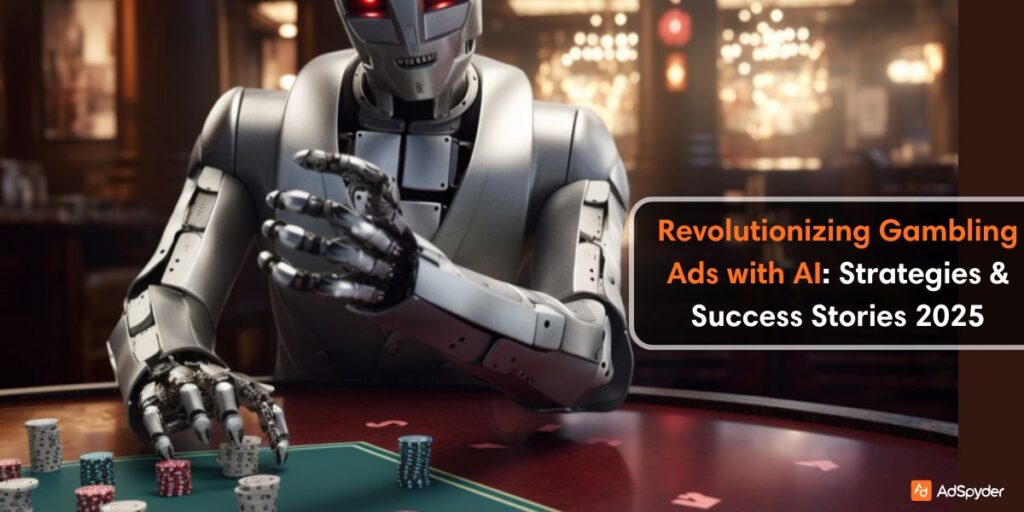
Gambling ads are getting harder to run — not because demand is low, but because platforms are tightening compliance, users are more skeptical, and creative fatigue hits faster than most verticals. In 2026, the brands that win in AI gambling advertising aren’t the ones “spending more” — they’re the ones using AI to make campaigns safer, smarter, and more relevant without crossing policy lines.
This guide breaks down how AI for gambling ads works in real life: compliance-first targeting, creative testing at scale, and optimization that improves ROI while protecting your account. You’ll also learn a practical framework for sports betting ads AI and AI casino advertising, plus 2026-ready best practices you can apply immediately.
What is AI Gambling Advertising (and what it is not)?
AI ads gambling is the use of machine learning + generative AI to improve how you plan, create, target, and optimize gambling campaigns — while staying compliant. It’s not “auto-run my ads.” It’s an operating system for better decisions: which audience to target, which hooks to test, how to reduce policy risk, and how to scale winners with less waste.
- Targeting precision (adult-only, geo-legal, intent-based cohorts)
- Creative iteration speed (more safe variations, less fatigue)
- Budget allocation (scale what’s working, cut what isn’t)
- Compliance assurance (language checks, disclaimer checks, landing-page checks)
If you want the foundational playbook first, this deep dive on online gambling advertising pairs perfectly with the AI systems you’ll build here.
Why 2026 is Different for Gambling Marketing
2026 isn’t just “more competition.” It’s a shift in how digital spend is delivered (more algorithmic and programmatic), how creatives are produced (GenAI everywhere), and how platforms enforce policies (stricter automation + manual reviews). That means your edge comes from systems — not hacks.
- Build “safe creative libraries” with multiple compliant angles (not just one hero ad)
- Use AI to map legal geos + audience rules (adult-only, no minors)
- Optimize for value, not just volume (quality leads + retention)
- Treat compliance as part of performance (fewer disapprovals = more stable delivery)
This is also why programmatic ads for online betting sites and AI-driven execution are increasingly tied together: more inventory is programmatic, and more creative decisions are automated.
Use Cases That Actually Work for AI in Advertising

Below is the simplest way to understand how gambling AI ads create ROI: AI helps you create more “good bets” (creative + audience combinations) while reducing “bad bets” (policy risk, irrelevant traffic, low-intent clicks).
| Use case | What AI does | Best for | Success metric |
|---|---|---|---|
| Compliance scoring | Flags risky claims, missing disclaimers, under-18 cues | Account stability | Lower disapproval rate |
| Audience clustering | Builds adult-only cohorts by intent + behavior | Sports gambling AI ads | CPA / ROAS improvement |
| Creative variation engine | Generates multiple safe hooks, headlines, thumbnails | Fatigue reduction | CTR stability over time |
| Landing-page alignment | Checks message match + friction points | AI casino advertising | Conversion rate lift |
| Bid & budget automation | Reallocates spend to high-quality segments | Scaling winners | ROAS + payback period |
And if you’re running multi-channel, pair the same system with Google Smart ad campaigns so your learning loops stay consistent across networks.
AI in Advertising: Targeting for Gambling
The fastest way to lose a gambling account is to treat targeting like a growth hack. The safest way to scale AI ad targeting for gambling is to start with constraints: legal geo, age-gated audience, and clean messaging.
- Eligibility filters: adult-only + geo-legal states/countries
- Intent signals: sports news consumption, fantasy sports content, odds comparison interest (where allowed)
- Lifecycle segmentation: new sign-ups vs active bettors vs dormant users (different creatives for each)
- Quality control: exclude low-quality placements + bot-prone traffic sources
AI helps most when you feed it the right “seed.” Start with high-quality first-party cohorts: verified depositors, repeat bettors, VIP segments, or high-LTV players — then let AI discover similar patterns (without expanding into unsafe segments).
For travel-heavy bettors (events, tournaments, match weekends), you can also align offers with location + timing using Google Hotel ad strategies as a blueprint for intent-based timing (even if the product differs, the “moment marketing” logic stays the same).
Creative + Testing System for AI in Advertising (safe and scalable)

In gambling, the winning creative is rarely the “flashiest.” It’s the clearest. AI should help you produce a controlled set of variations that stay compliant, reduce fatigue, and improve message match. That’s how you scale sports gambling AI ads without burning your account.
- Angle buckets: education, features, social proof, product walkthrough, seasonal events
- Hook templates: “How it works…”, “Before you bet…”, “New players: start here…”, “Safer play tips…”
- Offer variants: bonus types (where allowed), odds boosts, free-to-play, loyalty points
- Visual variants: clean UI mockups, match-day visuals, leaderboard style creatives
- Compliance variants: different disclaimer layouts and “responsible” framing
You can generate creative sets using dynamic testing workflows — but don’t confuse speed with randomness. Use a DCO-style setup where AI generates variations from fixed components (headline, primary text, CTA, thumbnail, disclaimer). If you want a full DCO blueprint, map your components using augmented reality in online gambling concepts as well: AR campaigns win when the “experience pieces” are modular and testable.
- Education: “How odds work” / “How to set limits” / “Beginner guide to picks”
- Product clarity: “Fast withdrawals, transparent rules, live support”
- Trust signals: licensing, security, responsible tools, verified payments
- Event-based: match-day previews, tournament hubs, limited-time boosts (where legal)
Compliance + Responsible Ads: The Non-Negotiable Part of AI Gambling Advertising
Platforms treat gambling differently than most verticals: authorizations, age gating, geo restrictions, and stricter reviews. For example, Meta’s policy states that ads promoting online gambling and gaming are only allowed after the ad account obtains authorization and follows applicable laws. (Always check your market rules before launching.)
| Risk area | What to avoid | AI-safe best practice |
|---|---|---|
| Minors | Anything that can appeal to under-18 audiences | Hard age gating + content tone checks |
| Unrealistic claims | Guaranteed wins, “easy money,” exaggerated earnings | AI claim filter + compliant rewrites |
| Geo legality | Serving where gambling ads are restricted | Geo map rules + automated exclusions |
| Landing pages | Mismatch between ad + landing, missing disclaimers | AI landing audit + message-match scoring |
| Disclosure | Hidden terms, unclear bonus conditions | Auto-generate clear T&Cs summary modules |
This is also why many teams keep a separate “policy checklist” for each platform and route creatives through an internal review before publishing.
The 2026 framework: Build an AI System, Not a One-Off Campaign
Here’s the execution framework used by top-performing teams running AI casino advertising and sports betting ads AI: a loop that repeatedly improves audience quality, creative relevance, and compliance score.
List allowed geos + age rules + platform authorizations. This becomes your “guardrail layer” for AI targeting.
Use first-party cohorts (depositors, repeat users, high LTV). Avoid low-quality leads as seeds — they poison the model.
Generate 20–40 variations across 4–6 angles. Keep components modular so you can recombine safely.
Test one variable at a time (angle vs hook vs offer vs thumbnail). Don’t change everything and guess what worked.
Track: approved rate, CTR stability, conversion rate, cost-per-qualified signup, and retention (not just CPA).
Scale by duplicating the winning structure into new geos and new angles — not by pushing the same ad until it dies.
Want to keep your learning loop strong across marketplaces? Use Amazon ads as a reference for intent-driven creatives — the same “buyer intent logic” helps gambling funnels too (clear value, clear terms, clear next step).
Key AI + Gambling Advertising Statistics (2026-ready snapshot)
How AdSpyder Helps you Execute AI Gambling Advertising Faster
AI is powerful — but it performs best when you give it real market truth. That’s where AdSpyder becomes your advantage: instead of guessing what angles work, you can analyze what competitors are already running, then build safer, better variations.
- Competitor creative research (hooks, headlines, CTAs, visual layouts)
- Landing-page analysis (message match + offer positioning)
- Angle discovery (which themes appear repeatedly across winning ads)
- Iteration speed (turn insights into new compliant variations faster)
And if you’re building a broader strategy beyond gambling, reuse the same testing discipline from programmatic ads for online betting sites across other networks and formats — the principle stays the same: more controlled tests, fewer risky surprises.
If you want this same guide in a shorter checklist format, bookmark online gambling advertising for your team’s campaign SOP.
FAQs: AI in Advertising (2026)
What is AI gambling advertising?
How does AI ad targeting for gambling work safely?
Can AI create gambling ad creatives automatically?
What’s the best way to reduce disapprovals for gambling AI ads?
Do sports betting ads AI campaigns need different creatives than casino campaigns?
What should I optimize for beyond CPA?
How does AdSpyder help with AI for gambling ads?
Conclusion
In 2026, winning with AI gambling advertising is about building a repeatable system: compliance-first targeting, modular creative libraries, controlled testing, and quality-based optimization. Use AI to increase the number of safe experiments you can run — and use competitor insight to make those experiments smarter. If you do that consistently, your gambling AI ads become more stable, more scalable, and far more profitable.