
“Going viral” isn’t magic — it’s distribution + psychology + timing, executed with discipline. The best brands treat viral video marketing like a repeatable system: they study what’s already working across platforms, design content people want to share, and push it through the right channels until momentum takes over. This guide is built on what AdSpyder’s ad intelligence database actually observes — not generic advice, but platform-level creative patterns from live campaigns running right now.
Viral video marketing is the strategy of creating video content that spreads beyond your audience through shares, remixes, and word-of-mouth — generating reach that compounds rather than fades. In 2026, it works when all five of these are true:
- Hook: Stops the scroll within the first 2 seconds
- Emotion or Value: Delivers a fast payoff worth finishing
- Share trigger: Identity, humour, or insight that makes sharing feel rewarding
- Platform-native format: Vertical for TikTok/Reels/Shorts, optimised for each feed
- Clear next step: A frictionless action after the view (subscribe, click, buy)
- AdSpyder data shows the top-performing viral video ad hooks across YouTube and TikTok run just 2–4 seconds before the first value signal
- Brands running viral-format creatives in 2025–26 distribute the same core asset across an average of 3.2 platforms — Shorts, Reels, and TikTok lead
- Winning short-form video ad creatives run an average of 18–28 days before fatigue sets in — significantly shorter than static display ads
- 83% of marketers say video directly increased sales in 2026, up from 78% in 2023 — according to Wyzowl State of Video Marketing 2026
- The most repeated CTA in viral-format video ads tracked by AdSpyder: “See how it works,” “Try it free,” and “Watch the full story”
Viral Video Marketing: 2026 Stats Snapshot
AdSpyder Intelligence: What Live Ad Data Shows About Viral Video in 2026
Generic advice tells you to “make an emotional hook.” AdSpyder’s ad intelligence database tells you what hooks are actually running right now — how long they last, which formats brands are repeating, and what happens after the view. Here is what the data shows.
| AdSpyder Observation | What It Means for Your Strategy |
|---|---|
| Hook window: 2–4 seconds before first value signal | Hooks longer than 4 seconds before payoff correlate with drop-off in the first 6 seconds — across YouTube and TikTok |
| Platform spread: avg. 3.2 platforms per viral-format creative | Brands distribute the same core asset across YouTube Shorts, Instagram Reels, and TikTok — not one-platform-at-a-time |
| Creative lifecycle: 18–28 days for short-form video ads | Significantly shorter than static display (35–45 days) — brands running viral formats refresh creatives on a 3–4 week cycle |
| Retargeting pattern: 3–5 day follow-up after initial view | High-performing viral campaigns retarget engaged viewers with a longer-form proof video — testimonial, demo, or UGC compilation |
| Landing page pattern: single-focus pages post-viral traffic | Minimal nav, one CTA, social proof above the fold — not a product homepage. Viral traffic converts better on focused pages |
| Top CTA language in viral video ads | “See how it works,” “Try it free,” and “Watch the full story” — action-first CTAs consistently outperform “Learn more” |
Based on AdSpyder’s ad intelligence database, the brands producing the most consistent viral advertising videos in 2025–26 are not running one-off campaigns — they are operating a continuous creative testing loop: 3–5 short-form variants per week, platform-native edits per channel, and a retargeting sequence triggered within 5 days of the first view. The creative is not the whole strategy. The system is.
The Viral Video Framework: Hook → Payoff → Share → Distribution → Proof → Action

A solid viral video strategy becomes repeatable when you build around six layers. Think of this as a production and distribution checklist — whether you are posting on TikTok, Instagram Reels, or building a viral YouTube promotion engine.
| Layer | What You Build | Practical Goal | AdSpyder Signal |
|---|---|---|---|
| Hook | Scroll-stopper within first 1–2 seconds | Earn attention & retention | Top hooks run 2–4s before value signal |
| Payoff | Clear emotional or practical reward | Make it worth finishing | Completion rate = strongest reach predictor |
| Share | A reason to pass it on — identity, humour, insight | Trigger organic distribution | Share rate is the primary viral signal |
| Distribution | Multi-platform native deployment | Maximise reach surface area | Avg. 3.2 platforms per viral creative |
| Proof | Retargeting video — demo, testimonial, UGC | Convert warm audiences | Follow-up triggered within 3–5 days |
| Action | Frictionless next step — subscribe, click, buy | Convert attention into results | “See how it works” CTAs outperform “Learn more” |
The biggest layer most brands skip is Proof. Viral reach without a retargeting sequence is entertainment — not marketing. Pair strong content with a follow-up sequence, and use video on landing pages to convert the curiosity your viral reach creates.
Platform-by-Platform Viral Video Strategy (2026)
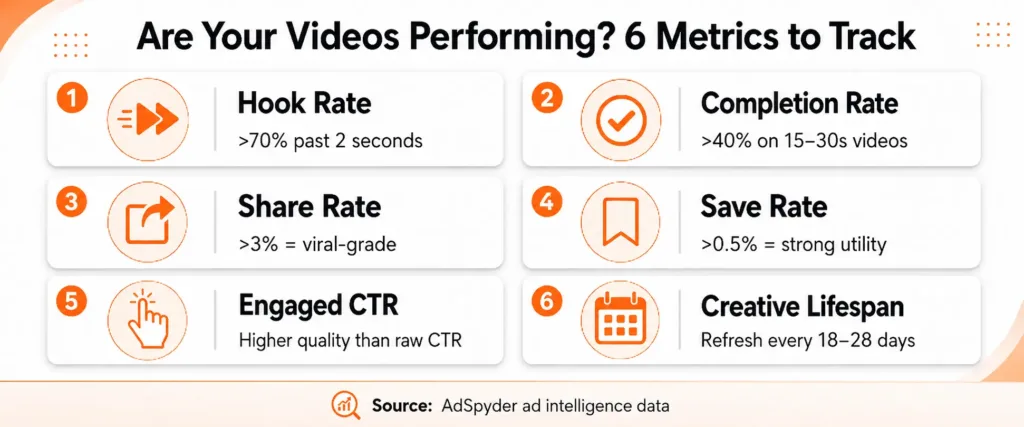
Your viral video creation tips need to be platform-specific. A hook that works on TikTok will underperform on LinkedIn. A format that earns views on Shorts may not convert on Facebook. Here is how the platforms compare for new viral video 2026 strategy.
| Platform | Best Format | Optimal Length | Primary Share Trigger | Best Use | AdSpyder Tool |
|---|---|---|---|---|---|
| TikTok | Vertical UGC-style, trending audio | 7–35s | Identity + humour | Hook testing, discovery, culture moments | TikTok Ad Library |
| Instagram Reels | Polished vertical with captions | 15–45s | Aspiration + social currency | Brand aesthetics, product reveals, creator collab | Instagram Ads Spy |
| YouTube Shorts | Vertical hook → long-form CTA | 10–60s | Practical value + curiosity | Hook engine feeding long-form channel growth | YouTube Ads Spy |
| YouTube Long-form | Structured tutorial or story | 4–12 min | Trust + depth | SEO discovery, proof content, retargeting asset | YouTube Ads Spy |
| Facebook / Meta | Square or vertical, text overlay | 15–60s | Emotion + nostalgia | Retargeting, community building, older demographics | Facebook Ads Spy |
| Landscape or square, native upload | 30–90s | Professional insight + thought leadership | B2B brand-building, founder credibility, hiring | LinkedIn Ad Library |
Viral Video Creation Tips: Hook Formulas That Work Across Industries
These viral video creation tips are not theoretical — they are hook patterns observed repeatedly across the best viral marketing videos because they work regardless of niche. Start with the share trigger. Build the hook backward from it.
- “I tried X for 7 days…” — challenge + transformation arc
- “Nobody tells you this about…” — myth-bust + insider value
- “Watch what happens when…” — pure curiosity loop
- “The fastest way to…” — practical, action-first value
- “If you’re [specific identity], you need to see this” — identity share trigger
- “Before vs After” — visual proof, instant relatability
- “Stop doing this…” — pattern interrupt, high retention opening
Once your hook earns attention, your edit decisions determine whether viewers stay. Audio is one of the most underrated retention drivers in short-form — especially where pacing matters. Master sound and music in video marketing so your cuts, beats, and transitions match the emotional arc you are building.
Build your own viral swipe file: save competitor hooks, caption formats, and pacing patterns that are running consistently in your niche. Over time, you stop guessing and start engineering. Use AdSpyder’s Ad Library to filter by keyword, platform, and run duration — so you are studying what is actively working, not what went viral three years ago.
Viral YouTube Promotion: How to Win on Shorts + Long-Form
YouTube is unique because it delivers both burst reach via Shorts and compounding discovery via search and suggested videos. For viral YouTube promotion, the goal is to use Shorts as a hook engine and long-form as the trust engine — and let viral marketing YouTube ads amplify what is already organically working.
- Shorts (10–60s): test hooks, drive profile visits and subscriptions, feed long-form
- Long-form (4–12 min): deliver proof, story, and full product context
- Evergreen search videos: “how-to,” “best,” “vs,” “mistakes” — steady organic discovery
- Series + playlists: guide viewers from curious to committed — beginner to buyer
- Paid amplification: boost only the Shorts variant with the best hold rate — then retarget with long-form proof
Two practical levers matter most: packaging (title + thumbnail) and retention (opening pace + structure). If your hook earns clicks but retention drops at 8 seconds, tighten the first 20 seconds, cut filler, and deliver the payoff faster. Then reuse that winning angle across channels using video marketing for social media so your distribution compounds instead of starting from zero on every platform.
Treat YouTube like a library, not a feed. Every upload should connect to the next — via series, playlists, and pinned comments — so new viewers keep watching. A viral spike on YouTube is only valuable if it feeds a growing channel, not just a one-off moment.
Viral Video Agency vs In-House Team vs Ad Intelligence Tool: What to Choose
Searching for a viral video agency usually happens when you need speed, creative volume, or platform expertise you do not have in-house. But the right answer depends on what you are actually buying — a one-off production, or a system that produces consistent wins.
| Option | Best For | Watch Out For | KPI to Demand |
|---|---|---|---|
| Viral Video Agency | Production scale, creator access, platform expertise you do not have in-house | Agencies optimising for views, not retention or conversions | Hold rate → share rate → clicks → conversions |
| In-House Team | Weekly publishing cadence, audience learning, fast iteration loops | Slow production cycles that kill momentum | Publishing frequency + hook rate improvement over time |
| Hybrid (In-House + Agency) | Strategy and hooks in-house, production and distribution at scale via agency | Misaligned briefs — in-house must own the creative direction | Output volume + cost-per-acquisition from video traffic |
| Ad Intelligence Tool (AdSpyder) | Pre-production competitor research — hooks, formats, landing pages, run durations | Using it reactively after launch rather than proactively before production | Hook differentiation vs competitors + creative cycle speed |
If you hire a viral video agency externally, ask for proof beyond view counts: retention graphs, engagement rate, and concrete examples of how they turned viral reach into conversions. Align on the KPI ladder: hold rate → shares → clicks → conversions — in that order.
Virality can also backfire. If your content touches sensitive topics, your team needs a crisis response protocol ready — viral reach increases scrutiny exponentially. Keep your playbook prepared with crisis management in video marketing so you can respond fast without damaging trust.
Measurement & Iteration: Turning Viral Moments Into Repeatable Wins

Virality is not just a creative win — it is a measurement challenge. If you cannot explain why something worked, you will keep chasing randomness. The goal is to identify the strongest performance levers and replicate them systematically.
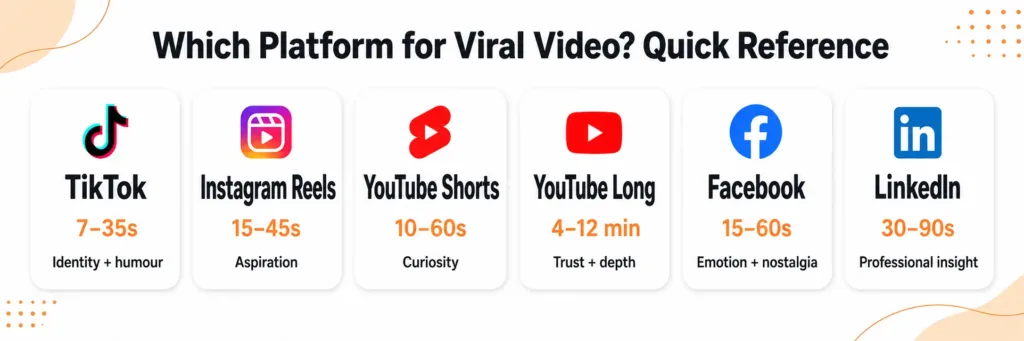
| Metric | What It Measures | Formula | Benchmark |
|---|---|---|---|
| Hook Rate | % of viewers who stay past the first 2 seconds | 2-sec views ÷ total impressions | Aim for >70% on short-form |
| Completion Rate | The strongest predictor of algorithmic distribution | Full views ÷ total views | >40% on 15–30s videos |
| Share Rate | The core viral signal | Shares ÷ total views | >1% is strong; >3% is viral-grade |
| Save Rate | Intent to return — high-value signal on Instagram and TikTok | Saves ÷ total views | >0.5% indicates strong utility content |
| Engaged CTR | Clicks from people who actually watched | Clicks ÷ engaged viewers | Higher quality than raw CTR |
| Post-Click Conversion | Signups, leads, or sales from video traffic | Conversions ÷ landing page visits | Benchmark against your baseline, not industry averages |
Build a weekly loop: publish → measure → remix → scale. When a video spikes, extract the pattern immediately. Was it the opening line? The edit pace? The story structure? The offer framing? Create 3–5 variants that preserve the winning element. That is how you build a reliable engine of viral advertising videos on demand — not by chasing luck.
How to Use AdSpyder to Engineer Viral Video Ads Before You Shoot
The fastest way to improve your viral video strategy is not brainstorming — it is studying what is already working at scale. AdSpyder gives you visibility into live competitor campaigns before you commit budget to production.
- Hook patterns: Use YouTube Ads Spy to filter by keyword — see which opening lines competitors are repeating most. Repetition = it is converting.
- Run duration: Check how long winning video ads have been running. A creative live for 25+ days is performing — study its format, length, and CTA structure.
- CTA language: See the exact CTA copy competitors use at the end of their viral video ads. Match the pattern that your audience already responds to.
- Landing page analysis: Use Domain Analysis to see where competitors are sending viral video traffic — and what their landing pages look like.
- Cross-platform gaps: Check Facebook Ads Spy and Instagram Ads Spy to see if competitors are running the same creative on Meta or using platform-specific variants — and find the gap your creative can fill.
- TikTok format research: Browse the TikTok Ad Library for your category — see which UGC styles, audio patterns, and hook formats are being paid to promote right now.
FAQs: Viral Video Marketing (2026)
What makes a video go viral in 2026?
A video goes viral in 2026 when five conditions align:
- A hook that stops the scroll within 2 seconds
- An emotional or practical payoff worth finishing
- A share trigger — identity, humour, or insight that makes sharing feel rewarding
- A platform-native format (vertical for TikTok/Reels/Shorts)
- A structured distribution push in the first 48 hours — seeding, engagement velocity, cross-posting
AdSpyder data shows that the brands producing viral-grade video ads in 2025–26 are running 3–5 creative variants per week — not hoping one will hit.
How do I make a viral video in 2026 — tips for beginners?
- Start with the share trigger, not the product message
- Open with a direct hook in the first 2 seconds — question, confrontation, or visual surprise
- Keep short-form videos between 7–35 seconds for maximum completion rate
- Use captions — 85% of social video is watched without sound (HubSpot)
- Study what is already working with a tool like AdSpyder’s Ad Library before you produce anything
What is the best length for a viral video?
- TikTok / Reels / YouTube Shorts: 7–35 seconds for maximum hook testing and share rate
- YouTube long-form: 4–12 minutes when the story, retention, and trust-building justify the length
- LinkedIn video: 30–90 seconds for B2B thought leadership
Shorter is better for discovery. Longer is better for conversion. Use both — let Shorts drive awareness, let long-form close.
How do I do viral YouTube promotion effectively?
- Use Shorts to test hook variations — the one with the best hold rate gets boosted
- Optimise titles and thumbnails for long-form — packaging drives CTR before the algorithm can help you
- Connect every video to the next via playlists, pinned comments, and series structure
- Use YouTube Ads Spy to see which competitor hooks are running the longest — those are your benchmarks
- Retarget viewers who watched 50%+ with a proof video within 5 days
Should I hire a viral video agency?
- Yes — if you need production scale, creator network access, or platform expertise you cannot build in-house fast enough
- No — if you cannot yet brief them clearly on hooks, platform formats, and conversion goals. A bad brief produces expensive generic content.
- Hybrid — is usually the best answer: in-house owns the strategy and creative direction, the agency owns execution and distribution volume
Before hiring, demand retention graphs, share rate data, and examples of campaigns where viral reach converted into leads or sales — not just view counts.
What are viral video ads and how are they different from regular video ads?
Viral video ads are paid video creatives designed to earn organic distribution beyond their paid reach — through shares, remixes, and earned media. They differ from regular video ads in three ways:
- They prioritise share rate and completion rate, not just impressions or CTR
- They are built to work as organic content first — the ad spend amplifies something that already performs natively
- They are followed by a retargeting sequence, not treated as standalone campaigns
How do I promote a video organically without paid spend?
- Seed it in 5–10 relevant communities — Reddit, Facebook Groups, Discord, niche forums — before going public
- Reply to every comment in the first 2 hours — engagement velocity signals quality to the algorithm
- Cross-post natively on every relevant platform — do not share a YouTube link on TikTok, upload the file
- Create 3 remixed versions with different hooks — distribute over 5 days, not all at once
- Turn top comments into the next video — community-generated direction earns repeat shares
What is a viral video strategy for a new brand with zero following?
- Start with TikTok or YouTube Shorts — both platforms give new accounts organic reach without requiring an existing audience
- Post 3–5 short videos per week — frequency beats perfection at the discovery phase
- Study competitor hooks before producing — use AdSpyder’s Ad Library to find which formats your niche is already rewarding
- Founder-led UGC outperforms polished production early on — authenticity earns first-follower shares
- Pick one platform and dominate it before expanding — distribution focus beats spreading thin
Conclusion
Great viral video marketing is built, not wished into existence. Start with a hook that earns attention in 2 seconds, deliver a clear payoff worth finishing, trigger sharing with identity or emotion, and direct viewers to a frictionless next step. Layer in distribution intelligence — knowing what hooks are already working in your niche, which platforms your competitors are testing, and what their retargeting sequences look like — and your viral moments become a repeatable growth engine, not a one-time spike.
The brands winning at viral video promotion in 2026 are not luckier than their competitors. They are more systematic. They study more, test faster, and refresh creatives before fatigue sets in. Use AdSpyder for your agency or brand to bring that intelligence into every video brief — before you produce a single frame.