
Quick Answer
In May 2026, the Delhi High Court ruled in Hindware Ltd. vs Google LLC that brand keyword bidding — including invisible backend keyword use — constitutes trademark infringement under the Trade Marks Act, 1999. If a competitor is bidding on your registered brand keyword in India, you now have legal grounds to act against both the advertiser and the platform. The five-step response is: detect them using AdSpyder’s Google Ads Spy, classify the bidder type, decide your response, monitor ongoing activity, and measure impression-share recovery. Every step is backed by real data from AdSpyder’s 164M+ Google Search ad archive.
You spend years building a brand. Customers search for you by name — that is your highest-intent traffic, already converted at the awareness stage. Then a competitor buys your brand name as a Google Ads keyword. Their sponsored result appears above yours. The customer clicks on it.
Most brands discover this months after it starts. By then the traffic has leaked, the revenue has gone elsewhere, and the competitor’s Quality Score on your brand keyword has quietly grown stronger. Until May 2026, Indian brands had limited legal recourse — Google’s safe harbour defence kept the platform insulated, and whether invisible keyword use even constituted trademark infringement was a genuinely unresolved question in Indian courts.
That changed on May 22, 2026. The Delhi High Court’s 163-page ruling in Hindware Ltd. vs Google LLC settled both questions permanently. Brand keyword bidding is trademark infringement in India — even when your name never appears in the visible ad. And Google can no longer use its safe harbour defence to avoid acting on trademark complaints. This guide covers what the ruling means, how to find out if it is happening to you right now, how to respond based on who is doing it, and how to build a monitoring cadence that catches it before it costs you.
In This Article
The Ruling That Changed Brand Bidding Law in India: Hindware vs Google, May 2026
On May 22, 2026, Justice Mini Pushkarna of the Delhi High Court delivered a 163-page judgment in Hindware Ltd. v. Google LLC [CS(COMM) 591/2017] that permanently restrained Google LLC and Google India from using “HINDWARE” or any deceptively similar variation as an advertising keyword — and ordered Google to pay ₹30 lakh in damages.
The case started in 2013 when Hindware — a coined, registered trademark with 40% market share in Indian sanitaryware — discovered that competitors Cera Sanitaryware and Grohe India had purchased its trademark as a Google Ads keyword. Competitor sponsored ads appeared above Hindware’s own organic listing whenever a user searched the brand. Cera, Grohe, and Omkara Infoweb eventually settled. Google alone contested the case for nine years, arguing it was a neutral intermediary. The court disagreed on every substantive ground.
Four findings every brand manager needs to know:
1. Invisible keyword use equals trademark infringement
The keyword trigger never appears in the visible ad. The court held this does not matter: backend keyword use qualifies as trademark use under Section 29(6) of the Trade Marks Act, 1999. A competitor does not need to write your brand name in their ad headline for infringement to exist. The invisible traffic diversion itself is the infringement. This directly overturns the assumption — prevalent in many markets — that invisible keyword use falls outside trademark law.
2. Google lost its safe harbour protection
Google argued Section 79 of the IT Act shields it as a passive intermediary. The court stripped that protection on two grounds: Google’s Keyword Planner actively suggests trademarked terms to advertisers during campaign setup, and Google earns revenue from every click on those keywords. That is active participation in the infringement — not neutral hosting. The court noted Google was effectively monetising the commercial value of a trademark it did not own.
3. The advertiser is liable too — not just the platform
The ruling is not limited to Google. The competitor who placed the keyword bid also infringed Hindware’s trademark. If a rival is bidding on your registered brand keyword in India, they face direct legal liability — not just a platform policy complaint that can be ignored or delayed indefinitely.
4. The precedent is binding — and immediate
This Delhi High Court ruling sets binding precedent within its jurisdiction and is highly persuasive across other Indian High Courts. Nithin Kamath of Zerodha and Anupam Mittal of Shaadi.com publicly noted this ruling addresses a problem Indian brands had faced for years without clear recourse. Before this judgment, even raising the complaint required proving that invisible keyword use was “use in advertising” — a legally contested question Indian courts had answered inconsistently. That question is now settled.
Source: Hindware Ltd. v. Google LLC, CS(COMM) 591/2017 & 592/2017, Delhi HC, May 22, 2026.
Read the full ruling breakdown
AdSpyder’s detailed analysis covers the 13-year timeline, every legal finding, and what to do now as an Indian brand: Delhi HC Brand Bidding Ruling 2026: What Hindware vs Google Means for Every Indian Brand →
Outside India
In the US, EU, and most other jurisdictions, bidding on a competitor’s trademarked keyword is generally permitted at the keyword level — restrictions apply only when the trademark appears visibly inside ad copy or display URLs. The Hindware ruling is specific to India under the Trade Marks Act, 1999. Detection and monitoring advice in this guide applies globally. The legal escalation section applies specifically to Indian registered trademark holders.
How Widespread Is Competitor Brand Bidding? The Data
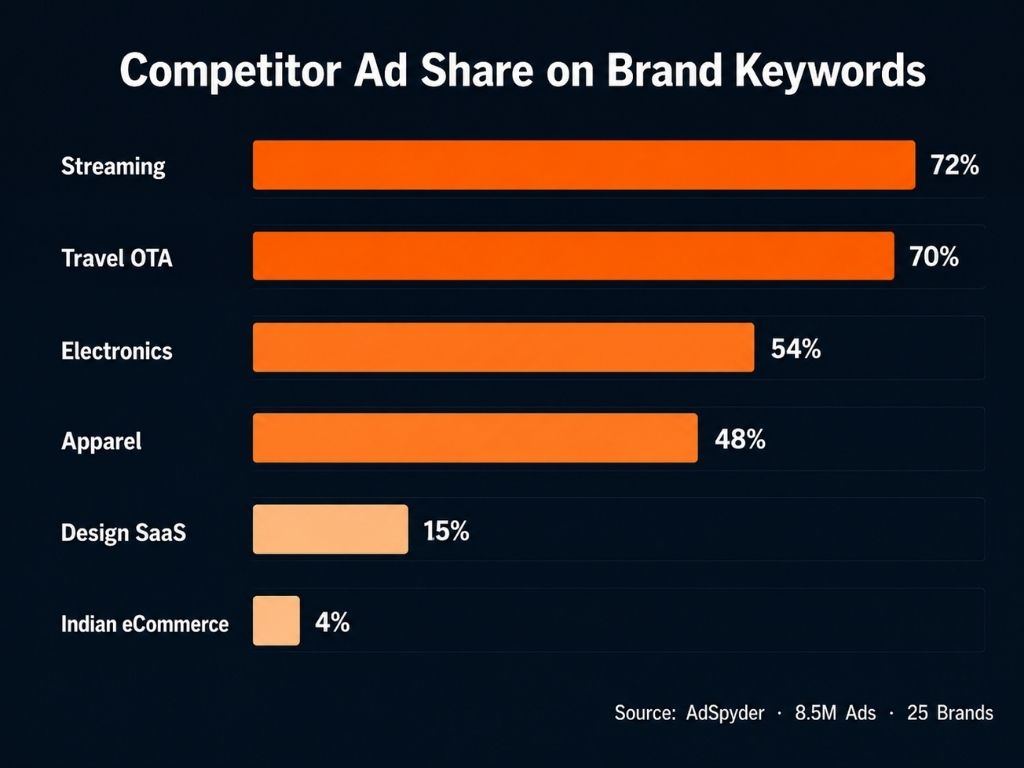
Most brands assume brand bidding is something that happens to Netflix and Booking.com, not to them. AdSpyder analyzed 8.5 million Google Search ads across 25 of the world’s most-searched brand keyword auctions. One in eight of those ads came from a different advertiser — not the brand being searched.
Source: AdSpyder Google Search Ads archive — analysis of 8.5M ads across 25 brand keyword auctions, May 2026.
Is someone bidding on your brand keyword right now?
Search your brand name across 164M+ Google Search ads. See which competitors are running ads — their copy, their landing pages, their history.
The 5 Brand Hijacking Patterns in Paid Search — With Ad Counts
Not all brand hijacking looks the same. AdSpyder’s analysis of 164M+ Google Search ads reveals five distinct attack patterns. Each requires a different detection method and a different response.
Direct Competitor Conquesting
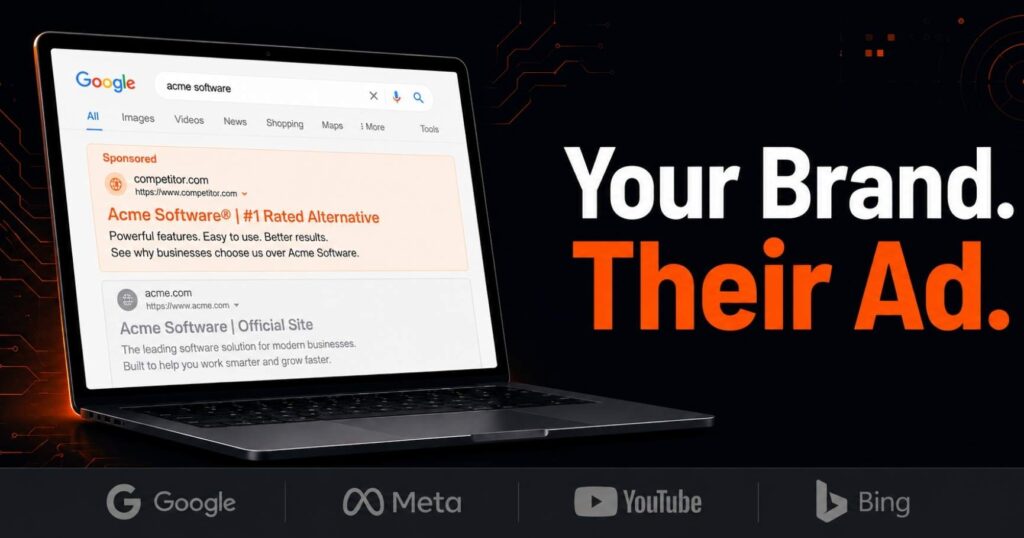
What it looks like: A competitor’s ad appears on your brand keyword — “Switch from [Your Brand]” or “[Your Brand] Alternative — Better Pricing”. Across 25 of the world’s biggest brand-keyword auctions, 13.1% of all ads come from non-brand advertisers — roughly 912,951 ads in AdSpyder’s sample. In India, every one of these ads now carries trademark-infringement exposure under the Hindware precedent, whether or not your brand name appears in the visible copy.
Detection: Search your exact brand name in AdSpyder’s Google Ads Spy. Any advertiser domain that is not yours is a conquesting candidate. Note first-seen and last-seen dates — these form part of any legal evidence package in India.
“Official Site” Impersonation
What it looks like: An ad carries “Official Site” or “Official Store” in the headline but the destination domain is not the brand’s own domain. Common in finance, software licensing, and consumer electronics. 3.39 million Google Search ads use “Official Site” or “Official Store” phrasing — a further 5.27 million use “official” in any context. That volume far exceeds the number of genuinely official brand presences. The gap is where impostor activity lives.
Detection: Search “[your brand] official site” in AdSpyder. Any ad whose destination domain is not yours is an immediate red flag — and under the Hindware ruling, grounds for trademark action in India whether or not your brand name appears in the ad copy.
“Alternative to” and “Better Than” Positioning
What it looks like: Competitors run ads explicitly framing themselves as the substitute — “Alternative to [Brand]”, “[Brand] vs Us”, “Cheaper than [Brand]”. 393,000+ Google Search ads use “alternative to”, “alternatives to”, or “better than” phrasing. These target users who already know your brand and are in active consideration — the highest-value switching traffic in your category.
Detection: Search “alternative to [your brand]” and “better than [your brand]” in AdSpyder. In India, if these ads appear when a user searches your registered trademark, the keyword bid itself is confirmed infringement regardless of whether your name is in the copy.
Coupon / Affiliate / Discount Redirect Hijacking
What it looks like: Coupon aggregators and unauthorized affiliates bid on your brand keyword with copy like “[Brand] Promo Code” or “[Brand] 50% Off”. They capture the click, drop the user on a page with competitor affiliate links, and earn commission regardless of where the user converts. 475,331 Google Search ads use “compare prices” phrasing. This is particularly insidious because the coupon site often holds a legitimate affiliate contract — making it a compliance problem as much as a competitive one.
Detection: Search “[brand] coupon”, “[brand] promo code”, “[brand] discount” in AdSpyder. Compare destination domains against your affiliate programme’s approved list.
Review and Comparison Site Bidding
What it looks like: Review platforms bid on “[Brand] reviews”, “[Brand] vs Competitor”, or “[Brand] pricing” to capture research-stage traffic. Their pages often carry paid placements for competing products. 3.33 million Google Search ads use “review” or “reviews” phrasing — 2.02% of the entire 164M+ archive. This is the highest-volume hijacking pattern by ad count because it spans every category.
Detection: Search “[brand] reviews” and “[brand] vs” in AdSpyder. Check whether the review site lists you fairly or consistently promotes competitors on a page that your brand searchers land on.
Source: AdSpyder Google Search Ads archive (164.7M ads), May 2026.

Your Industry Determines Your Hijacking Risk Level
Brand hijacking is not evenly distributed. AdSpyder analyzed 25 of the world’s largest brand-keyword auctions — 8.5 million ads — and the risk pattern is clear: your industry archetype determines your exposure more than how aggressively you currently defend.
| Industry | Sample Brands | Competitor Ad Share | Primary Hijacker Type |
|---|---|---|---|
| Streaming | Netflix, Disney+ | Up to 72% | VPN providers, rival streaming services |
| Travel / OTA | Booking.com, MakeMyTrip | Up to 70% | Meta-search engines, regional OTAs |
| Electronics | Samsung | 54% | Resellers, price-comparison sites |
| Apparel / Footwear | Nike, ASOS, SHEIN | 5% to 48% | Multi-brand retailers, competitor shops |
| Design / Productivity SaaS | Adobe, Shopify, Canva, Grammarly | 4% to 15% | “Alternative to” competitor ads |
| Indian eCommerce | Flipkart, Myntra | ~4% | Coupon sites, limited direct competition |
| Marketplaces | Mercado Libre, Agoda, eBay | 0% to 3.4% | Near-zero — platform scale as natural defense |
Source: AdSpyder Google Search Ads archive — 25-brand sample (8.5M ads), May 2026.
What this means practically
If you are in SaaS, travel, streaming, or consumer electronics, brand hijacking is already happening at scale in your category. Waiting to discover it through an impression-share drop or a customer complaint means it has been going on for months. Even lower-risk categories like Indian eCommerce still face coupon-site bidding. And after the Hindware ruling, every instance in India now carries legal exposure — for the bidder and for the platform.
The 5-Step Brand Keyword Defense Action Plan
Work through these in order. Do not jump to counter-bidding or legal notices before the classification step — the right response depends entirely on who is bidding and why.
1
DETECT — Find Out Who Is Bidding on Your Brand
You cannot defend what you cannot see. Start with a systematic detection pass — not a one-time manual search in an Incognito window.
Why a manual Google search is not enough: Results vary by location, device, time of day, and auction conditions. A competitor bidding in Mumbai may not appear in a search from Delhi. A campaign running on mobile may not show on desktop. You see a single slice of a dynamic auction that runs differently across hundreds of contexts simultaneously.
With AdSpyder: Go to AdSpyder’s Google Ads Spy and search your exact brand name. You see every advertiser whose ads appeared on that keyword across 164M+ indexed ads, including:
- The advertiser’s domain
- Full ad headline and body copy
- The destination landing page URL
- First-seen and last-seen dates
- Country and market the ad appeared in
- Position in the SERP
Extend the search to your brand + “review”, brand + “pricing”, brand + “alternatives”, brand + “vs”, and brand + “coupon” to catch all five attack patterns.
Evidence tip: Document everything before moving to Step 3. Export the list of advertiser domains, ad copy, and first-seen/last-seen dates. Under the Hindware ruling, these timestamps are part of the evidence package required for a trademark complaint or legal filing in India.
2
CLASSIFY — Not Every Brand Bidder Needs a Cease-and-Desist
The right response to a coupon site is completely different from the right response to a direct competitor or an impostor. Run each flagged domain through AdSpyder’s Domain Analysis to see their full ad portfolio across all platforms, then classify each one:
| Bidder Type | How to Identify It | Urgency |
|---|---|---|
| Impostor / look-alike | Uses “Official Site”, cloned landing page, suspicious domain | CRITICAL |
| Direct competitor | Same industry, “alternative to” or “vs” copy, links to their product page | HIGH |
| Unauthorized affiliate | Coupon/deal site not in your programme, or violating brand-bidding policy | HIGH |
| Authorized affiliate violating policy | In your programme — agreement prohibits brand keyword bidding | MEDIUM |
| Comparison / review site | G2, Capterra, editorial site ranking for brand queries | MEDIUM |
| Marketplace reseller | Amazon, Flipkart — sends traffic to a listing for your actual product | LOW |
3
DECIDE — Match Your Response to the Bidder Type
🚨 Impostor — Act Within 24 Hours
- File a Google Ads trademark complaint through Google’s policy pages. Attach the AdSpyder export as your evidence file.
- In India: send a legal notice simultaneously to both the advertiser and Google under the Hindware vs Google precedent. Invisible keyword use is confirmed infringement — you do not need your brand name in the visible ad to act.
- If the landing page clones yours, file a DMCA takedown with the hosting provider and a domain abuse report with the registrar.
⚔️ Direct Competitor
- Run or strengthen your own brand campaign with exact-match brand keywords. You will almost always hold a higher Quality Score for your own brand name — meaning you pay less while holding the top position.
- Sharpen your brand ad copy. Lead with a specific offer, your USP, and a direct CTA. A generic “Official Site” headline can lose to a well-written competitor ad even at a lower Quality Score.
- Consider counter-bidding on their brand keyword. This creates a mutually-assured-bidding dynamic — many competitors back off when they see their own name being targeted in return.
- In India: if the competitor uses your registered trademark as their keyword, the Hindware ruling gives you direct legal grounds for trademark action — without needing your name in their visible ad copy. Consult an IP attorney before formal filing.
🔗 Unauthorized Affiliate
- Send a written cease-and-desist to the site owner. State clearly that brand keyword bidding is not permitted without written authorization.
- File a Google Ads trademark complaint if their ad copy uses your brand name visibly.
- If they are earning commissions through a network you use, flag the affiliate manager for policy violation and deny commission on disputed transactions.
📋 Authorized Affiliate Violating Brand Bidding Policy
- Check your affiliate agreement. Most explicitly prohibit brand keyword bidding. A direct reminder is usually sufficient for established affiliates who want to keep the relationship.
- If they persist, suspend or terminate their affiliate account.
⭐ Comparison / Review Sites
- Engage editorially: claim your listing on each platform, respond to reviews, push for a stronger position in their rankings.
- Use AdSpyder’s Landing Page Analysis to see exactly where they send your brand searchers. If they consistently push competitors over you, maintain 95%+ brand impression share so your ad always appears above theirs.
🛒 Legitimate Marketplace Reseller
- Generally: tolerate it. The marketplace is selling your product — the conversion still benefits you.
- If their bid pushes you below position 1, increase your own brand campaign bids. You should win on Quality Score alone.
4
MONITOR — Set Up Ongoing Brand Keyword Surveillance
A one-time audit is not a defense. Competitors start and stop brand bidding campaigns constantly. New entrants appear. Old ones return after a cease-and-desist lapses. Brand keyword monitoring needs to be a repeating workflow.
With AdSpyder: Add each identified violator domain to a Competitor Tracking project. There are currently 8,663 active tracking projects monitoring 3,687 competitor domains across AdSpyder’s platform (AdSpyder platform data, May 2026). When you run subsequent Ad Library searches on your brand keyword, you will see whether those domains are still active and whether new ads have appeared.
Cross-platform: Brand hijacking rarely stays on one platform. Run the same brand-name search on Meta, Bing, YouTube, and LinkedIn using AdSpyder’s respective ad spy tools. The same competitor often runs parallel campaigns across multiple platforms simultaneously.
Coming soon: Brand Keyword Alerts
AdSpyder is building a real-time Brand Keyword Alert feature that will notify you the moment a new competitor ad appears on your brand keyword — across platforms. Instead of a weekly scan, you get notified the day it happens. This closes the detection gap that causes most brands to discover brand bidding only months after the traffic has already leaked.
5
MEASURE — Track Recovery in Google Ads
Once you have acted on Steps 1 through 4, confirm your defense is working by tracking these metrics inside your Google Ads account:
| Metric | Where to Find It | Target |
|---|---|---|
| Brand Impression Share | Campaigns → Competitive Metrics | 95%+ |
| Absolute Top Impression Share | Campaigns → Competitive Metrics | 90%+ on exact brand match |
| Branded CPC trend | Keyword report — filter brand terms | Stabilises or drops as competition reduces |
| Auction Insights — Overlap Rate | Campaign → Auction Insights | Decreases for known violators after enforcement |
Note: AdSpyder does not connect to your Google Ads account and does not display CPC or impression share. The measurement step lives in your Google Ads UI. AdSpyder’s role is in Steps 1, 2, and 4 — competitive intelligence, classification, and ongoing monitoring. Both tools are needed for the complete brand defense picture.
Taking Legal Action in India: What the Hindware Ruling Enables
Before May 22, 2026, an Indian brand facing competitor brand keyword bidding had limited options. Filing a Google Ads trademark complaint was uncertain — Google’s India policy did not consistently cover invisible keyword-use complaints. Filing in court meant confronting an unresolved legal question about whether invisible keyword use even constituted infringement. Both options changed with the ruling.
| Action | Before Hindware Ruling | After Hindware Ruling |
|---|---|---|
| Google Ads complaint | Uncertain; Google’s policy did not cover invisible keyword-use complaints | Google faces legal exposure for non-action; complaint carries significantly greater leverage |
| C&D to competitor | Grey area — advertiser could argue invisible keyword use is not infringement | Invisible keyword use is confirmed infringement under Section 29; C&D carries binding legal weight |
| Court injunction | Contested legal basis; inconsistent outcomes across Indian High Courts | Binding precedent; interim injunction applications on significantly stronger footing |
| Platform demand letter | Google could invoke Section 79 IT Act safe harbour to dismiss liability | Safe harbour stripped where platform actively suggests and monetises trademarked keywords |
Important caveat
The Hindware ruling is a single-judge Delhi High Court order. It sets binding precedent within its jurisdiction and is highly persuasive across other Indian High Courts — but it is not a Supreme Court ruling and may be challenged on appeal. Consult a qualified IP attorney before formal legal action. Nothing in this blog constitutes legal advice.
What the ruling confirms beyond litigation: if you are an Indian brand with a registered trademark and a competitor is bidding on your brand keyword in Google Ads, you now have documented legal grounds to demand enforcement. For the first time in India, that demand carries consequences the platform can no longer dismiss with a safe-harbour argument.
Brand Hijacking Detection Cadence — Daily, Weekly, Monthly
Most brands get hijacked because there is no monitoring cadence. Here is the operational routine that closes the gap.
Detect brand hijacking before it costs you
AdSpyder indexes 164M+ Google Search ads, 55M+ Meta ads, and 10 platforms in total. Search your brand name now — see exactly who is running ads against you, their copy, their landing pages, and how long they have been doing it.
Monitor Your Brand with AdSpyder →
88,000+ competitor-ad searches run · 8,663 active monitoring projects · 164M+ Google Search ads indexed