Local Offers · Memberships · Packages · Bookings
Quick Answer
- Spa advertising is highly local: service, location, price, availability and trust usually matter more than broad reach.
- Research introductory offers, seasonal packages, memberships and rebooking campaigns separately.
- Compare competitor pricing only when it is publicly shown in an ad or landing page—do not infer private economics.
- Google is strongest for active local intent; Meta and Instagram help create demand, show the experience and retarget visitors.
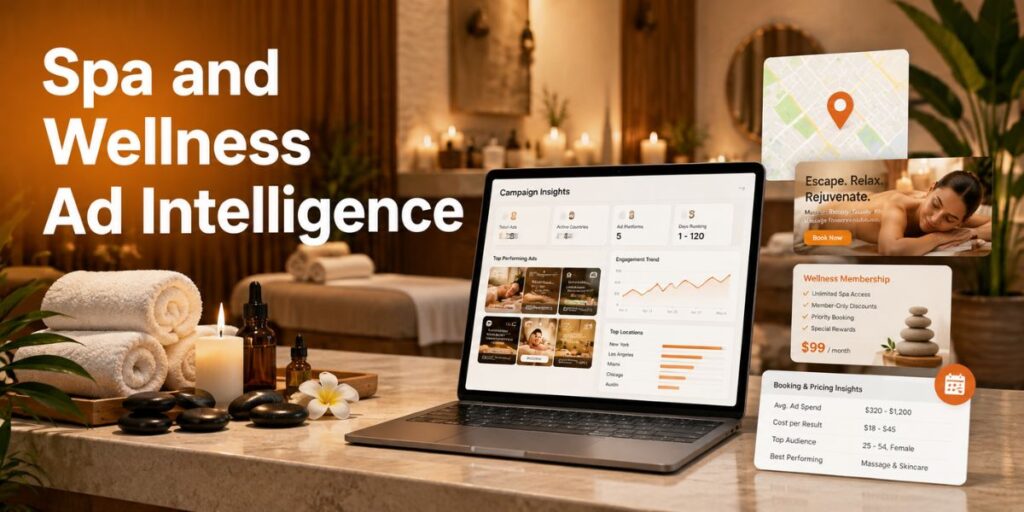
- Use AdSpyder’s Spa & Wellness Ad Intelligence workflow to research competitor campaigns before creating your own offer.
A spa does not need the most creative advertisement in the city. It needs the right offer for the right local client at the right stage. Someone searching “deep tissue massage near me” may be ready to book today, while an Instagram user watching a treatment Reel may need an introductory package before committing. Spa ad intelligence helps marketers understand how nearby competitors structure those offers, packages and memberships before spending their own budget.
Why Spa and Wellness Marketing Is Local-Offer Driven
PROXIMITY
Most treatments require an in-person visit, making neighborhood and travel distance central to the decision.
AVAILABILITY
“Today,” “this weekend” and appointment availability can matter as much as the discount itself.
TRUST
Reviews, therapist expertise, treatment environment and clear service information reduce booking hesitation.
AdSpyder’s Local Spa Advertising guide makes the same distinction: local campaigns work best when service intent, location relevance and the booking destination all align. :contentReference[oaicite:1]{index=1}
Research Competitor Offers Before Setting Your Own Price
Do not begin by asking, “What discount should we run?” First map what the local market is already offering.
| Offer Type | What to Record | What It Helps You Learn |
|---|---|---|
| First-visit offer | Service, discount, expiry, booking conditions | How competitors reduce the risk of trying a new spa. |
| Multi-session package | Number of treatments, saving, expiry | How competitors encourage repeat visits. |
| Seasonal package | Occasion, bundle, urgency, gift angle | Which events are used to create short-term demand. |
| Membership | Monthly price, included services, benefits | How spas position recurring value rather than one-off discounts. |
| Win-back offer | Time away, incentive and CTA | How inactive clients are encouraged to return. |
Current wellness-industry guidance strongly supports this lifecycle approach. Mindbody’s 2026 spa/salon material emphasizes introductory packages, memberships, rebooking and re-engagement rather than permanent discounting. Its recent intro-offer guidance specifically recommends multi-visit packages because the goal is to turn a first visit into repeat behavior. :contentReference[oaicite:2]{index=2}
How to Find Local Spa Campaign Patterns With AdSpyder
1. Build a local competitor list
Include direct spas, massage studios, med spas and specialist wellness clinics competing for the same treatment demand. Use URL & Domain Analysis to review each competitor’s visible advertising footprint instead of relying on one ad you happened to see.
2. Search the wider category
Use the AdSpyder Ad Library to compare massage, facial, skincare, wellness package and spa-membership campaigns beyond your immediate competitor list.
3. Tag the offer—not just the design
Classify each ad as first visit, membership, package, seasonal promotion, service-specific booking, consultation or retargeting.
4. Record location language
Look for neighborhood names, proximity claims, same-day availability, city references and branch-specific CTAs.
5. Inspect where the ad sends the user
A strong competitor study includes the booking page, not only the advertisement. Record whether the click leads to a treatment page, offer page, membership page, WhatsApp, lead form or appointment calendar.
Google vs Social: Research Different Spa Buying Moments
Google Search
Capture existing demand
Research service + location keywords, pricing language, availability, reviews and booking CTAs. Searches such as “massage near me” or treatment-specific queries often indicate immediate intent.
Instagram / Facebook
Create and nurture demand
Research treatment experiences, before-and-after proof where appropriate, therapist expertise, seasonal offers, testimonials and retargeting messages.
Use AdSpyder’s Google Ads for Spas guide for high-intent search planning. Its current spa research separates broad informational terms from more booking-oriented service and “near me” queries. :contentReference[oaicite:3]{index=3}
For discovery and retargeting, the Social Media Ads for Spa guide recommends treating Instagram and Facebook differently from search because users are scrolling rather than actively requesting a treatment. :contentReference[oaicite:4]{index=4}
What to Look for in Spa Membership Campaigns
Membership ads should not be evaluated like one-time discount ads. Their job is to communicate recurring value.
Does the membership start after a first visit, consultation or introductory package?
Monthly treatment, service credit, preferred pricing, add-ons or priority booking?
Is the message about saving money, maintaining a routine or receiving premium access?
Monthly billing, prepaid package, annual plan or another structure?
Memberships matter because spa growth depends heavily on repeat visits. Mindbody’s current spa guidance specifically highlights memberships, packages, rebooking and automated follow-up as recurring-revenue and retention levers. :contentReference[oaicite:5]{index=5}
Seasonal Packages Are a Different Campaign Category
Do not mix Mother’s Day, Valentine’s Day, bridal packages or holiday gift campaigns with evergreen massage or facial ads when doing competitor research. Seasonal campaigns have different urgency, gifting behavior and creative expectations.
AdSpyder’s Paid Ads for Spa Services guide recommends refreshing the creative and offer structure as seasonal demand changes rather than repeating the same spa promotion indefinitely. :contentReference[oaicite:6]{index=6}
Research rule: if five competitors are all advertising “20% off massage,” the opportunity may not be another 20% discount. It may be a clearer package, stronger proof, better availability, easier booking or a differentiated service experience.
Build a Local Competitor-Informed Campaign
| Research Input | Your Decision |
|---|---|
| Competitors emphasize first-visit discounts | Test an introductory package, consultation or value-added first visit rather than copying the exact discount. |
| Membership ads emphasize savings | Test whether your audience responds better to routine, convenience or premium benefits. |
| Search competitors emphasize availability | Make appointment availability easier to see if your operations can support it. |
| Social competitors use treatment videos | Create original videos showing your own environment, staff and service experience. |
| Competitors use dedicated booking pages | Remove unnecessary steps from your own ad-to-booking journey. |
Do Not Stop the Research at the Ad
A spa campaign can have excellent CTR and still fail if the next step is confusing. Compare how competitors move from ad → service details → trust → availability → booking.
AdSpyder’s Spa Lead Generation Funnel guide highlights message match, trust signals, service-specific destinations and reduced booking friction as the critical post-click elements to review.
Spa Competitor Campaign Research Checklist
☐ 5–10 local competitors mapped
☐ Main services categorized
☐ Introductory offers documented
☐ Public pricing captured where visible
☐ Membership offers separated
☐ Seasonal packages tagged
☐ Location language recorded
☐ Reviews and proof noted
☐ Landing pages reviewed
☐ Booking CTA documented
☐ Original campaign angle defined
☐ Cost per booked appointment tracked
See what nearby spa competitors are actually advertising
Research local offers, memberships, seasonal packages, creatives and booking journeys before building your next spa campaign.
Frequently Asked Questions
Spa ad intelligence is the structured analysis of competitor ads, offers, public pricing, creative patterns, platforms and landing pages to improve your own marketing decisions.
Research first-visit offers, multi-treatment packages, memberships, seasonal promotions, rebooking incentives and win-back offers separately.
They can be valuable when services naturally repeat. Membership advertising should communicate recurring value and benefits rather than relying only on a monthly discount.
Google is useful for capturing active service and “near me” intent. Instagram and Facebook are stronger for visual discovery, offers, social proof and retargeting. Many spas can use both for different funnel stages.
AdSpyder can surface publicly observable ads and landing pages. Pricing can be researched when a competitor displays it publicly, but private pricing, margins and booking economics are not available.
No. Persistence is useful for prioritizing research, but competitor conversion rates, cost per booking and revenue remain private. Validate every campaign idea with your own data.