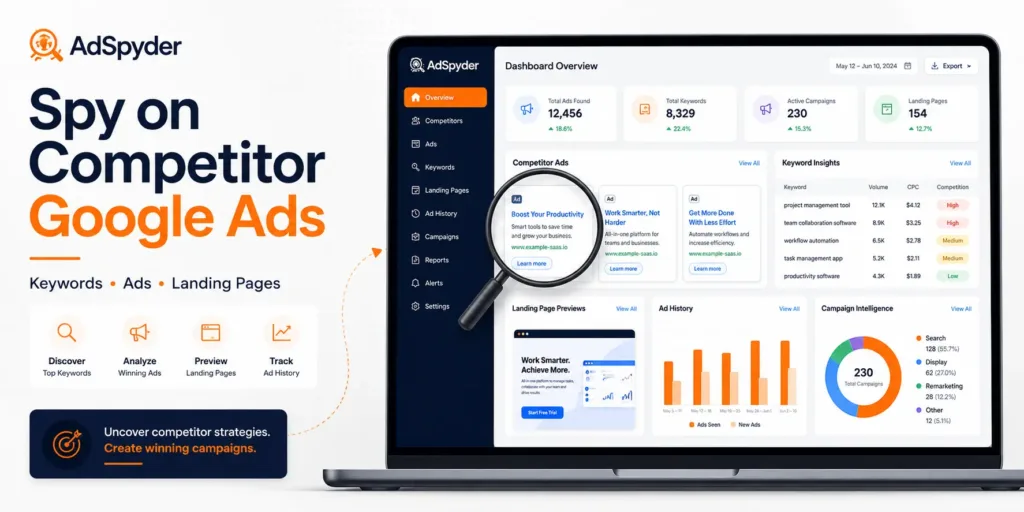
Your competitors have already paid to figure out what works on Google Ads. AdSpyder’s Google Ads Spy tool lets you see their ad copies, keywords, and landing pages — from 164 million+ archived Google Search ads — before you spend a single rupee on your own campaign. This guide gives you the exact 6-step workflow to turn that into an unfair advantage.
Running Google Ads without competitor research is like playing poker without looking at anyone else’s moves. You’re guessing — and guessing costs money.
The good news: every campaign your competitor has ever run is a signal. Their ad copies, the keywords they keep bidding on, the landing pages they’ve refined over months — all publicly accessible if you know where to look.
Here’s the step-by-step workflow to do it ethically, legally, and without a big research budget.
Skip the manual research
AdSpyder indexes 164 million+ Google Search ads across 100+ countries, going back to 2008. Search by competitor domain or keyword — get the full picture in minutes.
Why Competitor Research Is Non-Negotiable in 2026
Google Ads is an auction. Every time someone searches a keyword you want, you’re bidding against advertisers who may already know exactly what converts. The cost of getting it wrong:
- Wasted budget on keywords that look good but don’t convert
- Low CTR from copy angles the market has already moved past
- 4–6 weeks of A/B testing to find what a competitor figured out months ago
| What you learn | Why it matters |
|---|---|
| Which keywords competitors sustain spend on | Long-running bids = proof of conversion. No rational advertiser wastes months of budget on non-converting keywords. |
| Which copy angles survive over time | Ad longevity is your performance proxy — ads running 90+ days in a competitive niche almost certainly work. |
| How aggressive competitors are | A brand running 40+ variants is in acquisition mode. One unchanged for 3 months may be pulling back. |
| What gaps exist in their strategy | Keywords they ignore and personas they skip are your highest-leverage campaign opportunities. |
Source: AdSpyder platform data, May 2026
What You Can (and Can’t) Actually See
Most guides oversell or undersell what’s visible. Here’s the honest picture.
| Data point | What it tells you | Visible? |
|---|---|---|
| Active ad copies | Current headlines, descriptions, CTAs | ✓ Yes |
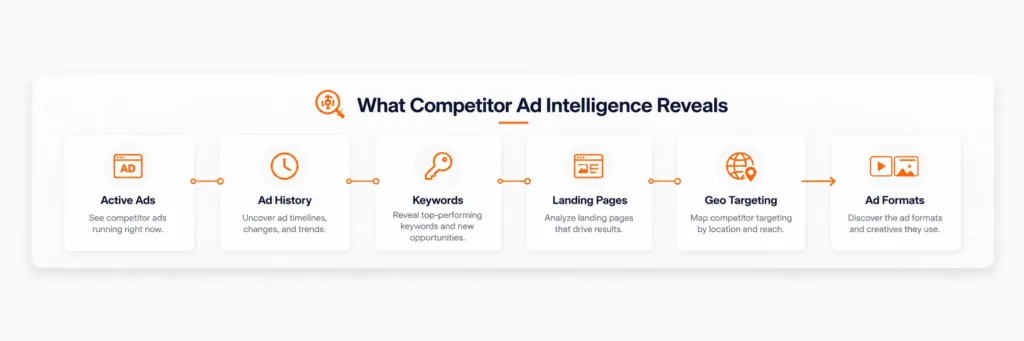
| Historical ad copies | What they tested, what they kept, how copy evolved | ✓ Yes |
| Keywords triggering ads | Exact and phrase-match terms they bid on | ✓ Yes |
| Landing pages per ad | Offer, CTA, page structure, message match | ✓ Yes |
| Geographic targeting | Which markets they’re prioritising | ✓ Yes |
| Ad format breakdown | Search, Display, Shopping mix | ✓ Yes |
| Actual spend / ROAS | — | ✗ Private |
| Conversion rates | — | ✗ Private |
| Quality Scores | — | ✗ Private |
Can’t see conversion rates? Use ad longevity instead. An ad running continuously for 90+ days in a competitive market almost certainly converts. That’s your filter — not aesthetics, not personal preference.
Free Tools vs. Real Intelligence: The Honest Comparison
Here’s what Google’s free tools actually do — and where they leave you stuck.
- See active ads for one advertiser at a time
- Broad geographic signal
- Auction overlap (needs active campaign)
- ❌ No keyword data
- ❌ No ad history
- ❌ Can’t search by keyword
- ❌ No landing page data
- ❌ No multi-competitor view
- Search by keyword or domain
- 164M+ Google Search ads in archive
- Ad history going back to 2008
- Keyword-level data for any competitor
- Landing page links per ad
- Multi-competitor benchmarking
- Filter by country, format, date
- Monitor competitors over time
| Capability | Transparency Center | Auction Insights | AdSpyder |
|---|---|---|---|
| See competitor active ads | ✓ | ✗ | ✓ |
| Historical ad copies | ✗ | ✗ | ✓ since 2008 |
| Search by keyword | ✗ | ✗ | ✓ |
| Keyword-level competitor data | ✗ | Partial | ✓ |
| Landing page mapping | ✗ | ✗ | ✓ |
| Needs active campaign to work | No | Yes | No |
The 6-Step Workflow: From Zero to a Fully-Briefed Campaign
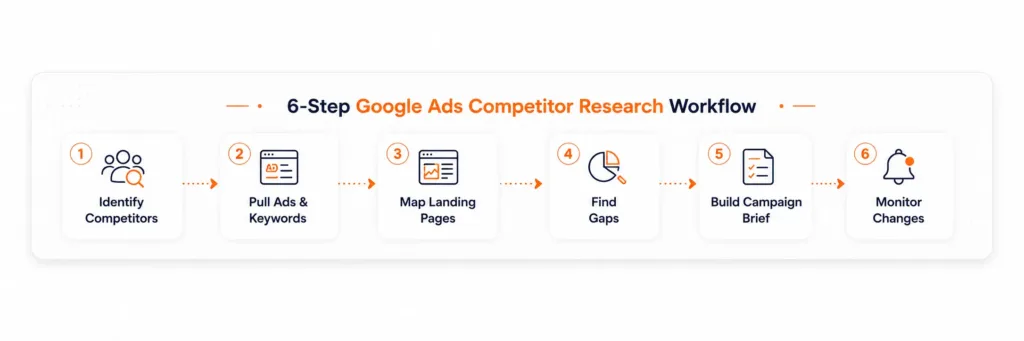
Identify Your Real Google Ads Competitors
Your Google Ads competitors and your business competitors are often not the same list. A brand you’ve never heard of may be outspending you on your most valuable keywords.
How to build your real list:
- Open an incognito browser (removes personalisation)
- Search your 8–10 highest-intent target keywords
- Note every advertiser appearing in Sponsored positions
- In Google Ads → Auction Insights → export and cross-reference
Run this separately for brand keywords and category keywords. The competitors bidding on “AdSpyder alternative” are a completely different set from those bidding on “google ads spy tool” — and both matter.
Pull Competitor Ad Copies and Keyword Data
Open AdSpyder’s Google Ads Spy tool and search each competitor’s domain. You’ll see their full ad library — active and historical — alongside the keywords triggering those ads. AdSpyder tracks 227 million+ PPC keywords across Google.
| Element | What it reveals | What to note |
|---|---|---|
| Headline structure | Primary hook type | Feature / outcome / question / urgency |
| Description angle | What they think matters most to the buyer | Pain point / benefit / proof / offer |
| CTA language | Funnel stage they’re targeting | “Start Free” vs “Book a Demo” vs “Get Quote” |
| Offer structure | Their conversion strategy | Trial / demo / discount / freemium |
| Ad longevity | Strongest performance signal | 90+ days running = likely converting |
Map Competitor Landing Pages
The ad is the promise. The landing page is the delivery. A mediocre ad connected to a brilliant landing page beats the reverse every time.
For each competitor ad, check:
- Message match — does the page headline mirror the ad? Strong advertisers maintain tight match. Weak ones dump all traffic on a generic homepage.
- Offer consistency — does the page deliver what the ad promised? Pivots create friction — and friction is your opportunity.
- Social proof placement — testimonials, case study numbers, user counts. Above the fold or buried?
- Objection handling — does the page address the 3 most obvious reasons someone wouldn’t buy?
- Page length — long pages signal longer buying cycles. Short single-CTA pages signal low-friction conversions.
AdSpyder’s Landing Page Analysis lets you review competitor page structure directly alongside their ads — no manual clicking through each one.
Find the Gaps Your Competitors Are Missing
The biggest opportunity isn’t where everyone else is bidding — it’s where they aren’t.
Keyword gaps to look for:
- Long-tail, high-intent terms — “google ads spy tool for agencies” vs. just “google ads spy tool”. More specific = lower CPC, higher intent.
- Pain-point queries — “why is my google ads not converting” has strong commercial intent but lower competition.
- Comparison queries — “[Competitor] alternative” queries are BOFU goldmines most established brands underfund.
- Geographic niches — if everyone runs national, a targeted geo campaign wins auctions at significantly lower CPCs.
Messaging gaps to look for:
- Nobody speaking to a specific persona (agencies vs. founders vs. ecommerce teams)
- Everyone leads with features — nobody leads with ROI or outcome numbers
- No one addresses the #1 objection in their copy (price, complexity, switching cost)
- All offers look identical — a different structure stands out immediately
Build Your Campaign Brief From the Intelligence
Don’t jump from research directly into Google Ads. Run everything through a brief first. Your brief needs five things:
- Three-tier keyword list — Tier 1: Proven (3+ months sustained spend). Tier 2: Gap opportunities. Tier 3: Experimental (long-tail, pain-point, comparison).
- Ad copy swipe file — the 3–5 competitor ads showing clear longevity. Your benchmark. Write headlines that beat them, not echo them.
- Offer decision — match, undercut, or completely differentiate. Pick one deliberately.
- Landing page specs — length, social proof type, CTA placement, message match requirements per ad group.
- Negative keyword list — built before you launch, not after budget leaks. Competitor brand names, irrelevant terms, informational queries.
AdSpyder’s Keyword Research tool covers 377 million+ keywords with metrics — search volume, CPC, competition score, and top advertisers per keyword. Validate every tier of your list before building campaigns.
Set Up Ongoing Competitor Monitoring
Competitor research isn’t a one-time audit. Markets shift. Competitors get funded, change agencies, launch new products, and update offers. What’s true in January may be completely wrong by April.
| Frequency | What to do | Time needed |
|---|---|---|
| Monthly | Fresh domain search on top 3–5 competitors. Flag new copies, keywords, landing pages. | ~30 min |
| Quarterly | Full audit — all competitors, keyword gap analysis, landing page re-review, offer comparison. | 2–3 hrs |
| Event-triggered | Before any new campaign, product launch, or new geo entry. | 1–2 hrs |
AdSpyder’s Competitor Intelligence tracks specific domains and surfaces new creative, ad copy changes, and platform shifts — automatically. Over 8,600 competitor tracking projects are actively running on the platform right now.
What to Do With the Data (Most Guides Skip This)
| Insight type | How to operationalise it |
|---|---|
| Copy evolution | Feature-led → outcome-led headline shift over 6–12 months means they found what converts. Static for 12 months = stopped paying attention. |
| Keywords they’re retreating from | If a competitor has been pulling back from certain keyword clusters, those terms likely don’t convert. Use this to build your negative keyword list. |
| Landing page patterns | Most advertisers run similar ad copy. The real differentiation happens post-click. A faster, more intent-specific landing page wins even at identical CPCs. See Landing Page Analysis → |
| Winning ad structures | Use competitor intelligence to inform your ad creation. AdSpyder’s Text Ad Generation lets you build variants based on market-proven angles — not guesswork. |
How AdSpyder Works — With Real Numbers
AdSpyder’s Google Ads Spy tool is built as a dedicated competitive intelligence environment — not a bolt-on feature inside a broader SEO suite.
Source: AdSpyder platform data, May 2026
Platforms covered:
Google Shopping
Meta / Facebook
YouTube
Bing
TikTok
Amazon
Display
The core workflow inside AdSpyder:
- Domain search — enter any competitor domain and pull every Google ad they’ve ever run. Full copy, keywords, destination URL, geography, and date range.
- Keyword search — search by keyword instead of brand name. Surfaces every advertiser bidding on that term, including ones you didn’t know were competing for your audience.
- Competitor Intelligence — automated alerts when tracked competitors launch new creative, shift keyword focus, or change platforms. Daily delta summaries.
- Domain Overview — full ad-spend profile, platform mix, and creative history for any advertiser. See Domain Overview →
- Cross-platform research — extend the same workflow to Facebook Ads, Bing Ads, and more via AdSpyder’s full Ad Library.
5 Mistakes Marketers Make When Spying on Competitor Ads
Using competitor copy verbatim puts you in direct comparison on the SERP — where the established brand wins on trust alone. Study the pattern. Write something better.
A new aggressive entrant can shift auction dynamics in weeks. Research the full competitive field — not just the top name you already know.
A single ad tells you almost nothing. A pattern of 10+ ads over 6 months tells you a great deal. Always look for consistency and longevity.
The ad gets the click. The landing page wins or loses the customer. Audit both. Always.
Stale research = decisions built on a market that no longer exists. Set a monthly reminder or use AdSpyder’s automated competitor alerts.
Pre-Launch Checklist: Before Your Campaign Goes Live
Competitor research without action is just expensive browsing. Every insight should change something — a keyword you add, a headline you write differently, a landing page you sharpen, or a negative keyword that prevents waste. If it doesn’t change your plan, it didn’t count as research.
Start Your Competitor Research With AdSpyder
164 million+ Google Search ads. 227 million+ PPC keywords. 100+ countries. Ad history back to 2008. Everything you need to research competitor Google Ads — before your next campaign goes live.
Frequently Asked Questions
Is it legal to spy on competitor Google Ads? +
Yes, completely legal. You’re accessing publicly available advertising data — the same data Google surfaces through its Ads Transparency Center. AdSpyder aggregates this and adds historical copies, keyword data, and geographic filtering on top. No hacking, no grey areas.
What can I actually see when I spy on competitor Google Ads? +
With AdSpyder: active and historical ad copies (headlines, descriptions, CTAs), keywords triggering those ads, landing pages per ad, geographic targeting, and ad format breakdown across Search, Display, and Shopping. What you cannot see: actual spend, conversion rates, or Quality Scores — those remain private.
How is AdSpyder different from Google Ads Transparency Center? +
Google’s Transparency Center shows active ads for one advertiser name only — no keyword data, no history, no cross-competitor view. AdSpyder’s Google Search Ads archive covers 164 million+ ads going back to 2008, is searchable by keyword, and lets you benchmark multiple competitors simultaneously.
How often should I run competitor Google Ads research? +
Before any new campaign: mandatory. During active campaigns: monthly minimum, weekly in high-velocity niches (ecommerce, finance, SaaS). Before major launches or seasonal pushes: 2–3 weeks in advance so you have time to act on findings.
Can competitor research improve my Google Ads Quality Score? +
Indirectly, yes. Studying which copy angles drive engagement helps you write ads with better CTR (ad relevance). Auditing competitor landing pages helps build a sharper post-click experience. Both are direct Quality Score components.
Can I spy on competitor Google Ads for free? +
You can get limited data from Google’s Transparency Center and manual SERP searches — but no keyword data, no history, and no multi-competitor benchmarking. AdSpyder offers a free trial to run the full workflow before committing. Start here →