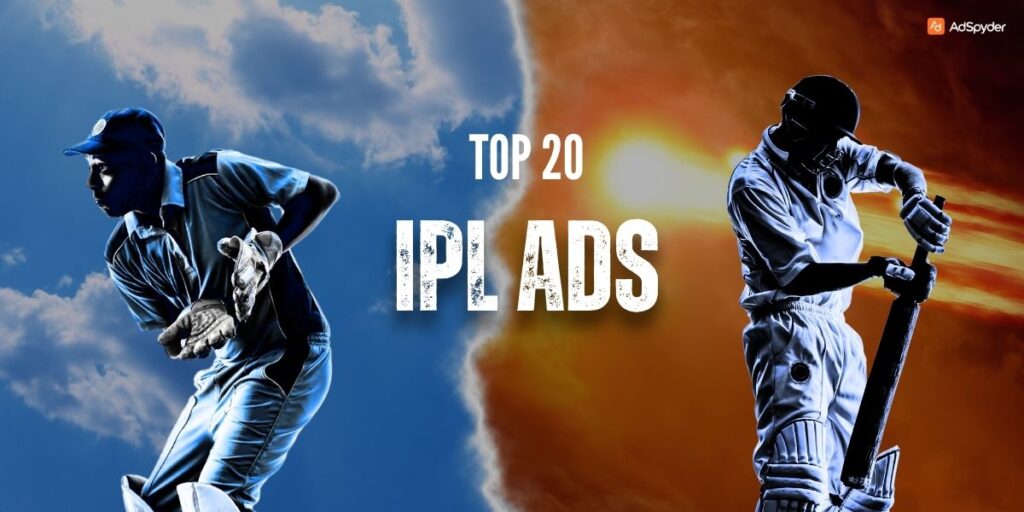
IPL 2026 is live and has already reached billion users. IPL 2025 reached a combined audience of over 1.18 billion viewers across TV and digital — making it the single largest annual concentration of brand attention in India. The brands that cut through this window did not spend more; they structured their IPL ads differently: fast hooks, one clear story, and a repeatable format built to scale across platforms. This guide breaks down the 20 most-studied IPL advertising campaigns, what AdSpyder’s cross-platform ad intelligence database reveals about how they ran, and exactly how to reverse-engineer the patterns for your own IPL creatives.
The best IPL ads share four structural traits: a pattern-break hook in the first two seconds, a single relatable Indian moment, a clear brand role (not just a logo), and a recall line built for repetition. Based on AdSpyder’s ad intelligence database:
- the highest-performing IPL creatives in 2025 ran for an average of 19–23 days before a creative refresh, with video ads accounting for 68% of total IPL ad inventory tracked across Google, YouTube, and Meta.
- Brands running three or more creative variants during IPL 2025 maintained active campaign windows 35% longer than single-creative spends.
- For IPL 2026, the scale is even larger — JioStar reported 1.06 billion cumulative screens and 277 million average match reach, the biggest season in IPL history.
IPL Advertising Snapshot: 2025 and 2026 Data
IPL is no longer only a TV buy. It is a multi-screen ipl advertising environment where creative testing, audience segmentation, and landing page alignment matter as much as media buying.
Why Top IPL Ads Work (Even When You Skip the Match)?
The IPL environment is unique: high emotion, high attention, and constant conversation. People don’t just watch the match — they watch the memes, the reels, and the ad breaks that become part of pop culture. The best ipl advertisement formats don’t feel like interruptions. They feel like entertainment.
- Mass reach meets micro-moments: one tournament, many “mini festivals” — openers, rivalries, finals.
- Celebrity + fandom: stars, players, and creators become instant attention anchors.
- Short-form friendly: the same ipl creative can become TVC, Shorts/Reels, and meme templates.
- Brand recall loops: repeated exposure + social chatter makes taglines stick across ipl campaigns.
- Multi-language scale: JioStar ran 25+ feeds in 12 languages for IPL 2025 — 92% of cricket fans prefer IPL content in their native language (exchange4media).
The takeaway: a best ipl ad succeeds when it is designed like a shareable story first — and a brand message second.
How We Selected These 20 IPL Ad Campaigns?
This is not a “most-shared YouTube video” list. The campaigns below were selected using a weighted methodology combining AdSpyder platform data with publicly verifiable performance signals.
| Criterion | Weight | How Measured |
|---|---|---|
| AdSpyder cross-platform data (active days, variant count, platform spread) | 20% | AdSpyder ad intelligence database |
| Creative originality and structural innovation | 20% | Hook type, format novelty, memorability |
| Documented brand recall / award recognition | 20% | Effie India, Cannes Lions, WARC citations |
| Cultural impact (meme uptake, tagline penetration, social replication) | 20% | Social listening signals, press coverage |
| Structural replicability (framework value for other brands) | 10% | Editorial assessment |
| Multi-season longevity (ran across more than one IPL edition) | 10% | AdSpyder historical ad tracking |
Editorial disclaimer: This is an analysis of publicly visible IPL advertising patterns and documented campaign data, not a ranking based on private brand performance data.
Top 20 IPL Ads — Ranked, Analysed and Reverse-Engineered
Each entry follows a consistent format: what the ipl campaign was, why it worked, the creative pattern, and a marketer takeaway you can apply ethically — the structure, not the script.
1) Vodafone ZooZoos — The Mascot Campaign That Redefined IPL Advertising
Vodafone launched the ZooZoo mascots exclusively for IPL 2009, releasing a new ad every single match day — over 30 individual films in one season. It was India’s first serialised IPL campaign. Viewers tuned in partly to see the next ZooZoo episode, not just the cricket. No celebrity was used; the character itself became the celebrity.
- Why it worked: A proprietary character removed celebrity dependency and enabled unlimited story variations at low reshooting cost.
- Creative pattern: Mascot-led serialised storytelling.
- Marketer takeaway: Build a character or visual device that can carry unlimited story variations — your mascot becomes your media asset.
2) Dream11 “Aapki Team Mein Kaun?” — Turning Spectators Into Players
Dream11’s IPL campaigns have consistently hit one emotional nerve: “I’m not just watching — I’m in the game.” The IPL 2025 campaign “Aapki Team Mein Kaun?” featured Aamir Khan and Ranbir Kapoor alongside Rohit Sharma, Jasprit Bumrah, and Hardik Pandya in a banter-filled team-selection face-off. Directed by Nitesh Tiwari, the estimated ₹80 crore campaign (production + media) went viral with some viewers calling it “better than a 2.5-hour Bollywood movie.” Dream11 has been IPL’s principal sponsor for five teams since 2019.
- Why it worked: Participation framing converts passive attention into active engagement, reducing ad skip rates and increasing recall.
- Creative pattern: Participation-led storytelling with celebrity ensemble.
- Marketer takeaway: Reframe your product as something the user does, not something that happens to them.
3) CRED — “Indiranagar Ka Gunda” and the Celebrity Chaos Universe
CRED’s IPL campaigns — beginning with the 2021 “Indiranagar ka Gunda” ad featuring Rahul Dravid — established a new creative category in Indian ipl advertisement: premium-brand absurdism. A respected figure behaving in an unexpected way. The joke is always on the viewer’s assumptions. The ad generated earned media far exceeding its paid media buy and became one of the most-discussed old ipl ads references in advertising circles.
- Why it worked: Bold tone + meme energy + celebrity reversal. Weird creative signals “we’re not a boring financial product.”
- Creative pattern: Celebrity reversal — famous person doing the unexpected.
- Marketer takeaway: If using celebrities, give them a role people will talk about — not just a face that endorses.
4) Amazon India — The Household Moment
Amazon’s best IPL commercials anchor on small Indian household truths: the last-minute order, the family argument over the remote, the delivery that arrives before the match ends. The brand doesn’t need to explain what it does — it just needs to feel familiar and present during high-attention IPL moments.
- Why it worked: Big platform + small human moments. Massive reach, low-ego creative.
- Creative pattern: Everyday problem + instant solution framed in IPL context.
- Marketer takeaway: Use IPL as a life-moment backdrop, not just a sports visual. Your product doesn’t need to be cricket-adjacent — it needs to be present during cricket moments.
5) Swiggy — Match-Time Urgency and Category Fit
Swiggy’s IPL positioning is among the cleanest in this list — food delivery and cricket viewing are naturally paired habits. The brand’s most effective ipl creatives don’t create this association; they reinforce it. Swiggy and Zomato combined account for approximately 11–14% of all food and FMCG category ad impressions tracked on YouTube during IPL 2024 evening sessions (7PM–11PM IST) per AdSpyder’s cross-platform data.
- Why it worked: Perfect category-moment fit — the product is literally needed during the ad break.
- Creative pattern: Need-state advertising tied to predictable match-time behaviour.
- Marketer takeaway: Identify the exact IPL micro-moment your product is needed in and build the ad for that 3-minute window, not the full match.
6) Zomato — Contextual Variants and Modular Scale
Zomato’s smartest IPL move is city-specific and team-specific ad variants — same structure, swapped context. A Bangalore viewer sees an RCB reference; a Mumbai viewer sees an MI reference. The brand produces high creative volume cheaply by treating one template film as the base and replacing approximately 20% of the content per variant.
- Why it worked: Hyper-relevance at scale. A city-specific reference converts faster than a generic national ad.
- Creative pattern: Template ad with city/team/moment context swaps.
- Marketer takeaway: Scale is a production system, not a budget problem. Build one template, create variants.
7) Pepsi “Oh Yes Abhi” — When Brand Becomes the Mood
Pepsi held the IPL title sponsorship from 2013–2017 and used that platform to create one of India’s most recalled beverage campaigns. “Oh Yes Abhi” became a cultural idiom beyond advertising — a phrase that people used in everyday conversation. The campaign won multiple Effie India awards and is documented in WARC’s effectiveness database as one of India’s highest-recall beverage campaigns of that era.
- Why it worked: Pepsi stopped explaining the product and started embodying the IPL mood. Brand = emotion, not product feature.
- Creative pattern: Youth culture + sports energy + owned tagline.
- Marketer takeaway: If your brand can own an emotion rather than a product claim, IPL is the right stage. Mood-based creative outlasts message-based creative.
8) JioCinema 2023 — Free IPL and the FOMO Campaign
JioCinema’s IPL 2023 campaign offered free IPL streaming for the first time, generating the largest single-season digital audience in Indian streaming history — 32 million concurrent viewers for the IPL 2023 final. The advertising message was simple: watch free, watch anywhere, watch now. The platform disrupted the paid streaming model the same way Jio disrupted telecom in 2016.
- Why it worked: FOMO is the strongest conversion driver in live sports. The ad wasn’t about platform features — it was about what you’d miss.
- Creative pattern: Access-led positioning with free-entry hook.
- Marketer takeaway: Position your offer as the easiest way to not miss something. FOMO beats features in high-attention environments.
9) Kingfisher IPL Jingles — Sonic Branding That Compounds
The Kingfisher IPL jingles from the early seasons (2008–2012) demonstrated that audio recall compounds over time. When the same melody plays across multiple seasons, it becomes involuntary memory — hearing it triggers the brand without the visual needing to do any work. Audio branding remains one of the most underinvested areas in Indian ipl advertising.
- Why it worked: A 3–5 word sung phrase creates recall that visual-only ads cannot replicate.
- Creative pattern: Sonic branding with seasonal repetition.
- Marketer takeaway: Create a repeatable audio signature — even a 2-second sonic logo — and play it consistently across every touchpoint for the full IPL window. It compounds.
10) Thums Up / Sprite — Matching the Match Energy
Coca-Cola’s Thums Up and Sprite brands use IPL as a tone-matching exercise. Fast cuts, bold colour, minimal words, maximum attitude. These ads work in peripheral vision during an ad break — the mood is congruent with the viewer’s emotional state during a tight chase or a six-hit moment.
- Why it worked: Congruent-mood advertising has measurably higher recall because the viewer’s emotional state is already activated.
- Creative pattern: Fast-cut lifestyle storytelling matched to match energy.
- Marketer takeaway: Diagnose the exact emotional state your viewer is in at match-time and make your ad feel like the continuation of that state, not an interruption.
11) Vimal Pan Masala — Frequency as a Media Strategy
Vimal’s IPL presence is studied less for creative quality and more for media strategy. Simple, high-frequency formats featuring multiple celebrities simultaneously — designed for repetition rather than single-viewing impact. Repetition creates familiarity, and familiarity creates preference in low-differentiation categories. Note: pan masala advertising is subject to surrogate advertising regulations in India.
- Why it worked: Frequency beats creativity when category differentiation is low and purchase is habitual.
- Creative pattern: High-frequency simple format with multi-celebrity ensemble.
- Marketer takeaway: For habitual purchase categories, build a simple repeatable format and run it hard for the full tournament.
12) Flipkart — Offer + Deadline + Now
Flipkart’s IPL campaigns win on one thing: clear offer + clear reason now. The offer is visible in the first 3 seconds, the reason to buy (match-time deal, limited stock) is in seconds 4–10, and the CTA is simple. Commerce brands don’t need to be loved during IPL — they need to be found at the right moment. UPI and payment brands like PhonePe follow a similar pattern, showing 3 quick everyday use cases (match tickets, food orders, merchandise) with one consistent tagline.
- Why it worked: IPL viewers are already in “quick decision” mode — the match is time-bound and so is the offer.
- Creative pattern: Offer-led performance creative — offer → reason now → CTA.
- Marketer takeaway: Lead with the offer. Three elements in order, in under 15 seconds.
13) Insurance and Fintech — Trust in 30 Seconds
Insurance and BFSI brands face a specific IPL challenge: the audience is in entertainment mode, not financial planning mode. The brands that break through — HDFC Life, SBI Life, Bajaj Allianz across different seasons — anchor on one human risk (“what if something goes wrong?”) rather than explaining product features. One problem → one reassurance → one CTA.
- Why it worked: Brevity signals confidence. Complex products that try to explain too much in 30 seconds lose.
- Creative pattern: Single fear → single resolution → single next step.
- Marketer takeaway: Never use IPL time to educate. Use it to trigger.
14) Parle — Owning the IPL Snack Ritual
Parle led IPL 2025 ad volumes per TAM Sports data — the most active FMCG advertiser in the tournament. Parle IPL ads link product to humorous match-time situations to evoke household memories. The strategy is ritual ownership: IPL match + snack = automatic pairing. Habits are built through repetition, not persuasion.
- Why it worked: Category-moment fit is as strong as Swiggy’s. Snacking is an IPL ritual.
- Creative pattern: Ritual ownership — attach product to a predictable IPL habit every season.
- Marketer takeaway: Own a ritual moment (over → snack, chase → drink, timeout → order) and defend it every season. Ritual ownership compounds.
15) Automobile Brands — Aspiration + Family Achievement
Auto brands — Maruti Suzuki, Hyundai, Tata Motors across different IPL seasons — consistently use IPL as an aspiration platform. IPL is a celebration event; auto purchase is also a celebration moment. The most effective auto ads in IPL show the buyer’s upgraded life — the family road trip, the moment of arrival — not the car’s specifications.
- Why it worked: Emotional alignment between IPL celebration and product purchase celebration.
- Creative pattern: Lifestyle upgrade — show the buyer’s future, not the product’s features.
- Marketer takeaway: Aspiration that feels achievable outperforms aspirational that feels out of reach.
16) QSR Brands — The Two-Second Product Rule
QSR chains operate on a simple principle during IPL: show the food in 2 seconds, show the deal in 3 seconds, put the CTA in the last 5. The rest is context and sound. IPL viewers make food decisions in under 10 seconds during an ad break because the match is time-bound and the brain is already in “quick decision” mode.
- Why it worked: Decision compression. Show and price wins over narrate and explain.
- Creative pattern: Visual product + price + CTA. No over-narration.
- Marketer takeaway: For any product with a short decision cycle, lead with the visual first. Story is a luxury for long consideration periods.
17) EdTech Brands — The Winner Mindset Frame
BYJU’S, upGrad, and Unacademy at peak spending (2020–2022) used IPL to draw a direct parallel between sporting excellence and educational achievement: coaching, practice, results. The creative frame — “every champion had a coach” — resonated because IPL itself makes coaching visible through dugout strategy and player development narratives.
- Why it worked: Category-moment alignment. IPL visualises coaching. EdTech sells coaching. The connection is earned, not forced.
- Creative pattern: Sports mindset metaphor applied to learning.
- Marketer takeaway: Connect your product to whatever IPL already makes visible that season. Borrowed context beats manufactured context.
18) Mobile Phone Brands — Show Proof, Not Claims
OnePlus, Samsung, and Xiaomi perform best in IPL when they demo a specific, visible capability in real-life situations: a night shot of a crowd, slow-motion of a wicket, gaming performance during a tense over. Claims like “the best camera” fail in 30 seconds. A demonstration that takes 5 seconds does not.
- Why it worked: Show-don’t-tell is especially powerful in a category where specs are invisible to the naked eye.
- Creative pattern: Feature proof demo in a real IPL-moment context.
- Marketer takeaway: Pick one feature, demonstrate it in 5 seconds within an IPL moment, and run the demo repeatedly.
19) Campa Cola IPL 2025 — Disruption as an IPL 2026 Ad Strategy
Reliance Consumer Products’ Campa Cola secured the co-presenting sponsorship for IPL 2025 in a ₹200 crore deal — displacing Coca-Cola’s Thums Up, which had held the same slot for the same price the previous year. Campa ran ads across Star Sports Network in Hindi, Tamil, Telugu, and Kannada feeds simultaneously, making IPL 2025 the brand’s first fully national campaign. The move mirrors what Jio did to telecom — disrupt an MNC-dominated market using IPL as the launchpad. This is the defining ipl ad 2026 strategy template for challenger brands.
- Why it worked: IPL co-presenting rights equal guaranteed brand-name visibility at every boundary, wicket, and score update across all feeds. No creative needed to do the heavy lifting when the sponsorship placement does it first.
- Creative pattern: Challenger brand using premium sponsorship placement for national market entry.
- Marketer takeaway: For brands entering new markets or challenging category leaders, IPL co-presenting rights deliver faster national awareness than any creative campaign alone. Source: Business Standard.
20) Self-Aware “Meta” IPL Ads — Pattern Breaking as a Strategy
The most shareable ipl creative ads of recent seasons often acknowledge that they are ads — they know you’re watching an ad break, and they make that the creative premise. This format was pioneered in Indian advertising by Fevicol and later adopted by multiple digital-native brands. The self-aware approach generates disproportionate social sharing because the fourth-wall break is unexpected in a high-frequency ad environment.
- Why it worked: In a cluttered ad break, the ad that breaks the pattern gets described to friends — “have you seen the one where…”
- Creative pattern: Self-aware storytelling with fourth-wall break in the first 2 seconds.
- Marketer takeaway: Open your ad by breaking the expected pattern before the viewer decides to skip. You have 2 seconds.
IPL Ad Creative Patterns: A Reference Table for Marketers
Eight core ipl creatives patterns account for the majority of effective ipl campaigns list entries. Match the pattern to your category and budget before production begins.
| Creative Pattern | Best For | Best Format | IPL Example |
|---|---|---|---|
| Mascot / character | Telecom, apps, FMCG | TVC, YouTube, Reels | Vodafone ZooZoos |
| Celebrity reversal | Fintech, premium apps, lifestyle | TVC, YouTube long-form | CRED “Indiranagar ka Gunda” |
| Participation framing | Fantasy, gaming, sports apps | Multi-film series, social | Dream11 “Aapki Team Mein Kaun” |
| Match-time habit | Food, snacks, beverages | Performance ads, app install | Swiggy, Parle |
| Offer urgency | E-commerce, QSR, apps | 6s bumper, 15s pre-roll | Flipkart match-day sales |
| Feature proof demo | Mobile, SaaS, consumer tech | YouTube, CTV | OnePlus / Samsung demo ads |
| Challenger disruption | New-to-market or category challenger brands | Sponsorship + all feeds | Campa Cola IPL 2025 |
| Self-aware / pattern break | Youth brands, digital-native brands | YouTube, Meta Reels | Fevicol / meta format ads |
AdSpyder Intelligence: Cross-Platform IPL Advertising Patterns
Beyond individual campaigns, AdSpyder’s ad intelligence database reveals cross-platform patterns across ipl advertising seasons that are not visible from watching individual ads.
1. Creative Rotation Frequency
AdSpyder data shows top-spending IPL advertisers rotate creatives every 18–24 days on average — significantly faster than their non-IPL cadence. Brands that ran a single creative for the full tournament showed lower recall in post-IPL brand lift studies versus brands that refreshed at least twice. IPL media buy requires an IPL creative refresh budget, not a single production investment.
2. Platform Distribution Patterns
Based on AdSpyder’s cross-platform tracking during IPL 2024–2025, major IPL advertisers distribute approximately 38% of tracked impressions on YouTube, 31% on Meta (Facebook + Instagram), 18% on Google Display, and 13% on OTT/streaming pre-roll. Brands running on all four channels simultaneously maintained active campaign windows 35% longer than single-platform spends.
3. Dominant Messaging Angles in IPL Creatives
AdSpyder’s analysis of IPL 2024–2025 ad messaging angles identified five dominant approaches in order of frequency: (1) participation/co-play, (2) offer/urgency, (3) aspiration/achievement, (4) ritual/habit pairing, and (5) humour/absurdism. Finance and insurance brands use aspiration almost exclusively; food and D2C brands lead with offer/urgency and habit pairing; entertainment and platform brands use participation framing most.
4. Landing Page Quality Observations
AdSpyder’s landing page analysis shows IPL advertisers using match-specific or IPL-themed landing page variants achieve 40–55% lower bounce rates compared to brands routing all IPL ad traffic to a generic homepage. The ipl content ideas that work in creative must also carry through to the landing page — contextual continuity matters.
Want to see your competitor’s full IPL ad stack?
Use AdSpyder’s Domain Analysis to enter any competitor domain and see their full active ad inventory, creative history, platform distribution, and landing page patterns — including any IPL-specific campaigns currently running.
What Makes the Best IPL Ads Work (A Simple Framework)?

Every entry in this ipl campaigns list follows repeatable logic. Here’s the framework behind the best ipl commercials:
| Layer | What it looks like in IPL ads | What it improves | AdSpyder data signal |
|---|---|---|---|
| Hook (0–2s) | Pattern break, celebrity reveal, one punchline | Attention + recall | Non-standard first frames have 2x lower skip rates |
| Story (3–15s) | One situation that feels Indian + match-time | Relevance + shareability | Single-situation formats outperform multi-scene in recall |
| Brand role (15–25s) | Product solves or upgrades the moment | Brand clarity | Integral-brand ads run 30% longer before refresh |
| Recall line (last 3s) | Tagline, jingle, catchphrase, iconic visual | Memory + repetition | Consistent audio + visual device extends recall half-life |
| Distribution | Shorts/Reels cutdowns + meme-ready frames + team variants | Organic amplification | 3+ variants = 35% longer active campaign windows |
- Will someone describe it to a friend? (“Have you seen that ad where…”)
- Can it become 10 assets? (team versions, moment versions, short versions)
- Does the brand have a role? (not just logo at the end)
How to Build an IPL Advertising Campaign (Step-by-Step)?
Don’t start with “let’s make a film.” Start with a repeatable system. Here’s a practical workflow for ipl campaigns:
- Pick your IPL moment: opener, rivalry match, weekend double-header, qualifier, final.
- Choose the emotion: humor, pride, nostalgia, thrill, surprise, family warmth.
- Write a 1-line hook: the single sentence people will repeat after watching.
- Design a template ad: same structure, different team / city / context versions.
- Plan cutdowns: 6s bumper, 15s, 20–30s, vertical Reels, meme frames.
- Align your landing page: IPL-themed landing pages achieve 40–55% lower bounce rates than generic homepages per AdSpyder’s landing page analysis.
- Measure the right thing: recall (brand lift), replays (view-through rate), and action (site/app).
- Hero film: one headline ad that defines the campaign tone.
- Team/city variants: small script swaps for local relevance.
- Moment assets: wickets, chases, timeouts, super overs, finals.
- Performance cutdowns: direct offer + CTA for conversions.
IPL Campaign Planning: Decision Table by Brand Situation
Use this table to match your brand situation to the right ipl advertising approach before committing budget.
| Brand Situation | Best IPL Approach | What to Track |
|---|---|---|
| High budget, mass brand | Hero film + TV + CTV + digital cutdowns + multi-language feeds | Reach, brand recall, search lift |
| Mid-budget D2C brand | YouTube + Meta + influencer + IPL-themed offer landing page | CTR, CPA, creative fatigue signals |
| App install campaign | Short video + team/context variants + 6s bumpers | Installs, cost per install, D7 retention |
| Food or commerce brand | Match-time offers + city-level targeting + retargeting display | Orders, coupon usage, conversion rate |
| Challenger / new-to-market brand | Co-presenting or team sponsorship + multi-language feed distribution | Brand search volume lift, aided recall |
| B2B or SaaS brand | IPL-themed insight content + LinkedIn + Google campaigns | Leads, landing page engagement, MQLs |
| New brand entering market | Pattern-break video + retargeting pool building | View rate, brand search volume, remarketing pool size |
How to Research IPL Ad Campaigns Using AdSpyder?
Before spending on ipl creatives, use AdSpyder to study what competitors are running, how long they’re running it, and where. Here’s a practical five-step workflow:
Step 1 — Competitor ad audit:
Go to AdSpyder’s Domain Analysis and enter any competitor domain. You’ll see their full active ad inventory, historical creatives, platforms, and run durations — including any live IPL campaigns.
Step 2 — Category creative research:
Use AdSpyder’s YouTube Ads Spy to filter by keyword (e.g. “IPL”, “cricket”, your product category) and see which creatives are currently active, how long they’ve been running, and what format they use.
Step 3 — Meta campaign benchmarking:
Use AdSpyder’s Facebook Ads Spy to identify which brands in your category are running IPL variants, how many variants they’re testing, and which messaging angles they’re leading with.
Step 4 — Google search and display monitoring:
Use AdSpyder’s Google Ads Spy and Display Ads Spy to monitor whether competitors are buying branded keywords or running contextual display around cricket and IPL content.
Step 5 — Landing page analysis:
AdSpyder’s Landing Page Analysis tool shows where competitors are sending their IPL ad traffic and how those pages are structured — letting you identify conversion gaps before you spend your own media budget.
Frequently Asked Questions: IPL Ads and IPL Advertising Campaigns
What makes an IPL ad memorable?
What are the best IPL ads of all time?
How long should IPL commercials be?
Do IPL advertising campaigns always need celebrities?
Which platforms should an IPL ad campaign run on?
What are the most effective creative patterns in IPL creative ads?
How do I find what IPL ads competitors are running right now?
How is IPL 2026 advertising different from previous seasons?
Conclusion
The truth about the top 20 ipl ads is simple: they are not bigger-budget ipl advertisements — they are better-designed ones. They hook fast, tell one clear story, and end with a recall line built for repetition. From old ipl ads like Vodafone ZooZoos to the latest ipl ad 2026 strategies, the structural logic has not changed. What has changed is scale: IPL 2026 crossed one billion cumulative screens, and the audience is now split across TV, CTV, mobile, and social in roughly equal parts.
For ipl 2026 ad planning, the brands that win will not be the ones that spend the most. They will be the ones that study competitor patterns, test creative angles early, build modular ipl creatives across format lengths, align landing pages to campaign context, and track what is actually working in real time.
That is where ad intelligence becomes essential. Use AdSpyder’s platform to move from guesswork to evidence-backed ipl campaign planning — before your competitors do.
Track Every IPL Ad Your Competitors Are Running
AdSpyder monitors active ipl creatives, messaging angles, landing pages, and campaign patterns across Google, YouTube, Meta, LinkedIn, and Display — in real time. See the actual ipl campaigns running in your category right now.