Ad Copy Intelligence
Quick Answer
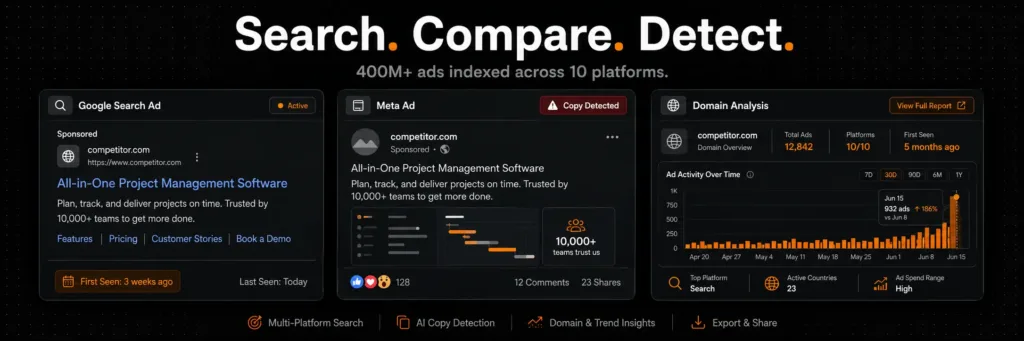
To find out if competitors are copying your ad copy, search your exact headline phrases and offer language in AdSpyder’s Ad Library. Compare first-seen dates against your own campaign launch dates. Then check their landing pages using AdSpyder’s Landing Page Analysis for replicated angles, proof structures, and offer mechanics. If three or more elements match and the competitor’s ad appeared after yours, you are looking at a copy pattern — not coincidence. AdSpyder indexes 400M+ ads across 10 platforms so you can run this check in minutes.
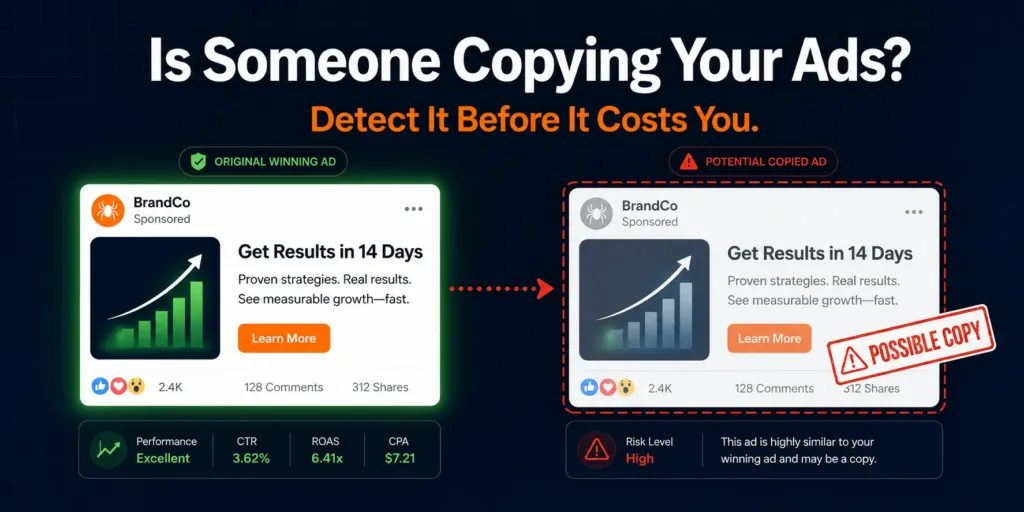
You spent weeks testing ad variants. One headline broke through — ROAS jumped, CPAs dropped. Six weeks later a competitor is running the same offer angle, the same urgency hook, and a landing page that mirrors your layout almost line for line.
This is not a coincidence. It is a documented, repeatable pattern in DTC and eCommerce paid search. Most brands discover it by accident — if at all. This guide gives you a concrete detection workflow: what gets copied, how to find it, how to classify it, and how to stop it from happening again.
The same problem now has a legal dimension too. In May 2026, the Delhi High Court’s landmark ruling in Hindware Ltd. vs Google LLC permanently restrained Google from allowing competitors to bid on the HINDWARE trademark as a keyword — ruling that even invisible backend keyword use constitutes trademark infringement under India’s Trade Marks Act, 1999. For Indian brands, copy theft detection is no longer just a performance marketing issue. It is a brand protection and legal risk issue.
400M+
Ads indexed across 10 platforms
Searchable archive to find copies across Google, Meta, TikTok, Shopping, YouTube and more.
56.4%
Branded-intent Ad Library searches
More than half of AdSpyder searches are direct brand or domain lookups. Your competitors are watching.
8,663
Active competitor tracking projects
Monitoring 3,687 distinct competitor brands for creative changes and new ad launches.
13.1%
Non-brand ad share on major brands
Across 8.5M brand-in-title Google Search ads from 25 major auctions, 13.1% come from competitors.
Source: AdSpyder platform data, June 2026.
Table of Contents
Why Competitors Copy Winning Ad Copy — and How Fast They Do It
Ad intelligence tools exist on every media buyer’s desk in a competitive DTC market. Your competitors are not browsing your ads manually — they are running systematic domain searches using the same category of tools you are reading about right now. And more than half of all searches inside AdSpyder (56.4%) are direct brand or domain lookups. Your creative is visible to them the moment it starts running.
The trigger is predictable: an ad that keeps running. When a new creative stays live for more than 21 days, experienced media buyers read it as a profitability signal. If you are still spending on the same creative after three weeks, it is almost certainly working. That creative becomes a target.
PPC specialist note: The longer your ad runs unchanged, the more visible your winning angle becomes. That is why brands need creative monitoring, not just campaign reporting. This detection gap also has a legal dimension — the Delhi HC’s Hindware vs Google ruling (May 2026) confirmed that even invisible keyword-level brand bidding constitutes trademark infringement in India. Detecting copying early gives you the evidence you need to act.
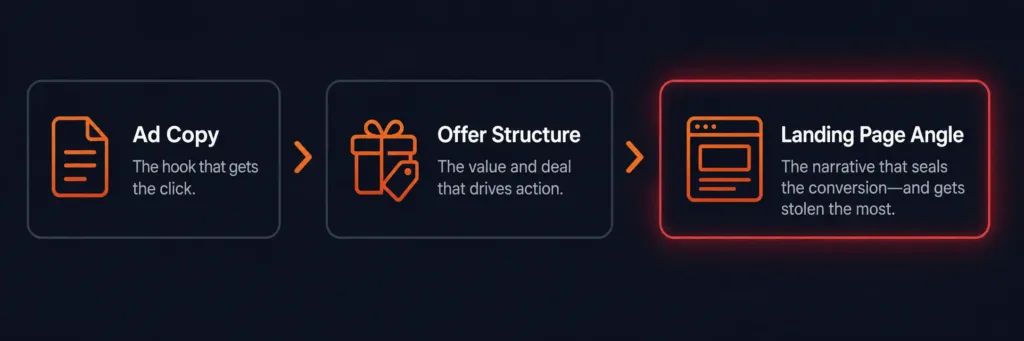
The Three Layers of Ad Theft — and Why the Third Is the Most Damaging
Most marketers assume ad copy theft means verbatim plagiarism — someone lifts your headline word for word. That happens, but it is the easiest to catch. The harder-to-detect forms operate at the structural level and damage your conversion rate, not just your click volume.
Ad Copy Layer
What gets copied: Your headline formula (“X in Y days without Z”), offer framing, and urgency trigger.
Detection: Exact phrase search in AdSpyder’s Ad Library.
Offer Layer
What gets copied: Your bundle composition, discount mechanics, free-gift trigger, subscription framing — not just the price point.
Detection: Domain search filtered by offer-related keywords.
Landing Page Angle
What gets copied: Hero headline, opening proof mechanism, benefit-bullet sequence, offer block, and CTA pattern.
Detection: AdSpyder’s Landing Page Analysis — compare destination URLs.
Why Layer 3 is the most damaging: When a competitor mirrors your page’s proof mechanism and benefit sequencing, searchers see two apparently equal offers. Your differentiation collapses at the moment of decision — and you typically cannot tell why your conversion rate is declining. This is the layer most brands never check.
What Counts as Copying vs Normal Competitor Inspiration?
Not every similar ad is theft. Brands in the same category often use similar phrases because they sell to the same audience. The strongest copying signal is not one shared word — it is repeated similarity across headline, offer, creative, landing page angle, and timing.
| Signal | Normal Inspiration | Possible Copying |
|---|---|---|
| Headline | Uses a common category promise | Uses your specific phrase structure, word order, and emotional hook |
| Offer | Runs a standard discount | Copies your exact bundle, threshold, guarantee, or urgency frame |
| Creative | Uses similar category visuals | Copies layout, before-after framing, or testimonial style and sequence |
| Landing page | Has similar product benefits | Mirrors your headline angle, objection flow, CTA order, and offer explanation |
| Timing | Competitor already ran this type of ad | Competitor’s new creative appeared 2–4 weeks after your winner launched |
Find copied ads before they steal your leads
Search 400M+ ads across Google, Meta, TikTok, Shopping, YouTube and 5 more platforms. See first-seen dates, landing page URLs, and full competitor ad history from one interface.
Step 1 — Build Your Ad Fingerprint Before You Start Monitoring
You cannot detect copying without a documented baseline. Before running any searches, record your current winning creative elements. This is your detection reference — without it, you will waste time investigating coincidental overlaps.
Copy elements to document
- Your top 3–5 headline formulas (exact wording)
- Your core offer language — bundle names, price anchors, discount trigger phrasing
- Your primary urgency phrase
- Your strongest social proof hook
- Your CTA verb and outcome pairing
Landing page elements to document
- Hero headline angle and sub-headline
- Opening proof mechanism — before/after format, stat presentation, testimonial layout
- Benefit-bullet structure and order
- Offer block — bundle structure, price display, guarantee framing
- Primary CTA placement and wording
Step 2 — Search the Ad Archive Using Three Query Types
With your fingerprint documented, run three types of searches in AdSpyder’s Ad Library. Each catches a different kind of copying.
Exact phrase search
Take your top headline verbatim and search it in the Ad Library. Set the platform to Google or Meta. Any result not from your own domain is a direct copy candidate.
What to look for: Your exact phrasing in a different advertiser’s headline. Also check slight word swaps on the same sentence frame — “30 days” instead of “60 days” is still your formula.
Domain-level search on top 3–5 competitors
Use URL/Domain Analysis to pull each competitor’s recent ad history. Sort by most recent and look at the past 60 days. Are any new creatives structured like your current winners?
What to look for: A pattern of creative pivots that correlates with your winner’s launch date. A competitor who started running a new angle 3–5 weeks after your ad went live — that timeline is meaningful.
Offer keyword search
Search your specific offer mechanics: the bundle name if unique, the exact discount phrase, the free-gift name. This catches offer theft even when the headline copy has been reworded.
What to look for: A competitor running an offer with an identical mechanic — same bundle size, same buy-X-get-Y ratio — launched after yours was visible in the archive.
Which platforms to check — and what AdSpyder indexes
| Platform | Ads Indexed | DTC Priority | AdSpyder Tool |
|---|---|---|---|
| Google Search | 164M+ | High | Google Ads Spy |
| Meta (Facebook + Instagram) | 55M+ | High | Facebook Ads Spy / Instagram Ads Spy |
| Google Shopping | 94M+ | High | Shopping Ads Spy |
| Amazon | 21M+ | High | Amazon Ad Library |
| TikTok | 3M+ | Medium | TikTok Ad Library |
| YouTube | 2.4M+ | Medium | YouTube Ads Spy |
| Display | 17M+ | Lower | Display Ads Spy |
Source: AdSpyder platform data, June 2026.
Step 3 — Audit the Landing Page Angle, Not Just the Ad
Finding a copied ad headline is step one. The more damaging theft typically happens on the landing page — and it is the layer most brands never check. A competitor who mirrors your proof mechanism and benefit sequencing competes with your conversion rate, not just your click-through rate.
Use AdSpyder’s Landing Page Analysis to pull the destination URL from any suspicious competitor ad and compare it against your own page using this five-point framework.
| Page Element | Signal of copying | Severity |
|---|---|---|
| Hero headline angle | Same outcome promise, similar phrasing — even if exact words differ | High |
| Opening proof mechanism | Same format — before/after image, identical stat presentation, matching testimonial layout | High |
| Benefit bullets | Same benefits in the same order with similar phrasing | Medium |
| Offer block | Same bundle structure, crossed-out price mechanic, or free-gift positioning | High |
| CTA wording + placement | Same verb-outcome pattern — “Start my transformation” vs “Start your transformation” | Medium |
The 3-out-of-5 rule: If a competitor’s page matches your fingerprint on 3 or more of the 5 elements above — and their page went live after yours — you are looking at structural imitation, not category convention. One or two overlapping elements is normal in most verticals. Three or more pointing back to your specific fingerprint is the threshold.
Step 4 — Classify the Copy Theft and Choose Your Response
Not every instance of competitor copying warrants the same response. The right action depends on the type and severity of the imitation. Use this classification before sending any legal notice or platform complaint.
| Copy type | What it looks like | Recommended action |
|---|---|---|
| Verbatim copy | Your exact headline or offer copy lifted with minimal alteration. First-seen date in AdSpyder is after your launch. | Export AdSpyder evidence (ad copy, domain, dates). File a platform complaint. Involve legal if trademarked language is involved. Act fast — audience confusion accumulates. |
| Structural imitation | Same formula, different words. Same page structure, different images. Matches 3+ fingerprint elements. Most common type. | Creative velocity is your fastest defence. Retire the angle and launch a differentiated replacement within 2 weeks. Go deeper with messaging they cannot replicate — proprietary data, founder story, specific customer outcomes. |
| Coincidental overlap | Competitor was already running similar copy. One or two shared elements from category conventions. | Monitor and move on. Document for future comparison. Focus on differentiating your offer, not your copy format. |
Step 5 — Set Up Ongoing Monitoring So You Catch It Early
A one-time search tells you the current state. A monitoring routine tells you when something changes. There are 8,663 active competitor tracking projects inside AdSpyder, monitoring 3,687 distinct competitor brands — the majority watching for exactly this kind of creative activity.
Weekly — creative scan
Run a domain search on your top 3 competitors. Sort by most recent. Look at new ads from the past 7 days. Any creative that mirrors your current fingerprint — document the timeline immediately.
Monthly — category scan
Search your core offer phrase across the full category — not just known competitors. Copy thieves are not always the brands you track. A fast-growing new entrant may run your angle before you know they exist.
After every new winner
The moment you identify a new creative winner, run a baseline phrase search in AdSpyder. This gives you a clean timestamp — and tells you whether your angle is already in use before you scale spend behind it.
The archive date advantage: AdSpyder records the first-seen date for every ad in the archive. This means you can establish a documented copying timeline: your ad launched on date X, the competitor’s near-identical ad appeared on date Y. That timeline is your evidence baseline for a platform complaint — and for Indian brands, for a legal notice citing the Hindware vs Google ruling.
Manual Tracking vs AdSpyder — What Each Actually Gives You
You can manually check competitor ads through Google’s Transparency Center or Meta’s Ad Library, but both have significant limitations for copy theft detection.
| Detection Task | Manual / Free Tools | With AdSpyder |
|---|---|---|
| Search by exact phrase across all advertisers | Limited or not available | Yes — full text search |
| See first-seen / last-seen dates | Partial on Meta, not on Google | Yes — exact dates, multi-year archive |
| Full competitor domain ad history | Current only, single platform | Full archive, multi-platform |
| View landing page for each ad | Not available | Yes — Landing Page Analysis |
| Cross-platform monitoring in one interface | Separate tools per platform | All 10 platforms, one search |
| Structured ongoing competitor tracking | Not available | Yes — 8,663 active projects |
Ad Copy Theft Detection Checklist
Run this every time you suspect a competitor has copied your creative, and as part of your monthly monitoring routine. Before taking any external action, confirm these points:
Before you take action, confirm these:
- Your original ad copy, offer, and landing page elements are documented with launch dates.
- You have run an exact phrase search for your top 3 headlines in AdSpyder’s Ad Library.
- You have done a domain search on your top 5 competitors sorted by most recent.
- You have compared competitor ad first-seen dates against your own launch dates.
- You have pulled competitor landing page URLs via AdSpyder’s Landing Page Analysis.
- You have compared the competitor’s landing page against your 5-point fingerprint checklist.
- You applied the 3-out-of-5 rule — 3 or more matching elements = structural imitation, not coincidence.
- You have classified the copy type: verbatim, structural, or coincidental.
- You have screenshots with the advertiser domain and first-seen date clearly visible.
- For verbatim copy: a platform complaint has been filed with your documented evidence timeline.
- For structural imitation: a differentiated replacement creative is planned for the next 2 weeks.
- The offending domain has been added to a Competitor Tracking project in AdSpyder.
Stop guessing who is copying your ads
Use AdSpyder to search competitor ad copy, compare landing page angles, check first-seen dates, and catch copied offers before they weaken your funnel. Start with a free search today.
FAQs
How do I know if a competitor is copying my ad copy?
Search your exact headline phrases and offer language in AdSpyder’s Ad Library. Compare first-seen dates against your own launch dates. If multiple elements match — headline structure, offer mechanics, landing page angle — and the competitor’s ad appeared after yours, you are looking at a copy pattern, not coincidence.
Is copying ad copy illegal?
General campaign angles and structures are not protected. Verbatim reproduction of trademarked slogans or copyright-protected copy may be actionable. In India, the Delhi HC’s Hindware vs Google ruling (May 2026) has also strengthened brand keyword protections significantly — even invisible keyword-level brand bidding now constitutes trademark infringement. Consult an IP attorney for specific cases.
Can competitors copy my offer structure?
Competitors can run similar discounts, but copying your exact bundle structure, guarantee mechanics, free-gift trigger, and urgency framing together points to deliberate imitation. Use AdSpyder’s offer keyword search to detect this at the structural level even when the ad headline has been reworded.
What is the difference between a copied ad and a trend-following ad?
A trend-following ad uses a broadly popular format — UGC-style creative, before/after hooks, testimonial sequences. A copied ad replicates your specific headline formula, offer structure, and landing page angle in combination. The test is whether three or more elements point back to your documented fingerprint specifically — not to a category convention everyone uses.
Can AdSpyder detect copied Meta and TikTok ads too, not just Google?
Yes. AdSpyder indexes 55M+ Meta ads and 3M+ TikTok ads alongside 164M+ Google Search ads. You can run phrase and domain searches across all platforms from the same Ad Library interface. In DTC, copy thieves typically mirror winning creative across channels simultaneously — so multi-platform checks are important.
Should I contact the competitor directly if they copied my ad?
Not immediately. First collect evidence — screenshots from AdSpyder showing the copied ad, the advertiser domain, and first-seen dates relative to your launch. Classify the issue as verbatim copy, structural imitation, or coincidental overlap. For verbatim copy involving trademarked language, file a platform complaint or consult a legal team first. Unilateral direct contact without a clear legal basis can complicate matters.