Twitter / X Ad Library
Quick Answer
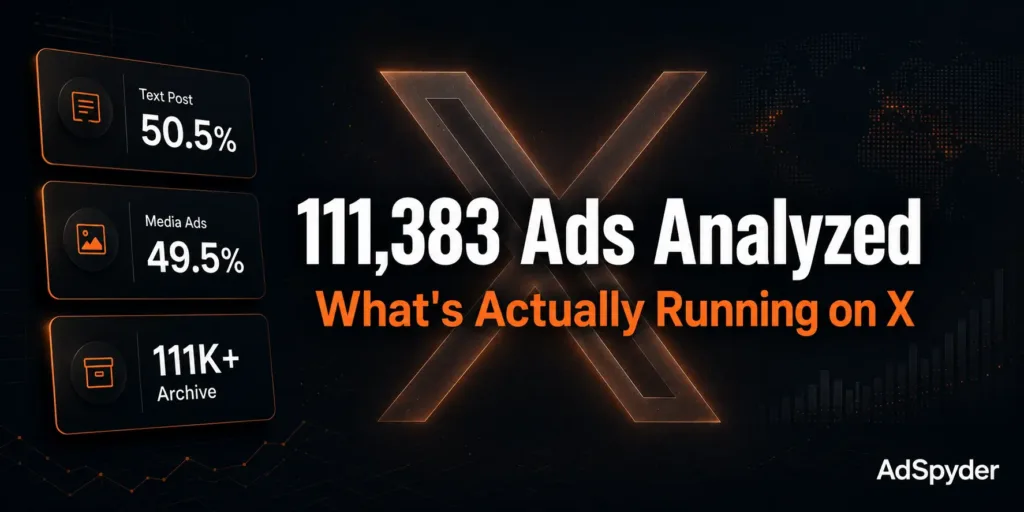
X has one native ad unit — the Promoted Tweet. Every ad is a tweet-style post; the variation is what is embedded: text, image, video, GIF, or link card. AdSpyder’s Twitter Ad Library analyzed 111,383 ads from October 2022 through December 2024 and found X advertising splits almost evenly: 49.5% of ads embed media, 50.5% are text-only — a finding no competitor blog has quantified from actual archive data.
Most Twitter/X ad format guides recycle the same spec sheets. They list image sizes and video lengths — but none tell you what advertisers are actually running at scale, which industries use which creative approaches, and why format choice depends almost entirely on your vertical.
AdSpyder’s X archive covers the complete Musk era: from the acquisition in October 2022 through December 2024. That is 111,383 real ads, 100+ countries, and brands including Apple, HBO Max, Bybit, Mercado Livre, and thousands more. This is pattern analysis from actual ad data — not what X’s ad team says is possible.
Data note
AdSpyder’s measured X archive covers October 2022 through December 2024. Format planning context (carousel, vertical video, and so on) reflects X’s current ad documentation. Archive-derived stats are clearly labeled throughout.
In This Article
AdSpyder Original Data
What the X Archive Actually Shows
The most useful format question for X ads is not “image vs video vs carousel.” It is simpler: does the ad include media or not? That is the real strategic fork on this platform — and the only split the archive can cleanly measure.
111,383
X ads analyzed
Archive coverage: Oct 2022 to Dec 2024.
49.5%
Media-embedded ads
Based on 5,000-ad sample with t.co media signals.
50.5%
Text-only promoted posts
Strong signal that copy-first ads work at scale on X.
Source: AdSpyder platform data, June 2026. X/Twitter archive: October 2022 to December 2024. Sample n=5,000.
That near-even split is genuinely useful. It tells you X is not a visual-first platform the way Instagram or TikTok are. Half the advertisers — including some of the largest brands in the archive — run pure-text ads and win with copy alone. Most media buyers assume they need polished video to perform on X. The archive says otherwise.
How to read this data
A t.co signal can represent an image, video, GIF, or external link card. It is accurate to say nearly half the sampled ads had embedded media. Publishing a separate image/video/carousel percentage is not possible from this schema without a media-classification pass — that is the honest limit of the data, and it is still more than any competitor guide has.
Twitter Ad Library
See competitor X ads before your next campaign.
Search 111,383 archived X ads by keyword, domain, or advertiser handle. Filter by country and date. See what creative actually ran.
X Has One Ad Format — Everything Else Is a Variation
This trips up media buyers coming from Meta or Google. On those platforms you choose a format — carousel, collection, responsive display — and the platform renders it differently. X does not work that way.
Every X ad is a Promoted Tweet. That is the only ad unit in the system. What varies is what you embed inside it: text only, a single image, a video, a GIF, or a link preview card. X Ads Manager labels like “Promoted Video” or “Website Card” are presentation wrappers on the same underlying Promoted Tweet. In archive data and competitive intelligence tools, what you are always looking at is tweet content plus embedded media.
Why this matters for research
Because the archive does not classify “carousel” or “vertical video” as separate format fields. Those distinctions exist in the X Ads Manager UI but not in the underlying ad data. What the archive can measure is the media/text split, advertiser patterns, copy approaches, and creative hooks. That is what this article focuses on.
The Main X Ad Creative Formats: A Practical Guide
For day-to-day media buying, think in five practical creative buckets. These are not X’s official product names — they are how actual advertisers approach the format decision.
1. Promoted Text Posts
Text posts work when the message itself is the hook: a sharp opinion, a timely offer, a useful insight, a direct question. In AdSpyder’s archive, text-only posts were 50.5% of sampled X ads — not a fringe tactic, but a mainstream one. Use this when your copy can stand alone. Especially effective for B2B SaaS, finance, newsletters, and thought-leadership campaigns where the opening line does the heavy lifting.
2. Image Ads
Image ads work when the product, offer, or result needs visual support. E-commerce brands use them for product shots and price-led creatives. SaaS brands use them for dashboard screenshots and feature cards. Consumer electronics brands use them for hero shots and launch visuals. The image should make the message easier to understand — not decorate it. An image that only repeats the tweet copy without adding context is wasted space.
3. Video Ads
Video works when motion explains the product better than a static frame: app demos, game clips, entertainment trailers, event highlights, tutorials. Keep the first two seconds branded and clear without sound — 80% of video views on mobile are silent. If the first two seconds do not show the value, the rest of the video does not matter.
4. Carousel Ads
Carousels help when one card is not enough: multiple products, multiple benefits, feature steps, plan comparisons, or a story sequence. The mistake is using carousel because it looks richer. Every card should add a reason to click. If each card repeats the same message, a single image works better.
5. Vertical Video
Vertical video is built for full-screen mobile attention. It fits entertainment, gaming, apps, live events, and creator-style campaigns. Do not use it by cropping a horizontal ad. A strong vertical video feels native to mobile — not like a resized desktop asset.
Format Comparison: Which to Use When
| Format | Best For | Check Before Launching | Avoid When |
|---|---|---|---|
| Promoted text post | Thought leadership, quick offers, news-led campaigns | Opening hook, clarity, timing, reply potential | The product needs visual explanation to make sense |
| Image ad | Product shots, offer cards, feature screenshots | Visual clarity, offer visibility, readable on mobile | The image just repeats the copy without adding context |
| Video ad | Demos, trailers, gameplay, app flows, product reveals | First 2 seconds, captions, pacing, CTA timing | The story can be told faster with one image |
| Carousel ad | Multiple products, feature sequences, comparisons | Card order, card-level message, reason to swipe | All cards say the same thing in different ways |
| Vertical video | Mobile storytelling, entertainment, events, creator-led ads | Native vertical framing, sound-off clarity, motion hook | The asset is just a cropped horizontal video |
Industry Format Patterns: Which Verticals Use Which Creative
The most useful insight from the archive is not the overall split — it is that format choice on X is almost entirely industry-driven. A SaaS company and a streaming platform should not copy the same X creative structure just because they are buying ads on the same platform.
| Industry | Brands in Archive | Typical Creative Approach | Format Direction |
|---|---|---|---|
| Streaming / Entertainment | HBO Max, Paramount+, Prime Video, Globoplay | Trailers, show clips, still images from new releases | Video ad + vertical video |
| Crypto / Web3 | Bybit, Bitget, Immutable, Chainlink | Text-heavy threads + image cards showing trading interfaces and fee structures | Text post + image ad |
| Consumer Electronics | Apple, Xiaomi, Samsung Brasil, Motorola India | Product reveal images, short product videos, hero shots with feature callouts | Image ad + video ad |
| Gaming | Hero Wars, DITOGAMES, PokerStars Brasil, GoblinzPub | Gameplay clips, screenshot cards, GIF loops | Video ad + image ad |
| E-commerce | Mercado Livre, Nordace, Canles, Karma Shopping | Product-focused imagery with offer and discount text in the tweet copy | Image ad + carousel |
| B2B SaaS | HPE, Aspose, Shortwave, Affinidi | Text-led thought leadership, product UI screenshots, links to long-form content | Text post + image ad (screenshot) |
| Finance / Sports Betting | Interactive Brokers, CAIXA, Betfair, FDSportsbook | Offer numbers, trust signals, match-tied creative for sportsbooks | Text post + image card |
Source: AdSpyder platform data, June 2026. Directional observations from manual review of top-advertiser samples — not quantified frequency counts.
Visual-product industries go media-heavy; thought-leadership industries go text-first. B2B SaaS brands treat X like Twitter was always designed — fast-moving ideas where a strong text hook and a link to depth outperforms a polished video. Gaming and streaming are the opposite: their audiences are on X for entertainment, so video and clips fit the context better than paragraphs.
Crypto is the interesting outlier. Text-heavy thread-style ads build community and credibility; image cards with fee comparisons drive direct acquisition. It is one of the few verticals running two different creative approaches for two different objectives simultaneously. Verify this directly in AdSpyder’s Twitter Ad Library by searching by brand.
6 Recurring Creative Hooks Across the Archive
Format (text vs media) is the first-level choice. Inside that, six creative hook patterns repeat across industries. These are the structural approaches advertisers keep returning to:
Short Product Hook + Link
A single punchy line about the product, followed by a link. The tweet copy does the selling; the link handles conversion. Used heavily by e-commerce and consumer electronics brands. Pattern: “[Product name]. [Core benefit]. [Link].”
Event-Tied Creative
Ads anchored to a live event — a sports match, TV premiere, cultural moment. Mercado Livre’s #BBB23 campaign (Brazil’s Big Brother tie-in) is a standout example. Prevalent among Latin American advertisers and reflects X’s real-time conversation strength.
Offer / Bonus Lead
The number is the headline. Sportsbooks, fintech, and crypto brands use this for direct-response: “100% deposit bonus up to X,” “0% fee for first 30 days.” Lead with the incentive, then the mechanics.
Product UI Screenshot
A screenshot or diagram of the actual product interface paired with brief explanatory copy. B2B SaaS brands (HPE, Aspose, Shortwave) rely on this. If the UI looks clean and the feature makes sense in a glance, the click is more qualified.
News / Headline-Style Tweet
A declarative statement written like a news headline, linking to a longer piece. Media brands (Bloomberg, AlGhad TV, beIN Sports) use this as their default. It does not look like an ad — which is exactly why it works in an environment where users are already reading fast.
Visual Gameplay / Show Clip
Short video clips from games or streaming shows used as the entire creative. Gaming brands (Hero Wars, GoblinzPub) and streaming platforms (Prime Video Brasil, HBO Max) depend on this. The media is the ad — copy is minimal, usually just a CTA or release date.
Practical takeaway
Before writing your next X ad, check which hook pattern your direct competitors are using. If they are all running offer-lead copy, there is an opening to differentiate with a UI screenshot or a news-style hook. AdSpyder’s Twitter Ad Library lets you search by advertiser domain to pull their exact creative history.
The Brazil Effect: Why Geography Shapes Format Choice
One finding from the archive that surprises most media buyers: Brazil accounts for 31.1% of all ads in AdSpyder’s X archive — over three times the US share at 10.3%. India is second at 12.0%, Turkey third at 11.0%.
31.1%
Brazil — 34,616 ads
12.0%
India — 13,317 ads
11.0%
Turkey — 12,283 ads
10.3%
United States — 11,507 ads
6.8%
Argentina — 7,521 ads
Source: AdSpyder platform data, June 2026. X/Twitter archive: October 2022 to December 2024.
This Latam-heavy distribution shapes what “X ad formats” look like in aggregate. Brazilian advertisers — streaming platforms, Mercado Livre, sportsbooks, consumer brands tied to major TV events — skew toward media-rich, event-tied creative. For Indian advertisers, the archive shows performance-first, offer-led copy rather than brand storytelling.
If you are looking at X benchmarks from US-focused studies, you are looking at roughly 10% of actual platform activity. Filter by country in AdSpyder’s Twitter Ad Library to pull market-specific creative.
How to Use AdSpyder’s Twitter Ad Library for Creative Research
The best approach is not to copy one competitor. Compare many active and historical ads, group them by creative pattern, and identify what your category keeps repeating. Here is the workflow:
Search by competitor domain
Enter your competitor’s domain in the domain/handle search. You will see every archived ad they have run on X — their full creative history from October 2022 onward. For broader research, use the main ad library to compare patterns across platforms.
Filter by country
X creative behavior changes significantly by market. The Country Filter lets you isolate market-specific patterns — a brand in India may use entirely different messaging from its US campaigns.
Search by keyword
Search a keyword appearing in competitor tweet copy to find how brands in your category frame offers, feature claims, or CTAs across the full archive.
Use the date range filter
Narrow to specific windows to spot seasonal creative patterns, campaign bursts around product launches, or how creative evolved over time for a specific advertiser.
Click through to the original X post
Each result card links to the original x.com post. Check engagement signals and replies to judge whether a format actually resonated or just ran. Use landing page analysis to check whether the ad promise matches the post-click experience.
Manual Research vs AdSpyder Twitter Ad Library
| Task | Manual X Research | With AdSpyder |
|---|---|---|
| Find competitor ads | Depends on what appears in your feed or manual profile checks | Search by advertiser, keyword, domain, country, and date |
| Compare creative patterns | Screenshots and manual spreadsheet notes | Review copy, visuals, advertiser names, and last-seen signals in one workflow |
| Historical archive | Not available — only live posts visible | Oct 2022 to Dec 2024 archive — 111,383 ads |
| Build creative tests | Guesswork from visible posts | Use repeated competitor patterns to plan text, image, and video test angles |
| Cross-platform learning | Requires separate tools and manual checks per platform | Compare X with LinkedIn, TikTok, Meta, and more in one platform |
Mistakes to Avoid When Choosing X Ad Formats
Copying format without copying context
A competitor’s video ad may work because of the offer, timing, audience, or brand trust — not because it is video. Check the full picture before copying the format.
Defaulting to media when copy can do the job
The archive shows 50.5% text-only ads. Most media buyers are biased toward visual. If your message is sharp enough, a promoted text post may outperform a polished image.
Ignoring landing-page match
If the ad promises one thing and the landing page opens with another, no format choice saves the campaign. The creative and post-click experience must align.
Treating engagement as conversion proof
Replies, likes, and reposts show attention — not revenue intent. A text post about a hot take can go viral and drive zero signups. Measure what actually converts.
Pre-Launch Creative Checklist for X Ads
✓ Chose format based on the message, not trend pressure or what looks richer
✓ Checked what hook pattern direct competitors are using in AdSpyder’s Twitter Ad Library
✓ Testing at least one text-led and one media-led variation — the near 50/50 split means both can work
✓ Confirmed country targeting and checked AdSpyder for market-specific creative patterns
✓ Tweet copy reads like a native tweet, not a banner ad transplanted into a text field
✓ If using video: communicates the point without sound in the first 2 seconds
✓ Ad copy, CTA, and landing-page headline are aligned
Find the X ad formats your competitors are actually using.
AdSpyder’s Twitter Ad Library gives you 111,383 archived X ads searchable by keyword, domain, country, and date. Study competitor creative hooks, media patterns, and copy approaches before you spend on your next X campaign.
Try AdSpyder’s Twitter Ad Library Free
Also covers: Google · Meta · LinkedIn · TikTok · YouTube · Display · Amazon and more
FAQs
What are the main Twitter/X ad creative formats?
The five practical formats are promoted text posts, image ads, video ads, carousel ads, and vertical video. X also offers Takeovers, X Live, Dynamic Product Ads, and Amplify video placements. But every ad unit is fundamentally a Promoted Tweet — the variation is what is embedded inside it.
Are promoted text posts still effective on X?
Yes — and at scale. AdSpyder’s archive analysis found 50.5% of sampled X ads were text-only. Major brands including B2B tech companies, media outlets, and crypto platforms run pure-text Promoted Tweets. X’s culture is built on fast reading and real-time conversation, which makes strong copy native to the feed in a way it is not on Instagram or TikTok. Source: AdSpyder platform data, June 2026.
Should I use image ads or video ads on X?
Use image ads when one visual can explain the product, offer, or benefit quickly. Use video when motion helps users understand the experience — demos, trailers, gameplay, app flows. If the first two seconds of your video do not communicate value without sound, a single image may be more effective.
Can AdSpyder show image vs video vs carousel percentages for X ads?
Not from the current archive schema. AdSpyder can show the media/text split (49.5% media-embedded, 50.5% text-only from a 5,000-ad sample). Exact image vs video vs carousel classification would require a separate media-type detection pass — the t.co URL system covers all of these under one signal.
How do I research competitor X ads?
Use AdSpyder’s Twitter Ad Library. Search by domain, advertiser handle, or keyword. Filter by country and date range to see exactly what creative competitors ran, when they ran it, and how copy evolved over time. Each result links to the original X post.
Why does Brazil dominate X advertising data?
Brazil has historically had one of the highest X usage rates outside the US, driven by strong engagement with live events, sports, and entertainment. In AdSpyder’s archive, Brazil accounts for 31.1% of all archived X ads (34,616 ads) — more than three times the US share. Major Brazilian advertisers including Mercado Livre, Globoplay, and Amstel run heavy event-tied creative campaigns. Source: AdSpyder platform data, June 2026.
Sources and Methodology
- AdSpyder platform data, June 2026: X/Twitter archive, 111,383 ads, October 2022 to December 2024.
- Media signal sample: 5,000 X ad records reviewed for t.co URL presence to determine media/text split.
- Industry pattern observations: manual review of top-advertiser creative samples. Directional — not classifier-counted percentages.
- Current X format names: X Business ad-format documentation at https://business.x.com/en/advertising/formats