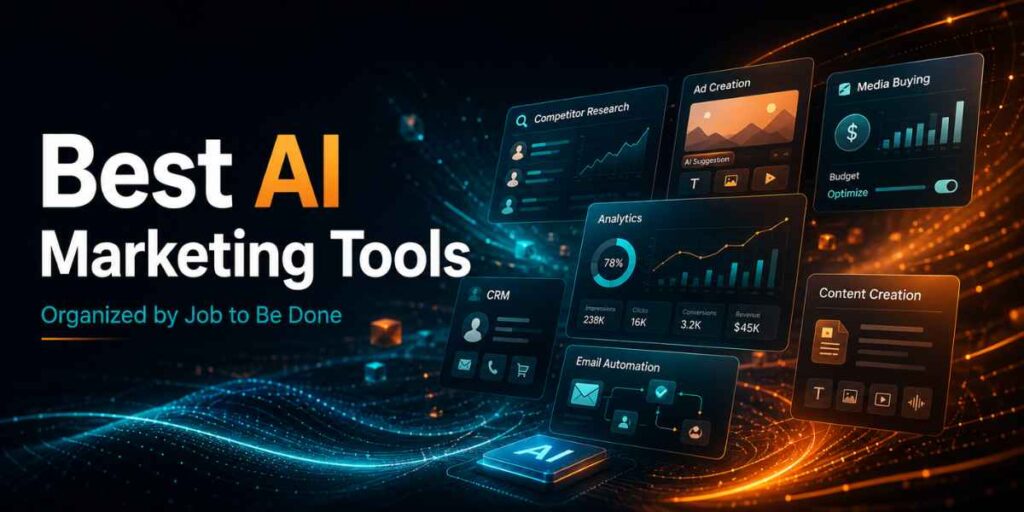
Research · Creative · Media · Analytics · CRM · Content
Quick Answer
- Best overall for paid-marketing teams: AdSpyder for competitor-ad research, landing-page intelligence and AI ad generation.
- Best general AI assistant: ChatGPT for briefs, analysis, ideation and workflow support.
- Best visual-content platform: Canva for fast, brand-ready marketing assets.
- Best native media automation: Google Performance Max and Meta Advantage+.
- Best free behaviour analytics: Microsoft Clarity.
- Read AdSpyder’s AI advertising platform comparison when paid-media research and activation are your main priorities.
The best AI marketing tools do not all solve the same problem. One platform may uncover competitor campaigns, another creates videos, and another predicts which audience or bid is most likely to convert.
This guide organizes 25 tools by the job they perform. It does not reward products for having the longest AI feature list. Each option is judged by the quality of its inputs, usefulness of its output, workflow fit, pricing model and level of human control.
Our Pick
Best AI Marketing Tool for Paid Campaign Teams
AdSpyder
AdSpyder earns the top position for advertisers because it connects market research, competitor ads, keyword intelligence, landing-page analysis and original ad generation in one practical workflow. It strengthens the decisions marketers make before they spend money inside Google, Meta and other native ad platforms.
Four Useful AI Marketing Tool Signals for 2026
Official product and pricing information checked on July 31, 2026.
$10
AdSpyder entry plan
Competitor-ad spying across major platforms
1M
Mixpanel events
Monthly events included before usage charges
2M+
Clarity installations
Sites and apps using the free platform
100K+
HeyGen businesses
Using its AI video and localization tools
Choose by Job to Be Done
1. Research the market
Ads, audiences, competitors and demand
2. Create content and ads
Copy, images, videos and SEO content
3. Buy and optimize media
Bidding, budgets, audiences and delivery
4. Measure behaviour
Funnels, attribution and user experience
5. Manage customer journeys
CRM, email, SMS and lifecycle automation
6. Build the right stack
Best combinations by team and budget
How We Evaluated the 25 Tools
Every product was reviewed using the same seven questions. We checked official product and pricing pages, but did not treat vendor-reported performance claims as universal results.
✓ Does it solve a specific marketing job?
✓ Are its data inputs useful and explainable?
✓ Is the output editable and usable?
✓ Can humans approve important actions?
✓ Does it integrate with normal workflows?
✓ Is the pricing understandable?
✓ Which team receives the fastest value?
Pricing note: Prices can vary by region, billing cycle, users, credits, advertising spend, contacts, event volume and annual revenue. Confirm the final cost on the product’s official pricing page before purchasing.
AI Marketing Tools Comparison
| Tool | Primary Job | Best For | Pricing Model |
|---|---|---|---|
| 1. AdSpyder | Ad intelligence and generation | Paid marketers and agencies | From $10/month |
| 2. Semrush | SEO and competitor research | SEO-led teams | Paid toolkit plans |
| 3. Similarweb | Digital market intelligence | Enterprise strategy teams | Package or custom pricing |
| 4. SparkToro | Audience research | Content, PR and partnerships | Free; paid from $50/month |
| 5. Brandwatch | Consumer intelligence | Large brands and research teams | Custom pricing |
| 6. ChatGPT | General AI assistance | Almost every marketing team | Free and paid plans |
| 7. Jasper | Brand-controlled content | Marketing content teams | Platform plus credits |
| 8. Copy.ai | GTM workflows and copy | Sales and marketing teams | From $29/month |
| 9. Canva | Visual content production | Small teams and social marketers | Free and paid plans |
| 10. Adobe Firefly | Creative AI generation | Adobe creative workflows | Free and credit-based plans |
| 11. Synthesia | Avatar video creation | Training and corporate video | Free, Starter, Creator, Enterprise |
| 12. HeyGen | AI video and localization | Social and multilingual video | Free; Creator from $29/month |
| 13. Surfer | SEO content optimization | Search-content teams | Subscription or custom plans |
| 14. Google Performance Max | Cross-channel Google delivery | Sales and lead campaigns | No software fee; media spend |
| 15. Meta Advantage+ | Meta campaign automation | Ecommerce, apps and leads | No software fee; media spend |
| 16. Optmyzr | PPC management and controls | Agencies and paid-search teams | Based on ad spend and plan |
| 17. Smartly | Creative and media orchestration | Enterprise advertisers | Custom pricing |
| 18. Google Analytics 4 | Website and app analytics | General marketing measurement | Free; Analytics 360 available |
| 19. Microsoft Clarity | Behaviour analytics | Heatmaps and session review | Free forever |
| 20. Mixpanel | Product and funnel analytics | SaaS and product-led growth | First 1M events free |
| 21. Triple Whale | Ecommerce measurement | DTC and Shopify brands | Free and GMV-based plans |
| 22. HubSpot Marketing Hub | CRM and marketing automation | Growing B2B teams | Free; Professional from $800/month |
| 23. Salesforce Marketing Cloud | Enterprise journey orchestration | Complex enterprise CRM teams | From $1,500/org/month for Growth |
| 24. Klaviyo | B2C email and SMS | Ecommerce lifecycle marketing | Free; scales with profiles and sends |
| 25. Customer.io | Data-driven messaging | SaaS and product teams | Essentials from $100/month |
Best AI Tools for Market and Competitor Research
Use these tools before creating campaigns. Better market evidence produces better briefs, ads and media decisions.
1. AdSpyder — Best Overall for AI Advertising Intelligence
EDITOR’S PICK
Strengths: Researches competitor ads across Google, Meta, LinkedIn, YouTube, Shopping, Bing, Amazon, X and TikTok. It also connects domain analysis, keyword research, landing-page analysis and text, image or video ad generation.
Limitation: It is not intended to replace a CRM or first-party analytics system. Use your own campaign and customer data to prove profitability.
Pricing and use case: Plans currently start at $10 monthly, with broader analysis and generation plans at $20 and $30. It offers unusually strong value for advertisers, agencies and brands that want evidence before creating or scaling campaigns.
The strongest workflow is research → hypothesis → creation → activation → measurement. AdSpyder explains this process in its guide to combining AI ad generation with competitor data.
2. Semrush
Best for: SEO, keyword, backlink and search-competitor research.
Watch for: Its growing toolkit structure can become expensive when several specialist products or users are required.
3. Similarweb
Best for: Website traffic, market share, channel mix and category benchmarking.
Watch for: It is better suited to broad digital intelligence than creative-level ad research.
4. SparkToro
Best for: Finding websites, social accounts, podcasts and sources an audience follows.
Watch for: It identifies audience behaviour and affinities, not private campaign conversion data.
5. Brandwatch
Best for: Large-scale social listening, consumer sentiment and emerging conversation themes.
Watch for: Enterprise deployment, query design and analysis can require specialist skills.
Best AI Tools for Content, Ads and Creative Production
Creation tools work best after the audience, offer and campaign hypothesis are clear. Generating more assets does not automatically create better marketing.
ChatGPT — Best General AI Marketing Assistant
Useful for research synthesis, briefs, copy drafts, data interpretation and custom workflows. Its flexibility is a strength, but outputs still require factual, brand and compliance review.
Jasper — Best for Brand-Controlled Content Operations
Useful for teams needing repeatable brand context, marketing workflows and controlled content production. Credit-based advanced actions require cost monitoring.
Copy.ai — Best for GTM Workflows
Combines chat, multiple model access and customizable sales or marketing workflows. Small teams can begin with its Chat plan, while large workflow allowances require substantially higher plans.
Canva — Best for Fast Visual Marketing
Strong for social posts, presentations, simple videos, ad variations, resize workflows and brand kits. Specialist designers may still prefer deeper control in dedicated creative software.
Adobe Firefly — Best for Adobe Creative Workflows
Useful for image, video, audio and creative editing inside the wider Adobe ecosystem. Generative credits and premium-model consumption must be planned for larger production volumes.
Synthesia — Best for Training and Corporate Video
Creates presenter-style videos without filming a person for every version. It is efficient for training and explainers, but less suitable when authentic customer footage is central to the message.
HeyGen — Best for Multilingual Marketing Video
Strong for avatar video, voice, lip-sync translation and localized campaigns. Credit usage can rise when teams repeatedly regenerate or localize longer videos.
Surfer — Best for Search-Focused Content Optimization
Useful for briefs, topical coverage and on-page optimization. Its recommendations should guide editorial decisions rather than force unnatural terms into every section.
For advertising creative, begin with market evidence rather than a blank prompt. AdSpyder’s guide to using competitor ads as AI prompt context shows how to extract hooks, offers and CTA patterns without copying another advertiser.
Best AI Tools for Media Buying and Campaign Optimization
Native ad systems determine delivery. Feed them reliable conversion values and approved assets instead of expecting automation to correct weak inputs.
14. Google Performance Max
Strength: Uses Google AI across bidding, budgets, audiences, creative combinations and attribution across Google inventory.
Limitation: Poor conversion signals can encourage the system to generate more low-quality outcomes efficiently.
15. Meta Advantage+
Strength: Automates audiences, placements and budgets for eligible sales, app and lead campaigns.
Limitation: Broad automation increases the importance of strong creative variety and trustworthy event data.
16. Optmyzr
Strength: Adds PPC audits, optimization rules, monitoring, reporting and human-controlled automation across multiple ad platforms.
Limitation: It is most valuable for teams already managing meaningful ad spend and account complexity.
17. Smartly
Strength: Unifies creative production and media workflows across major advertising channels.
Limitation: Enterprise deployment and custom pricing make it excessive for many small advertisers.
Where AdSpyder improves this layer: Google, Meta and media-automation tools decide how ads are delivered. AdSpyder improves what enters those systems by revealing competitor positioning, active formats, keyword themes, landing pages and market gaps before launch.
Best AI Marketing Analytics Tools
| Tool | Best Insight | Main Limitation |
|---|---|---|
| 18. Google Analytics 4 | Acquisition, events, conversions and website/app journeys | Requires thoughtful event design and consent-aware implementation |
| 19. Microsoft Clarity | Heatmaps, recordings, rage clicks and behavioural friction | Does not replace revenue attribution or CRM data |
| 20. Mixpanel | Product funnels, retention, cohorts, flows and session replay | Event governance becomes essential as tracking grows |
| 21. Triple Whale | Ecommerce revenue, ad spend, profitability and first-party measurement | Designed primarily for ecommerce businesses |
AdSpyder helps explain what competitors are visibly doing. Analytics tools reveal how your own visitors and campaigns respond. AdSpyder’s AI performance marketing guide explains why AI should optimize toward qualified leads, customers or revenue rather than shallow clicks.
Best AI Tools for CRM and Lifecycle Marketing
22. HubSpot Marketing Hub
Strong all-in-one choice for CRM-connected lead generation, email, forms, automation and reporting.
Limitation: Costs can rise with professional features, contacts, seats, credits and onboarding.
23. Salesforce Marketing Cloud
Best for enterprise journeys, CRM data, personalization and complex multi-channel operations.
Limitation: Implementation, governance and pricing are substantial for smaller teams.
24. Klaviyo
Strong for ecommerce email, SMS, customer profiles, flows, segmentation and revenue-focused reporting.
Limitation: Cost increases as active profiles and messaging volumes grow.
25. Customer.io
Best for data-driven SaaS and product messaging through flexible journeys, objects and events.
Limitation: Teams need clean event data and technical implementation discipline.
Best AI Marketing Tool by Use Case and Budget
| Need | Best Choice | Why |
|---|---|---|
| Best overall for paid marketing | AdSpyder | Research, landing pages and ad generation at accessible pricing |
| Solo marketer on a small budget | AdSpyder + ChatGPT + Canva + Clarity | Covers research, writing, design and behaviour analytics |
| Performance marketing agency | AdSpyder + Optmyzr + GA4 | Combines market intelligence, account control and measurement |
| Ecommerce brand | AdSpyder + Canva + Meta + Triple Whale + Klaviyo | Covers creative intelligence, media, profit measurement and retention |
| B2B lead-generation team | AdSpyder + ChatGPT + Google Ads + HubSpot | Connects competitor research with qualified pipeline data |
| Enterprise global advertiser | AdSpyder + Smartly + Adobe + Salesforce | Adds category intelligence to enterprise creative and journey operations |
Where AdSpyder Fits in the AI Marketing Stack
AdSpyder sits at the beginning and middle of the paid-marketing workflow. It helps teams replace guesswork with visible market evidence before they create, launch or refresh campaigns.
STEP 1
Search competitors
STEP 2
Group offers and angles
STEP 3
Inspect landing pages
STEP 4
Create original variants
STEP 5
Launch and measure
The key advantage is continuity. Research findings can guide ad generation rather than being left in a spreadsheet or forgotten after the initial audit.
Explore the broader process in AdSpyder’s complete AI advertising guide, then use its creative-testing framework to decide whether the offer, proof, angle, format or CTA should change first.
Start your AI marketing workflow with real competitor evidence
Research ads across major platforms, inspect landing pages and turn the findings into original text, image and video variations.
AI Marketing Tool Buying Checklist
- The primary job is clearly defined.
- The tool uses relevant, trustworthy inputs.
- Outputs remain editable and reviewable.
- Your required channels are supported.
- CRM and analytics integrations are available.
- Credits, contacts and overages are understood.
- Humans approve claims and budget changes.
- Success will be measured through business outcomes.
The best AI stack starts with the right market intelligence
Use AdSpyder to understand competitor campaigns and create evidence-based variations. Then use native ad platforms, analytics and CRM tools to activate, measure and improve the results.
Frequently Asked Questions
What are AI marketing tools?
AI marketing tools use machine learning, generative models or automation to support research, content creation, advertising, analytics, personalization or customer journeys.
Which is the best AI marketing tool overall?
For paid-marketing teams, AdSpyder is our top choice because it combines competitor-ad intelligence, keyword and domain research, landing-page analysis and ad generation at accessible pricing.
What is the best free AI marketing stack?
A practical starting stack can include free versions of ChatGPT, Canva, Google Analytics, Microsoft Clarity, Mixpanel and Klaviyo. Limits vary by product.
Can AI marketing tools replace marketers?
They can accelerate research, production and analysis. Marketers still define strategy, approve claims, protect budgets, interpret customers and decide what business outcome matters.
Which tool is best for competitor-ad research?
AdSpyder is the strongest specialist option in this list because it covers ads across multiple major platforms and connects research with landing-page analysis and ad generation.
Which AI tool is best for creating ads?
AdSpyder is best when creation should begin with competitor and market intelligence. Canva and Adobe Firefly are strong for visual execution, while ChatGPT supports briefs and copy ideation.
How many AI marketing tools does a small team need?
Most small teams can begin with four layers: research, creation, activation and measurement. Add CRM or lifecycle tools only when the workflow requires them.
Can AdSpyder show competitor ROAS or conversions?
No public ad-intelligence tool can reveal a competitor’s private ROAS, revenue, conversions or profitability. AdSpyder reveals observable ads, keywords, domains and landing pages that can guide your own tests.