Quick Answer
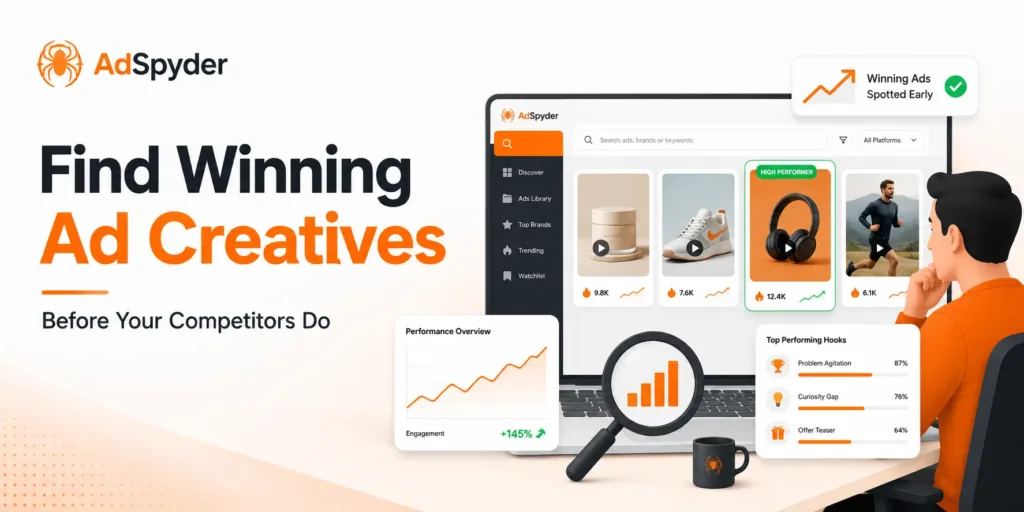
To find winning ad creatives before your competitors do, filter by longevity — not recency. Ads running 14+ days with multiple active variations are being scaled, not tested. Use AdSpyder’s Ad Library to search across 400M+ ads on 10 platforms, spot these patterns early, and extract hook structures before they saturate your market.
Most creative research happens too late. You scroll through the Meta Ads Library, screenshot what looks good, and by the time you’ve built a version of it, that hook has already been seen by your audience 40 times from four different brands.
This guide is about getting there earlier. There are specific, observable signals that predict a winning creative in its first 3–14 days — before it scales, before your competitors copy it, and before it stops being an edge. Once you know what to look for, spotting them takes under 20 minutes.
What makes this different from every “best ad creatives” list you’ve read: those posts describe winners after they’ve won. This one shows you how to find them while they’re still winning. Data and signals in this guide are current as of May 2026 — we update this when platform behaviour shifts materially.
400M+
Ads indexed
AdSpyder platform data, May 2026
10
Platforms covered
AdSpyder platform data, May 2026
8,600+
Competitor tracking projects
AdSpyder platform data, May 2026
88K+
Ad Library searches run
AdSpyder platform data, May 2026
400M+ ads. 10 platforms. One search.
AdSpyder indexes every creative signal you need to get ahead — before your competitors see it.
In This Guide
What Makes an Ad Creative “Winning”?
A winning ad creative is not one with strong design. It’s a creative that earns enough attention to survive testing, matches its offer, and gives the media buyer confidence to increase spend. A lot of beautiful ads die after 4 days. A lot of ugly ones run for 60.
For media buyers and founders, the goal is not to copy a competitor’s best performing ad creatives. The goal is to understand why it works — what customer pain it targets, what format it uses, what proof it deploys — and turn that understanding into a new test for your own brand.
The working definition
A creative is worth studying when it shows signs of repeated investment: longer runtime, multiple versions, similar hooks across variations, cross-platform presence, or strong landing page alignment. Any one of those is a signal. More than one is a system.
Why Most Creative Research Happens at the Wrong Time
The standard workflow: a competitor’s ad goes viral, someone screenshots it, your creative director builds a version, and you launch three weeks later into a market that’s already fatigued on that hook. You’re not competing — you’re catching up.
Most marketers study what’s already won. They look at polished “top-performing ads” lists and competitor creative that’s been running 60+ days. By that point, the audience has seen it, the algorithm has deprioritized it, and the insight that made it work is table stakes.
There’s a second problem: platform-blind research. Most creative intelligence stays on Meta because the Ads Library is free. But your competitors run different creative on TikTok, test hooks on YouTube, and sometimes launch their best-performing concepts on Google Display before Meta. If you’re only watching one platform, you’re seeing one-fifth of the picture.
Common mistake
Sorting ad libraries by “most recent” to find fresh ideas. Recency tells you what just launched — not what’s working. The ads from 3 weeks ago that are still running? Those are your signal. The ones from yesterday are untested hypotheses.
The Longevity Signal: The Best Free Proxy for Ad Performance
You can’t see a competitor’s ROAS or CPA. But you can see one thing that tells you almost as much: how long an ad has been running. Advertisers don’t keep paying for ads that don’t convert. A creative active for 30+ days has cleared the internal performance bar of whoever is running it.
The longevity proxy gets sharper when you add a second signal: variation count. A single ad running 30 days could be a forgotten campaign nobody paused. Five variations of the same core hook running simultaneously means an advertiser found something and is actively scaling it. That combination — longevity plus variation density — is the closest thing to a public performance signal that exists.
14+ days
Minimum longevity threshold for a proven creative signal
3–5 days
Average lifespan of a test creative that doesn’t find its audience
<10%
Of video ads over 60 seconds survive 30+ days across most verticals
15–25s
Video length range with the highest survival rate in spy tool data
Sources: Adligator creative trends analysis, Feb 2026; Brandsearch Meta ad patterns study, Apr 2026
You can access this signal across 55 million+ Meta ads — indexed since 2012, newest crawl reaching April 2026 — and 3 million+ TikTok ads in AdSpyder’s archive. The 14-year Meta history is particularly valuable: you can trace the full creative evolution of any competitor and identify whether their “new” hook is actually a recycled angle from two years ago. AdSpyder platform data, May 2026.
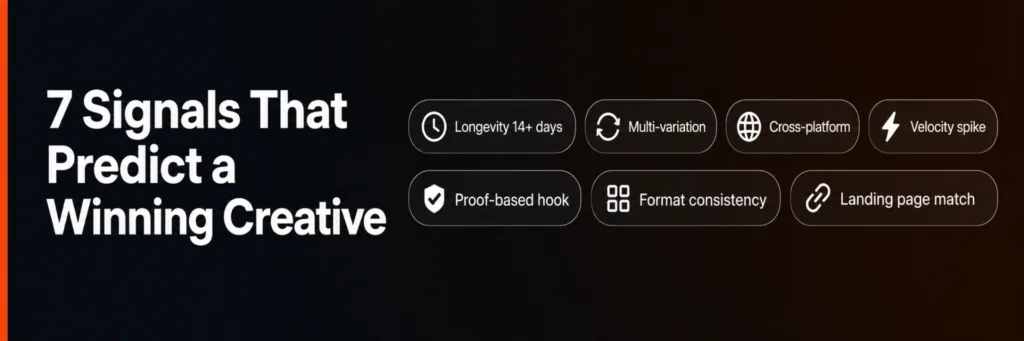
7 Signals That Predict a Winning Creative Before It Scales
Stop looking at ads as isolated examples. A single ad may be a test. A repeated pattern is a strategy. Here are the seven observable signals that indicate a creative has passed an internal performance threshold — before it shows up in any trend report.
| Signal | What It Tells You | How to Act on It |
|---|---|---|
| Ad longevity (14+ days) | Advertiser is getting enough return to justify continued spend. Ads killed in 3–5 days are failed tests. | Sort AdSpyder oldest-first. Study ads still active after 14 days, not last week’s launches. |
| Multi-variation testing on one concept | 6–12 versions of the same hook angle means they found a winner and are optimising it, not replacing it. | Count variations per advertiser. 6+ on the same concept = scaling mode, not testing mode. |
| Cross-platform migration | A hook that moves from Meta to TikTok or YouTube within the same month passed internal performance review on channel one. | Search the same domain across platforms in AdSpyder. Cross-platform presence = strong pre-scale signal. |
| Sudden creative velocity spike | A competitor jumping from 3–4 ads/week to 15 on the same theme is responding to a positive internal performance signal. | Track weekly launch rate per advertiser. A spike tells you what theme their data just validated. |
| Proof-based hook replaces aspiration | Shifting from “feel confident” to “12,000 five-star reviews” is test-data-driven. Proof-based ads convert ~14% better in competitive verticals. | Watch for structural copy shifts. Aspiration → proof = a data signal, not a rebrand. |
| Format consistency without visual repetition | Consistent format (e.g. 15–25s UGC) with genuinely different visuals = scaling mode. Meta’s Andromeda clusters identical ads — scaling advertisers must diversify visually. | Look for brands maintaining one format but varying scenarios. That’s a deliberate creative system. |
| Landing page alignment | A hook actively supported by the landing page headline and proof tells you the full funnel is working — not just the ad. | Use Landing Page Analysis to compare the ad promise with post-click experience. |
Source: AdMapix creative intelligence report, May 2026; Brandsearch Meta ad longevity analysis, Apr 2026
Why Signal 6 matters more in 2026
Since Meta’s global rollout of the Andromeda delivery system in late 2025, creative diversity has become a ranking signal — not just a testing strategy. Andromeda uses computer vision and semantic analysis to cluster similar-looking ads into a single entity. Running 100 identical ads performs no better than 10. Scaling advertisers must now produce genuinely distinct variations — which makes their intent easier than ever to spot from the outside.
Hook Patterns by Niche: What Actually Survives 30 Days
The most useful thing you can do with a large creative archive is study what hook types survive by category — not what looks good in a swipe file, but what keeps running for 30+ days, which is the only signal that spend stayed on it.
Analysis of 500+ Meta ads with 30+ day longevity shows a consistent pattern: hook survival is niche-specific, not universal. The “best practice” hooks in generic guides often have the worst survival rates in specific categories.
| Niche / Vertical | Highest Survival Hook | Lowest Survival Hook | Dominant Format |
|---|---|---|---|
| Fitness | Pain-point opener | Question hook | UGC-style video, 15–25s |
| Supplements | Authority claim (numbers, credentials) | Aspirational lifestyle | UGC-style video, 15–25s |
| Home Goods | Visual pattern interrupt | Feature list | Carousel (strong comeback 2026) |
| Beauty / Skincare | Authority claim (18% of 30d+ survivors) | Generic aspiration | Short video + static combo |
| SaaS / B2B | Problem diagnosis (specific symptom) | Feature-first descriptions | Static image or short demo |
| Fashion / Apparel | Visual pattern interrupt (61% of 30d+ winners) | Discount-first messaging | Carousel for multi-product |
Source: Brandsearch Meta ad longevity analysis, Apr 2026; AdMapix ad intelligence report, May 2026
AdSpyder Original Data — Meta Format Shift
2026 is the first year video ads outnumber image ads on Meta
Across AdSpyder’s Meta archive of 55 million+ ads, the historic split always favoured static images. That changed in 2026. Video now accounts for 50.8% of new Meta ad creatives — the first time it’s exceeded image. The trend line has been consistent: 38.6% in 2024, 47.2% in 2025, now past the tipping point.
38.6%
Video share on Meta, 2024
47.2%
Video share on Meta, 2025
50.8%
Video share on Meta, 2026 ✓
Source: AdSpyder Meta (Facebook & Instagram) Ads archive — 55 million+ ads indexed since 2012. AdSpyder platform data, May 2026.
What this means for your niche benchmark: filter for video-only ads and sort oldest-first. Any competitor who’s ramped creative output in the last 12 months has almost certainly done it in video. That’s where the surviving patterns now live.
Question hooks have the worst survival rate across almost every niche. They get clicks — people answer questions — but those clicks don’t convert. The click is curiosity, not buying intent. If a competitor switches away from question hooks, pay attention. That’s a data-driven decision.
You can validate these patterns for your specific niche using AdSpyder’s Facebook Ads Spy — filter by your category keywords, sort oldest-first, and look at what hook types the 30+ day survivors are using.
Why Cross-Platform Research Is the Real Competitive Edge
Here’s the pattern most media buyers miss: a brand often tests a new hook format on one platform before committing production budget on another. TikTok gets the raw test. YouTube gets the polished version. Meta gets the scaled version. If you’re only watching Meta, you’re at the end of that pipeline — not the beginning.
In 2026, top-spending advertisers use platform-specific creative for roughly 55% of their assets. What they run on TikTok is not what they run on Google Display, and what they test on YouTube Shorts doesn’t always make it to Meta Reels. Watching one platform gives you one perspective on a multi-platform strategy.
| Research Task | Manual / Free Method | AdSpyder Workflow |
|---|---|---|
| Find competitor ads | Search native libraries one by one. Paused ads disappear permanently. | AdSpyder Ad Library — 10 platforms, date-filterable, domain-searchable, archive from 2008. |
| Study Meta hooks | Scroll active ads manually. No longevity filter. Archive goes dark when ads pause. | Facebook Ads Spy and Instagram Ads Spy — 55M+ ads, archive back to 2012. |
| Compare video angles | Scroll social feeds manually. No cross-platform view. | YouTube Ads Spy and TikTok Ad Library — spot the same hook migrating platforms. |
| Analyse search intent ads | Google Transparency Center — no performance signal, active ads only. | Google Ads Spy, Bing Ads Spy, and Shopping Ads Spy for intent-led copy research. |
| Connect ad to funnel | Open landing pages manually, take notes in a spreadsheet. | Landing Page Analysis and URL Domain Analysis — full ad-to-page journey in one place. |
AdSpyder platform data, May 2026
The other limitation of free tools: they only show active ads. Once a competitor pauses a creative — even a high-performer retired to fight fatigue — it disappears permanently. AdSpyder’s archive goes back to 2008 for Google Search ads and 2012 for Meta, meaning you can study a brand’s full creative history and understand what concepts they’ve cycled before.
The Workflow Most People Use (And Why It’s Backward)
Here’s a finding from AdSpyder’s own platform data. We analysed two years of behaviour across 23,000+ registered users — specifically, whether people run competitor research before or after generating ad copy.
The finding: 85.6% of users who generated a text ad on AdSpyder had run zero competitor Ad Library searches before their first generation. They skipped creative research entirely. Only 14.4% did any research first. Image ad creators behave in nearly the opposite pattern — 62% researched before generating.
85.6%
of text-ad creators ran zero competitor searches before generating
62%
of image-ad creators researched competitor ads first — the opposite pattern
88K+
Ad Library searches run on AdSpyder since launch — by 6,800+ distinct researchers
Source: AdSpyder platform usage data, Aug 2025 – May 2026. AdSpyder platform data, May 2026.
The contrast is the signal. Image ad creators — typically working from a real brand with a visual identity — need to see what the market looks like before committing to a visual direction. Text-ad creators tend to generate first and treat research as validation afterward. Neither sequence is wrong. But the one who researches first has a structural advantage: they’re writing against what’s actually surviving in the market.
Practical workflow recommendation
Run 20 minutes of research in AdSpyder’s Ad Library before opening any AI writing tool or briefing your creative team. Identify the 2–3 hook structures surviving 30+ days in your niche. Then brief from those patterns. Your text ad generation and image ad generation output will be grounded in real market signals — not a blank-page guess.
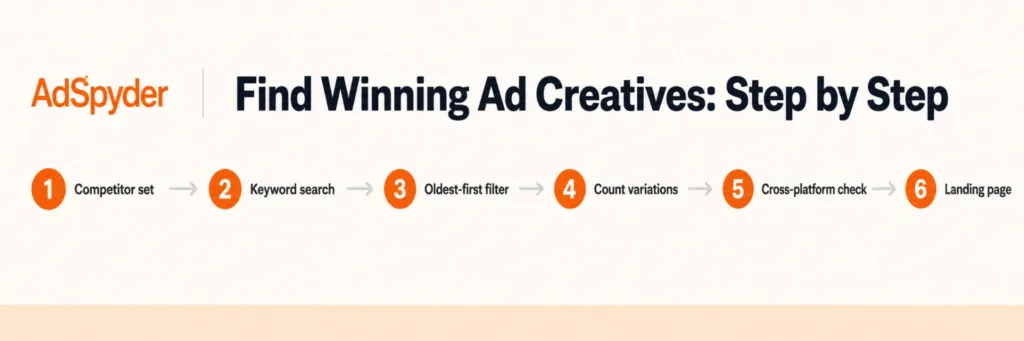
How to Find Winning Ad Creatives Using AdSpyder: Step by Step
This workflow takes under 20 minutes per competitor and produces a creative brief backed by real market signals — not a mood board.
Build your competitor set
List direct competitors, category leaders, fast-growing brands, and adjacent brands targeting the same buyer pain. A D2C skincare brand should study not just skincare competitors — but wellness, beauty, and personal-care advertisers too. Winning hook angles travel across adjacent categories before they reach yours.
Search by keyword or domain — not by ad type
Open adspyder.io/ad-library and search your niche keywords. Don’t filter by format yet — you want everything a competitor is running. Use URL/Domain Analysis to pull every ad a specific competitor domain has ever run.
Sort oldest-first and filter the 14+ day window
This is the most important step most people skip. Sorting oldest-first surfaces long-running ads — the ones advertisers have kept paying for. Filter to a 14–45 day start-date window. Recent launches (last 3–5 days) are untested hypotheses.
Count variations per concept — look for clusters
For each advertiser, count ads sharing the same core hook. 6+ variations of the same concept = scaling signal. Look at the opening line, visual treatment, and CTA. Are they testing different offers on the same hook? Different formats on the same script? That structural pattern is what you’re extracting — not the creative itself.
Run the same advertiser across platforms
Once you’ve found a winning concept on Meta, search their domain on TikTok Ad Library, YouTube Ads Spy, and Google Ads Spy. Same hook on a second platform = they’ve committed production budget to channel two because channel one performed.
Check the landing page to complete the funnel picture
An ad hook is only half the intelligence. Use Landing Page Analysis to see what page the winning creative sends traffic to. Does the landing page continue the same hook, or shift the offer? This full-funnel view tells you whether the creative is the conversion driver or just the traffic driver — a distinction that changes how you replicate the idea.
AdSpyder archive — full depth as of May 2026
164 million+ Google Search ads, 55 million+ Meta ads since 2012, 21 million+ Amazon Sponsored ads, 17 million+ Display ads, 6 million+ Bing/Microsoft ads, 3 million+ TikTok ads, 2.4 million+ YouTube ads, 1 million+ LinkedIn ads, 110,000+ Twitter/X ads — across 100+ countries. 23,000+ registered users have run 88,000+ Ad Library searches. Every creative is preserved, even after advertisers pause or delete. AdSpyder platform data, May 2026.
How This Plays Out in Practice
A media buyer preparing a DTC supplement launch
Say you’re a media buyer launching a new magnesium supplement on Meta. The obvious move is to scroll the Meta Ads Library, search “magnesium,” and save whatever looks good. You’ll find 50 ads. Most are from the last 7 days. You have no idea if any of them work.
Instead: open AdSpyder’s Facebook Ads Spy, search “magnesium sleep,” sort oldest-first, and filter to a 21–60 day window. You’ll immediately see which advertisers have kept the same creative concept running for over a month. Look at three of the top survivors — they’ll almost all have one thing in common: an authority claim hook with a specific number in the first three seconds. “9 out of 10 people over 40 are magnesium deficient.” That pattern has survived 30+ days across multiple advertisers. That’s not coincidence — that’s the market telling you what works.
Now search the same advertisers on AdSpyder’s TikTok Ad Library. If the same authority-claim format is appearing on TikTok within the last 30 days, that’s your cross-platform migration signal. The hook has graduated from test to scale. You haven’t copied a single ad — but your creative brief is now grounded in the one hook structure that’s surviving your category right now.
This is a representative scenario based on the workflow described in this guide. The AdSpyder filters and signals used here are real and available in the platform.
Building a Swipe File That Actually Improves Your Creative
Most swipe files are graveyards of screenshots. They look good in Notion. They don’t make your ads better. The reason: teams save the ad, not the structure behind it. A swipe file should be a research system — not a folder of things to copy.
Better swipe file principle
Save the idea behind the ad, not the ad itself. Your notes should say “founder-led objection handling for a high-price product” — not “copy this competitor’s founder video.” The pattern transfers. The creative doesn’t.
| Field | What to Note | Example |
|---|---|---|
| Hook type | Pain-point, authority claim, visual interrupt, demo, comparison, founder story, objection handling | “Stop wasting budget on ads no one notices.” |
| Creative format | UGC, product demo, static, carousel, testimonial, screen recording. Video length if applicable. | UGC-style video, 18s, pain-point opener, no voiceover |
| Audience pain | The specific frustration the ad speaks to — not the demographic | Media buyer needs hooks before weekly creative testing deadline |
| Proof mechanism | Data, testimonial, demo, social proof, comparison, expert credential, before/after | Shows competitor ad examples side-by-side with landing page |
| CTA structure | Direct offer, soft click, free trial, shop now, learn more | “Try free for 7 days” — direct offer, no friction |
| Longevity signal | Days running. Active variation count. Cross-platform presence. | 32 days, 8 variations on same hook, also on TikTok |
| Your test angle | How you’ll adapt the structural insight for your own brand | “Research before spend” hook for founders, using archive depth as the proof point |
Run this log weekly. After 4–6 weeks, you’ll have enough pattern data to write creative briefs from market signals rather than gut feel. The structural patterns that repeat across multiple competitors and survive 30+ days are your category’s current creative playbook.
For B2B and programmatic research, AdSpyder’s LinkedIn Ad Library and Display Ads Spy complete the picture for brands running across professional and programmatic channels.
Mistakes to Avoid When Studying Competitor Creatives
Copying the surface
Do not copy colors, scripts, actors, thumbnails, or exact wording. These are symptoms of the strategy, not the strategy itself. Study the structure behind the execution.
Trusting one ad
A single ad may be a failed test, a brand-awareness play, or a campaign someone forgot to pause. Look for repeated concepts across multiple ads and platforms before treating something as a signal.
Ignoring the landing page
Creative performance depends heavily on what happens after the click. A hook not supported by the landing page will underperform even if the creative is strong. Always review the full ad-to-page journey.
Watching only Meta
Winning ideas move across channels. Your competitors’ best hook may have started on TikTok, refined on YouTube, and arrived on Meta last. Check Twitter Ad Library and Amazon Ad Library too — some categories run aggressive creative on platforms you’d never think to check.
How Often to Run Ad Creative Research (And What to Do With It)
Ad creative research is only useful if it feeds a live testing cadence. Running it once before a launch and never touching it again is how teams end up with ad fatigue problems six weeks later — running the same hooks into an audience that’s already seen them too many times.
A sustainable competitor creative tracking routine looks like this:
| Cadence | What to Do | Output |
|---|---|---|
| Weekly | Check top 5 competitors for new ads launched in the last 7 days. Flag any new hook angle or UGC hook format you haven’t seen before. | 1–2 new creative brief ideas per week for testing |
| Monthly | Run the full longevity filter (14–45 days) across your category. Update your hook survival table. Identify if a new format (e.g. carousel, short demo) is gaining traction. | Updated category benchmark — your live ad copy research process |
| Before every new launch | Run the full 6-step AdSpyder workflow. Check the landing page. Confirm your hook type is currently surviving in the niche. Brief 3+ variations minimum. | Market-validated creative brief — not a gut-feel brief |
AdSpyder’s AI Agent for Google Ads can automate parts of this competitor monitoring cadence for search campaigns.
The point of a weekly cadence isn’t to find a brand new creative strategy every 7 days — it’s to catch the moment a competitor shifts their hook angle or doubles down on a new format. That shift is a signal. By the time it’s saturated your market, you should already have your version in testing.
Ad fatigue is almost always a research gap in disguise. The brands that refresh creatives proactively — based on market signals rather than declining CTR — rarely hit the wall that reactive teams do. The ad creative research process isn’t a project. It’s a standing operation.
Pre-Launch Creative Research Checklist
Before your next campaign goes live, run through this. Every item you can check off means one fewer blind spot in your creative brief.
✓
Reviewed at least 5–10 direct competitors’ recent ads
✓
Filtered by longevity (14+ days), not recency
✓
Checked ads across more than one platform — not just Meta
✓
Identified repeated hooks — not just attractive design
✓
Verified at least one competitor’s winning hook appears on a second platform (cross-platform signal)
✓
Compared the ad promise with the landing page — confirmed alignment
✓
Separated hook type, format, proof mechanism, offer, and CTA into swipe file entries
✓
Created an original creative brief — not a copy instruction
✓
Prepared at least 3 creative variations testing the same insight — not one single execution
Key Findings From This Guide
85.6%
of ad creators skip competitor research before generating their first text ad
AdSpyder platform usage data, Aug 2025 – May 2026
50.8%
of new Meta ads in 2026 are video — the first year video has exceeded image on the platform
AdSpyder Meta Ads archive, 55M+ ads indexed since 2012
14 days
is the minimum longevity threshold that separates a proven creative from an untested hypothesis
Adligator creative trends analysis, Feb 2026
AdSpyder Ad Library
Find winning ad hooks before your next campaign goes live
Search 400M+ ads across Meta, Google, YouTube, TikTok, LinkedIn, Shopping, Display, and more. Filter by longevity, format, keyword, and advertiser. Spot winning creative patterns before they saturate your market.
Frequently Asked Questions
More AdSpyder Tools for Creative Research