Quick Answer
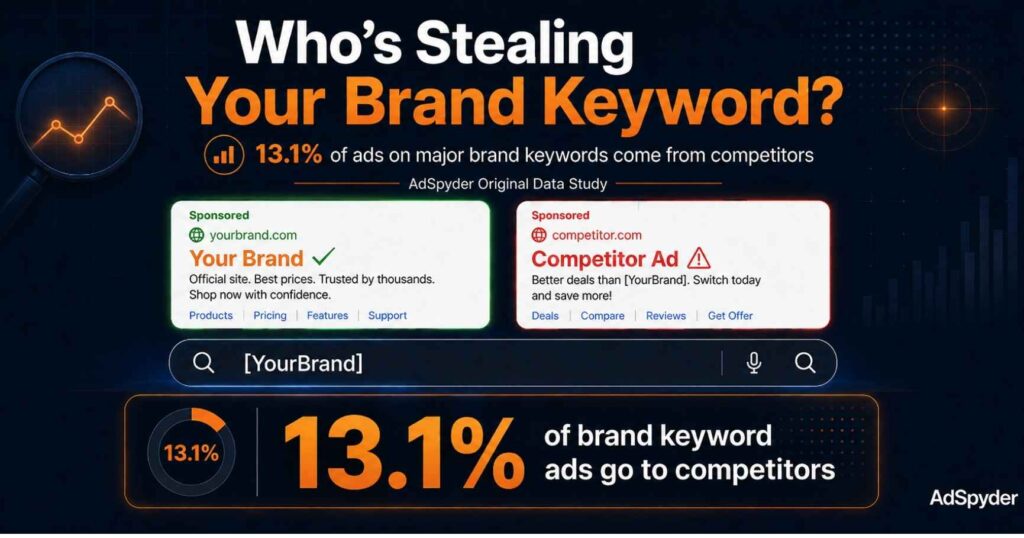
AdSpyder analysed 8.5 million Google Search ads across 25 major brand keyword auctions. The finding: 13.1% of all brand-keyword ads come from competitors, not the brand itself. Netflix (72.1%) and Booking.com (69.9%) lose the most. Marketplaces like Mercado Libre (0%) and eBay (1.7%) are the most defended.
In 2026, India’s Delhi High Court in Hindware Ltd. vs Google LLC permanently banned competitor bidding on registered trademark keywords — making this a legal issue, not just a PPC one. Use AdSpyder to see who is bidding on your brand keyword right now. Source: AdSpyder platform data, May 2026.
A customer types your brand name into Google. They already know you. This is the highest-intent traffic you will ever receive — built through years of marketing spend, word of mouth, and earned reputation.
But before they reach your site, a competitor ad appears at the top. Your brand created the demand. Someone else may capture the click.
This is the core problem behind brand keyword bidding. In 2026, India’s Delhi High Court made it a legal problem too — for the first time establishing clear precedent that competitor bidding on a registered trademark is trademark infringement, even when the brand name is never visible in the ad itself.
This study is AdSpyder’s original data. We went into our Google Search Ads archive — 164 million+ ads — pulled every ad containing a major brand name in its headline, then separated the brand’s own ads from everyone else’s across 25 brands and 8.5 million ads. The results show how big the problem actually is, which industries get hit hardest, and exactly who is doing the bidding.
In This Article
The Delhi HC Ruling That Changed Brand Bidding in India Forever
This section comes first because it changes the entire context of what follows. Brand keyword bidding is no longer just a PPC efficiency question in India. After the Hindware ruling, it is a trademark infringement question with legal consequences for both the advertiser doing the bidding and the platform enabling it.
On 22 May 2026, Justice Mini Pushkarna of the Delhi High Court delivered a 163-page judgment in Hindware Ltd. vs Google LLC. Hindware, one of India’s largest sanitaryware manufacturers with a registered trademark since 1991, had discovered in 2013 that competitors Cera Sanitaryware and Grohe India were purchasing “HINDWARE” as a Google Ads keyword. When users searched for Hindware, competitor ads appeared above Hindware’s own organic result.
Cera and Grohe settled during the case. Google contested its own liability for 13 years — and lost.
163
Pages in the judgment
₹30L
Damages awarded to Hindware
13 yrs
Discovery to final verdict
Zero
Safe harbour for Google
Three findings from the judgment matter for every brand in India:
1. Invisible keyword use is still trademark infringement. Google argued that because keywords are backend triggers never shown to the user, they cannot be “use” of a trademark. The court held that using a registered trademark as a keyword to trigger an ad constitutes use in advertising under Section 29(6)(d) of the Trade Marks Act, 1999 — regardless of whether the trademark appears in the visible ad.
2. Google is an active participant, not a neutral platform. Google’s Keyword Planner recommends competitor trademarks to advertisers. Its auction system earns revenue from every click triggered by your trademark. The court rejected the “neutral intermediary” defence entirely.
3. Safe harbour under the IT Act was denied. Section 79 of the IT Act protects passive intermediaries. Because Google actively selects who sees your brand’s search results and profits from it, the court denied the protection.
Scope — who this applies to
This ruling applies to registered trademarks in India. The precedent is that competitor bidding on a registered trademark as a Google Ads keyword is legally actionable — against both the competing advertiser and Google. The bigger operational challenge is knowing when it is happening. Most brands discover competitor brand bidding months after it starts, after traffic has already leaked. Read the full ruling analysis: Delhi HC Brand Bidding Ruling: What Hindware vs Google Means for Every Indian Brand →
Is a competitor bidding on your brand keyword right now?
Search your brand name in AdSpyder’s 164M+ Google Search Ads archive and see exactly who is running ads on your keyword — their copy, their landing page, how long they have been running.
Methodology: How We Analysed 8.5 Million Brand Keyword Ads
AdSpyder Google Search Ads archive · 2026 · 25 brands · 8,523,737 ads
We selected 25 globally recognised brand names across seven industry categories: e-commerce marketplaces, travel and hospitality, fashion and footwear, consumer electronics, design SaaS, streaming entertainment, and productivity SaaS. Regulated categories — finance, insurance, healthcare, pharma — were excluded because different ad-disclosure rules make cross-industry comparison unreliable.
For each brand, we queried AdSpyder’s Google Search Ads archive — 164 million+ ads with first-seen dates from 2009 through 2026 — and extracted every ad containing the brand name in its headline. We then identified the top 50 advertisers by ad count for each brand keyword and classified each as either the brand’s own domain or a conquesting advertiser.
What counts as a conquesting advertiser
Any non-brand-domain advertiser running a headline ad containing the brand name. This includes direct competitors, marketplaces reselling the brand, affiliates, coupon and voucher sites, comparison sites, alternative SaaS tools, and lead-gen aggregators. The top-50 cohort covers approximately 85% of brand-in-title ads for each keyword. Source: AdSpyder platform data, May 2026.
Key Findings: Brand Keyword Bidding in 2026
AdSpyder Google Search Ads archive · 25 brands · 8,523,737 ads
13.1%
Aggregate competitor share
1 in 8 ads on a major brand’s keyword comes from a competitor, not the brand
72.1%
Netflix — most conquested brand
Nearly 3 in 4 “Netflix” headline ads come from advertisers other than Netflix
311k
“Alternative to” ads
Explicit competitor positioning against named brands, across 164M ads
5.27M
“Official” ads
Signals used for brand defence — and by look-alike impostors
Source: AdSpyder platform data, May 2026. Google Search archive covers ad first-seen dates 2019–2026.
Brand Keyword Competitor Bidding Benchmark 2026: Full Results
25 brands · 8,523,737 Google Search ads · Sorted by competitor share · AdSpyder platform data, 2026
The table below is the complete dataset. “Total ads” is the count of Google Search ads with the brand name in the headline. “Competitor ads” is from all non-brand-domain advertisers in the top-50 cohort. “Competitor %” is the share of branded search real estate that goes to non-brand advertisers.
| # | Brand | Industry | Total Ads | Competitor Ads | Competitor % |
|---|---|---|---|---|---|
| 1 | Netflix | Streaming | 57,001 | 27,430 | 72.1% |
| 2 | Booking.com | Travel / Hospitality | 348,582 | 131,806 | 69.9% |
| 3 | Samsung | Consumer Electronics | 747,122 | 210,266 | 54.4% |
| 4 | Nike | Footwear / Apparel | 824,734 | 236,004 | 47.5% |
| 5 | Disney | Streaming / Entertainment | 373,538 | 59,264 | 22.3% |
| 6 | Adobe | Design SaaS | 302,379 | 34,581 | 15.1% |
| 7 | Alibaba | B2B Marketplace | 24,805 | 2,864 | 13.9% |
| 8 | Shopify | E-commerce SaaS | 155,535 | 11,712 | 13.3% |
| 9 | AliExpress | Cross-border E-commerce | 117,342 | 7,968 | 9.3% |
| 10 | Canva | Design SaaS | 100,877 | 6,550 | 7.6% |
| 11 | Amazon | Marketplace | 2,704,091 | 138,176 | 5.5% |
| 12 | SHEIN | Fast Fashion | 337,629 | 15,672 | 5.3% |
| 13 | Temu | Cross-border E-commerce | 5,643 | 240 | 4.5% |
| 14 | Grammarly | Productivity SaaS | 96,938 | 3,634 | 4.3% |
| 15 | Flipkart | Marketplace (India) | 17,246 | 642 | 4.3% |
| 16 | Myntra | Fashion (India) | 35,969 | 1,474 | 4.3% |
| 17 | Walmart | Big-box Retail | 121,866 | 3,679 | 3.5% |
| 18 | Etsy | Marketplace | 94,186 | 2,986 | 3.4% |
| 19 | Udemy | EdTech | 259,330 | 6,954 | 2.8% |
| 20 | eBay | Marketplace | 371,491 | 5,945 | 1.7% |
| 21 | Expedia | Travel / Hospitality | 169,566 | 1,626 | 1.1% |
| 22 | Trendyol | Marketplace (Turkey) | 154,432 | 1,482 | 1.0% |
| 23 | ASOS | Fashion | 413,698 | 1,769 | 0.4% |
| 24 | Agoda | Travel / Hospitality | 75,191 | 227 | 0.3% |
| 25 | Mercado Libre | Marketplace (LATAM) | 614,546 | 0 | 0.0% |
| Total / Aggregate | 8,523,737 | 912,951 | 13.1% | ||
Source: AdSpyder platform data, May 2026. Google Search archive, ad first-seen dates 2018–2024. Top-50 advertiser cohort per brand covers ~85% of brand-in-title ads.

Who Is Actually Bidding on These Brand Keywords?
Top conquesting advertisers by brand — AdSpyder Google Search Ads archive, May 2026
The aggregate number tells you how much branded real estate is being lost. The advertiser breakdown tells you who is taking it and why. The pattern is industry-specific — and understanding the type of competitor you face determines the right response.
Booking.com (70% conquered): OTAs and travel aggregators
The top conquesting advertisers on “Booking” branded keywords are Agoda (15,417 ads), Trivago UK (9,923), MakeMyTrip (7,654), Goibibo (6,684), RedBus (6,543), Trivago.com (6,329), Airpaz (5,067), and Cleartrip (4,793). Every major OTA and travel meta-search platform is present. The keyword “booking” sits at the edge of branded intent and generic action — which makes it one of the most competitively contested travel brand keywords in the archive.
Nike (47% conquered): multi-brand fashion retailers
ASOS (24,876 ads), Sneaksup (12,569), JD Sports UK (10,508), Farfetch (10,470), Dexter Argentina (9,236), Barcin (8,726), Finish Line (8,493), and Lyst (7,351) all appear on “Nike” brand keywords. Many are legitimate authorised retailers — but they still intercept branded demand and redirect that traffic through their own customer journey, at Nike’s brand-building cost. For Indian apparel brands in a similar position, the Hindware ruling now makes this a legally contestable issue.
Adobe (15% conquered): SaaS alternatives and learning platforms
Udemy (5,864 ads), Domestika (2,758), Filmora/Wondershare (2,560), Lenovo (2,203), Skillshare (1,729), LinkedIn Learning (1,663), Envato Elements (1,177), and Wondershare PDF (1,077) target Adobe brand keywords. The intent here is deliberate: “Alternative to Adobe”, “Cheaper than Photoshop”, “Adobe Premiere alternative”. This is the pure “alternative to” attack — unambiguous competitor positioning against the incumbent SaaS brand.
Samsung (54% conquered): marketplaces reselling the brand’s products
Amazon India (15,386 ads), Trendyol (10,855), and Hepsiburada (10,255) dominate Samsung’s brand keyword competition. Unlike the Adobe case, these are not saying “use something else instead”. They are selling Samsung products — but doing it in a way that captures Samsung’s branded demand, removes Samsung’s direct customer relationship, and gives the marketplace control over the post-click experience. Even reseller bidding has a cost.
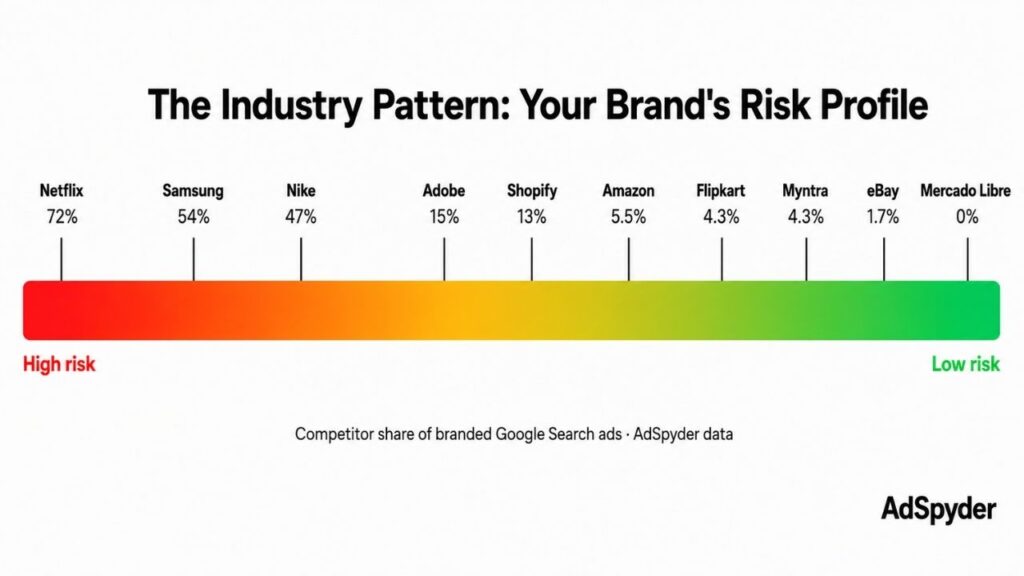
The Industry Pattern: Your Brand’s Risk Profile
Brand keyword competition maps cleanly to business model — not just category
The variation across 25 brands is not random noise. It follows a clear structural principle: the more exclusive you are as the source of your product, the more competitors bid on your keyword. Streaming services lose the most because there is no legitimate reseller — only alternatives. Marketplaces lose the least because their brand and their product are the same thing.
| Brand Type | Typical Competitor % | Who Bids on You | Examples |
|---|---|---|---|
| Single-content streaming | 47–72% | Competing streamers, VPNs, coupon sites | Netflix, Disney |
| Single-brand electronics | ~54% | Marketplaces reselling the brand | Samsung |
| Single-brand apparel | ~48% | Multi-brand fashion retailers, comparison sites | Nike |
| Design / e-commerce SaaS | 8–15% | Competing SaaS tools, learning platforms | Adobe, Shopify, Canva |
| Indian e-commerce | ~4% | Category-adjacent platforms | Flipkart, Myntra |
| Global marketplaces | 0–2% | Almost no one — the platform IS the product | Mercado Libre, eBay, ASOS, Trendyol, Agoda |
Source: AdSpyder platform data, May 2026. Competitor % ranges derived from the 25-brand dataset above.
For Indian brands — specifically those in SaaS, D2C, e-commerce, EdTech, fintech, travel, and consumer electronics — the data and the Hindware ruling converge on the same conclusion: brand keyword monitoring is no longer optional. Use AdSpyder’s Ad Library to establish your baseline and track changes over time.
The Language of Brand Bidding: What 164 Million Ads Reveal
Keyword-based phrase classifier · 164,707,232 Google Search ads · AdSpyder platform data
Beyond the per-brand data, we scanned the full 164 million+ Google Search ad archive for the specific phrases that signal brand keyword activity. Two signals anchor the landscape: “official” is how brands defend. “Alternative to” is how competitors attack.
| Phrase | Ads Found | % of Archive | Signal |
|---|---|---|---|
| “official” (any) | 5,275,074 | 3.20% | Brand Defence / Look-alike |
| “reviews” or “review” | 3,332,768 | 2.02% | Competitor / Comparison |
| “official site” | 3,187,192 | 1.94% | Brand Defence / Look-alike |
| “compare prices” | 475,331 | 0.29% | Comparison Site |
| “alternative to” | 268,596 | 0.16% | Direct Competitor Attack |
| “genuine” | 274,117 | 0.17% | Brand Defence |
| “vs” | 254,940 | 0.15% | Comparison |
| “better than” | 82,642 | 0.05% | Direct Competitor Attack |
| “alternative to” + “alternatives to” combined | 310,585 | 0.19% | Direct Competitor Attack |
Source: AdSpyder platform data, May 2026. Full 164,707,232-ad Google Search archive.
“Alternative to” bidding is most concentrated in the US (74,833 ads), India (43,575), UK (30,232), Canada (25,447), and Germany (14,573). India is the second-largest market for “alternative to” brand attacking — and now the jurisdiction where it is most legally exposed after the Hindware ruling.
Pay particular attention to “official” signals
5.27 million Google Search ads use the word “official”. Some of these are your own brand-defence ads. Others are look-alike advertisers or impostors creating trust signals to intercept your brand traffic. After the Hindware ruling, any non-authorised advertiser using “official” language on your registered trademark keyword is in significantly riskier legal territory than before May 2026.
How to Monitor Competitor Brand Bidding With AdSpyder
A repeatable workflow for PPC managers, brand teams, and legal departments
More than half of all AdSpyder Ad Library searches (56.4% of 88,035+ searches from 6,859 users) are brand-or-domain lookups. Checking competitors by brand name is already the majority use case. Here is the systematic workflow to do it properly.
Search your brand keyword — and its variations
Go to the Google Ads Spy tool and search your main brand name. Then expand to variations: brand + pricing, brand + login, brand + coupon, brand + discount, brand + alternative, brand + reviews, brand + product name, common misspellings. Each variation can have different competitors.
Separate brand-own ads from competitor ads
Filter out your own domain. Then classify the remaining advertisers: direct competitor, marketplace, reseller, affiliate, coupon site, review site, comparison page, or lead-gen aggregator. Each type requires a different response — a direct competitor may need brand defence strategy, a misleading advertiser may need legal escalation.
Review the full ad — headline, description, display URL
Look for: your brand name in the headline, “official” language, “alternative to” or “better than” copy, trademark-like wording, misleading claims. In India after the Hindware ruling, your brand name appearing in a competitor’s headline on your registered trademark keyword is now legally significant — save screenshots with date and market.
Check the landing page — do not stop at the ad
The ad copy is often the mild version. The landing page may compare your brand directly, present itself as official, rank alternatives, or use your trademark in metadata. Use AdSpyder’s Landing Page Analysis to understand the full post-click destination without manually opening every link.
Build a brand auction report and set ongoing tracking
A complete report should capture: keyword searched, advertiser domain, ad headline, description, landing page URL, date, country, and risk level. Add repeat offenders to your AdSpyder competitor tracking projects. AdSpyder currently tracks 3,687 competitors across 8,663+ active projects — the infrastructure for systematic brand monitoring is already there.
Enable Brand Keyword Alerts — coming soon
Most brands in this dataset discovered competitor brand bidding long after it started. AdSpyder is building a real-time Brand Keyword Alert feature that will notify you the moment a new competitor ad appears on your brand keyword — enabling immediate detection rather than delayed discovery. Manual spot-checks catch what is already running. Alerts catch what just started.
5 Brand Keyword Monitoring Mistakes to Avoid
❌ Checking brand keywords only once
Brand auctions change constantly. Competitors run time-limited campaigns during launches, seasonal periods, or discount windows. A one-time check is a snapshot, not a monitoring practice. Set a weekly or bi-weekly cadence — especially for Indian brands after the Hindware ruling, where the legal window for action depends on how early you detect the activity.
❌ Looking only at direct competitors
The data shows that many of the most aggressive brand keyword bidders are not direct competitors at all — they are affiliates, coupon sites, marketplaces, comparison pages, and review aggregators. On the Nike keyword, the biggest conquester was ASOS — a retailer, not a rival shoe brand. Track all non-brand advertisers, not only obvious competitors.
❌ Treating marketplace/reseller bidding as harmless
Amazon bidding on Samsung’s brand keyword is not neutral — it redirects branded traffic through Amazon’s checkout, removes Samsung’s direct customer relationship, and gives Amazon the first-party data. Even when the reseller sells your authentic product, the loss of the direct relationship, margin, and upsell opportunity is real. Samsung’s 54% conquesting rate is dominated by resellers, not direct rivals.
❌ Stopping at the ad — ignoring the landing page
Ad copy is often conservative. The landing page is where the real positioning happens: brand comparison tables, “we are better than X” claims, fake “official” branding, lead-gen forms capturing your branded demand. Use Landing Page Analysis to see the full post-click destination. For Indian brands with registered trademarks, trademark usage on a competitor’s landing page is part of the legal evidence.
❌ Waiting until CPC increases before acting
By the time your branded CPC rises noticeably, competitors have already been running for weeks. Traffic has leaked. Revenue has been affected. Brand keyword monitoring needs to be proactive — build the weekly check into your routine, not your incident response.
Brand Keyword Protection Checklist — Run This Every Week
Get your personalised brand keyword competition report — powered by AdSpyder data
See who is bidding on your brand keyword across 164M+ Google Search ads. Review their copy, their landing pages, and how long they have been running. The Delhi HC ruling gives you the legal standing. AdSpyder gives you the evidence.
23,000+ registered users · 360M+ ads indexed · 10 platforms · AdSpyder platform data