AI Ads & Automation
Quick Answer
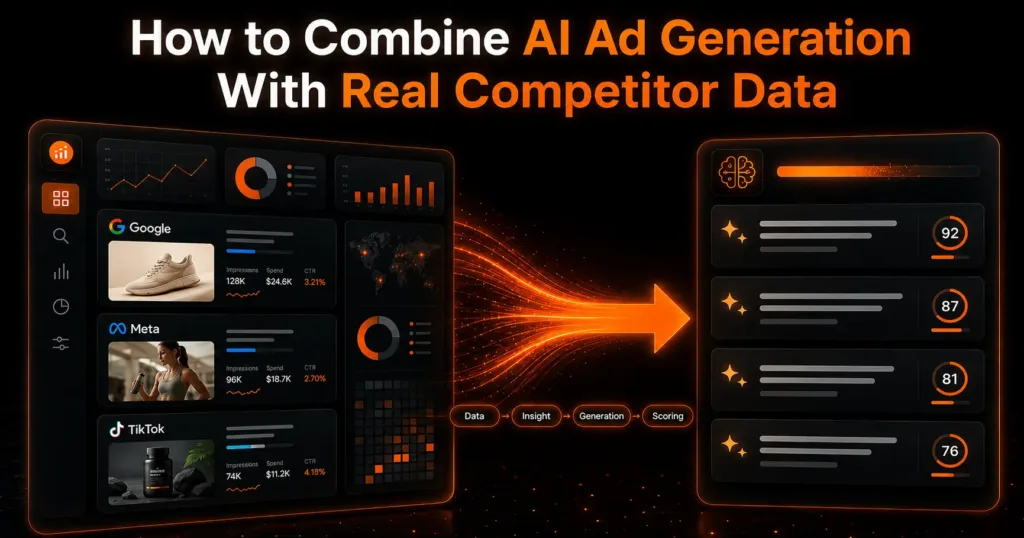
To combine AI ad generation with competitor data effectively, research real competitor ads first — then use those patterns to guide your AI generation inputs. The strongest workflow is data → insight → generation → scoring. Study which messaging angles dominate your category, which formats survive longest, and which CTAs your market defaults to using AdSpyder’s Ad Library, then feed those signals into Text Ad Generation and Image Ad Generation before scoring the output with the Winning Ads AI Agent. This is how AdSpyder connects both sides — competitive intelligence and AI creation — in one workflow.
AI ad generation is fast. Competitor research is practical. But when performance marketers use them separately, the output stays incomplete.
AI alone produces polished but generic ads. Competitor research alone reveals useful patterns but leaves teams with manual execution. The real advantage comes when both run in sequence: use competitor intelligence to understand what is working in the market, then use AI to create original ad variations from those insights.
That is where AdSpyder’s positioning becomes different. AdSpyder is not only an ad library, and it is not only an AI ad generator. It connects competitor ad intelligence with Text Ad Generation, Image Ad Generation, and Winning Ads scoring so marketers can move from research to creative output faster — without switching tools.
88,035
Ad Library searches
AdSpyder platform usage data, Aug 2023–Jul 2025
85.6%
Generated text ads with zero prior search
1,101 of 1,286 text ad generators skipped research entirely
78.6%
Of generation runs used scoring
1,613 of 2,051 Text Ad Generation runs included Winning Ads scoring
62%
Image ad creators searched first
Image generation is significantly more research-led than text generation
Source: AdSpyder platform data, May 2026.
Table of Contents
Why AI Ad Generation Needs Competitor Data
AI ad generation helps teams create more copy, more hooks, and more creative variations in less time. But AI output is only as strong as the context behind the prompt.
If a marketer asks AI to create ads for a performance marketing tool, the output may sound clean, but it may miss the real competitive angles actually running in the market. Some competitors push time savings. Others sell workflow automation, team reporting, integration depth, or pricing transparency. Without competitor data, AI has to guess which of those angles matters.
The core problem
Most AI ad tools generate from user inputs alone. Most ad intelligence tools show competitor ads but leave execution manual. The compounding advantage comes when competitive intelligence and AI generation work together in the same workflow — data informing generation, not replacing it.
This is why performance marketers should not treat AI generation as the first step. The smarter process is to use competitor research before generation so the AI output is based on real ad patterns, not broad assumptions.
AdSpyder Original: What Platform Usage Data Shows
AdSpyder usage data shows that marketers already use both competitor research and AI generation — but the order is not always ideal. Across two years of platform usage from August 2023 to July 2025, AdSpyder users ran 88,035 Ad Library searches, generated 2,051 AI text ads from 1,286 distinct generators, and produced 521 image ads from 171 distinct users.
2,051
Text Ad Generation runs
From 1,286 distinct text ad generators, Aug 2023–Jul 2025
10.5
Average titles per generation run
Text Ad Generation output average across all runs
55.9%
Of generation runs are sales-goal
1,146 of 2,051 runs. This is a direct-response-first workflow.
The clearest finding is the sequence gap. Among users who generated a text ad, 85.6% had run zero Ad Library searches before their first generation. Only 14.4% researched competitor ads before generating. For image ads, the pattern flips — 62% of image ad creators researched before generating, which shows the instinct to research before producing visual work is already there for most marketers.
What this means for your workflow
AdSpyder data shows a practical opportunity: users often combine competitor research and AI generation on the same day — 64.4% of text generation user-days also included an Ad Library search. But many still generate before researching. Moving competitor data earlier in the workflow, before generation rather than after, is the structural change that makes AI prompts more specific and output more differentiated.

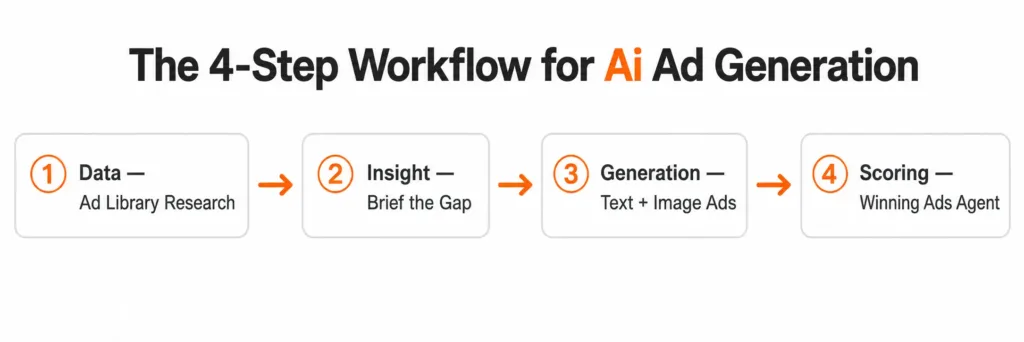
The 4-Step Workflow: Data → Insight → Generation → Scoring
The best way to combine AI ad generation with competitor data is to follow a clear sequence. The goal is not to copy competitors — it is to convert their patterns into original, testable ad ideas grounded in real market behavior.
Data: Research competitor ads before writing anything
Open AdSpyder’s Ad Library and search by competitor domain, product keyword, platform, and ad type. This gives you a real view of what brands are actively running rather than relying on assumptions. Use URL & Domain Analysis for a full competitor profile across all platforms. Use Landing Page Analysis to see where competitor ads send traffic — not just what the ads say.
Insight: Extract repeatable patterns and brief gaps
Look across multiple competitor ads and note repeated hooks, offer types, CTAs, format choices, and platform behavior. One competitor ad is not enough. Document what angle dominates your category, what CTAs are the default, and — critically — what angles are almost absent. In AdSpyder’s archive of 364 million+ ads, comparison-led copy appears in only 0.5% of all ads. That is a documented gap most brands never find without looking at real data first.
Generation: Turn insights into AI-generated ad variations
Use Text Ad Generation with your brand, ad goal, seed keywords, personas, location, and language — now informed by the competitor patterns you identified. For visual-led platforms, use Image Ad Generation after studying competitor creative formats, product placement, offer visibility, and background styles. Generate multiple variants — not one final ad. AdSpyder text generation produces an average of 10.5 titles per run.
Scoring: Shortlist before you spend
Use the Winning Ads AI Agent to shortlist generated ad sets based on persona match and ad-copy fit before moving to campaign testing. AdSpyder telemetry shows 1,613 of 2,051 Text Ad Generation runs — 78.6% — included the scoring step before marketers moved forward. Scoring does not guarantee performance, but it surfaces which variants are better aligned to your audience before you put budget behind them.
What Competitor Data Should You Pull Before AI Generation?
The best competitor intelligence is not a copied ad — it is a pattern. Before using AI generation, extract these specific signals from the ads already running in your market.
| Competitor signal | What to observe | How to use it in AI generation |
|---|---|---|
| Headline hooks | Problem, benefit, urgency, price, comparison, or proof — which angle dominates your category | Generate multiple headline angles, including the gaps competitors are not using |
| Offer structure | Free trial, demo, discount, bundle, audit, guarantee framing, or limited offer | Create offer-led variations that differentiate on mechanism, not just price |
| CTA pattern | Learn More and Shop Now account for 56.5% of Meta CTAs — what are the other 43.5% using? | Generate CTA variants that either match or deliberately break from the category default |
| Format survival | On Meta, carousel runs past 30 days at 39.9% vs 23.3% for single image. On LinkedIn, image ads survive at 91.1%. | Let format survival data drive format choice, not gut preference |
| Landing page angle | Pricing page, demo page, comparison page, product page — where are competitor ads landing? | Align your generated ad promise with the right destination and message match |
How to Build a Stronger AI Prompt From Competitor Research
A weak AI prompt asks for ads without market context. A strong prompt gives the generator a specific angle, audience, platform, and offer direction — all pulled from real competitive research.
Prompt framework
Create ad variations for [brand/product] targeting [audience] on [platform] in [location]. The campaign goal is [sales/leads/traffic/app downloads]. Competitor ads in this market commonly use [hook type], [offer type], and [CTA type]. The angle I want to lead with is [your chosen angle] because competitors are not using it. Generate original ad copy using this market direction without copying competitor wording.
This framework works because it does not ask AI to guess the market. It supplies a direction based on real intelligence — the angle your research confirmed is underused, the CTA default you are deliberately matching or breaking, and the platform context that shapes copy length and format.
Body copy carries the angle — not just the headline
AdSpyder’s analysis of Meta ads shows body copy carries 25x more messaging-angle signal than headlines. Urgency language appears in only 0.28% of Meta ad headlines but 6.7% of body copies. If you load your competitive angle into the headline only, it may not be where the persuasion actually happens. Specify the body-copy angle explicitly in your generation inputs.
Platform Examples: How to Combine Ad Spy With AI Generation
The workflow shifts slightly by platform. Google Search needs keyword and intent clarity. Meta needs hook and creative clarity. YouTube needs an opening hook and script flow. Research should be platform-specific before generation inputs are set.
| Platform | Research focus in AdSpyder | AI output to generate |
|---|---|---|
| Google Search | Keyword intent, headline formulas, description style, CTA, offer framing using Google Ads Spy | RSA headline and description variations across angles and CTAs |
| Meta | Hook angle, primary text patterns, creative format, CTA button, offer placement using Facebook Ads Spy and Instagram Ads Spy | Social ad copy and image creative concepts informed by format survival rates |
| YouTube | Opening hook, pain point framing, proof placement, CTA timing using YouTube Ads Spy | Video ad hooks and script direction variations |
| Headline angle, professional tone, offer type, creative format using LinkedIn Ad Library | B2B ad copy and creative variations optimised for the 91.1% image survival rate on LinkedIn | |
| TikTok | Visual hook style, caption approach, UGC vs branded creative using TikTok Ad Library | Short-form video hooks and caption variations for native-style creative |
Where AdSpyder Fits in This Workflow
AdSpyder connects competitive ad intelligence and AI generation in one platform. You do not need a separate research tool and a separate generation tool. The same platform that surfaces what your competitors are running also lets you generate, score, and shortlist before you spend.
Step 1
Ad Library
Search competitor ads across Google Search, Google Shopping, Meta, Amazon, Display, Bing, TikTok, YouTube, LinkedIn, and X. 400M+ ads, 10 platforms.
Step 2
Text Ad Generation
Generate headlines and descriptions using your brand, goal, keywords, personas, language, and locations — informed by what you found in Step 1.
Step 3
Image Ad Generation
Create visual ad directions after reviewing competitor image formats, creative patterns, and the format survival data your research surfaces.
Step 4
Winning Ads AI Agent
Shortlist generated ad sets based on persona match and ad-copy fit before moving to campaign testing. 78.6% of generation runs already use this step.
AdSpyder’s broader ad archive includes 400 million+ ads across 10 platforms, 227 million+ PPC keywords tracked, 180,000+ advertiser domains indexed, and coverage across 100+ countries.
Stop prompting AI from a blank page.
Use real competitor ads from AdSpyder to guide your AI ad copy, image creative, and testing workflow — all in one platform.
AI Generation vs Competitor Research vs Both Together
Most tools solve only one side of this problem. Some generate ads. Some show competitor ads. The stronger workflow connects both sides in sequence.
| Approach | What it gives you | Main limitation | Best use case |
|---|---|---|---|
| AI ad generation only | Fast copy, headline ideas, image concepts, and creative variations | Becomes generic without real market context behind the prompt | Early brainstorming and quick drafting from established briefs |
| Competitor research only | Real hooks, offers, CTAs, platform choices, and landing page patterns | Research stays manual if it is not converted into creative output at scale | Market understanding, competitor monitoring, and positioning work |
| AI generation + competitor intelligence | Insight-backed ad variations that are faster to create and better positioned to differentiate | Needs human review and clear testing discipline before launch | Performance marketers, founders, agencies, and creative teams running active paid campaigns |
Mistakes to Avoid When Combining AI and Competitor Data
Copying competitor ads, not patterns
Competitor data should guide strategy, not duplication. Extract the angle, mechanism, and structure — then create original ads for your own offer and positioning.
Prompting AI with no market context
A generic prompt produces generic output. Add competitive hook types, offer structures, CTA defaults, and platform patterns before generation starts — not after.
Using discount-only angles without longevity signals
Discount-only ads average 8.9 days lifetime on Meta vs 15.4 days for value-prop ads. If your generated ads lead entirely on a sale, flag them as short-term inventory before launch, not after.
Treating AI output as final without review
AI creates options. A human still needs to review claims, brand voice, compliance, landing page match, and campaign fit before anything goes live.
Checklist: Better AI Ads Using Competitor Intelligence
Before generating your next AI ad, check this:
- Have you searched competitor domains and product keywords in the AdSpyder Ad Library?
- Have you noted which messaging angles dominate your category — and which are almost absent?
- Have you checked format survival rates for your target platform?
- Have you documented the CTA defaults in your market and decided whether to match or break from them?
- Have you used Landing Page Analysis to see where competitor ads send traffic?
- Have you translated research patterns into a structured generation brief — not just pasted a prompt?
- Have you generated multiple variants across different angles, not one final ad?
- Have you run scoring to shortlist the strongest variants before setting campaign budgets?
- Have you reviewed generated ads for accuracy, brand voice, and claims before launch?
- Have you connected each ad promise to the right landing page destination?
Create better AI ads with real competitor intelligence.
Use AdSpyder to research competitor ads, generate text and image variations, and shortlist stronger campaign ideas before launch — all from one platform.
FAQs
What does it mean to combine AI ad generation with competitor data?
It means researching real competitor ads first, identifying repeatable patterns — hooks, offer structures, CTAs, format choices — and then using those insights to guide AI-generated ad copy or image creatives. This produces more specific and differentiated output than prompting AI from a blank page.
Should I use competitor research before AI generation?
Yes, in most cases. Research-first generation is more targeted because it includes real market patterns — which angles dominate, which CTAs are the default, and which gaps exist. AdSpyder data shows 85.6% of text ad generators currently skip this step, which is exactly the opportunity a research-first approach captures.
Can I copy competitor ads and rewrite them with AI?
No. Competitor ads should be used for pattern research, not copying. Study the strategy — the angle, the offer mechanism, the CTA choice, the format — then create original variations for your own brand, audience, and positioning.
How does AdSpyder connect competitor intelligence with AI generation?
AdSpyder’s Ad Library gives you the competitor research step — 400M+ ads across 10 platforms, searchable by keyword, domain, or PPC term. Text Ad Generation and Image Ad Generation give you the creation step. The Winning Ads AI Agent gives you the scoring step. All four run in the same platform, so the intelligence from research can directly inform the generation inputs without switching tools.
Does competitor-informed AI generation guarantee better performance?
No. It improves creative direction and variation quality, but campaign performance still depends on targeting, offer strength, budget, landing page quality, bidding, and testing discipline. The Winning Ads scoring step helps shortlist stronger variants before testing — it is a pre-launch filter, not a performance guarantee.
Which teams should use this workflow?
This workflow is built for performance marketers, founders, agencies, media buyers, and creative teams running active paid campaigns across Google, Meta, YouTube, LinkedIn, TikTok, or Amazon who need more ad variation with better market context — without adding manual research time to every generation session.