Ad Library Intelligence
Quick Answer
A strong ad creative iteration strategy is not a fixed refresh calendar. AdSpyder’s archive shows creative refresh patterns vary sharply by platform, format, and industry vertical. Display ads have a mean lifespan of 0.5 days. LinkedIn ads average 75 days. Top Meta advertisers ran millions of distinct creatives in 15-month windows. The practical rule: update ads based on platform lifespan, format survival, and competitor volume — not a generic “30-day rule.” Use AdSpyder’s Ad Library to benchmark how long competitors actually run their creatives.
Most advice on creative iteration is generic: “test more,” “refresh every 30 days,” “avoid ad fatigue.” None of it is grounded in what brands at scale actually do — or how long ads actually survive in the wild.
This AdSpyder Original uses measured archive data to show you the real numbers: creative volume by top advertiser, median ad lifespan by platform, format survival rates on Meta, and per-vertical creative benchmarks. No invented statistics. No generic advice.
2.96M
Top 15 Meta advertiser creatives
Combined distinct creatives in a 15–16 month archive window.
43.3
LinkedIn median run days
Longest observed median lifecycle across platforms in this dataset.
39.9%
Meta carousel 30+ day survival
Highest of any Meta format — 71% more durable than single-image.
400M+
Ads indexed by AdSpyder
Across 10 platforms, 100+ countries, since 2008.
Source: AdSpyder platform data, June 2026. Meta top-advertiser creative volume uses a March 2023 – May 2026 historical archive window.
Table of Contents
AdSpyder Original
Big Advertisers Refresh Through Volume, Not Just Small Tweaks
Most teams think of ad version testing as swapping one headline or changing a CTA. At enterprise scale, the pattern looks completely different. The top 15 Meta advertisers in AdSpyder’s historical archive ran a combined 2.96 million distinct creatives in a 15–16 month window — that is 6.7% of the entire 43.9M-ad Meta historical archive, from just 15 advertisers.
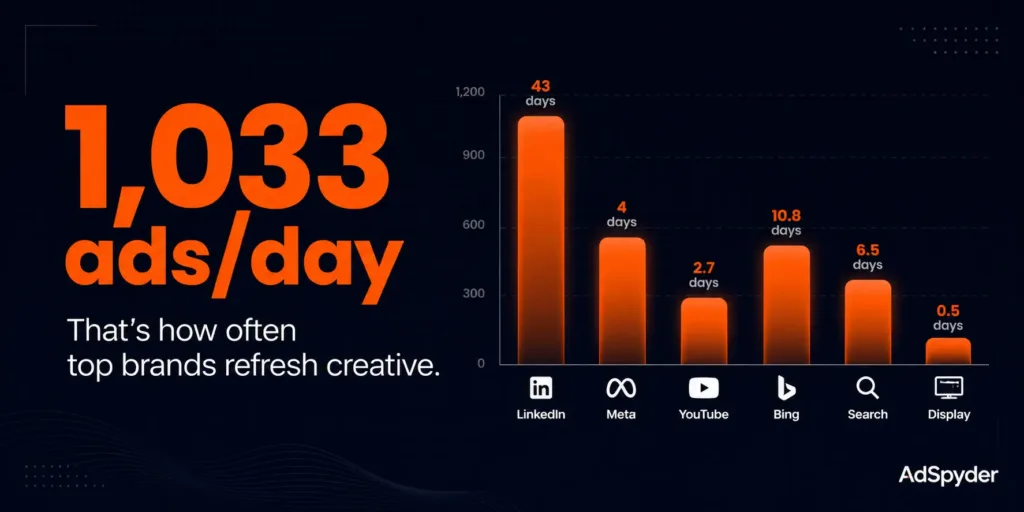
MercadoLibre Mexico alone ran 494,861 distinct creatives — roughly 31,100 per month, or 1,033 unique ads per day. Even Booking.com, a relatively conservative brand category, shipped ~240 new creatives daily.
| # | Advertiser | Distinct Creatives | Per Month | Per Day |
|---|---|---|---|---|
| 1 | MercadoLibre Mexico | 494,861 | ~31,100 | ~1,033 |
| 2 | Domestika | 341,614 | ~21,500 | ~717 |
| 3 | SHEIN Official | 311,262 | ~19,500 | ~650 |
| 4 | Shopee Thailand | 235,005 | ~16,300 | ~543 |
| 5 | Shopee Philippines | 196,143 | ~12,300 | ~410 |
| 6 | Liverpool Mexico | 172,335 | ~10,800 | ~360 |
| 7 | Amazon Mexico | 169,247 | ~10,600 | ~353 |
| 8 | Udemy | 123,712 | ~7,700 | ~257 |
| 9 | Booking.com | 114,385 | ~7,200 | ~240 |
| 10 | Nike | 108,851 | ~6,800 | ~227 |
Source: AdSpyder platform data, June 2026. Distinct creatives observed in Meta historical archive, March 2023 – May 2026 window. These figures represent creative presence, not confirmed spend or performance.
What this means for your team
The practical insight is not “run 31,000 ads a month.” It is that high-volume advertisers treat creative production as a continuous operation, not a campaign cycle. The creative iteration question at that scale is not “should we test variant B?” — it is “how do we build a pipeline?” Smaller teams should match the discipline, not the volume.
See how long your competitors actually run their ads.
AdSpyder’s Ad Library tracks first-seen and last-seen dates for every creative across 10 platforms. Search any competitor, measure their real refresh cadence, and build your iteration plan on actual data.
Your Platform Sets the Refresh Rate — Not Your Team
The single most important variable in your creative iteration strategy is not your testing process or your team’s capacity. It is the platform you are running on. AdSpyder tracks first-seen and last-seen timestamps for every ad in its archive. Here is what the lifespan data shows across six platforms:
| Platform | Median Run Days | Mean Run Days | 30+ Day Survival | Implied Refresh Pace |
|---|---|---|---|---|
| 43.3 | 75.3 | 70.7% | Monthly review | |
| Meta (real-time) | 4.0 | 52.4 | 29.8% | Weekly tests; let winners run |
| YouTube | 5.1 | 30.3 | 22.1% | Bi-weekly review |
| Bing | 0.0 | 10.8 | 8.1% | Weekly rotation |
| Google Search | 0.0 | 6.5 | 4.9% | Continuous pipeline |
| Display | 0.0 | 0.5 | 0.2% | Always-on production |
Source: AdSpyder platform data, June 2026. Last-seen date = last observed by AdSpyder, not guaranteed campaign end date.
The mean vs median gap on Meta (52 days mean vs 4 days median) tells you something important: a small proportion of Meta ads run for a very long time while the majority are short-lived tests. The “30-day refresh rule” you have probably read about is meaningless without this context.
LinkedIn insight
70.7% of LinkedIn ads survive past 30 days. If you are pulling LinkedIn creatives at 14 days, you are almost certainly killing them too early. Let them run a full month before making a decision.
On Meta, Carousel Ads Are the Most Durable Format
Beyond platform-level lifespan, the format you choose on Meta directly affects how long your creative stays active. In AdSpyder’s Meta real-time data, carousel ads had a 39.9% 30+ day survival rate — 71% higher than single-image and 52% higher than video.
39.9%
Carousel — 30+ days
Most durable Meta format
26.2%
Video — 30+ days
Mid-range durability
23.3%
Single Image — 30+ days
Fastest to refresh
Source: AdSpyder Meta real-time archive, June 2026.
On Meta’s historical archive, the video vs image gap is even wider: video ads are roughly twice as likely to survive 30+ days (14.9% vs 8.0%).
Format strategy takeaway
Use single-image as your fast-test layer — low production cost, expect to refresh it quickly. Use carousel as your long-term layer — invest more per creative, let it run 30–60 days before evaluating. Do not apply the same kill criteria to both formats. They serve different jobs in your iteration cycle. You can check competitor format split and lifespan directly in AdSpyder’s Facebook Ads Spy.
Industry Benchmarks: Average Ads Per Advertiser
Creative volume is not just about budget. It is largely determined by your industry. AdSpyder’s Meta data shows average distinct creatives per advertiser varies by a factor of 12x across verticals.
| Industry Vertical | Avg Ads / Advertiser | What This Means |
|---|---|---|
| Publishing / Books | 51.3 | Title launches generate many audience and angle variants |
| Retail Companies | 26.9 | Product range, seasonal, and offer-led refreshes |
| Media / News | 15.0 | High content velocity = high creative velocity |
| Product / Service | 9.7 | Use-case and objection-led creative rotation |
| Clothing Brand | 8.2 | Season and SKU-driven refresh cadence |
| Financial Services | 7.1 | Compliance constraints limit volume |
| Health / Beauty | 5.9 | Product and UGC mix with moderate cadence |
| Real Estate | 4.2 | Fragmented market — many small advertisers, few creatives each |
Source: AdSpyder platform data, June 2026. Average ads per advertiser by Meta page category.
If you are in retail and running 5 active creatives, you are at roughly 20% of your vertical’s average. If you are in real estate and running 4, you are on benchmark. These numbers tell you what is normal in your category — and therefore what you need to match before expecting parity with your competitive set.
A Data-Backed Refresh Framework by Platform
Based on the lifespan and survival data above, here is how to structure your creative iteration cadence per platform:
Display and Google Search — Always-on pipeline
Mean lifespan under 7 days. Do not think in “campaigns” — think in production queues. Build modular templates your team can produce in batches of 10–20. You need new creative available before the current one expires.
Meta — Two-speed model
The 4-day median tells you most ads are short-lived tests. The 52-day mean tells you some ads compound. Run single-image as your fast-test layer: ship 5–10 per week, kill underperformers at 7 days. Run carousel as your long-term layer: invest more per creative, evaluate at 30–60 days. Do not apply the same kill criteria to both formats.
YouTube — Bi-weekly review
Mean lifespan of 30 days, 22% surviving past that. Review at 14 days: if the creative is in the top tier by engagement, let it run another 14 days. Pull at 28 days unless it is clearly compounding. Video production cost makes frequent replacement expensive — use lifespan data to justify which videos deserve the investment.
LinkedIn — Monthly refresh
70.7% of LinkedIn ads survive past 30 days. Run each creative for a full 30-day window before making decisions. Refreshing more often than monthly means you are almost certainly pulling creatives before they have had enough impressions to evaluate fairly. Use AdSpyder’s LinkedIn Ad Library to see which competitor creatives are still running at 60+ days.
All platforms — Benchmark competitors first
Before building a refresh cadence in isolation, look at what your direct competitors are actually doing. How many creatives are they running? How long do theirs last? If they are refreshing every 5 days and you are refreshing every 30, you are not competing on even terms — regardless of how good your individual creative is.
How to Use AdSpyder to Benchmark Competitor Creative Cadence
Setting your cadence against benchmarks only works if you have real competitor data to compare against. Here is a repeatable workflow using AdSpyder:
Open AdSpyder’s Ad Library and search by competitor domain
Domain search pulls their full ad history across platforms — not just what is currently live. For platform-specific research, use Google Ads Spy, YouTube Ads Spy, or Display Ads Spy.
Filter by platform and set a 90-day date window
A 90-day window gives you enough data to see their cadence pattern clearly without mixing in historical campaigns that may not reflect current strategy.
Count distinct creatives and note first-seen / last-seen dates
Each result card shows the first-seen and last-seen timestamp. Count unique creatives and average the lifespan across the set. That is their effective refresh rate in your market window.
Sort by last-seen date descending
The creatives that have run longest are the ones worth studying most carefully. Long-surviving ads are better research inputs than one-day tests — they are the ads that kept getting funded. Group them by hook, offer, format, and CTA to find your competitor’s repeating patterns.
Check the landing page with Landing Page Analysis
See whether their ad message matches the post-click experience. A creative that survives long often has strong ad-to-landing-page alignment — not just a compelling headline.
Manual Swipe File vs AdSpyder Creative Tracking
A swipe file inspires ideas. It rarely shows timing, volume, platform differences, or observed lifespan. That is where ad-library intelligence becomes more useful.
| Need | Manual Swipe File | AdSpyder Workflow |
|---|---|---|
| Find competitor ads | Manual searches across platforms | Search by domain, keyword, platform, date — one workflow |
| Understand ad lifecycle | Limited to what is visible now | First-seen and last-seen timestamps for every ad in the archive |
| Plan refresh cadence | Based on opinion or internal fatigue signals | Based on platform lifespan, competitor volume, and format survival data |
| Historical archive | Not available — only live ads visible | 400M+ ads across 10 platforms, archived from 2008 |
| Output | Ideas to copy or save | A structured creative refresh queue built on real competitor cadence |
Mistakes to Avoid in Ad Version Testing
Refreshing every platform on the same schedule
LinkedIn, Meta, YouTube, Search, and Display do not behave the same way. A 14-day kill rule that is appropriate on Meta will pull LinkedIn creatives before they have been seen enough times to evaluate.
Copying short-lived competitor ads
An ad that appeared briefly in the archive was probably a failed test. Prioritize long-running ads when doing competitive research — they are the ones that kept getting funded.
Treating ad survival as ROAS proof
AdSpyder shows observed ad presence and lifespan — not CTR, CPA, ROAS, or spend. A long-running ad was funded; it was not necessarily the most profitable ad in the account.
Ignoring the landing page
Creative refresh without landing-page alignment is wasted. If the new ad promises one thing and the page opens with another, the iteration gain disappears at the click.
Creative Iteration Strategy Checklist
✓ Map your refresh cadence to platform-specific lifespan data — not a generic rule
✓ Run single-image as your fast-test layer; carousel as your long-term layer on Meta
✓ Benchmark your per-advertiser creative count against your vertical’s average before setting production targets
✓ Search competitors in AdSpyder’s Ad Library and measure their actual refresh cadence over a 90-day window
✓ For Display and Google Search: build batch production workflows — these platforms require volume, not craft
✓ Sort competitor ads by last-seen descending to identify their longest-running (most durable) creative assets
✓ On LinkedIn: resist the urge to refresh before 30 days — 70.7% of ads are still running at that point
✓ Check landing-page alignment before scaling any new creative variation
Turn competitor creative data into your next refresh plan.
AdSpyder indexes 400M+ ads across 10 platforms. Every ad has a first-seen and last-seen timestamp. Search any competitor, measure their real refresh rate, and build your ad creative iteration strategy on actual archive data — not generic advice.
Also covers: Meta · Google · LinkedIn · YouTube · TikTok · Display · Amazon and more
FAQ
What is an ad creative iteration strategy?
An ad creative iteration strategy is a planned process for refreshing ads using new hooks, formats, visuals, offers, proof points, and landing-page angles — based on platform lifespan data, competitor creative volume, and format survival signals. It is not a fixed calendar rule.
How often should you update ad creatives?
It depends entirely on your platform. Display ads have a mean lifespan of 0.5 days — you need near-continuous production. Google Search averages 6.5 days. Meta’s median is 4 days, though some ads compound past 50. LinkedIn has a 43-day median — monthly is fine. Source: AdSpyder platform data, Adspyder 2026.
Which ad format lasts the longest on Meta?
Carousel ads. AdSpyder’s Meta real-time data shows 39.9% of carousel ads survive past 30 days, versus 26.2% for video and 23.3% for single-image. Carousel is the most durable Meta format by a significant margin. Source: AdSpyder platform data, Adspyder 2026.
How many new ads do top brands run per month?
Far more than most teams expect. MercadoLibre Mexico ran ~31,100 distinct new creatives per month on Meta — over 1,000 per day. SHEIN ran ~19,500 per month. Booking.com ran ~7,200 per month. At that scale, creative strategy is a volume operation, not just an A/B testing operation. Source: AdSpyder platform data, Adspyder 2026.
Does creative volume vary by industry?
Yes, significantly. Book publishers run ~51 ads per advertiser on Meta. Retail companies average ~27. Real estate sits at ~4 per advertiser. Your industry sets the creative volume benchmark before your team’s capacity even comes into play. Source: AdSpyder platform data, June 2026.
Does AdSpyder show exact ad variants or variant families?
AdSpyder stores each observed ad creative as a distinct document. It does not automatically cluster creatives into variant families. Teams should group related ads manually by hook, offer, format, and landing page. AdSpyder can export a single advertiser’s full ad list with first-seen, last-seen, headline, and landing URL — making manual grouping practical.
What platforms require the fastest creative refresh?
Display advertising has the shortest lifespan (mean 0.5 days), followed by Google Search (mean 6.5 days) and Bing (mean 10.8 days). Teams on these channels need near-continuous creative pipelines. Source: AdSpyder platform data, June 2026.
How can AdSpyder help with creative iteration strategy?
AdSpyder’s Ad Library lets you search competitor ad histories across 10 platforms, filter by date range, and see first-seen and last-seen timestamps for every ad. This gives you a direct view of how long competitors run their creatives and when they refresh — so you can benchmark your cadence against real data, not assumptions.
Sources and Methodology
- AdSpyder platform data, June 2026: cross-platform ad archive, 400M+ ads, 10 platforms.
- Top-advertiser creative volume: Meta historical archive, top 15 advertisers by distinct ad count, March 2023 – May 2026 window.
- Platform lifespan data: first-seen and last-seen timestamp analysis across LinkedIn, Meta (real-time), YouTube, Bing, Google Search, and Display.
- Meta format survival: AdSpyder Meta real-time archive — carousel, video, and single-image 30+ day survival rates.
- Industry vertical benchmarks: average ads per advertiser by Meta page category classification.
- Disclaimer: last-seen date = last observed by AdSpyder, not guaranteed campaign end date. Creative volume = distinct creatives observed, not confirmed spend or performance data.