Quick Answer
- Separate campaigns by course, learner type, location and admission intent.
- Match each keyword with one clear offer: syllabus, counselling, eligibility or application.
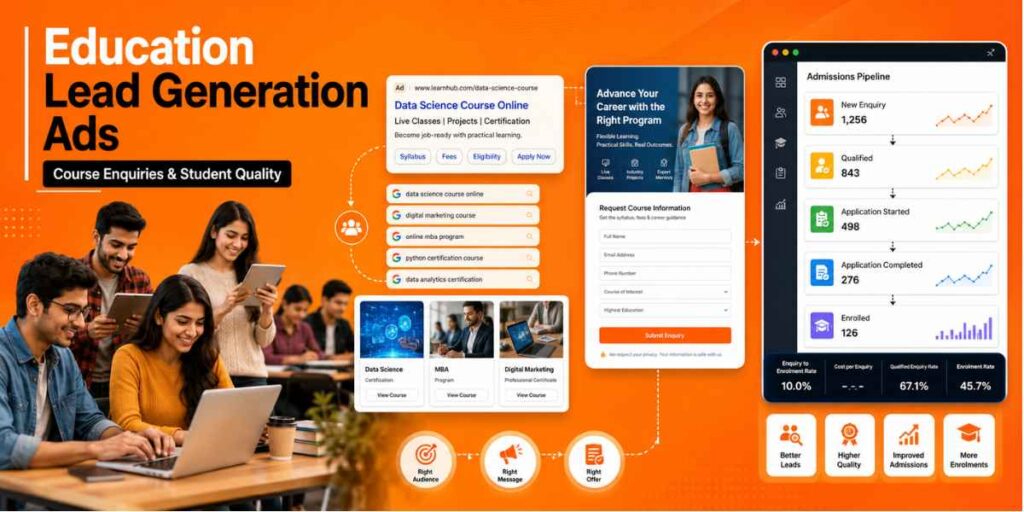
- Measure qualified enquiries, completed applications and enrolments—not forms alone.
- Use AdSpyder Google Ads Spy to compare competitor keywords, ad messages and landing pages.
Education campaigns often generate high enquiry volume but weak student quality. The cause is usually not one bad ad. It is a mismatch between learner intent, course details, qualification questions, landing-page promises and the admissions follow-up process.
In This Guide
The Education Lead-Generation Challenge
A submitted course form does not prove that the person is eligible, financially prepared, available for the course schedule or ready to enrol.
| Funnel Stage | Meaning | Useful Quality Check |
|---|---|---|
| Enquiry | A person submitted a form, call or message. | Valid contact information |
| Qualified enquiry | The learner broadly matches the program. | Eligibility, interest and start period |
| Application started | The learner begins the formal admission process. | Profile and required information entered |
| Application completed | Required details or documents are submitted. | Complete and reviewable application |
| Enrolled student | Admission and required payment steps are completed. | Confirmed enrolment |
Reporting rule
Do not label every brochure download or callback request as a qualified student lead. Define the conditions that make an enquiry useful to the admissions team.
Target Audiences and High-Intent Education Moments
| Learner Type | High-Intent Moment | Suitable Offer | CTA |
|---|---|---|---|
| School student and parent | Admissions, entrance preparation or school comparison | Admission information or counselling session | Request details |
| College applicant | Eligibility, degree comparison or application deadline | Program guide and eligibility check | Check eligibility |
| Working professional | Career change, promotion or new skill requirement | Curriculum, schedule and advisor discussion | Download brochure |
| Self-paced learner | Immediate interest in a defined skill | Free lesson, trial or course preview | Start learning |
| Executive learner | Leadership responsibility or specialist development | Program consultation and cohort information | Speak to an advisor |
Build each creative around one learner decision. The lead-generation creative strategy explains why audience, problem, offer and proof should be tested before minor design changes.
Best Ad Channels and Campaign Structure
1. Google Search for active course demand
Separate campaigns by program, credential, delivery mode, location and learner stage. Send each keyword group to the closest matching course page.
2. YouTube for explanation and trust
Show course structure, class format, instructor access, student projects and the admission process. Use a low-commitment CTA when the viewer still needs context.
3. Meta and Instagram for discovery
Use skill demonstrations, learner stories, course previews and webinars. Match age settings, data collection and personalization with current minor-audience rules.
4. LinkedIn for professional and executive programs
Use role, industry and professional-context messaging for postgraduate, certification and executive education aimed at working adults.
CTA commitment rule
Use “Explore Program” or “Download Syllabus” for learners researching options. Use “Check Eligibility” or “Apply Now” only when the page provides enough information for that commitment. See the lead-generation CTA commitment ladder.
Education Keyword, Offer and Creative Examples
| Search Intent | Keyword Examples | Offer |
|---|---|---|
| Course discovery | digital marketing course, data analytics course, online MBA program | Course overview or syllabus |
| Location intent | coaching institute near me, MBA college in Pune, coding classes in Delhi | Campus visit or counselling |
| Eligibility intent | MBA eligibility, data science course requirements, diploma admission criteria | Eligibility checker |
| Cost intent | course fees, online MBA cost, coding bootcamp price | Fee details and payment options |
| Application intent | apply for online MBA, course admission form, next bootcamp cohort | Application or advisor call |
Adaptable ad structures
Professional certificate
Goal: build a defined skill → Proof: projects and credential → CTA: view syllabus.
Degree or diploma
Program: exact qualification → Details: duration, eligibility and mode → CTA: check eligibility.
Cohort-based bootcamp
Outcome: applied learning → Proof: live sessions and projects → CTA: download brochure.
Use the structures in the lead-generation ad examples guide as inspiration, then replace every generic claim with verified program details.
2026 Education Search-Ad Benchmarks
WordStream’s US search-ad dataset reports the following median results for Education and Instruction. Use them as external context rather than guaranteed performance targets.
7.56%
Average search-ad CTR
$4.81
Average cost per click
13.14%
Average conversion rate
$77.48
Average cost per lead
Source: WordStream 2026 Google and Microsoft Ads benchmarks, based on US search campaigns running from April 2025 through March 2026.
Do not optimize toward CPL alone. Report qualified-enquiry cost, application-start cost, completed-application cost and enrolment CAC. The lead-generation KPI framework explains the complete impression-to-revenue measurement chain.
Education Ad Compliance and Claim Review
Education advertising rules vary by country, regulator, institution type, learner age and platform. Use this as a review checklist rather than legal advice.
Qualification names are accurate: distinguish certificates, diplomas, degrees, credits and completion documents.
Affiliations are genuine: do not imply university, government, employer or accreditation relationships without authorization.
Career claims are supported: avoid guaranteed jobs, promotions, salaries or placement outcomes.
Fees are clear: explain total fees, taxes, financing conditions, trials, subscriptions and cancellation terms.
Urgency is genuine: only use real cohort dates, application deadlines and seat limitations.
Minor data is protected: follow current age-targeting, consent, tracking and parent-or-guardian requirements.
Google policy notes
Google disables ad personalization for users under 18 and applies additional protections to children and teens. Advertising on content marked “Made for kids” cannot use personalized ads, third-party trackers or personal-data collection from minors.
Google also prohibits misleading affiliations, unavailable offers, hidden pricing and improbable outcome claims. Review current platform and local rules before launch.
Education Landing Page and Lead-Quality Checklist
| Page Element | Information the Learner Needs |
|---|---|
| Program headline | Exact course, credential, provider and delivery mode |
| Eligibility | Education, experience, age, location or entrance requirements |
| Program structure | Modules, projects, class format, duration and time commitment |
| Fees | Total cost, payment schedule, financing and refund conditions |
| Proof | Faculty, projects, recognition and authorized student experiences |
| Next step | Syllabus, counselling, eligibility, application or enrolment |
Useful qualification fields
- Program of interest
- Highest education or current study level
- Work experience where relevant
- Preferred cohort or start period
- Location, time zone or study mode
- Consent for the selected contact method
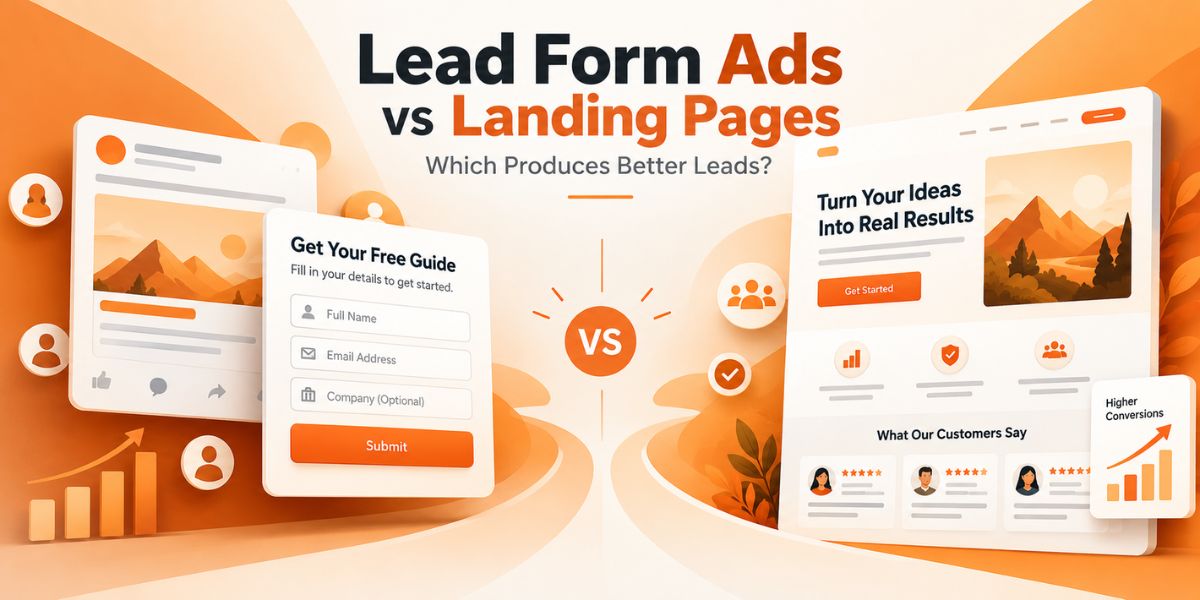
Ask only questions that change routing, eligibility or follow-up. The lead-generation form guide explains the trade-off between shorter forms and better pre-qualification.
Education Competitor Funnel Teardown
The examples below are based on public program pages observed in July 2026. Use AdSpyder to verify which ad copies, keywords and landing pages are currently visible in your market.
| Public Funnel | Offer Pattern | Page Pattern | Campaign Lesson |
|---|---|---|---|
| Coursera | Low-friction enrolment or trial-led offer | Skill outcome, level, duration, schedule, course series and reviews | Reduce uncertainty before asking for payment. |
| Simplilearn | Brochure and syllabus-led enquiry | Live-learning format, projects, tools, curriculum and career support | Use detailed information as the lead value exchange. |
| upGrad | Application and advisor-assisted enrolment | Cohort date, fees, eligibility, brochure, application, shortlisting and seat confirmation | Higher-cost programs require a clearer decision journey. |
How to research education ads with AdSpyder
Search competitor domains and commercial course keywords in Google Ads Spy.
Filter by country, date and comparable course intent.
Record the learner, course, offer, proof, CTA and urgency language.
Open the landing-page snapshot and compare the ad promise with the visible program details and form.
Turn one repeated pattern or missing angle into an original campaign hypothesis.
Follow the complete competitor-ad research workflow. Visible ads can reveal messages and destinations, but they cannot confirm private CPL, student quality or enrolment revenue.
Recommended AdSpyder screenshot
Insert a current Google Ads Spy result showing education ad copies, keyword themes, dates and landing-page previews. Suggested alt text: “Education competitor Google ads and course landing pages in AdSpyder.”
See how competing courses attract enquiries
Compare visible Google ad copy, course keywords, offers, dates and landing pages before creating your next student-acquisition campaign.
30-Day Education Lead Generation Action Plan
| Days | Work | Deliverable |
|---|---|---|
| 1–4 | Document courses, capacity, eligibility, fees, start dates and lead definitions. | Acquisition brief |
| 5–8 | Research competitor ads, keywords, offers and pages in AdSpyder. | Competitor matrix |
| 9–12 | Group keywords by course, location, eligibility, fees and application intent. | Campaign structure |
| 13–16 | Create offer, proof and CTA variations for each learner stage. | Creative test matrix |
| 17–20 | Build or improve program-specific landing pages and forms. | Course funnels |
| 21–23 | Complete claim, price, affiliation, privacy and minor-audience reviews. | Approval record |
| 24–26 | Test forms, calls, CRM stages, notifications and admission routing. | QA log |
| 27–30 | Launch a controlled campaign and review enquiry quality daily. | Initial performance report |
Before increasing budgets, use the lead-generation campaign audit to verify tracking, forms, qualification, admissions capacity and outcome reporting.
Frequently Asked Questions
What is education lead generation? +
Education lead generation attracts prospective learners and moves suitable enquiries toward counselling, application and enrolment.
Which ad channel is best for course enquiries? +
Google Search suits active course demand. Meta and YouTube support discovery and education. LinkedIn can suit professional and executive programs.
What is a qualified education lead? +
A qualified education lead meets the institution’s documented criteria for program relevance, eligibility, timing and genuine interest.
Should every education ad use Apply Now? +
No. Use a lower-commitment action such as View Syllabus or Check Eligibility when the learner still needs important information.
What should an education lead form ask? +
Ask for contact details plus only the information required for course routing, eligibility and appropriate follow-up.
Which metrics should education advertisers track? +
Track valid enquiries, qualified-enquiry rate, application starts, completed applications, admission offers, enrolments, CAC and collected revenue.
How does AdSpyder help education advertisers? +
AdSpyder helps teams research visible competitor Google ads, keywords, countries, dates and landing pages. Use those observations to create original tests and measure them with your own student-quality data.