Ad Strategy
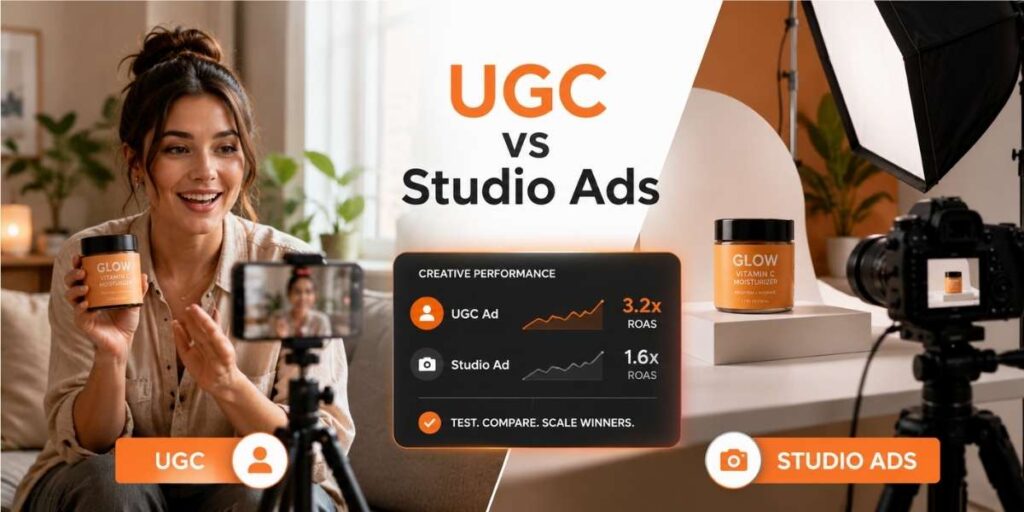
UGC vs Studio Ads: What the Data Actually Says in 2026
Quick Answer
- UGC ads usually win when you need trust, speed, native-feed feel, creator-style hooks, and fast testing.
- Studio ads usually win when you need premium control, launch storytelling, product polish, legal review, and brand consistency.
- The better question is not UGC vs studio ads. It is: which creative style fits the platform, offer, funnel stage, and audience objection? Use AdSpyder Ad Library to compare both styles across competitor ads before you produce anything.
Most teams argue about UGC vs studio ads too early. They choose a production style before they understand the actual creative job.
This guide gives you a practical answer: where UGC works, where studio ads work, what AdSpyder data can prove, and what it cannot prove yet.
Important honesty note: AdSpyder does not currently tag ads as “UGC” or “studio.” This blog uses proxy signals from format, longevity, CTA, copy length, and creative behavior.
61M+
Social/video ads
Meta, TikTok, and YouTube scope used for UGC-relevant analysis.
42%
Live Meta video share
Meta realtime feed shifted heavily toward video formats.
40%
Carousel survival
Carousel ads survive 30+ days more often than video or image ads.
15.5%
Short-copy survival
Meta ads under 50 characters survive 30+ days best by copy length.
Source: AdSpyder platform data, July 2026. Proxy signals do not directly classify UGC vs studio. They show format, copy, CTA, and longevity patterns that help guide creative decisions.
Table of Contents
Bottom Line
UGC vs Studio Ads: The Right Answer Is “Use Both”
If you force one style to do every job, your creative system becomes weak.
| Creative Job | Better Starting Point | Why |
|---|---|---|
| Testing hooks fast | UGC | Faster production, more creator angles, easier variation. |
| Premium product launch | Studio | Cleaner control over product, lighting, message, and brand feel. |
| Trust and objections | UGC | Creator-led proof feels closer to the buyer’s real concern. |
| Hero brand campaign | Studio | Better for consistency, polish, compliance, and brand memory. |
Practical recommendation
Run UGC for angle discovery. Run studio for product control. Scale whichever format proves it can survive longer without fatigue.
Compare UGC and studio ads before you produce them.
Use AdSpyder to study competitor creative styles, landing pages, CTAs, first-seen dates, last-seen dates, and platform patterns across social and video ads.
What AdSpyder Data Can Actually Say About UGC vs Studio Ads
AdSpyder does not directly label ads as UGC or studio-shot. That means we should not claim “UGC beats studio by X%.”
But the proxy signals are useful. Format mix, copy length, CTA choice, and creative longevity show how modern social ads are behaving.
| Proxy Signal | AdSpyder Finding | What It Suggests |
|---|---|---|
| Meta format shift | Historical Meta archive was 88.6% image-only. Realtime Meta feed is 42.4% video, 30.2% carousel, and 26.9% single image. | The live market has moved toward video and multi-asset formats where creator-style ads fit naturally. |
| 30+ day survival | Carousel ads survive 30+ days at 39.9%, video at 26.2%, and image at 23.3% on Meta realtime. | Multi-asset storytelling has endurance. That can support both UGC series and studio product sequences. |
| Copy length | Meta ads under 50 characters survive 30+ days at 15.5%, the strongest copy-length bucket. | Short hooks matter. UGC-style ads often fit this pattern better than over-written brand copy. |
| Long-running language | Long-running Meta ads use less discount language and more social proof than short-lived ads. | Trust-driven creative can outlast pure promo creative. |
Data limitation
These are proxy signals, not a direct UGC-vs-studio classifier. The safe conclusion is that live social creative is becoming more video-heavy, short-hook-heavy, and social-proof-heavy.
UGC vs Studio Ads: Pros and Cons
| Creative Type | Pros | Cons |
|---|---|---|
| UGC ads | Fast to test, creator-led, native to Meta/TikTok, strong for objections, flexible for hooks. | Quality varies, brand control is lower, claims need review, too many fake-looking UGC ads feel scripted. |
| Studio ads | High control, better polish, easier brand consistency, strong for hero campaigns, safer for product close-ups. | Slower to produce, higher production pressure, harder to vary quickly, may feel less native in creator-heavy feeds. |
Best operating model
Use UGC as your testing engine. Use studio as your brand-control engine. Feed winning UGC hooks into studio production once the message proves itself.
UGC vs Studio Ads Cost: What to Know Before Budgeting
AdSpyder does not store production cost, creator fees, agency fees, shoot costs, CPM, CPC, or ROAS. So this section gives cost logic, not fake cost ranges.
| Cost Area | UGC Ads | Studio Ads |
|---|---|---|
| Production speed | Usually faster when creator brief and product samples are ready. | Usually slower because of scripting, shoot planning, crew, edits, and approvals. |
| Variant volume | Better for many hooks, angles, intros, and testimonials. | Better for fewer, more polished assets. |
| Revision cost | Can become messy if creator contracts do not include revisions and usage rights. | More controlled, but each edit can take more production time. |
| Best budget use | Testing hooks and objections. | Scaling proven messages into polished campaign assets. |
Cost warning
Do not compare only production cost. Compare usable variants, revision terms, usage rights, creative fatigue, and how quickly each style gives you a real learning.
When to Use UGC Ads vs Studio Ads
Use UGC when…
- You need many hooks fast.
- Your buyer has trust objections.
- Your platform is Meta or TikTok.
- The product needs demonstration.
- You want a native-feed feel.
Use studio when…
- The product must look premium.
- Brand consistency matters.
- The launch needs polish.
- Claims need tight legal control.
- You need hero assets for multiple channels.
How to Research UGC vs Studio Ads in AdSpyder
Use this workflow before you brief creators or book a shoot.
Search competitor ads by platform
Start in AdSpyder Ad Library. Check Meta, TikTok, and YouTube first if you are researching UGC-style ads.
Separate creative styles manually
Tag examples yourself as creator-style, product demo, founder-led, testimonial, polished studio, animation, or product-only.
Check first-seen and last-seen signals
Longer-running ads are not proof of profit, but they are useful signals. Compare whether UGC-style or studio-style ads keep appearing longer in your category.
Inspect the landing page
Use Landing Page Analysis to see whether UGC ads send users to proof-heavy pages, product pages, quizzes, bundles, or offer pages.
Generate and score new variants
Use Text Ad Generation and Image Ad Generation to turn proven hooks into new creative variants.
UGC vs Studio Ads Testing Checklist
- Are both ads testing the same product and offer?
- Are both ads going to the same or equivalent landing page?
- Are you comparing the same funnel stage?
- Did you create more than one UGC hook?
- Did you create more than one studio variant?
- Are usage rights and revision terms clear for UGC creators?
- Are claims reviewed before launch?
- Are you tracking creative longevity, not just first-week CTR?
Stop guessing which creative style to produce.
Use AdSpyder Ad Library to compare competitor UGC-style and studio-style ads, inspect landing pages, study creative longevity, and build better test briefs.
FAQ
Are UGC ads better than studio ads?
Not always. UGC ads are better for trust, speed, testing, and native social feel. Studio ads are better for premium control, launch assets, brand consistency, and polished product storytelling.
What is the main difference between UGC and studio ads?
UGC ads usually feel creator-led, informal, native, and testimonial-driven. Studio ads are more polished, controlled, scripted, and brand-led.
Does AdSpyder directly classify UGC vs studio ads?
No. AdSpyder does not currently have a structured UGC-vs-studio classifier. You can still use platform, format, CTA, copy length, longevity, and landing page signals to compare creative styles manually.
Which is cheaper: UGC or studio ads?
UGC is often faster and more flexible for testing, but total cost depends on creator fees, usage rights, revisions, product samples, editing, and reshoots. Studio ads usually require more production planning but give more control.
Should D2C brands use UGC or studio ads?
D2C brands should usually use both. Use UGC to test hooks, objections, and trust angles. Use studio ads to polish proven ideas, control brand identity, and support bigger launches.
How can I research competitor UGC ads?
Search competitor brands inside AdSpyder Ad Library, Facebook Ads Spy, TikTok Ad Library, and YouTube Ads Spy. Save examples by hook type, creator format, product demo, testimonial, offer, CTA, and landing page.
Sources and Methodology
- AdSpyder platform data, July 2026: 61M+ paid social/video ads across Meta, TikTok, and YouTube; 55M+ Meta ads; 3M+ TikTok ads; 2.4M+ YouTube ads.
- AdSpyder Meta format proxy data, July 2026: historical Meta archive format split and realtime Meta format split.
- AdSpyder longevity proxy data, July 2026: 30+ day survival by format and copy-length buckets.
- AdSpyder CTA and angle proxy data, July 2026: CTA usage and social-proof / discount language patterns.
- Important limitation: AdSpyder does not currently classify ads directly as UGC-style or studio-produced. This guide uses proxy signals and editorial interpretation, not a direct classifier.
- External context reviewed: current market discussion around lo-fi creator-style advertising, short-form video, TikTok-native creative, and AI-assisted creative tools.