Quick Answer
- Choose competitors selling to the same audience or solving the same problem.
- Filter ads by country, platform, funnel stage, offer and conversion action.
- Record the audience, problem, offer, proof, angle, format and CTA.
- Inspect the landing page before deciding what the ad is trying to achieve.
- Turn repeated patterns into an original campaign hypothesis.
- Judge results using qualified-lead and sales metrics, not competitor visibility or CTR alone.
Competitor ads can reveal how a market describes customer problems, packages offers, presents proof and asks prospects to act.
They cannot reveal private conversion rates, lead quality, acquisition costs or profitability. The goal is not to copy an ad. It is to identify useful market patterns and test a better version for your own audience.
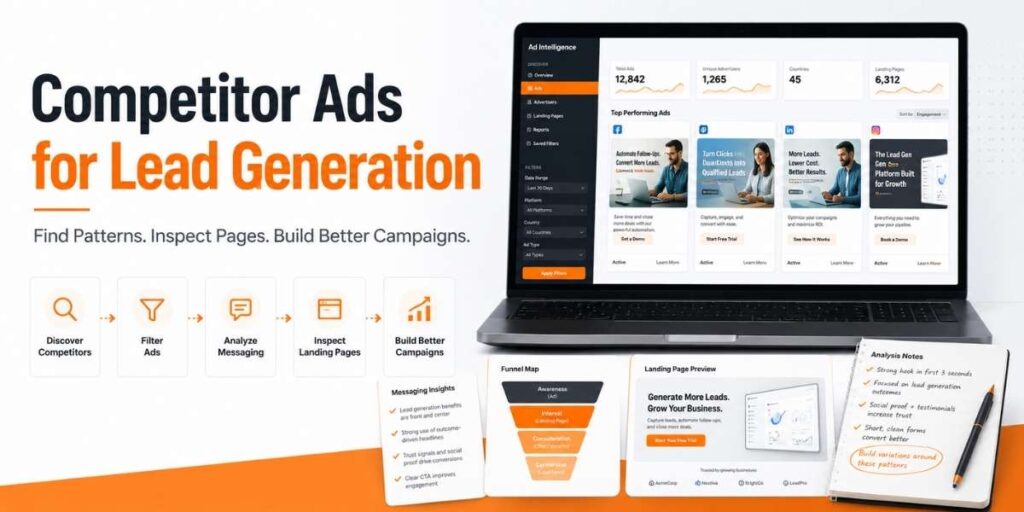
Begin with the AdSpyder Ad Library to find relevant search, social, video, shopping and display ads, then organise the findings using the workflow below.
Goal and Prerequisites
Define the campaign problem before researching competitors. Without a clear question, teams often save attractive ads that have no connection to their audience, offer or sales process.
Document the campaign objective, ideal customer profile, target country, platform, funnel stage, conversion action, current weakness and primary success metric.
Good Research Question: Which offer and proof style do B2B software advertisers use when targeting operations leaders ready to compare solutions?
The DRAFT Competitor-Ad Workflow
| Stage | Action | Output |
|---|---|---|
| D — Discover | Find relevant advertisers | Competitor set |
| R — Reduce | Filter comparable ads | Focused shortlist |
| A — Analyse | Break down message and creative | Pattern library |
| F — Follow | Inspect the post-click journey | Funnel map |
| T — Test | Build an original campaign | Test hypothesis |
Step 1: Discover Relevant Competitors
Create three groups. Direct competitors sell a similar solution to the same audience. Category leaders shape buyer expectations. Attention competitors offer a different way to solve the same problem.
A reporting software company might study another reporting platform, a major analytics suite and an agency selling managed reporting services. All three compete for the same buyer’s attention even though their products differ.
Use URL Domain Analysis to begin with a known domain and review visible ads, keyword themes, platforms, locations and destination pages.
Step 2: Filter and Shortlist Comparable Ads
Do not compare every visible ad. An awareness video for enterprise buyers should not be analysed beside a local quote ad aimed at small businesses.
Filter using audience, country, platform, category, funnel stage, offer, format and observed date. A useful starting shortlist is five direct-competitor ads, three category-leader ads and two alternative-solution ads.
Use Ad Analytics to compare visible domain activity, platforms, countries, active campaigns and recurring keyword patterns.
Step 3: Analyse the Message and Creative
Save structured observations, not screenshots alone. A research sheet makes patterns easier to compare and prevents visual preference from replacing evidence.
| Field | What to Record |
|---|---|
| Audience | Role, industry, company size or local need |
| Problem | Pain, risk or missed opportunity |
| Offer | Demo, audit, quote, trial, consultation or download |
| Proof | Result, testimonial, demonstration, review or capability |
| Angle | Cost, speed, control, convenience, growth or risk reduction |
| Format | Search text, image, carousel, testimonial or demonstration video |
| CTA | Requested action and commitment level |
Look for repeated combinations rather than isolated words. Several competitors may pair cost-saving messages with audit offers, or implementation-speed messages with product demonstrations.
Repetition makes a pattern worth investigating. It does not prove that the ad produces profitable leads.
Step 4: Map the Funnel and Inspect Landing Pages
An ad cannot be understood fully without its destination. A message that appears educational may lead to a direct demo form, while a strong sales CTA may route to a detailed comparison page.
| Ad Intent | Likely Destination |
|---|---|
| Problem Education | Guide or diagnostic page |
| Solution Exploration | Use-case or solution page |
| Category Comparison | Product, service or comparison page |
| Action Intent | Demo, quote, pricing or booking page |
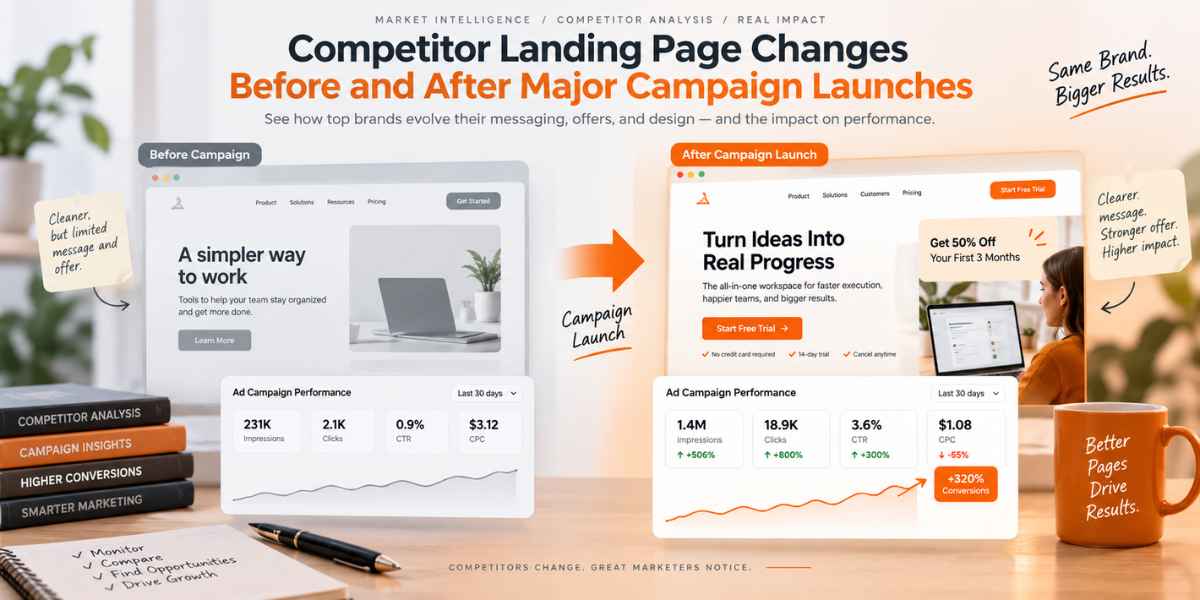
Use Landing Page Analysis to compare the ad promise with the headline, proof, CTA, form, trust signals and historical page versions.
Step 5: Turn Patterns Into an Original Campaign
Convert one research finding into one testable hypothesis. Do not combine a new audience, offer, format and landing page unless the goal is to test an entirely new campaign system.
Example Hypothesis: Three competitors lead with cost reduction, but none explains implementation time. We will test an implementation-speed angle against our current cost-saving message for operations leaders.
Create a brief containing the audience, problem, offer, proof, angle, format, CTA, landing page and success metric.
After the hypothesis is defined, use Ad Generation to create controlled text or visual variants rather than unrelated campaign ideas.
Worked Lead Generation Example – Competitor Ads for Lead Generation
Assume a B2B agency wants more qualified audit requests. Research reveals cost-saving messages paired with free audits, customer-result proof paired with consultations and competitor-comparison messages paired with detailed service pages.
The agency should not copy those ads. It can test a gap: an audit offer focused on identifying wasted spend within a fixed review period.
Control: Book a PPC Consultation. Variation: Get a 15-Point Wasted-Spend Audit. Keep the audience, proof style and landing page stable. Judge the result using valid-lead rate, cost per qualified lead and sales acceptance.
Build a One-Page Campaign Brief
The research becomes useful only when it changes a campaign decision. Summarise the findings in a one-page brief that the media, creative and landing-page teams can use.
| Brief Field | Decision to Record |
|---|---|
| Audience | The exact role, business type or customer situation |
| Core Problem | The pain or missed opportunity the ad will lead with |
| Offer | What the prospect receives after responding |
| Proof | The evidence supporting the promise |
| Test Variable | The one strategic element changing from the control |
| Success Metric | The qualified-lead or sales result that decides the winner |
This prevents the team from producing several unrelated ads and calling the exercise a test. Every variation should connect to the same research question and business objective.
When to Repeat Competitor Research
Repeat the review when a major competitor changes its offer, launches a product, enters a new market or replaces its landing page. Also refresh the research before seasonal pushes and large budget increases.
For stable B2B categories, a monthly review may be enough. Faster ecommerce, local-service or promotional categories may need weekly checks during active launch periods. The purpose is to detect meaningful strategic changes, not to react to every new visual.
Metrics That Should Decide the Result
Business Metrics
Valid lead rate, CPQL, MQL-to-SQL rate, cost per SQL, opportunity rate and paid media CAC.
Diagnostic Metrics
CTR, CPC, landing-page conversion rate, form completion, frequency and CPL.
A competitor-inspired campaign that improves CTR but reduces sales acceptance is not a business winner.
What Competitor Data Cannot Confirm
Publicly observable ads can show messaging, formats, offers, dates and landing pages. They cannot confirm a competitor’s audience settings, bids, negative keywords, conversion rate, CPL, CPQL, CAC, pipeline, revenue or ROAS.
Avoid presenting active, repeated or long-running ads as verified winners. Use them to decide what deserves testing, then rely on your own campaign and CRM data to decide what deserves more budget.
Common Competitor Ads for Lead Generation-Research Mistakes
- Copying competitor headlines, designs or page layouts
- Selecting famous brands instead of relevant competitors
- Mixing different audiences and funnel stages
- Treating long-running ads as proven winners
- Saving ads without structured notes
- Reviewing creative without the landing page
- Generating variants before writing a hypothesis
- Declaring success using CTR instead of lead quality
Competitor Ads for Lead Generation Workflow Checklist
FAQs for Competitor Ads for Lead Generation
Can You Copy a Competitor’s Ad?
No. Extract the underlying audience, problem, offer or angle, then create original copy, visuals and landing-page messaging.
Does a Long-Running Ad Prove Profitability?
No. It may deserve attention, but private costs, conversions, qualified leads and revenue remain unavailable.
How Many Ads Should You Analyse?
Start with approximately ten comparable ads. Expand only when additional examples answer a specific research question.
Which Metric Should Select the Winner?
Use qualified-lead, sales-acceptance, opportunity and customer-acquisition metrics rather than CTR alone.
Turn Competitor Patterns Into Original Campaign Tests
Select relevant competitors, compare their advertising patterns and build a campaign hypothesis based on your own audience, offer and qualification goals.