
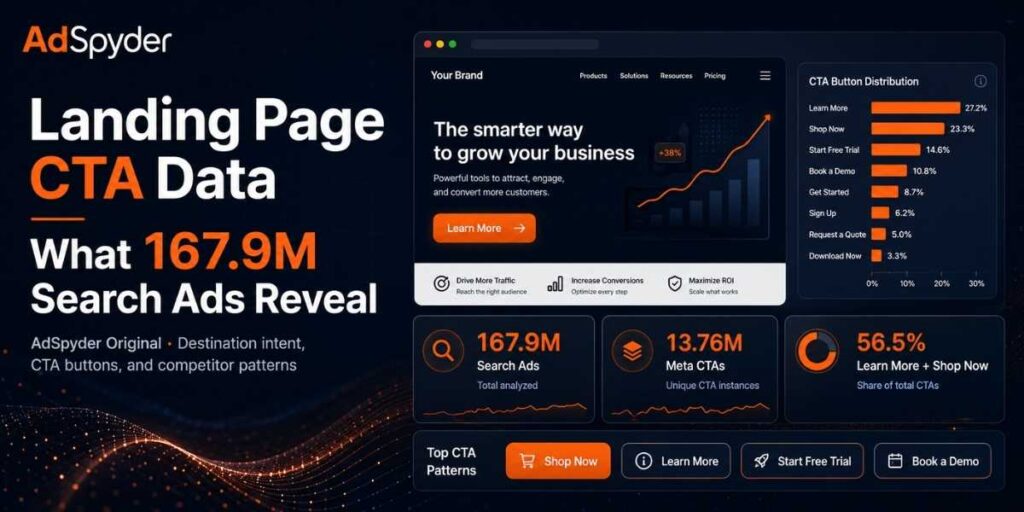
AdSpyder Original · Landing Page Intelligence
Quick answer: AdSpyder’s landing page CTA data shows that destination intent matters more than copying a popular button label. Across 167.9 million Google Search ads, transactional shop/buy paths dominate, pricing pages appear more often than signup or free-trial paths, and product-led CTA language outnumbers demo-led language by about 2.7 to 1. You can inspect competitor destinations with AdSpyder Landing Page Analysis.
Most landing page CTA advice starts with button colour, placement, or a list of “high-converting CTAs.” That skips the first decision: where the ad sends the visitor and what action that destination is built to support.
This analysis uses real destination-path patterns from 167,930,598 Google Search ads and structured CTA-button choices from 13,764,773 Meta ads. It does not pretend to measure landing-page button colour or visual placement, because AdSpyder does not currently classify those elements.
167.9M
Google Search ad destinations analysed
3.93M
Ads pointing to shop, buy, checkout, or product paths
56.5%
Meta CTA share from Learn More plus Shop Now
2.7×
PLG-style CTA ads versus demo-style CTA ads
Source: AdSpyder platform data, July 2026.
Table of contents
What Landing Page CTA Data Says About Destination Intent
The URL path is not the CTA button, but it is a reliable signal of the conversion stage the advertiser selected. A visitor sent to /pricing is being asked to evaluate. A visitor sent to /checkout is being asked to buy.
| Destination Pattern | Matching Ads | Archive Share | CTA Intent |
|---|---|---|---|
| /shop, /buy, /checkout, /product | 3,929,936 | 2.34% | Direct purchase |
| /learn, /learn-more, /about | 532,657 | 0.32% | Education |
| /pricing, /plans | 217,064 | 0.13% | Evaluation |
| /download | 181,890 | 0.11% | Install or resource |
| /signup, /sign-up | 179,903 | 0.11% | Product-led signup |
| /demo, /book-demo | 157,778 | 0.09% | Sales-assisted evaluation |
| /free-trial | 149,496 | 0.09% | Product trial |
| /get-started | 129,837 | 0.08% | Onboarding entry |
| /contact, /contact-us | 125,713 | 0.07% | Lead generation |
| /login, /signin | 61,715 | 0.04% | Existing-user action |
The useful conclusion: “Best CTA” is the wrong starting question. First identify the destination stage. A pricing page needs an evaluation CTA; a product page needs a transaction CTA; a comparison page may need a lower-friction next step.
See Where Competitors Send Paid Traffic
Compare destination URLs, offers, page changes, and ad-to-page continuity before choosing your next CTA test.
The Two CTA Buttons That Dominate Meta Ads
Meta provides a structured CTA choice at the ad level. Among 13,764,773 historical Meta ads with a populated CTA button, Learn More and Shop Now account for 56.5% combined.
| Rank | Meta CTA Button | Share of Populated CTAs | Likely Use |
|---|---|---|---|
| 1 | Learn More | 30.3% | Low-friction exploration |
| 2 | Shop Now | 26.2% | Direct commerce |
| 3 | Send Message | 6.1% | Conversation-led lead gen |
| 4 | Send WhatsApp Message | 5.4% | Direct chat |
| 5 | Sign Up | 4.1% | Account creation |
Popularity is not proof of conversion superiority. It tells you what advertisers repeatedly choose. Use the Facebook Ads Spy tool to compare CTA choices with the offer, creative, and destination instead of copying the button in isolation.
Three CTA Copy Patterns Worth Testing
1. Pricing Can Be a Stronger Bridge Than Immediate Signup
Pricing paths appear in 217,064 ads, ahead of signup paths at 179,903 and free-trial paths at 149,496. For visitors still comparing cost, forcing account creation may be one step too early.
2. Product-Led CTA Language Is Broader Than “Start Free Trial”
The Google Search archive contains 1,334,117 ads using “free trial.” When combined with “no credit card,” “try free,” “start free,” and “sign up free,” the product-led CTA cluster reaches 2.08 million ads.
3. Demo CTAs Remain Important—but They Are Not the Default
The enterprise demo cluster totals 758,881 Google Search ads. Product-led CTA language appears about 2.7 times as often, which suggests many advertisers prefer a self-serve first step when the product can support it.
Do not copy the ratio blindly: a complex enterprise product may need qualification and consultation. The right CTA reduces the next unit of friction for your specific buyer; it does not merely imitate the most common phrase.
A Practical Framework for Choosing a Landing Page CTA
Match the Destination to Search Intent
Classify the ad promise as transactional, evaluative, product-led, enterprise-led, informational, or lead generation. The page and CTA should complete that promise.
Choose One Primary Action
Give the page one measurable conversion goal. Keep secondary actions lower-friction and visually quieter so they do not compete with the main decision.
Check Message Continuity
Read the ad headline, landing-page headline, offer, and CTA in sequence. Any change in promise, audience, price, or commitment creates avoidable friction.
Validate With Behaviour, Not Opinion
Use click maps, scroll maps, form analytics, and controlled tests. A CTA becomes “high converting” only after your own traffic proves it.
How to Research Competitor CTA Strategy With AdSpyder
Treat competitor intelligence as a hypothesis generator, not a substitute for testing.
- Use the AdSpyder Ad Library or Google Ads Spy to find active competitor messages and offers.
- Open Landing Page Analysis to inspect destination pages and compare changes over time.
- Group destinations by intent: shop, pricing, signup, free trial, demo, contact, or education.
- Build your test around a clear difference—commitment level, outcome clarity, message match, or destination stage—rather than changing several elements at once.
Actionable test: When a paid-search campaign sends traffic directly to signup, test a pricing or product-detail destination for comparison-stage queries. Keep the ad promise constant so the destination change is the variable.
What This Analysis Can—and Cannot—Tell You
| Supported by AdSpyder Data | Not Measured in This Dataset |
|---|---|
| Landing destination URL patterns | Landing-page button colour |
| Structured Meta ad CTA buttons | Above-fold versus below-fold placement |
| First-seen and last-seen ad dates | Single-CTA versus multi-CTA page structure |
| Ad language clusters such as free trial and demo | Actual conversion rate or causal performance |
This distinction matters. Frequency shows what advertisers use; it does not prove what will convert best for your traffic. Your analytics and controlled tests provide the performance answer.
Landing Page CTA Checklist
☐ The CTA matches the query and ad promise.
☐ The destination matches the visitor’s decision stage.
☐ One primary action is visually dominant.
☐ The button states what happens after the click.
☐ Supporting proof appears near the decision point.
☐ Mobile visitors can see and tap the CTA easily.
☐ The test changes one meaningful variable and uses a defined success metric.
FAQs for Landing Page CTA Data
What Is the Best Landing Page CTA?
There is no universal best landing page CTA. The strongest option matches the visitor’s intent and the destination: Shop Now for a transactional page, View Pricing for evaluation, Start Free Trial for product-led signup, or Book a Demo for a higher-consideration sale.
What Does AdSpyder’s Landing Page CTA Data Measure?
This analysis measures CTA Intent through destination URL paths across 167,930,598 Google Search ads and structured CTA-button choices across 13,764,773 Meta ads. It does not classify button color, visual placement, or landing-page layout.
Which CTA Destination Appears Most Often in Google Search Ads?
Shop, buy, checkout, and product paths form the largest measured destination group: 3,929,936 ads, or 2.34% of the Google Search archive analysed.
Are Pricing Pages More Common Than Signup Pages?
Yes in this dataset. Pricing paths appear in 217,064 Google Search ads, compared with 179,903 ads pointing to signup paths and 149,496 pointing to free-trial paths.
Which CTA Buttons Dominate Meta Advertising?
Learn More accounts for 30.3% and Shop Now for 26.2% of populated Meta CTA Buttons. Together they represent 56.5% of the 13.76 million Meta ads with structured CTA-button data.
Should a Landing Page Use One CTA or Several?
Use one primary conversion goal. A secondary CTA can help visitors who are not ready for the main commitment, but it should be visually quieter and serve the same journey rather than compete with it.
Turn Competitor CTA Patterns Into Better Tests
Track the ads, destinations, offers, and page changes competitors keep using—then validate the right pattern with your own conversion data.