Quick Answer
- Separate emergency, general, cosmetic, implant and orthodontic campaigns.
- Match each search intent with one clear offer and booking action.
- Measure suitable inquiries and attended appointments—not form volume alone.
- Use the AdSpyder dental-clinic workflow to research competitor ads, keywords and landing pages.
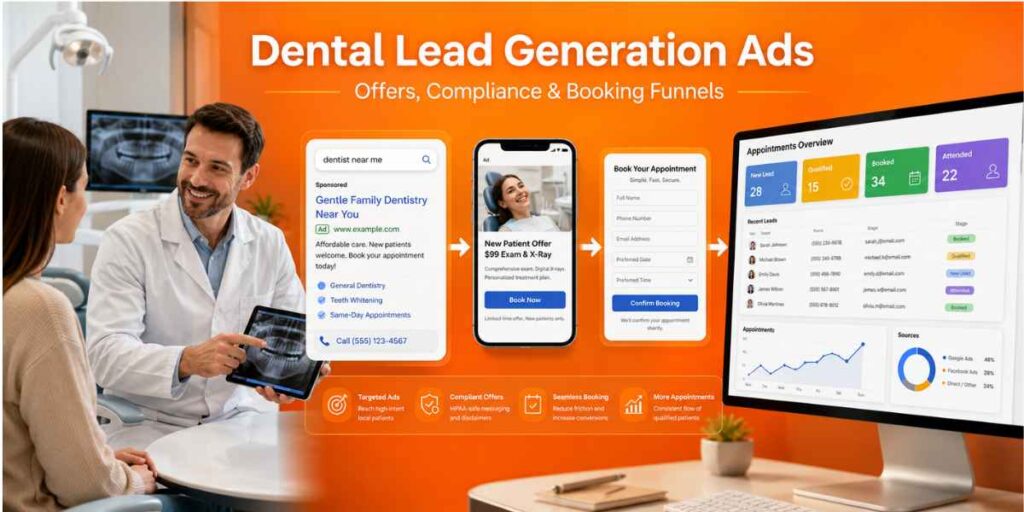
Dental advertising works best when the campaign reflects why a patient is searching now. Someone with severe tooth pain needs a different message, page and response process than someone comparing implants or cosmetic treatment. This playbook connects those high-intent moments with compliant ads and appointment-focused funnels.
In This Guide
Why Dental Lead Generation Is Different
A dental clinic is not selling one interchangeable service. It may be advertising preventive care, emergencies, implants, dentures, aligners, whitening and pediatric appointments at the same time.
- Intent varies: emergency searches require speed; implant searches require education and trust.
- Value varies: one hygiene appointment and one full-arch implant consultation have different economics.
- Location matters: most patients choose from a limited practical travel radius.
- Capacity matters: an ad should not promote immediate appointments when the schedule cannot support them.
- Compliance matters: offers, treatment claims, targeting, testimonials and patient data require careful review.
Core campaign rule
Do not send emergency, implant, routine-care and cosmetic traffic to one generic “Dental Services” page. Each intent needs its own message, proof, questions and next step.
Target Audiences and High-Intent Patient Moments
| Patient Intent | What Matters Now | Suitable Offer | Primary CTA |
|---|---|---|---|
| Emergency care | Availability, location and response speed | Same-day assessment when genuinely available | Call clinic |
| New general patient | Cost clarity, insurance and convenience | Clearly defined new-patient package | Book examination |
| Implant candidate | Suitability, process, trust and financing | Consultation and treatment-plan discussion | Request consultation |
| Cosmetic patient | Expected process, options and clinician credibility | Smile consultation without guaranteed results | Explore options |
| Parent or caregiver | Age suitability, environment and scheduling | Child-focused first visit or family appointment | Schedule visit |
Build creative around the patient’s decision—not the clinic’s full service list. The recent lead-generation creative strategy explains why the offer and proof should be tested before colours, layouts or minor visual changes.
Best Ad Channels and Campaign Structure
1. Google Search: capture active demand
Create separate campaigns or tightly controlled groups for emergencies, general dentistry, implants, dentures, cosmetic treatment and orthodontic services. Use location controls and review actual search terms regularly.
2. Local Services Ads: test where eligible
Availability depends on business category and location. Google may require screening involving licences, insurance or other checks. Confirm current eligibility before including Local Services Ads in the plan.
3. Meta and Instagram: educate and build consideration
Use clinician explanations, treatment-process education, clinic experience and clearly disclosed offers. Avoid copy that implies the viewer has a diagnosed condition or embarrassing personal attribute.
4. YouTube and short video: reduce uncertainty
Explain what happens during a consultation, how treatment planning works, what patients should bring and how financing discussions are handled. Keep clinical statements accurate and reviewed.
Recommended account structure
Separate campaigns by service economics and appointment urgency. Do not let a broad “dentist near me” campaign consume the budget intended for implant consultations or emergency calls.
Dental Keywords, Offers and Creative Examples
High-intent keyword groups
| Campaign | Example Keywords | Landing-Page Focus |
|---|---|---|
| Emergency | emergency dentist near me, same-day dentist, urgent dental appointment | Hours, phone, location and current availability |
| General | dentist accepting new patients, dental checkup near me, family dentist | New-patient process, insurance and booking |
| Implants | dental implants near me, implant dentist, full-arch implant consultation | Suitability, consultation, process and financing |
| Cosmetic | cosmetic dentist, teeth whitening dentist, dental veneers consultation | Options, clinician expertise and realistic expectations |
Offer and ad-copy structures
Emergency structure
Need: urgent access → Proof: location and opening hours → CTA: call to confirm availability.
New-patient structure
Offer: defined examination package → Disclosure: eligibility and exclusions → CTA: schedule first visit.
Implant structure
Concern: uncertainty about suitability → Value: consultation and treatment planning → CTA: request consultation.
Use the adaptable structures in the lead-generation ad examples guide, but replace generic promises with verified clinic details, real availability and legally reviewed offer terms.
2026 Dental Search-Ad Benchmarks
WordStream’s 2026 US benchmark dataset reports the following averages for dentists and dental services. Use them as external context—not as guaranteed targets.
5.66%
Average search-ad click-through rate
$8.00
Average cost per click
10.67%
Average conversion rate
$72.97
Average cost per lead
Source: WordStream 2026 Google and Microsoft Ads benchmarks. Results vary by location, service, competition, offer, tracking and lead definition.
A lower CPL is not automatically better. Track suitable inquiries, appointments booked, attendance, treatment acceptance and collected revenue. Use the lead-generation KPI framework to separate diagnostic ad metrics from patient-acquisition outcomes.
Dental Advertising Compliance Checklist
Rules vary by country, state, platform, professional body and treatment type. The following is a campaign-review checklist, not legal advice.
Claims are truthful: avoid guaranteed outcomes, unsupported superiority and misleading clinical claims.
Offer terms are visible: state eligibility, locations, exclusions, expiry and whether additional fees may apply.
Targeting is reviewed: do not build health-sensitive audiences in ways prohibited by the ad platform.
Creative respects patients: avoid humiliating language, fear-based exaggeration and assumptions about a viewer’s condition.
Patient media is authorized: obtain appropriate permission before using testimonials, images or treatment results.
Tracking is assessed: review pixels, analytics, call tracking, booking tools and form fields before sending patient-related information to vendors.
Avoid this ad style
“Are your missing teeth making you ashamed?”
It assumes a personal health condition and uses negative emotional pressure. Prefer neutral language such as: “Explore tooth-replacement options with a dental consultation.”
Dental Landing Page and Lead-Quality Checklist
| Page Element | What It Should Answer |
|---|---|
| Headline | Is this page for the exact service and location I searched? |
| Offer details | What is included, who qualifies and what happens next? |
| Clinician proof | Who will provide or supervise the care? |
| Booking options | Can I call, request a time or use an online scheduler? |
| Practical information | Where is the clinic, when is it open and what payment options exist? |
| Form | Does it collect only the minimum information required for follow-up? |
Useful lead-quality fields
- Preferred clinic location
- Service category or reason for appointment
- New or existing patient
- Preferred contact method and general time
- Insurance or payment question only when operationally necessary
Do not ask for a detailed diagnosis inside an advertising lead form. Route clinical assessment through the clinic’s approved patient process. Before scaling, use the lead-generation campaign audit to test forms, calls, notifications, CRM records, consent and follow-up.
Dental Competitor Funnel Teardown
The examples below use public landing pages observed in July 2026. They show market patterns—not verified ad profitability. Search the domains inside AdSpyder to confirm currently visible ads, platforms, dates and destination pages.
| Public Funnel | Offer Pattern | Landing-Page Pattern | Lesson to Test |
|---|---|---|---|
| Aspen Dental | Low-friction new-patient exam and X-ray offer | Location, appointment scheduling, eligibility, expiry and exclusions | Combine accessibility with detailed offer disclosure. |
| ClearChoice | Free implant consultation with imaging and treatment planning | Process explanation, clinician access, scan, financing and consultation CTA | Reduce uncertainty before requesting a high-value consultation. |
How to repeat the research in AdSpyder
Search five local competitors, two regional groups and two category leaders.
Filter by country, platform, observed date, service and likely funnel stage.
Record the service, keyword theme, offer, proof, visual, CTA and destination URL.
Compare the ad promise with the landing-page headline, form and booking action.
Turn one recurring pattern or market gap into an original clinic campaign test.
Follow the complete competitor-ad research workflow. AdSpyder can reveal visible ads and destination patterns, but it cannot reveal a competitor’s private targeting, CPL, booking rate or treatment revenue.
Recommended product screenshot
Insert a current dental competitor search from AdSpyder showing ad examples, keyword themes and destination pages. Suggested alt text: “Dental competitor ads and landing pages analysed with AdSpyder.”
See how nearby dental clinics advertise
Compare visible dental ads, keyword themes, offers, platforms and landing pages before building your next appointment campaign.
30-Day Dental Lead Generation Action Plan
| Days | Primary Work | Deliverable |
|---|---|---|
| 1–3 | Document services, capacity, locations, economics and disqualification rules. | Campaign brief |
| 4–7 | Research competitors, offers, keywords, ads and landing pages in AdSpyder. | Competitor pattern sheet |
| 8–11 | Create service-specific keyword groups, exclusions and location settings. | Account structure |
| 12–15 | Write original ad variations around offers, proof and intent. | Ad test matrix |
| 16–20 | Build separate emergency, new-patient and high-value service pages. | Booking funnels |
| 21–23 | Complete clinical, legal, privacy and platform-policy reviews. | Approval record |
| 24–26 | Test calls, forms, schedules, notifications, CRM fields and source tracking. | Quality-assurance log |
| 27–30 | Launch a controlled test and review search terms, inquiries and bookings daily. | First optimization report |
Set the initial test budget from CPC, page conversion, qualification and appointment targets—not from a generic monthly recommendation. The lead-generation ad budget guide provides the planning formulas.
Frequently Asked Questions
What is dental lead generation? +
Dental lead generation is the process of attracting prospective patients and moving suitable inquiries toward an appointment with a dental practice.
Which channel is best for dental leads? +
Google Search is often suitable for active local demand. Meta and video can support education and consideration. The correct mix depends on service type, location, capacity and economics.
What is a good offer for a dental ad? +
A useful offer solves a specific decision problem, such as a clearly defined new-patient examination or an implant consultation. Include eligibility, exclusions and what happens next.
Should every dental ad go to the homepage? +
No. Send each major service or intent to a focused page that continues the ad promise and provides the correct booking action.
How should dental lead quality be measured? +
Track valid inquiries, service suitability, appointment booking, attendance, treatment acceptance, collected revenue and acquisition cost.
Can dental ads use patient before-and-after images? +
Requirements vary by location and platform. Obtain appropriate authorization, avoid implying guaranteed results and have the creative reviewed under applicable professional and advertising rules.
How does AdSpyder help dental clinics? +
AdSpyder helps clinics research visible competitor ads, domains, platforms, keyword themes, offers, CTAs and landing pages. Use those observations to create original tests and judge them with the clinic’s own appointment and revenue data.
Research and compliance references
AdSpyder Dental Clinic Use Case ·
Google Health in Personalized Advertising ·
Google Local Services Screening ·
ADA Dental Advertising Guidance ·
HHS Online Tracking Guidance ·
WordStream 2026 PPC Benchmarks