Freelancers · Agencies · D2C · B2B
Quick Answer
- Best paid-ad research tool: AdSpyder for competitor ads, keywords, landing pages, and AI-generated campaign variations.
- Best general AI assistant: ChatGPT for briefs, analysis, ideation, and repurposing.
- Best visual-content tool: Canva for fast, editable campaign assets.
- Best free behaviour-analysis tool: Microsoft Clarity.
- Start with four jobs: research, creation, distribution, and measurement. Add CRM or automation only when the workflow requires it.
- For a deeper paid-media comparison, read AdSpyder’s best AI advertising platforms guide.
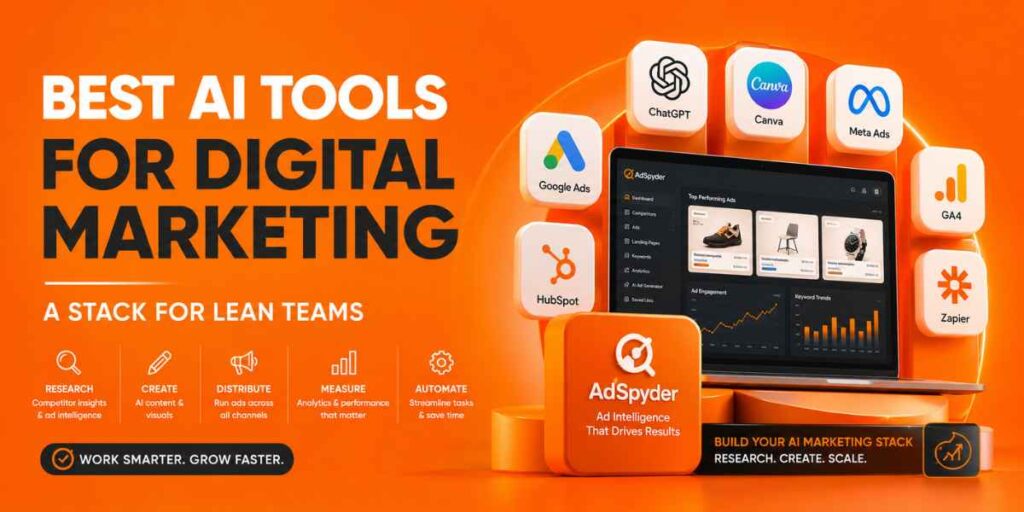
The best AI tools for digital marketing are not the tools with the longest feature lists. Lean teams need software that removes a real bottleneck without creating another dashboard, subscription, or complicated approval process.
This guide builds practical tool stacks for four types of teams: freelancers, agencies, D2C brands, and B2B marketers. Every recommendation has a defined job, a realistic limitation, and a clear reason to keep it in the stack.
The Lean-Team Rule
1
Research demand
2
Create assets
3
Distribute campaigns
4
Measure outcomes
5
Automate repetition
Useful Pricing Signals for Lean Teams
Official pricing checked on August 3, 2026. Regional pricing, annual discounts, usage limits, and promotional offers may change.
$10
AdSpyder entry plan
Multi-platform competitor-ad research
$5
Buffer Essentials
Per channel monthly with annual billing
Free
Microsoft Clarity
No paid traffic tier required
100
Zapier free tasks
Monthly automation allowance
Build Your Digital Marketing Stack
How We Evaluated the Tools
A tool qualified for this list only when it could own a clear stage of the digital marketing workflow. Products were not rewarded merely for adding an AI assistant to an existing dashboard.
✓ Solves a recurring marketing task
✓ Can be used without a large operations team
✓ Produces editable or reviewable output
✓ Has a realistic entry plan or free tier
✓ Connects with normal marketing workflows
✓ Keeps humans in control of claims and budgets
Best AI Tools for Digital Marketing Compared
| Tool | Best Job | Best Team | Entry Option |
|---|---|---|---|
| AdSpyder | Competitor ads and campaign intelligence | Freelancers, agencies, D2C, B2B | From $10/month |
| ChatGPT | Analysis, briefs, drafts, and repurposing | Every lean team | Free and paid plans |
| Canva | Editable visual content | Freelancers and small teams | Free; Pro available |
| Semrush | SEO and search-market research | SEO-led teams and agencies | Paid subscription |
| Buffer | Social scheduling and repurposing | Freelancers and agencies | Free; paid from $5/channel |
| Google Ads AI | Search and cross-channel ad delivery | Lead generation and ecommerce | Media-spend based |
| Meta Advantage+ | Facebook and Instagram automation | D2C, apps, and lead generation | Media-spend based |
| HubSpot | CRM, forms, email, and lead automation | B2B and service businesses | Free; Starter available |
| Klaviyo | Ecommerce email and SMS | D2C and ecommerce | Free up to 250 profiles |
| Google Analytics 4 | Traffic and conversion measurement | Every website team | Standard version free |
| Microsoft Clarity | Recordings and heatmaps | Every website team | Free forever |
| Zapier | Cross-app workflow automation | All lean teams | Free; Professional from $19.99 |
Best AI Tools for Research and Campaign Planning
1. AdSpyder — Best First Paid Tool for Advertising Teams
TOP PICK
Strengths: AdSpyder combines cross-platform competitor-ad research, domain analysis, keyword intelligence, landing-page analysis, and AI ad generation. It helps a lean team move from “What should we advertise?” to a documented campaign hypothesis.
Limitation: It cannot reveal competitors’ private spend, conversion rates, CAC, or ROAS. Those results must come from your own ad account, CRM, and analytics.
Best fit: Freelancers, paid-media agencies, D2C teams, and B2B marketers who need competitor evidence before creating or refreshing campaigns.
Agencies can follow the workflow on the AdSpyder for Ad Agencies page: search competitors, study funnel-stage ads and landing pages, analyse keywords, and then create original campaign-ready copy.
2. Semrush — Best for SEO-Led Research
Strength: Strong keyword, ranking, backlink, competitor, and content research.
Limitation: Broader and more expensive than a specialist tool when the team mainly needs advertising intelligence.
3. ChatGPT — Best for Research Synthesis
Strength: Turns notes, customer feedback, reports, and campaign data into briefs and structured insights.
Limitation: Generic prompts can produce generic answers. Verify facts, claims, links, and current product information.
Best AI Tools for Content and Creative Production
4. ChatGPT — Best for Briefs and Drafts
Use it for campaign briefs, content outlines, ad-copy options, interview synthesis, repurposing, spreadsheet analysis, and first-draft reporting.
Keep human control over: strategy, evidence, brand voice, compliance, and final claims.
5. Canva — Best for Fast Visual Production
Useful for social posts, presentations, banners, lightweight videos, campaign resizing, and editable brand templates.
Limitation: Specialist designers may need deeper animation, typography, or production control.
Better ad-creation sequence: Research relevant ads first, extract hook, offer, proof, format, and CTA patterns, and then generate original variations. AdSpyder explains this process in its guide to using competitor ads as AI prompt context.
Best AI Tools for Distribution and Paid Media
6. Buffer — Best Lean Social Scheduler
Strength: Scheduling, ideas, AI assistance, analytics, and affordable per-channel pricing.
Limitation: It is designed for practical publishing, not advanced enterprise listening or complex paid-social management.
7. Google Ads AI — Best for High-Intent Demand
Strength: Performance Max and AI Max use Google AI for bidding, matching, assets, audiences, and cross-channel delivery.
Limitation: Automation can pursue the wrong outcome when conversion tracking or lead-quality signals are weak.
8. Meta Advantage+ — Best for Social Scale
Strength: Applies AI to eligible audiences, placements, budgets, and campaign delivery across Facebook and Instagram.
Limitation: Strong automation still requires diverse creative, reliable events, and clear commercial goals.
AdSpyder improves the inputs sent into these native ad systems. Its AI performance marketing framework recommends optimizing toward qualified leads, customers, or revenue rather than shallow clicks.
Best AI Tools for Lead Management and Retention
9. HubSpot — Best for Lean B2B CRM
The free tier supports basic CRM, forms, email, reporting, and lead capture. Paid plans add stronger automation, segmentation, attribution, and AI-powered features.
Limitation: Costs can rise with seats, marketing contacts, credits, onboarding, and higher-tier reporting.
10. Klaviyo — Best for D2C Lifecycle Marketing
Useful for customer profiles, ecommerce segmentation, email, SMS, automated flows, product data, and revenue attribution.
Limitation: Pricing increases as the active profile count and sending volume grow.
Best AI Tools for Analytics and Conversion Insight
| Tool | Best Answer | Main Limitation |
|---|---|---|
| 11. Google Analytics 4 | Which channels, pages, and events contribute to conversions? | Requires thoughtful event naming, consent handling, and campaign tagging. |
| 12. Microsoft Clarity | Where do visitors hesitate, rage-click, stop scrolling, or abandon? | Does not replace revenue attribution, CRM reporting, or experiment design. |
Use both: GA4 shows what happened across traffic and events. Clarity helps explain how visitors behaved on the page. Neither can determine whether a competitor’s campaign is profitable.
Best AI Tool for Connecting the Stack
13. Zapier — Best for No-Code Marketing Automation
Useful workflows: Send form leads to the CRM, notify the correct salesperson, enrich campaign records, create reporting rows, assign follow-up tasks, and connect AI steps to structured processes.
Strength: Large integration ecosystem, visual automation builder, tables, forms, and AI-assisted workflow creation.
Limitation: Task usage can rise quickly when every lead triggers several paid actions. Automate stable, repetitive work rather than an unclear process.
Best AI Digital Marketing Stack by Team Type
Freelancer Stack
AdSpyder + ChatGPT + Canva + Buffer + GA4 + Clarity
Research clients and competitors, create content, schedule posts, and prove website results without buying enterprise software.
Agency Stack
AdSpyder + ChatGPT Business + Canva + Buffer Team + HubSpot + Zapier
Use AdSpyder for multi-client market intelligence, then standardize briefs, production, reporting, lead routing, and client approvals.
D2C Stack
AdSpyder + Canva + Meta Advantage+ + Google Ads + Klaviyo + GA4
Research product offers and creative patterns, create visual variations, acquire customers, and recover more revenue through lifecycle campaigns.
B2B Stack
AdSpyder + ChatGPT + Semrush + Google or LinkedIn Ads + HubSpot + Clarity
Connect search demand, competitor positioning, content, paid acquisition, lead qualification, and pipeline reporting.
Where AdSpyder Fits in Every Lean Stack
AdSpyder should sit before ad production and media activation. Its job is to improve the market evidence, campaign brief, creative direction, and post-click research that other tools depend on.
STEP 1
Find relevant competitors
STEP 2
Compare ads and keywords
STEP 3
Inspect landing pages
STEP 4
Generate original variants
STEP 5
Launch and verify results
This approach prevents the creation tool from working with an empty brief. AdSpyder’s guide to combining AI ad generation with competitor data explains how research, generation, scoring, and testing can operate as one connected process.
Public ads can reveal messages, formats, offers, timing, and landing pages. Use the structured competitor-ad research workflow to turn those observations into an original hypothesis rather than copying creative.
Start your lean AI stack with better campaign intelligence
Research competitor ads, keywords, offers, and landing pages before generating or launching the next campaign.
AI Digital Marketing Tool Buying Checklist
☐ One recurring job is clearly assigned.
☐ The tool replaces work, not another useful tool.
☐ Output can be reviewed and edited.
☐ Required channels and integrations are supported.
☐ Seats, credits, contacts, and tasks are understood.
☐ Customer and campaign data can be protected.
☐ Humans approve claims and budget changes.
☐ Success is connected to leads, sales, or revenue.
A smaller connected stack beats a collection of disconnected AI tools
Use AdSpyder for market and campaign intelligence, then connect only the creation, activation, CRM, analytics, and automation tools your team can use consistently.
FAQs for Best AI Tools for Digital Marketing
What are the best AI tools for digital marketing?
A practical stack includes AdSpyder for ad intelligence, ChatGPT for analysis, Canva for visuals, native ad platforms for distribution, GA4 and Clarity for measurement, and a CRM suited to the business model.
Which AI marketing tool should a freelancer buy first?
For paid client work, AdSpyder is a strong first paid tool because competitor research can improve pitches, campaign briefs, creative direction, and client strategy.
What is the best AI stack for a marketing agency?
A lean agency can combine AdSpyder, ChatGPT Business, Canva, Buffer, HubSpot, Zapier, GA4, and Clarity. Remove any tool the team does not use every week.
What is the best AI stack for ecommerce?
A useful D2C stack combines AdSpyder, Canva, Google Ads, Meta Advantage+, Klaviyo, GA4, and Clarity.
Are free AI marketing tools enough?
Free tools can cover drafting, basic design, analytics, and early CRM needs. Paid tools become valuable when they provide better data, automation, collaboration, or commercial control.
Can AI tools run digital marketing automatically?
They can automate production, distribution, bidding, routing, and reporting. Humans still need to define goals, approve claims, protect budgets, and interpret customer value.
How does AdSpyder help digital marketers?
AdSpyder helps marketers research competitor ads, keywords, domains, offers, formats, and landing pages, then use those findings to create original campaign variations.
Can AdSpyder show competitor sales or ROAS?
No. Competitor revenue, conversions, bids, CAC, and ROAS are private. AdSpyder provides observable campaign intelligence that can guide your own testing.