Quick Answer
- AI ad generation answers: “What should I create?”
- AI ad spying/intelligence answers: “What is my market already running?”
- Generation is strongest for headlines, copy, visual concepts and creative variants.
- Ad intelligence is strongest for competitor ads, offers, CTAs, platforms, landing pages and messaging patterns.
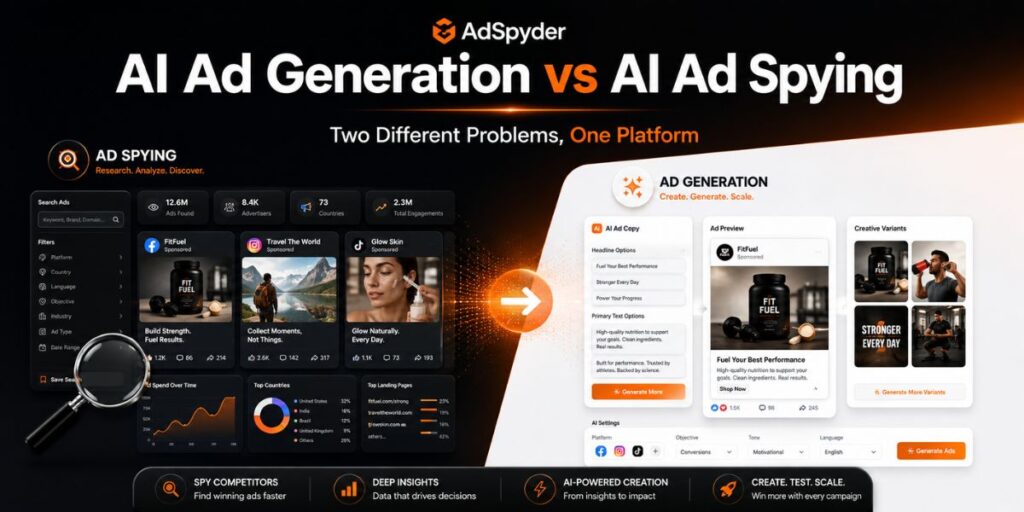
- Better workflow: research first → form a campaign hypothesis → generate original ads → test performance.
Most AI advertising tools are marketed around creation: give the AI your product, audience and tone, and it writes an ad. Useful—but that solves only half the problem. Before asking AI to create anything, marketers also need to understand what competitors are advertising, which offers dominate the category, which CTAs repeat and where those ads send users. AdSpyder connects those two jobs through its Ad Library and Ad Generation workflow.
From Research to New Ad
The Two AI-in-Advertising Problems, Explained
| Question | AI Ad Generation | Ad Spying / Intelligence |
|---|---|---|
| Main job | Create new assets | Understand existing market activity |
| Typical input | Product, audience, offer, platform | Competitor, keyword, domain, country, platform |
| Typical output | Headlines, descriptions, images, variants | Ads, landing pages, messaging patterns, market signals |
| Biggest risk | Generic output | Collecting ads without turning them into a test |
The mistake is treating these jobs as substitutes. Seeing competitor ads does not create your next campaign. Generating ten headlines does not tell you whether the category is currently competing on price, proof, speed, free trials or a completely different message.
AI Ad Generation Tools: What They’re Good At
Ad generation is most valuable once you already know what you want to test. Instead of writing every variation manually, AI can expand one clear campaign hypothesis into multiple creative executions.
- Headline variants: test benefit, pain, urgency or proof-led angles.
- Platform adaptation: turn one idea into formats suitable for different ad environments.
- Creative iteration: develop more variations without starting from an empty document.
- Audience personalization: shift wording for different buyer segments.
- Testing velocity: create controlled variations around one variable faster.
Use AI correctly
Do not ask: “Write me a high-converting SaaS ad.” Ask for controlled variants around a specific audience, problem, proof point, offer and CTA. AdSpyder’s recent AI Advertising guide recommends starting from a business goal and reliable conversion data rather than generating creative for its own sake.
SCREENSHOT PLACEHOLDER 1 — AD GENERATION
Use a real AdSpyder Ad Generation screenshot showing the product/business input, platform or campaign fields and generated text/image ad variants. Crop tightly enough that the generation workflow is readable.
AI Ad Spying and Intelligence Tools: What They’re Good At
Ad intelligence works before creation. Its purpose is not to hand you an ad to copy. It reduces uncertainty about what your market is currently saying and where competitors are placing those messages.
A useful competitor-ad review should answer:
- Which problems appear repeatedly?
- Which offers are common—and which are surprisingly absent?
- Which proof points are competitors using?
- Which CTA verbs dominate?
- Which platforms and countries show meaningful activity?
- What happens after the click on the landing page?
AdSpyder’s Ad Library currently provides a 1B+ ad repository across 50+ platforms and 80+ countries, with filters and workflows for competitor creatives, keywords, domains and landing-page research.
AdSpyder’s Own Data Shows the Research-First Gap
88,035
Ad Library searches in AdSpyder’s analyzed usage dataset.
2,051
text-ad generation runs in the dataset.
85.6%
of text-ad generators had zero Ad Library searches before their first generation.
64.4%
of text-generation user-days also included an Ad Library search.
Source: AdSpyder platform usage analysis published June 2026. Usage activity describes product behavior, not ad performance, conversion rate or ROAS.
The interesting part is not that users employ both tools. It is the order. Many marketers eventually research competitor ads—but only after they have already generated a draft. Research done afterward can critique an idea. Research done beforehand can shape the idea itself.
Why Solving Only One Side Creates Weak Advertising
| Workflow | Likely Problem |
|---|---|
| Generate without research | Polished creative with generic category messaging. |
| Research without generation | A folder full of competitor screenshots but no testable next campaign. |
| Copy competitor ads | Undifferentiated creative plus brand/IP risk. |
| Research → hypothesis → generate | Original creative informed by real market context. |
This is also why competitor research should never mean “find the longest-running ad and copy it.” Public ad data cannot tell you a competitor’s private CPA, lead quality, margins or profitability. AdSpyder’s recent competitor ads for lead generation guide recommends extracting patterns and turning them into an original hypothesis instead.
How AdSpyder Connects Research to Creation
The useful part of putting ad intelligence and generation in one AI advertising platform is continuity. You do not need competitor insights to remain trapped in one tool while creative prompts start from zero somewhere else.
The connected workflow
Market evidence → pattern → campaign hypothesis → AI generation → human review → test → performance data → next hypothesis
For a broader view of where this sits in the market, the recent Best AI Advertising Platforms comparison separates research, creation and activation instead of treating every product with an “AI” label as interchangeable.
Workflow Walkthrough: Ad Library → Ad Generation
Step 1: Define the Research Question
Do not search competitors with no objective. Ask something specific, such as: “How are project-management tools selling to small agencies on Meta?”
Step 2: Find Comparable Ads
Use the Ad Library to narrow results by relevant competitor, platform, country, date or keyword. Start with roughly 10–20 genuinely comparable ads rather than collecting hundreds of unrelated examples.
Step 3: Extract Patterns, Not Copy
Audience: Who is the ad speaking to?
Problem: Which pain point leads?
Offer: Demo, discount, free trial, consultation?
Proof: Customer count, testimonial, result, authority?
CTA: What action is requested?
Landing page: What promise continues after the click?
Step 4: Write One Original Hypothesis
Example: “Competitors lead with time savings, but few quantify client-reporting hours. Test a specific ‘save 5 hours/week’ proof-led angle for small agencies.”
Step 5: Generate Controlled Variants
Move into Ad Generation with your audience, product proof, offer and hypothesis. Generate variants around one meaningful variable—such as headline style—rather than ten completely unrelated concepts.
Step 6: Apply Human Review
Check factual claims, brand voice, prohibited claims, trademark use and whether the ad actually represents your product. AI speed does not remove advertiser responsibility.
Step 7: Test the Hypothesis, Not the AI
The final question is not “Did AI write a good ad?” Measure whether the creative generated qualified leads, purchases, pipeline or another business outcome. The AdSpyder research-to-generation guide uses the same sequence: data → insight → generation → scoring.
SCREENSHOT PLACEHOLDER 3 — RESEARCH → GENERATION WORKFLOW
Create one combined visual: left side = selected Ad Library competitor ads with annotated “Hook / Offer / CTA”; arrow in middle = “Campaign Hypothesis”; right side = Ad Generation output showing original variants. This should visually explain the article’s core workflow.
Don’t start your next AI ad from a blank prompt.
Research the market first, identify a real campaign hypothesis, then turn that insight into original ad variants inside the same workflow.
Research-to-Creation Checklist
FAQs for AI Ad Generation vs AI Ad Spying
What is the difference between AI ad generation and AI ad spying?
AI ad generation creates new advertising assets such as headlines, copy or visual concepts. AI ad spying or ad intelligence researches existing competitor advertising, including creatives, offers, CTAs, platforms and landing pages.
Which should come first: ad research or ad generation?
Research should usually come first when you are entering a competitive market or testing a new campaign angle. It gives the generation step better audience, offer and messaging context.
Can I copy competitor ads found in an ad spy tool?
No. Use competitor advertising to identify patterns, market language and testable opportunities. Your final copy, creative, proof and positioning should be original to your brand.
Can an ad spy tool tell me which competitor ads are profitable?
Not reliably. Public advertising intelligence can show observed creatives, dates, domains and other available signals, but it cannot reveal a competitor’s private conversion rate, CAC, margins or true ROAS.
What makes AdSpyder different from a basic AI ad generator?
AdSpyder connects ad creation with a broader advertising-intelligence workflow. Users can research competitor ads, domains, keywords and landing pages before moving into AI-generated text or image ad variants.
Is AdSpyder an AI advertising agency?
No. AdSpyder is an advertising-intelligence and AI advertising platform. An AI advertising agency usually provides managed strategy, campaign execution and client services rather than primarily offering self-service software.
What is the best AI advertising workflow?
A practical workflow is: define the business goal → research comparable competitor ads → identify a market pattern → write an original campaign hypothesis → generate controlled variants → review claims and brand accuracy → launch a test → measure business outcomes.