Quick Answer
- A marketing qualified lead is a prospect who matches agreed marketing criteria and has shown enough relevant engagement to deserve further nurturing or qualification.
- A sales qualified lead, or SQL, has moved beyond general interest and shown enough fit and buying intent to justify direct sales attention.
- Do not define MQLs with engagement alone. A student downloading five guides should not automatically outrank a decision-maker who visits pricing once.
- Marketing and sales should agree on fit criteria, intent signals, disqualifiers, acceptance rules, response ownership and rejection reasons before campaigns launch.
- Measure MQL-to-SQL conversion, sales acceptance, cost per SQL, opportunity rate and rejection reasons—not raw lead volume alone.
- Use AdSpyder Ad Analytics to research the ads, offers, keywords and landing pages that attract prospects before defining which acquisition signals should influence qualification.
Marketing says it generated 240 leads. Sales says only 37 were worth calling. That disagreement usually is not a lead-generation problem first. It is a definition problem.
If nobody has written down what separates an inquiry from a qualified lead, an MQL from an SQL, or an SQL from a genuine opportunity, every team ends up measuring a different funnel. Marketing optimizes for volume. Sales rejects the volume. Reporting becomes political instead of useful.
Table of contents
Qualified Lead vs MQL vs SQL: The Simple Difference
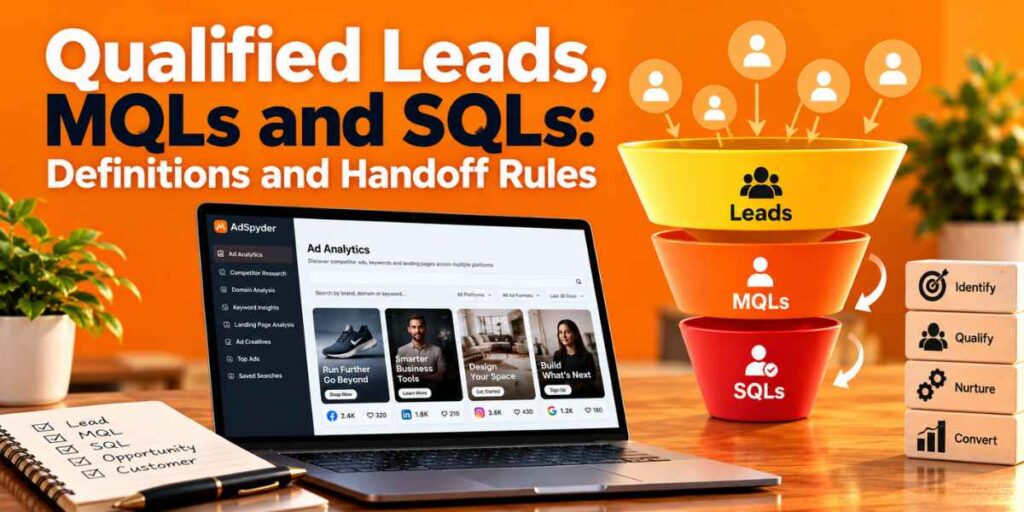
“Qualified lead” is the broad term. MQL and SQL describe where qualification has reached in the buying journey.
| Stage | Meaning | Typical Next Action |
|---|---|---|
| Lead | A person or account has entered your database | Validate and enrich |
| Marketing Qualified Lead | Fits agreed marketing criteria and shows meaningful engagement | Nurture or sales review |
| Sales Qualified Lead | Fit and buying intent justify direct sales engagement | Sales conversation |
| Opportunity | A real potential deal has been identified | Pipeline management |
The exact boundary will differ by company. A free-trial signup may be an MQL in one SaaS business and an immediate SQL in another. The important part is not copying someone else’s labels—it is making your own labels operationally clear.
A Practical Qualification Framework: Fit + Intent + Eligibility
A useful qualification model separates three questions.
Is this the kind of person or company we can successfully serve?
Are they behaving like someone actively evaluating a solution?
Is there any hard reason sales should not pursue the lead?
Fit signals
Useful fit criteria can include company size, industry, geography, job role, use case, account tier, technology stack or another characteristic that genuinely affects your ability to sell and deliver.
Intent signals
Intent is behavioral. Pricing-page visits, demo requests, product comparisons, repeated commercial-page sessions, trial activation or replies asking buying questions generally indicate more readiness than one ebook download.
Disqualifiers
Write down hard exclusions too: unsupported geography, personal email when B2B verification is mandatory, student/research use, impossible budget, competitor domain, duplicate lead, fraudulent submission or a service request you do not provide.
How Marketing Qualified Lead Scoring Should Work
Lead scoring is useful when it helps people make a consistent decision. It becomes dangerous when the score itself becomes the goal.
A transparent rules-based model can start like this:
| Signal | Example Score | Reason |
|---|---|---|
| Matches target company profile | +20 | Strong fit |
| Decision-making role | +15 | Relevant authority |
| Visits pricing page | +15 | Commercial intent |
| Requests demo | +30 | Direct buying signal |
| Downloads educational guide | +5 | Interest, but weak purchase signal |
| Outside service geography | Disqualify | Cannot be served |
Those numbers are examples, not universal thresholds. Your historical opportunity and customer data should determine the final weighting.
The AI lead scoring guide goes deeper into rule-based, predictive and hybrid approaches. For teams with limited clean CRM history, transparent rules are often a better starting point than a complicated model nobody can explain.
Qualification Starts Before the CRM
Your form determines which information is available at the first qualification step.
A webinar registration probably does not need budget and purchase timeline. A high-value consultation request might.
Good form rule: ask for the minimum information required to decide the next useful action—not the maximum information your CRM could theoretically store.
The lead generation form guide explains how to balance conversion friction with qualification needs rather than assuming shorter is always better.
MQL-to-SQL Handoff Rules Marketing and Sales Should Write Down
A lead should not become an SQL because marketing changes a lifecycle-stage field and hopes sales agrees.
Build a small service-level agreement around the handoff.
| Rule | Example |
|---|---|
| MQL threshold | Required fit + minimum intent score |
| Fast-track trigger | Demo, quote or sales-contact request bypasses normal nurture |
| Owner | Named sales queue, territory or account owner |
| Acceptance window | Sales must accept or reject within the agreed SLA |
| Rejection reasons | Bad fit, no intent, duplicate, student, unsupported use case, timing |
| Recycle rule | Valid but early leads return to nurture instead of being marked lost |
One especially useful distinction is rejected versus not yet ready. A good-fit prospect whose project starts in six months should not be treated the same as a fake phone number.
Once an MQL needs more education rather than immediate sales attention, the AI lead nurturing workflow shows how campaign source, landing-page context and later behavior can determine the next useful touchpoint.
Example: Two Leads, Same Form, Completely Different Priority
| Signal | Lead A | Lead B |
|---|---|---|
| Company | Target B2B account | Student / personal use |
| Role | Marketing director | Unknown |
| Acquisition path | High-intent search ad | Informational social post |
| Behavior | Pricing + case study + demo page | Downloaded three guides |
| Decision | Priority sales review | Do not qualify from engagement alone |
Lead B technically has more content interactions. Lead A has much stronger commercial context. That is why scoring volume of activity without understanding fit and intent creates noisy MQL queues.
Metrics and Benchmarks That Actually Help
There is no universal MQL-to-SQL percentage that every business should target. Sales cycle, product price, channel mix and qualification strictness can change the number dramatically.
Build your own baseline around these formulas instead:
| Metric | Formula | What It Tells You |
|---|---|---|
| Lead-to-MQL rate | MQLs ÷ leads × 100 | How much acquisition volume meets marketing criteria |
| MQL-to-SQL rate | SQLs ÷ MQLs × 100 | How well marketing qualification aligns with sales readiness |
| Cost per MQL | Ad spend ÷ MQLs | Acquisition cost after marketing qualification |
| Cost per SQL | Ad spend ÷ SQLs | Cost of generating sales-ready demand |
| SQL-to-opportunity rate | Opportunities ÷ SQLs × 100 | Whether SQL rules produce real pipeline |
| Sales rejection rate | Rejected MQLs ÷ handed-off MQLs × 100 | How much disagreement exists at the handoff |
The lead generation KPI framework extends this through opportunities, pipeline, customers, CAC and revenue so qualification is connected to commercial outcomes rather than stopping at MQL volume.
Common MQL and SQL Mistakes – Marketing Qualified Lead
1. Scoring activity without fit. Five ebook downloads do not automatically create a sales prospect.
2. Treating every demo form as automatically qualified. Intent can be strong while fit is still poor.
3. Letting marketing define SQL alone. Sales readiness needs sales agreement and feedback.
4. Using one score forever. ICP, pricing, channels and customer behavior change.
5. Recording “bad lead” as the only rejection reason. You cannot improve acquisition without knowing what failed.
6. Optimizing campaigns for MQL volume only. The real question is whether those MQLs become SQLs, opportunities and customers.
How AdSpyder Improves the Qualification Workflow
AdSpyder does not decide whether somebody in your CRM is an MQL or SQL. Your own first-party data and business rules should make that decision.
Its role comes earlier: understanding the acquisition context that created the lead.
With Landing Page Analysis, teams can study how competitor ads connect to landing-page offers, CTAs, forms and post-click messaging. That can help you design acquisition experiences that attract the type of prospect your qualification system is actually built to prioritize.
1. Research competitor acquisition patterns. Which audience problems, offers and CTAs appear repeatedly?
2. Compare intent levels. A free guide, free trial and “Book Demo” offer attract different buying stages.
3. Inspect qualification friction. Compare forms, questions and page proof.
4. Preserve acquisition context. Store campaign, keyword, creative, offer and landing-page data with the CRM record.
5. Feed outcomes back. Compare which campaign patterns produce MQLs, SQLs and opportunities—not only clicks.
The lead generation creative strategy provides the next layer: testing offers, proof and message angles based on qualified-lead outcomes instead of choosing winners from CTR alone.
MQL and SQL Definition Checklist
☐ Define what counts as a valid lead.
☐ Define required ICP / fit criteria.
☐ Define meaningful intent signals.
☐ Document hard disqualifiers.
☐ Set an MQL threshold.
☐ Define fast-track sales triggers.
☐ Define what makes an SQL.
☐ Set sales acceptance ownership and response SLA.
☐ Create standardized rejection reasons.
☐ Create a nurture/recycle path for valid but early prospects.
☐ Track MQL-to-SQL and SQL-to-opportunity rates.
☐ Review scoring rules using actual customer outcomes.
FAQs About Marketing Qualified Leads and SQLs
What is a marketing qualified lead?
A marketing qualified lead is a prospect marketing has identified as more likely to become a customer than a typical lead based on agreed fit, behavior and engagement criteria.
What is the difference between an MQL and SQL?
An MQL has enough fit and engagement to deserve qualification or nurturing. An SQL has demonstrated enough sales readiness and buying intent to justify direct sales engagement.
Does an MQL always have to become an SQL?
No. Some MQLs need more nurturing, some lose interest and others are rejected after deeper qualification. The MQL stage indicates priority for further evaluation, not guaranteed sales readiness.
What actions usually indicate SQL intent?
Signals may include requesting a demo, requesting pricing or a quote, starting a relevant trial, asking implementation questions or explicitly requesting contact from sales. The correct trigger depends on the business model.
What is a good MQL-to-SQL conversion rate?
There is no universal percentage that fits every company. Build a baseline by channel, campaign and segment, then improve it while also tracking SQL-to-opportunity and customer conversion.
How can AdSpyder help with qualified lead generation?
AdSpyder supports the acquisition-research layer by showing observable competitor ads, keywords, offers and landing pages. Your CRM and first-party outcome data should still determine whether an individual prospect qualifies as an MQL, SQL or opportunity.
Better qualification starts with better acquisition context
Research competitor campaigns, keywords and landing-page journeys, then connect your own campaign source data to MQL, SQL and pipeline outcomes.