Quick Answer
- An AI ads agency combines human strategy with AI-powered research, creative, media buying, optimization and reporting.
- AI is strongest at processing large datasets, finding patterns, producing variations and monitoring campaigns continuously.
- Humans still need to set goals, validate tracking, approve claims and decide business-level budget trade-offs.
- Modern AI agents can recommend campaign, search-term and ad-group changes, but responsible workflows keep approval controls.
- Best model: automate repetitive agency work while keeping strategy and accountability with people.
Search for an AI ads agency and you will find everything from traditional agencies using AI writing tools to platforms running specialized advertising agents. The useful distinction is not whether an agency says “AI.” It is which parts of the advertising workflow AI actually handles and which decisions remain with experienced marketers.
That distinction matters more in 2026 because AI is moving beyond content generation into planning, campaign execution and measurement. The latest AI advertising trends show agents increasingly connecting market research, creative production and campaign actions rather than operating as isolated writing tools.
Inside the Workflow
What Do People Mean by “AI Ads Agency”?
There is no single operating model. In practice, the term usually describes one of three setups:
| Model | What You Are Buying | Human Role |
|---|---|---|
| AI-assisted agency | Traditional managed advertising accelerated by AI tools | High |
| Agentic agency | Specialized agents handling recurring campaign tasks | Approval + strategy |
| AI advertising platform | Software your internal team operates directly | Internal ownership |
The market is moving toward a mixture of those models. IAB’s 2026 research found that only 10% of surveyed buyers aware of agentic advertising expected to build the capability entirely in-house. Hybrid deployment, licensed technology and external partners were substantially more common.
How Advertisers Expect to Deploy Agentic AI
37%
expect a hybrid approach.
29%
expect third-party AI solutions.
20%
expect external agencies or partners.
10%
expect to build fully in-house.
Source: IAB 2026 Outlook Study. Figures refer to respondents aware of agentic AI ad buying/campaign execution.
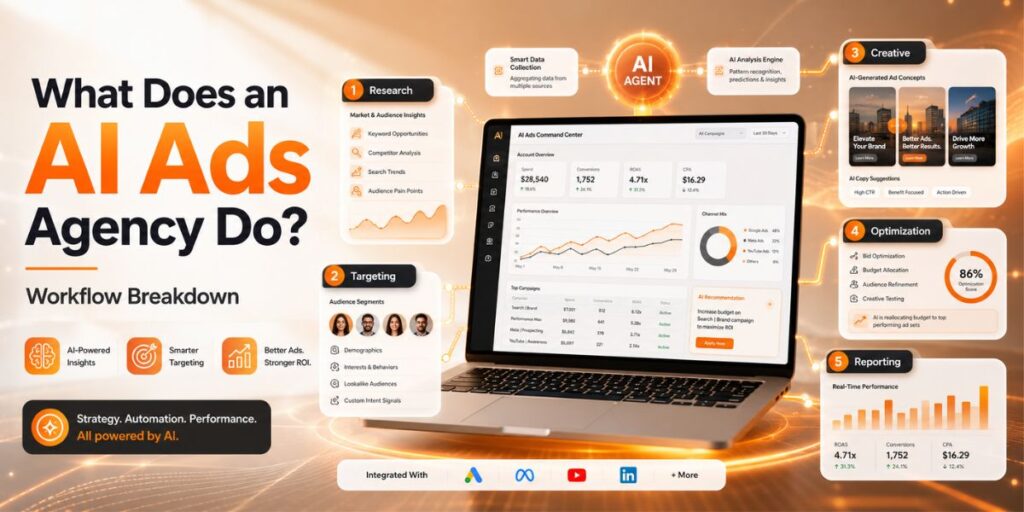
What Does an AI Ads Agency Actually Do?
A serious workflow begins before anyone writes an ad.
Revenue, qualified lead, booking, purchase, app install or another measurable business event.
Competitors, platforms, ads, keywords, offers and landing pages.
Identify who is researching, comparing and ready to act.
Build original hooks, offers, ad formats and destination pages.
Validate conversion tracking before optimizing against the data.
Reduce waste, protect useful tests and feed learnings into the next creative brief.
That workflow is also changing as discovery becomes conversational. The current AI search advertising guide explains why agencies increasingly need to understand not only keywords but the complete question, comparison or problem a buyer is trying to solve.
1. Research and Competitor Analysis
Before creating ads, an agency should know what customers in the category are already seeing.
- Which platforms do competitors use?
- Which hooks repeat?
- Which products or services are promoted?
- Which offers and CTAs dominate?
- Which formats appear repeatedly?
- Where does the user go after clicking?
This matters because format choice varies significantly by platform. AdSpyder’s analysis of hundreds of millions of indexed ads found different patterns across search, Shopping, Meta and other channels. The most-used ad formats study is a useful starting point when deciding whether your next test should be search text, Shopping, static social or video.
AdSpyder’s Winning Ads AI Agent helps shorten this research stage by analyzing public creative, offer, copy and distribution signals. Its output should be treated as a shortlist for investigation—not proof of a competitor’s private profitability.
2. Targeting and Audience Building
The next agency job is matching the offer with the right need state.
For search campaigns, that means separating queries such as:
- Learn: “how does CRM software work?”
- Compare: “HubSpot vs Salesforce”
- Evaluate: “best CRM for 20-person sales team”
- Act: “CRM software pricing”
AI can classify thousands of these signals quickly, but the agency still needs to decide which intent deserves budget and which landing page fits it. An advertising team that sends every query to the homepage has automated media buying without fixing the customer journey.
3. Creative Generation: AI Should Start With Evidence
AI makes producing ten ads easier. It does not automatically make those ten ads useful.
Better creative sequence
Competitor evidence → customer problem → original hypothesis → AI variants → human review → controlled test
One practical method is to extract the structural lesson from competitor advertising without copying the creative itself. The competitor ads AI prompt workflow shows how marketers can turn observed hooks, offers and CTA patterns into structured context for new AI-generated ideas.
Humans still own factual accuracy, brand voice, trademark concerns and claims. This is even more important now that AI-generated advertising faces increasing transparency expectations across major platforms and industry standards.
4. Landing Pages: The Agency Job AI Tools Often Ignore
Generating an excellent ad does not help much if the click lands on the wrong page.
An AI ads agency should check:
- Does the page repeat the ad’s main promise?
- Is pricing or the offer immediately understandable?
- Is the requested action appropriate for the funnel stage?
- Does proof answer the buyer’s main objection?
- Is mobile conversion friction unnecessarily high?
AdSpyder’s recent landing-page CTA analysis examined 167.9 million Google Search ad destinations and found that destination intent varies significantly between shopping, pricing, signup, demo and other paths. The lesson is not to copy the most common CTA. It is to match the destination to the stage of the decision.
5. Optimization: Where AI Can Remove Hours of Agency Work
Once campaigns are live, the job changes from prediction to evidence.
The agency now needs to detect:
- Search terms spending without converting
- Campaigns exceeding acceptable CPA
- Ad groups with weak conversion efficiency
- High-intent queries worth promoting
- Creative fatigue
- Budget trapped in lower-value segments
This is where a structured AI ad optimization workflow becomes more valuable than isolated automation. Research, creative, scoring, launch and monitoring should feed one another instead of living in separate tools and spreadsheets.
AdSpyder’s Campaign Optimisation AI Agent evaluates campaigns against user-defined performance rules and produces suggested changes. The important operating principle is that the marketer controls the objective and reviews the recommendation rather than blindly allowing a model to redefine the business goal.
6. Stop Waste Without Killing Useful Tests Too Early
One of the easiest automation mistakes is declaring an ad group a loser before enough data exists.
| Weak Rule | Better Rule |
|---|---|
| Pause because CPA looks high today | Require minimum spend/data + lookback window |
| Pause after a few clicks | Check conversion lag and statistical context |
| Scale because CPL is cheap | Check lead quality and downstream revenue |
The recent AI ad-group optimization workflow demonstrates a safer model: evaluate user-defined thresholds over a defined lookback period, show the exact reason an ad group was flagged and require review before applying the change.
7. Reporting: An AI Ads Agency Must Connect Ads to Business Results
An AI-generated report that says “CTR improved 18%” is not enough.
Good reporting should answer:
- Did qualified customers increase?
- Did CAC improve?
- Did lead quality change?
- Which campaign generated pipeline or revenue?
- What wasted money?
- What should happen next?
The lead generation KPI framework is useful here because it separates raw submissions from qualified leads, sales opportunities, CAC and revenue. Optimizing an AI system around the wrong conversion simply lets it make the wrong decision faster.
8. What AI Still Should Not Decide Alone
Even a sophisticated AI agency workflow needs clear boundaries.
- Business economics: what CAC the company can really afford.
- Brand strategy: which position the company wants to own.
- Legal claims: whether an advertising promise is supportable.
- Sensitive targeting: whether a technically available audience is appropriate.
- Large budget shifts: especially when inventory, sales capacity or seasonality are changing.
- Final accountability: someone needs to own what the system does.
Fresh 2026 governance point
AI advertising governance is becoming more formal. IAB’s August 2026 AI Transparency & Disclosure Framework V2 now provides risk-based guidance for AI-assisted text, imagery, video, audio and other consumer-facing marketing content. An AI ads agency therefore needs governance alongside automation—not only faster production.
How AdSpyder Maps to an AI Ads Agency Workflow
| Agency Function | AI / AdSpyder Role | Human Role |
|---|---|---|
| Competitive research | Surface relevant ads and patterns | Choose strategic implications |
| Creative planning | Generate and score variants | Approve positioning and claims |
| Campaign diagnosis | Detect performance problems | Interpret business context |
| Optimization | Recommend campaign actions | Set guardrails and approve |
| Measurement | Summarize patterns quickly | Connect metrics with revenue |
Automate the repetitive agency work. Keep control of the decisions that matter.
Use AdSpyder to move from competitor intelligence to campaign recommendations while your team keeps ownership of strategy, budgets and approvals.
So, Do You Need an AI Ads Agency?
Choose an agency when your biggest problem is lack of advertising expertise, internal capacity or strategic ownership.
Choose an AI advertising platform when your team already understands paid media but wants to remove hours of manual research, analysis and campaign maintenance.
Choose a hybrid model when you need specialist strategy but do not want specialists manually performing every repetitive task. That is increasingly where the market is heading: AI as an operating layer, humans as the strategic and accountability layer.
Frequently Asked Questions
What is an AI ads agency?
An AI ads agency uses artificial intelligence to support or automate advertising tasks such as competitor research, targeting analysis, creative development, optimization and reporting while human specialists manage strategy and oversight.
What does an AI advertising agency do every day?
Typical daily work includes monitoring campaign performance, checking search terms, reviewing competitor activity, testing creative, investigating tracking issues, adjusting budgets and identifying the next campaign experiment.
Is an AI ads agency fully automated?
Usually not. Responsible systems use automation for repetitive analysis and execution while retaining human control for goals, budget limits, claims, strategy and major changes.
Can AI manage Google Ads?
AI can analyze Google Ads performance, recommend search-term and ad-group actions, generate creative variants and support budget decisions. Reliable conversion tracking and human-defined objectives are still essential.
Is an AI advertising agency cheaper than a traditional agency?
It can reduce manual labor, but cost depends on media spend, creative production, technology, account complexity and the amount of human strategy included. Compare the complete operating cost rather than only the monthly fee.
Can AdSpyder replace an advertising agency?
AdSpyder can automate or accelerate many advertising research and optimization tasks. It does not replace every agency responsibility, including business strategy, tracking implementation, brand decisions, legal review and final accountability.