Ads · Landing Pages · Offers · Forms · Funnel Gaps
Quick Answer
- Use AI lead generation tools to study the full customer path—not just collect more contact data.
- Start with competitor ads to identify audience, problem, hook, offer and CTA.
- Use AdSpyder URL/Domain Analysis to map a competitor’s visible advertising activity, keywords, platforms and destinations.
- Use Landing Page Analysis to examine page structure, message continuity, proof, CTAs and form friction.
- Do not clone a competitor funnel. Turn repeated patterns and visible weaknesses into an original funnel hypothesis and validate it with your own leads, pipeline and revenue.
Most lists of AI lead generation tools focus on prospect databases, enrichment, outreach or automated follow-up. Those tools can help once you know whom to target and what to say. But they do not answer an equally important question: what funnel are your competitors already putting in front of buyers?
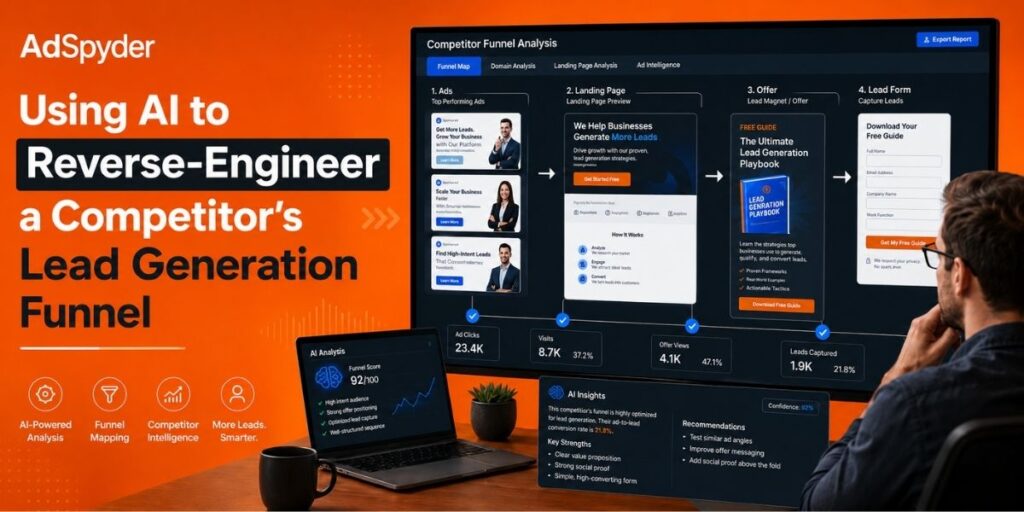
A competitor’s paid funnel leaves observable clues: ads, keywords, landing-page destinations, headlines, offers, proof, CTAs and forms. AdSpyder’s Domain Analysis and Landing Page Analysis can connect those clues into a practical research workflow. AI then helps organize the evidence, compare patterns and turn gaps into testable ideas rather than guesses.
1 · Ad
What earns the click?
Audience, pain, hook and promise.
2 · Page
What continues the promise?
Headline, hierarchy, proof and UX.
3 · Offer
Why act now?
Demo, audit, trial, report or quote.
4 · Form
What is the commitment?
Fields, qualification and next step.
Why Reverse-Engineer a Funnel Instead of Guessing?
Starting from a blank page creates dozens of subjective decisions. Should the offer be a demo or audit? Should the page educate first or push directly to a form? Does the market respond to cost, speed, risk reduction or another angle?
Competitor research narrows those questions. It does not tell you which competitor is profitable, what its conversion rate is or whether its funnel will work for you. Instead, it reveals observable patterns worth testing. That distinction matters: reverse-engineer the logic, not the competitor’s copy, creative or design.
Step 1 — Find the Competitor’s Live Advertising Strategy
Begin with a competitor domain rather than a broad keyword list. In AdSpyder Domain Analysis, enter the domain or a specific URL and review its visible cross-platform ad presence, keyword activity, ad copies, geographic activity and landing-page destinations.
| Observation | Question to Ask | Funnel Clue |
|---|---|---|
| Ad headline | What pain or outcome gets attention? | Hook |
| Keyword theme | What intent is being targeted? | Audience stage |
| CTA | How much commitment is requested? | Next step |
| Destination | Where does the click actually go? | Funnel stage |
AI Prompt
“Group these competitor ads by audience, pain point, offer, proof and CTA. Show repeated patterns separately from one-off messages. Do not assume performance from ad visibility.”
Step 2 — Analyze the Landing Page Structure
The ad tells you why someone clicked. The landing page shows how the competitor attempts to convert that interest.
AdSpyder’s Landing Page Analysis provides landing-page screenshots, historical views and ad-to-page pairing so you can compare the visible page structure with the promise that generated the click.
Above the Fold
Headline, promise, audience callout and primary CTA.
Proof
Reviews, customer logos, case studies, guarantees or product evidence.
Objection Handling
Pricing, process, FAQs, comparisons and risk reducers.
Conversion Path
CTA placement, form position, fields and next-step expectation.
Do Not Start by Asking “Which CTA Converts Best?”
AdSpyder’s 2026 landing-page research analyzed destination patterns across 167.9 million Google Search ads. Pricing paths appeared more frequently than signup or free-trial destinations, while different industries and funnel stages used very different next steps.
The useful lesson is not that every company needs a pricing page. It is that the CTA must match the visitor’s decision stage. Review the full landing page CTA data before treating a popular button label as a universal answer.
Step 3 — Reverse-Engineer the Offer and Form
Now move from page design to conversion economics. Ask what the visitor receives in exchange for submitting information.
Offer Formula
Audience + Problem + Useful Outcome + Proof + Appropriate Commitment
Record whether the competitor offers a demo, free audit, quote, calculator, trial, report, consultation or direct purchase. Then inspect the form. How many required fields exist? Are qualification questions used? Does the page explain what happens after submission?
Do not assume a shorter form is automatically better. AdSpyder’s guide to lead generation forms recommends collecting the minimum information needed for the next useful business action while measuring qualified-lead outcomes, not submissions alone.
Step 4 — Build Your Funnel From the Gaps
The goal is not to reproduce the competitor funnel. Your advantage comes from identifying what the competitor leaves unclear, difficult or generic.
| Competitor Pattern | Possible Gap | Original Test |
|---|---|---|
| Generic “Book Demo” | Outcome unclear | Offer a specific diagnostic |
| Long form immediately | High first-step commitment | Test progressive qualification |
| Strong ad, generic page | Message mismatch | Build intent-specific pages |
| Claims without proof nearby | Trust gap | Move relevant evidence closer to CTA |
AI-Powered Competitor Funnel Workflow
Choose 3–5 direct competitors
Prioritize companies selling a comparable solution to a comparable audience.
Run Domain Analysis
Collect ad themes, keywords, platforms, locations and destination patterns.
Analyze landing pages
Map headline, proof, offer, CTA, form and ad-to-page message continuity.
Ask AI to cluster the evidence
Separate repeated market patterns, competitor-specific tactics and obvious experience gaps.
Create and test an original funnel
Test one clear hypothesis using your own audience, proof, offer and conversion data.
Which AI Lead Generation Tool Do You Need at Each Stage?
| Job | Tool Type | Output |
|---|---|---|
| Competitor intelligence | AdSpyder Domain Analysis | Ads, keywords, platforms, destinations |
| Post-click research | Landing Page Analysis | Page structure, CTA, proof, history |
| Pattern synthesis | Generative AI | Clusters and test hypotheses |
| Lead conversion | CRM / follow-up platform | Qualification, routing and nurture |
What Competitor Intelligence Cannot Tell You
You can observe ads, destinations, visible page structure and messaging. You cannot reliably infer a competitor’s private CPL, SQL rate, CAC, CRM outcomes or revenue from those observations. Measure your own funnel using qualified leads, opportunities and customers—not assumptions about competitor profitability.
Stop building lead funnels from a blank page
Map a competitor’s observable ads and landing pages, identify the gaps, then turn the evidence into an original funnel test.
FAQs for AI Lead Generation Tools
What are AI lead generation tools?
They are tools that use AI or automation to support tasks such as prospect research, competitive intelligence, messaging, qualification, outreach, conversion analysis or campaign optimization.
Can AI reverse-engineer a competitor’s funnel?
AI can organize publicly observable ads and landing-page evidence into patterns. It cannot see private conversion data, CRM results or profitability.
What should I analyze in a competitor’s lead funnel?
Map the ad hook, target intent, landing-page headline, proof, offer, CTA, form fields and expected next step.
Should I copy a competitor’s winning funnel?
No. Treat competitor patterns as research inputs. Create original messaging, proof, offers and experiments for your own audience.
How does AdSpyder help with AI-powered lead generation?
AdSpyder provides competitor ad and domain intelligence plus landing-page analysis that can supply structured evidence for research, funnel planning and AI-assisted hypothesis generation.
How do I know whether my new funnel is better?
Measure your own landing-page conversion rate, valid-lead rate, CPQL, SQL rate, opportunity rate, CAC and revenue outcomes. Competitor visibility cannot replace first-party performance data.