AI Ads & Automation
Quick Answer
The most effective way to use an AI ad generator for Facebook ads is to start with competitor data, not a blank prompt. Use AdSpyder’s Facebook Ads Spy to extract which hook patterns, formats, and CTAs are already running in your vertical — then feed those signals into the Image Ad Generator to produce variants grounded in real market data. The Winning Ads AI Agent then scores every variant for persona-fit before you spend a dollar on testing.
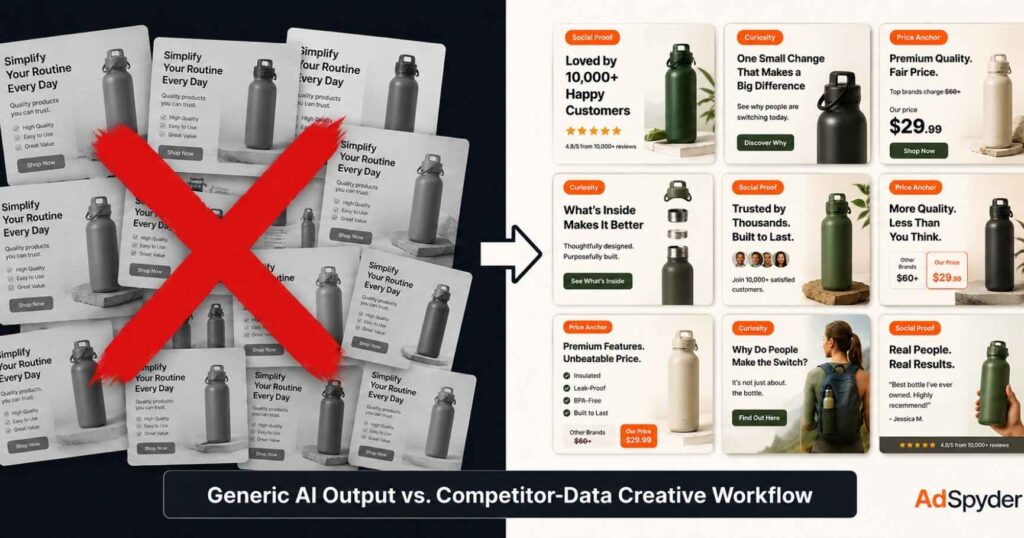
Most AI Facebook ad generators ask for your product, audience, and tone — then produce statistically average output. That is the problem. Your competitors are not average: they have tested angles, cycled through formats, and found hooks that work in your specific market. A generator that ignores that evidence is making your creative decisions faster, not better.
This guide covers a Facebook-specific workflow that starts with 55 million+ real Meta ads, extracts what is actually running in your vertical, and uses that intelligence as the brief for AI generation and scoring. Every number below is from AdSpyder’s archive — not industry surveys, not estimates.
In This Guide
Why Generic AI Facebook Ad Generators Produce Weak Variations
A generic AI Facebook ad generator runs on the same logic every time: product → audience → tone → output. The variations it produces are statistically representative of what language models have learned from large text corpora — which means they reflect an average of everything, not the specific market you are competing in.
Three specific problems follow from this:
You default to whatever angle the model favours
Generic outputs push urgency and discount by default — the same two angles accounting for 29% of all live Meta ads. Your category is already saturated with them.
You pick formats by gut, not by what is running
The Meta format mix has shifted dramatically. Running only static image ads in 2026 means building for the 2020 creative environment, not the current live feed.
You test everything with no pre-screening
Without a scoring layer, every variant gets equal test budget until the algorithm sorts it out — expensive and slow for teams running multiple campaigns at once.
Important: Competitor data should guide your creative strategy, not become a source to copy. The goal is to identify what angles and formats the market is using — and then create your own original variations with that intelligence as the brief.
See What Your Competitors Are Running on Facebook Right Now
48 million+ Facebook-tagged ads. Filter by competitor domain, keyword, format, or country.
What AdSpyder’s Meta Archive Actually Shows (June 2026)
Before generating anything, you need a baseline: what formats, hooks, and CTAs are running across Meta right now. The numbers below come from AdSpyder’s archive of 55 million+ Meta ads — the historical archive covering 2018–2024, and the real-time feed of 11 million+ active ads.
55M+
Meta ads indexed
Facebook and Instagram combined
48M+
Facebook-tagged ads
Historical + real-time archives
19,384
Facebook ad searches
22% of all AdSpyder Ad Library searches
1,613
AI scoring runs
Winning Ads Agent activity to date
Source: AdSpyder platform data, June 2026.
The Format Shift: What the Live Feed Actually Looks Like
The Meta format mix has structurally changed between the historical archive and what is running today. If your creative strategy is based on how Meta ads looked three years ago, it is misaligned with the current environment.
| Format | Historical Archive (43.9M ads) | Live Feed 2026 (11M ads) | Signal |
|---|---|---|---|
| Single Image | 88.6% | 27% | Dominant historically — now a minority |
| Video | 11.7% | 42% | Now the largest single format in the live feed |
| Carousel | — | 30% | Longest-running format — 40% survive 30+ days |
Source: AdSpyder Meta Ads archive. AdSpyder platform data, June 2026.
Carousel longevity advantage: 40% of carousel ads survive 30+ days in AdSpyder’s real-time archive, compared to 26% for video and 23% for single image. If you are building for evergreen performance — not just a campaign burst — carousel is the strongest format to generate first. AdSpyder platform data, June 2026.
Hook Frequency in Live Meta Ads — Which Angles Are Crowded
This is the data that generic AI generators do not have. Every hook type is more common in the live feed than in the historical archive — the overall messaging environment has become denser. Urgency alone nearly doubled. When you are choosing an angle for your AI-generated variations, you are not just asking “what works” — you are asking “how crowded is this angle already?”
| Hook Type | Historical Archive | Live Feed 2025–2026 | Crowding Signal |
|---|---|---|---|
| Price Anchor | 16.9% | 23.2% | Very crowded — 1 in 4 live ads |
| Discount | 15.4% | 15.8% | Crowded — stable at ~16% |
| Urgency | 6.9% | 13.6% | Crowded — nearly doubled, heavily used |
| Free Offer | 8.4% | 13.2% | Crowded |
| Aspiration | 2.5% | 7.2% | Growing — still less crowded |
| Curiosity | 3.8% | 6.8% | Growing — less crowded |
| Social Proof | 2.9% | 6.0% | Growing — less crowded |
| Comparison | 1.1% | 3.4% | Least crowded of all angles |
Source: AdSpyder Meta Ads archive — 43.9M historical + 11M real-time. AdSpyder platform data, June 2026.
On live Meta ads, value-prop language — “trusted,” “guaranteed,” “#1” — appears in 23.3% of ads, slightly ahead of pure offer language at 16.2%. Hybrid ads (both signals) account for 8.9%. Long-running ads (30+ days) use discount language less (12.6% vs 17.0%) and social proof more (2.9% vs 2.1%). The most durable creatives lean on credibility, not promotions. AdSpyder platform data, June 2026.
Your Vertical’s Creative Archetype Is Not What You Think
The “one D2C Facebook strategy” breaks down the moment you look at what is actually running by category. D2C fashion, health/beauty, EdTech, real estate, and SaaS each have a distinct dominant angle, format preference, and competitive pattern. Generating without knowing yours means producing average creative for a market that already has too much average creative.
| Vertical | Ads in Archive | Dominant Format | Top Angles | The Differentiation Gap |
|---|---|---|---|---|
| Fashion / D2C Apparel | 458K+ ads | 66% image | Discount (28.3%), Price anchor (27.7%), Urgency (9.2%) | Social proof and aspiration — both underused vs. a discount-saturated category |
| Health & Beauty | 916K+ ads | 54% video | Price anchor (23%), Discount (17.3%), Urgency (11.8%) | Curiosity and transformation-led aspiration — video-native formats critical here |
| Education / EdTech | 409K+ ads | 62% image | Authority (10.3% — highest of any vertical), Price anchor (19.2%), Aspiration (8.2%) | Discount is only 6.4% — lowest of any vertical. Heavy discounting signals commodity here |
| Real Estate | 315K+ ads | 68% image | Urgency (17.2% — highest of any vertical), Price anchor (23.3%), Aspiration (9.2%) | Aspiration is 2× other verticals — brand-building creative stands out here |
| SaaS / Software | 352K+ ads | 62% image | Benefit, Authority, Free trial | Comparison (3.4% overall but growing) — “switch from X” framing is underused and high-intent |
Source: AdSpyder Meta Ads archive — pageCategory cross-tabs. AdSpyder platform data, June 2026.
Long-running ads use different angles than short-lived ones. In AdSpyder’s archive, ads active for 30+ days use discount language less (12.6% vs 17.0% for short-lived ads) and social proof more (2.9% vs 2.1%). If you are building evergreen creative — not just a sale-period burst — credibility angles outlast promotional ones. AdSpyder platform data, June 2026.
A 5-Step Workflow: From Competitor Data to Scored Variations
This workflow uses three AdSpyder features in sequence: Facebook Ads Spy, Image Ad Generator, and the Winning Ads AI Agent. Each step eliminates a specific source of guesswork in the creative process.
Research competitor Facebook ads in Facebook Ads Spy
Go to Facebook Ads Spy and search your top 2–3 competitors by domain. Look for repeated ads — creatives a brand keeps running have usually tested well. Filter by format to see their image/video/carousel distribution. Also run a category keyword search to surface top advertisers you may not have been tracking.
You can also use the Ad Library to get a cross-platform view — many brands run the same creative positioning on Facebook and Instagram simultaneously, which is useful context for your format decisions.
Extract the pattern, not the wording — and map it against the crowding data
For each competitor ad you review, note: hook type, offer angle, CTA button, format, and the core audience promise. Then cross-reference what you observe with your vertical’s baseline from the table above.
If your competitors are almost entirely running discount hooks in a category where discount is already at 28%, social proof (6%) and aspiration (7.2%) are structurally underused openings. This is the insight generic AI generators cannot give you — it requires knowing both what your competitors are doing and how crowded that angle already is.
Build your variation matrix: angles × formats
Before prompting the generator, map out a 3–4 angle × 2–3 format grid. This ensures your generated set is structurally diverse — not ten headline edits of the same creative strategy. Example for a D2C health brand:
| Angle | Single Image | Carousel | Video Script |
|---|---|---|---|
| Price Anchor | ✓ | ✓ | — |
| Social Proof | ✓ | ✓ | ✓ |
| Curiosity | ✓ | — | ✓ |
| Free Offer | ✓ | — | — |
Generate matched visuals in the Image Ad Generator
Use each cell in your variation matrix as a specific brief — not a generic product description. For each variant, specify: the hook angle, the format, and the CTA. The specificity is the point. A brief grounded in competitor intelligence produces more differentiated output than “write me a Facebook ad for skincare.”
If you also need copy variations alongside visuals, Text Ad Generation runs in parallel — useful for testing headline variants against the same visual creative.
Score every variant with the Winning Ads AI Agent before launch
Run the Winning Ads AI Agent across your generated set. It evaluates each variant for persona-fit and surfaces a shortlist of the strongest options. This gives you a pre-launch filter so you are not putting every variant into paid rotation and waiting for the algorithm to sort it out over three weeks and a meaningful test budget.
What the Winning Ads AI Agent Does — and Does Not Do
The Winning Ads AI Agent has run 1,613 scoring sessions across AdSpyder users, and 78.6% of all generation runs are paired with it. That adoption rate reflects a real gap it fills: the step between “I have 12 variants” and “I know which 4 to actually test.”
What it does
- Scores generated variants for persona-fit against the audience you define
- Surfaces a shortlist of the strongest options
- Reduces the number of variants you need to test with real budget
- Acts as a structured creative review layer before launch
What it does not do
- Predict CTR, ROAS, or conversion rate
- Output a numeric 1–10 score
- Guarantee performance or win rate
- Replace live audience testing
Persona definition matters: The agent matches variants against the persona you define before generating. A vague persona (“D2C shopper”) produces a less useful shortlist than a specific one (“first-time female buyer, 28–35, health-conscious, primarily mobile”). The scoring is only as targeted as the brief you give it. AdSpyder platform data, June 2026.
Generic AI Generator vs. Competitor-Data Workflow
| Workflow | Best For | Main Weakness | Output |
|---|---|---|---|
| Generic AI generator | Quick first drafts with no setup | Starts from language-model defaults, not your specific market | Fast, often generic |
| Manual competitor research | Deep creative analysis | Slow, hard to scale, misses historical patterns | Useful, skill-dependent |
| AdSpyder competitor-data AI workflow | Performance teams, D2C brands, agencies | Still requires live testing — scoring is pre-launch, not predictive | Market-informed, structurally diverse, pre-screened |
Pre-Launch Checklist for AI-Generated Facebook Ad Variations
Stop Generating Blind — Start With the Competition
AdSpyder gives you 55M+ Meta ads, Facebook-specific competitor research, AI creative generation, and persona-fit scoring — all in one workflow. Facebook is the #2 most-searched platform on AdSpyder for a reason.
Try AdSpyder Free — Start With Facebook Ads Spy →
88,035 competitor-ad searches run · 8,663 active monitoring projects · 55M+ Meta ads indexed
Frequently Asked Questions
What is an AI ad generator for Facebook ads?
An AI ad generator for Facebook ads creates copy, headlines, CTAs, and visuals for Meta campaigns. The strongest workflow adds competitor intelligence before generation — so the output is grounded in real market patterns rather than language-model defaults. Without competitor data as the brief, the AI is optimising for the average of everything it has learned, not the specific market you are competing in.
How does competitor data improve AI Facebook ad generation?
Competitor data shows which hook types, formats, and CTAs brands are actively running — and critically, which angles are crowded vs. underused in your vertical. A generic AI generator does not know that urgency is now at 13.6% of all live Meta ads (nearly double its historical rate) or that social proof sits at 6% and is growing but far less saturated. That gap between crowded and underused is where differentiated creative is built.
What hook types are most common on Facebook right now?
Based on AdSpyder’s analysis of 11 million live Meta ads (June 2026): price-anchor at 23.2%, urgency at 13.6%, and free-offer at 13.2% are the three most used. Urgency nearly doubled from the historical archive (6.9%) — it is now heavily crowded. The less saturated growing angles are aspiration (7.2%), curiosity (6.8%), and social proof (6.0%). Value-prop language — “trusted,” “guaranteed,” “#1” — appears in 23.3% of live ads, slightly ahead of pure promotional language.
Does the Winning Ads Agent predict CTR or ROAS?
No. The Winning Ads AI Agent scores variants for persona-fit and surfaces a shortlist — it does not predict CTR, ROAS, or win rate, and does not output a numeric 1–10 score. It is a pre-launch review filter based on audience-alignment, not an outcome predictor. Final performance depends on live testing, targeting, budget, offer, and placement.
What format should I generate for Facebook ads in 2026?
The live Meta feed in 2026 shows 42% video, 30% carousel, and 27% single image — a complete reversal of the historical archive where 88.6% of ads were static images. If you have only been running static creative, carousel is the most practical expansion: AdSpyder data shows 40% of carousels survive 30+ days vs. 26% for video and 23% for single image. The format mix you generate should reflect the live environment, not the 2020 norm.
Which Facebook ad variations should I generate first?
Start with structural variation, not surface-level copy edits. Build a variation matrix: 3–4 different hook types (e.g. discount vs. social proof vs. curiosity vs. free offer) across 2–3 formats (single image, carousel, video). Ten headline rewrites of the same angle test copy execution, not creative strategy. Real creative testing requires genuinely different approaches to the same audience.