Advertising · CRM · Automation · Content
Quick Answer
- AI business software is not one category—choose tools according to the business problem you need to solve.
- Use advertising intelligence when competitor research, creative direction or paid-media decisions are unclear.
- Use CRM and sales AI when lead qualification, follow-up and pipeline management are the bottleneck.
- Use automation and operations AI when repetitive work keeps moving between people, apps and approval steps.
- For the advertising layer, AdSpyder’s AI advertising platform comparison explains which tools fit research, creation and campaign optimization.
Searching for the best AI business software can quickly become confusing. One list recommends a CRM, another recommends ChatGPT, another adds automation software, design tools, meeting assistants, analytics platforms and AI agents—all under the same heading.
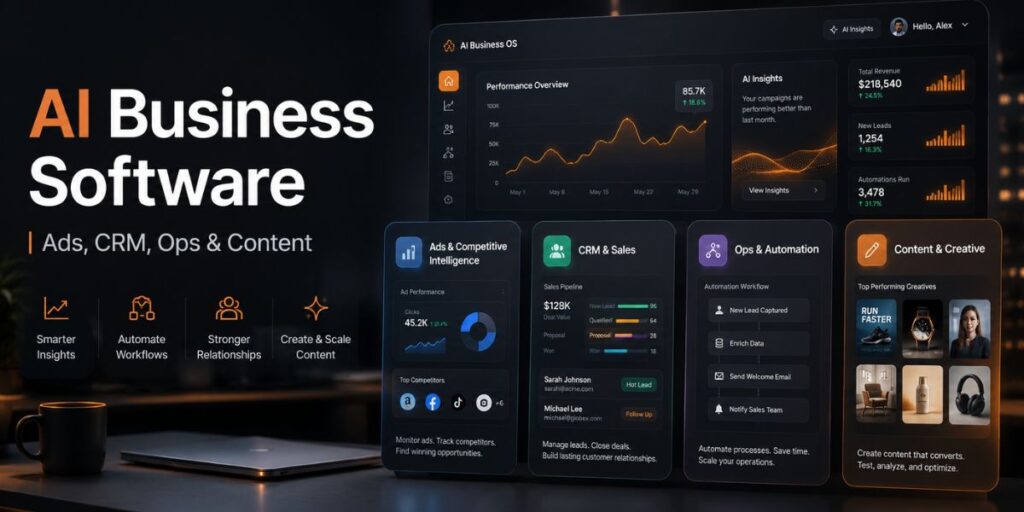
That is the wrong way to build a useful AI stack. In 2026, AI is increasingly embedded inside specialist business software. The better approach is to identify the workflow that needs improvement first, then choose the AI category designed to solve it. For most marketing-led businesses, four categories matter most: Ads & Competitive Intelligence, CRM & Sales, Operations & Automation, and Content & Creative.
Why “AI Business Software” Is Too Broad to Be Useful
AI has moved from being a standalone novelty to becoming a capability inside ordinary business systems. CRM software can summarize interactions and recommend follow-ups. Automation platforms can let agents make decisions between workflow steps. Creative software can generate campaign variations. Advertising platforms can analyse competitors, campaigns and audience signals.
That means two products can both advertise “AI” while solving completely different problems. Comparing them by the number of AI features creates a poor buying decision.
| AI Software Category | Primary Job | Example Tools | Measure Success With |
|---|---|---|---|
| Ads & Competitive Intelligence | Research competitors, campaigns, offers and market signals | AdSpyder, Semrush Advertising Research | Better campaign hypotheses, qualified leads, ROAS |
| CRM & Sales | Manage leads, follow-up and pipeline | HubSpot Breeze, Salesforce Agentforce | Response time, SQLs, opportunities, revenue |
| Operations & Automation | Connect apps and remove repetitive work | Make, Zapier | Hours saved, cycle time, error reduction |
| Content & Creative | Produce and adapt marketing assets | Canva, Adobe Firefly | Production speed, approval rate, campaign performance |
1. Ads & Competitive Intelligence AI
This category matters when the biggest uncertainty exists before a campaign launches. You may know how to run Google or Meta ads but still be unsure which audience, offer, keyword, creative angle or landing-page structure deserves the first test.
AdSpyder belongs specifically in this layer. It is designed around competitor-ad research, market intelligence, keyword analysis, creative patterns and campaign research rather than trying to replace your CRM or operations platform.
Current AI advertising goes much further than generating headlines. AdSpyder’s AI Advertising guide separates AI-created ads, AI-optimized campaigns and ads appearing inside emerging AI-powered discovery experiences. That distinction matters because each requires different data and controls.
Choose this category when: your team spends meaningful money on paid acquisition but still builds too many campaigns from assumptions instead of competitor, keyword and market evidence.
Another important 2026 shift is the rise of conversational advertising. AdSpyder’s AI Search Advertising guide covers how sponsored placements are starting to appear around conversational search and AI-assisted buying journeys, expanding the competitive-intelligence problem beyond traditional search engines.
2. CRM & Sales AI
CRM and sales AI becomes important after a lead exists. If marketing generates enough inquiries but sales representatives cannot research, qualify, prioritize and follow up consistently, adding another marketing content tool will not solve the real problem.
HubSpot Breeze
Useful when CRM records, marketing interactions and customer context already live inside HubSpot. AI can assist with research, summaries, preparation and follow-up while using that existing context.
Salesforce Agentforce
Designed for agentic workflows inside Salesforce, including customer-facing and employee workflows connected to CRM data, permissions and business processes.
The important buying criterion is not how impressive the generated email sounds. Ask whether the tool has accurate customer context, understands your pipeline stages and can measure what happens after the automated action.
For teams considering more autonomous selling workflows, AdSpyder’s AI Sales Agents buying guide compares prospect research, qualification, follow-up and automation while emphasizing qualified meetings and pipeline rather than the number of messages generated.
3. Operations & Automation AI
Operations AI solves a different problem: work already exists, but employees spend too much time moving it between systems. Common examples include copying new leads into a CRM, creating tasks from emails, generating internal summaries, routing requests and waiting for approvals.
Make combines visual automation with AI agents that can use connected applications as tools. This is useful when a process contains both predictable steps and decisions requiring more context.
Zapier plays a similar role across a large app ecosystem, combining traditional trigger-action automation with newer AI and agent-oriented workflows.
Good AI automation candidate: repetitive task + digital inputs + clear output + measurable result.
Poor AI automation candidate: rare, high-risk decision with unclear ownership and no reliable way to verify the result.
Automation becomes particularly sensitive when it starts changing advertising budgets, bids or live campaigns. AdSpyder’s AI Agent for PPC Teams framework separates tasks suitable for AI assistance from decisions where marketers should retain approval control.
That human-review model matters. AI can identify unusual spend, flag inefficient ad groups or recommend a schedule change much faster than a manual audit. The accountable marketer should still decide whether the action fits current budgets, attribution delays and business priorities.
4. Content & Creative AI
Content and creative AI makes sense when strategy is reasonably clear but production capacity is the constraint. Marketing teams commonly use it for social assets, presentations, ad concepts, campaign resizing, image generation, short videos and content repurposing.
| Example Tool | Best Fit | Main Control Needed |
|---|---|---|
| Canva | Fast visual production, templates and collaborative brand assets | Brand consistency and approval |
| Adobe Firefly | Generative image, video and creative-production workflows | Asset rights, model choice and enterprise governance |
The mistake is treating faster production as the end goal. Ten weak creatives produced in five minutes are not better than three useful variations built around a clear campaign hypothesis.
AdSpyder’s AI Ad Optimization workflow connects competitor research, controlled generation, scoring, launch and monitoring so creative volume contributes to learning rather than simply producing more assets.
Where Do ChatGPT, Claude and Microsoft Copilot Fit?
General AI assistants are best thought of as a horizontal productivity and reasoning layer. They can help analyse information, summarize documents, write drafts, develop ideas, prepare briefs or interpret datasets across many departments.
They do not automatically replace the specialist systems underneath the business. ChatGPT is not your CRM simply because it can draft a sales email. Claude is not an advertising database because it can analyse pasted ads. Copilot is not automatically your workflow engine because it can summarize an internal document.
The best stack usually combines a capable general assistant with specialist software that owns the relevant data and action. That is also why AdSpyder’s AI Performance Marketing framework emphasizes reliable campaign signals and measurable outcomes rather than AI output volume.
Do You Need One Tool From Every Category?
No. Small teams often create unnecessary complexity by buying several AI platforms simultaneously because each looks useful in isolation.
Instead, map your existing stack before buying anything:
- Which tools already contain your customer and campaign data?
- Which AI features are already included in subscriptions you pay for?
- Where are employees repeatedly doing manual work?
- Where are decisions being made without enough data?
- Which workflow has a measurable financial outcome?
- Which new tool could replace an existing subscription rather than becoming another one?
How to Decide Which AI Business Software to Buy First
| Your Current Problem | Best Category to Test | First KPI |
|---|---|---|
| “We do not know what competitors are advertising.” | Ads & Competitive Intelligence | Research speed + campaign test quality |
| “Marketing sends leads but sales follow-up is inconsistent.” | CRM & Sales | Lead response time + SQL rate |
| “Staff repeatedly move information between apps.” | Operations & Automation | Hours saved + error rate |
| “Campaign ideas are ready but production is too slow.” | Content & Creative | Approved asset output + production time |
A Better 30-Day AI Software Evaluation Process
Week 1 — Define the bottleneck
Document the current workflow, people involved, tools used, time consumed and measurable problem. Do not start with the software demo.
Week 2 — Test one real workflow
Use real business data where privacy and permissions allow. Avoid judging software entirely from vendor-provided demo scenarios.
Week 3 — Measure useful output
Measure whether the workflow became faster or produced better outcomes. Track corrections, failed outputs and manual intervention as well as successes.
Week 4 — Decide whether to scale
Compare subscription and usage cost against the value created. Scale only if the tool improves the original bottleneck without introducing unacceptable complexity.
What Is Changing in AI Business Software in 2026?
The biggest change is not simply better generation. Business AI is moving toward agents that can use tools, retrieve context and perform multi-step work. That makes governance, permissions and measurement more important than before.
Advertising is changing too. AdSpyder’s AI Advertising Trends 2026 tracks the movement toward conversational ad placements, native creative generation, AI agents and stronger transparency controls across advertising platforms.
For buyers, this means the best AI software will increasingly be judged by what it can safely do with business context—not just what it can generate from a prompt.
AI Business Software Buying Checklist
☐ Business bottleneck is clearly defined
☐ Existing software has been reviewed first
☐ Required data is available and reliable
☐ Integration with core systems is possible
☐ AI usage costs are understood
☐ Privacy and permissions have been reviewed
☐ Human approval rules are documented
☐ Success KPI exists before purchase
☐ Team ownership is assigned
☐ Pilot will happen before full rollout
☐ Duplicate software can be removed
☐ Exit/export process is understood
Final Verdict: Buy the Workflow, Not the AI Label
There is no single best AI business software package for every company. A business with weak paid-media intelligence needs a different tool from a company struggling with sales follow-up. A company drowning in repetitive internal work needs something different again.
Start with one expensive bottleneck. Choose the specialist category designed to solve it. Measure whether the workflow improves. Then expand only when another clearly defined problem justifies another tool.
For marketing teams whose immediate problem is deciding what to advertise, which competitors to study and which campaign hypothesis deserves budget, AdSpyder belongs in the Ads & Competitive Intelligence layer—not as a replacement for CRM, automation or creative-production platforms.
Need better paid-market intelligence before your next campaign?
Use AdSpyder to understand competitor advertising activity, campaign patterns and market signals before deciding what your team should test.
Frequently Asked Questions
AI business software uses machine learning, generative AI or AI agents to improve business activities such as advertising, customer management, sales, operations and creative production.
There is no universal best product. Choose according to the business problem: AdSpyder for advertising intelligence, CRM AI for lead management, automation tools for repetitive operations and creative AI for production.
Start with the software linked to the most expensive measurable bottleneck. Do not buy multiple AI tools at once simply because each offers useful features.
ChatGPT is useful as a general reasoning and productivity assistant, but specialist systems remain important for CRM records, competitive intelligence, automation, permissions and operational execution.
Traditional automation follows predefined steps. AI agents can interpret context and choose among allowed actions. Many modern business workflows combine deterministic automation with agentic decisions and human approval.
AdSpyder fits in the advertising and competitive-intelligence layer. It helps marketers research observable competitor ads, market signals and campaign patterns before deciding what to test in paid acquisition.