Quick Answer
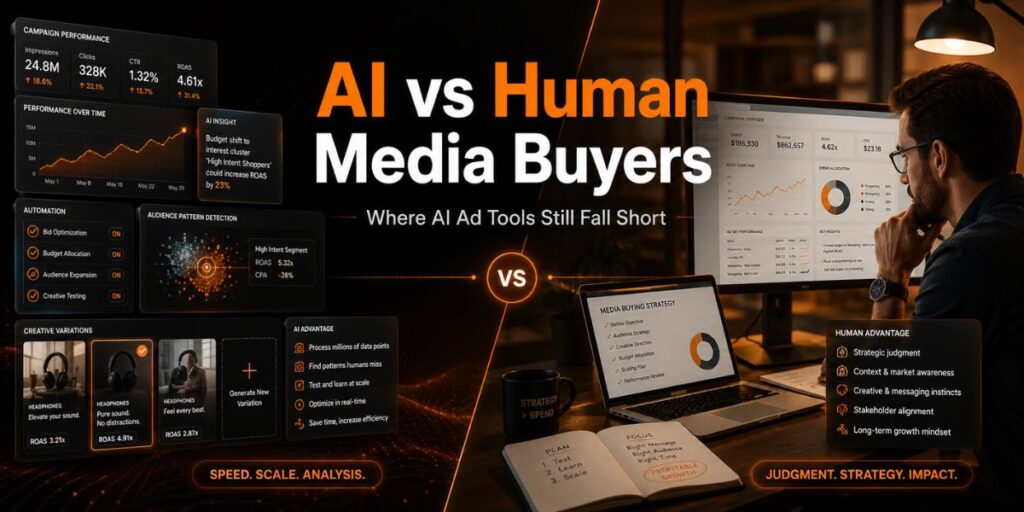
- AI wins on speed: research, pattern detection, reporting and creative variation.
- Humans win on context: brand judgment, economics, trade-offs and unusual situations.
- AI can recommend budget changes but does not know every business constraint behind the numbers.
- Relationship-heavy negotiations and high-risk decisions still benefit strongly from people.
- Best model: AI handles repetitive analysis; media buyers keep strategy and approval.
AI advertising is changing what media buyers spend their time on, but it is not removing the need for media-buying judgment. The useful shift is from manually finding every pattern to deciding which patterns deserve action. AI can scan faster than a person; a strong media buyer still decides whether the recommendation makes commercial, creative and brand sense.
Where AI Helps — and Where It Stops
The “AI Replaces Media Buyers” Narrative Is Overstated
Media buying contains two very different kinds of work.
| Repeatable Work | Judgment-Heavy Work |
|---|---|
| Finding anomalies | Deciding whether the anomaly matters |
| Grouping competitor creatives | Choosing the strategy worth responding to |
| Creating headline variations | Approving claims and brand tone |
| Flagging high CPA | Deciding whether to cut, fix or tolerate it |
| Forecasting based on past data | Handling a new situation with weak historical data |
AI is moving quickly into the left column. The right column is where experienced buyers continue to earn their value.
What Media Buyers Actually Want AI to Do in 2026
93%
already use or are likely to use agentic AI for performance analysis and outcome insights.
91%
for creative testing, selection or optimization.
84%
for media planning and buying recommendations.
45%
for direct I/O deal execution and negotiations.
Source: IAB 2026 Outlook Study. Percentages are among respondents aware of agentic AI ad buying/campaign execution.
That gap is revealing. Buyers are comfortable giving AI analytical work and recommendations much faster than they are handing over relationship-based negotiations. IAB’s July 2026 digital-video research also found that 40% of buyers specifically wanted humans in the loop, while buyers also asked for AI audit trails and guardrails.
Where AI Genuinely Wins: Speed, Scale and Pattern Detection
1. Competitor Research at Scale
A media buyer can manually review dozens of competitor ads. Software can search much larger archives, group ads by domain or keyword, identify platform activity and surface recurring creative patterns faster.
AdSpyder’s Ad Analytics currently supports domain campaigns, keyword analysis, geographic distribution, day-hour cohorts, funnels and cross-platform intelligence across 15+ advertising platforms.
2. Performance Monitoring
Machines are excellent at repeatedly checking large tables for patterns such as:
- CPA rising above a threshold
- Spend with zero conversions
- ROAS falling below target
- Search-term waste
- Unexpected pacing
- Creative fatigue or regional differences
This is where AI frees a media buyer from spending Monday morning hunting for problems that software could have flagged overnight.
3. Creative Variation
AI can turn one approved hypothesis into multiple headlines, image concepts or platform-specific versions quickly. The recent AI-generated vs human-written ads comparison is a useful reminder that generation speed and strategic quality are different questions.
Where Human Media Buyers Still Win
1. Budget Trade-Offs Under Uncertainty
Imagine Campaign A has a ₹1,200 CPA and Campaign B has a ₹900 CPA. The algorithm prefers B.
But the buyer knows:
- Campaign A generates higher-margin customers.
- Sales closes its leads twice as often.
- Inventory for Campaign B is almost exhausted.
- Campaign A enters a strategically important new market.
CPA alone cannot make that business decision. AI becomes better only when those deeper signals are available, clean and included in the optimization objective.
2. Nuanced Brand Voice and Risk
An AI tool can produce twenty ads that are grammatically correct and commercially aggressive. A human still needs to recognize when a claim is technically true but wrong for the brand—or risky in a regulated category.
- Can we legally make this claim?
- Does the tone fit our positioning?
- Will the customer misunderstand the offer?
- Are we creating short-term CTR at the cost of trust?
- Would leadership be comfortable seeing this ad publicly?
3. Relationship-Based Negotiation
Platform representatives, publishers, direct inventory sellers and agency partners sometimes create options that do not exist inside a dashboard—beta access, added-value inventory, custom packages, commercial flexibility or troubleshooting help. IAB’s data showing much lower AI appetite for direct-deal negotiations reflects that reality.
4. Knowing When the Data Is Lying
A system can optimize beautifully against a broken conversion event. A media buyer asks why lead volume doubled overnight, checks CRM quality and discovers that a thank-you page fires twice. Automation makes good data powerful—and bad data dangerous faster.
The real media-buying skill in 2026
It is becoming less important to manually calculate every answer. It is becoming more important to know which question to ask, which signal to trust and which recommendation not to accept.
What a Hybrid AI + Human Media Buying Workflow Looks Like
| Stage | AI Role | Human Role |
|---|---|---|
| Research | Surface competitors and patterns | Choose which pattern matters |
| Planning | Model scenarios and recommend allocation | Set economics, risk and priorities |
| Creative | Generate controlled variants | Approve concept, claim and brand fit |
| Optimization | Flag anomalies and recommend changes | Approve, reject or modify |
| Measurement | Summarize performance patterns | Connect campaign metrics to business reality |
The recent AI performance marketing guide follows the same principle: automate repetitive analysis and controlled execution, but keep minimum data requirements, budget caps, attribution lag and rollback rules visible.
How to Use AdSpyder Without Losing Strategic Control
AdSpyder works best here as a research and augmentation layer, not a substitute for the person responsible for media economics.
1. Let Analytics Reduce the Search Work
Use Ad Analytics to inspect domain activity, keywords, platform distribution, geography, landing pages and day-hour patterns. The system can narrow a large market into a smaller set of questions worth investigating.
2. Turn the Signal Into a Human Hypothesis
Example
AI signal: three competitors increased comparison-led creative.
Human interpretation: buyers may need more proof before conversion.
Test: create one comparison-style ad and matching landing-page section.
Decision metric: qualified conversion rate—not CTR alone.
3. Keep Approval Gates
AdSpyder’s current PPC agent workflow is designed around review before live changes. That matters because a recommendation can be statistically reasonable and still be commercially wrong.
For a deeper breakdown, the recent AI Agent for PPC Teams guide separates the work each agent can automate from the decisions a buyer still owns.
Before Letting AI Make a Media-Buying Decision, Check This
Use AI to see more—not to stop thinking.
Let AdSpyder accelerate competitor research, keyword analysis and campaign diagnosis while your media team keeps control of strategy, economics and approvals.
Final Verdict: AI Will Change Media Buyers More Than Replace Them
The strongest media buyer in an AI-heavy advertising market will not be the person who refuses automation—or the person who accepts every recommendation.
It will be the buyer who lets machines handle high-volume analysis, repetitive monitoring and variation while keeping human control over business trade-offs, unusual situations, brand judgment, negotiations and final accountability.
FAQs for AI vs Human Media Buyers
Will AI replace media buyers?
AI is likely to automate more research, reporting, bidding and optimization tasks, but strategy, business economics, brand judgment, negotiation and accountability still require meaningful human involvement.
What is AI best at in advertising?
AI is especially useful for analyzing large datasets, detecting patterns, generating creative variations, identifying performance anomalies and producing recommendations quickly.
What should AI not control alone?
High-risk budget changes, unsupported advertising claims, unfamiliar market situations, relationship-heavy negotiations and decisions based on incomplete or unreliable conversion data should retain human oversight.
Can AI allocate advertising budgets?
Yes, AI can recommend or automate budget allocation using defined objectives and historical data. Human buyers should still account for margins, inventory, sales capacity, strategy and risks that may not be represented in the campaign dataset.
Is an AI advertising agency the same as an AI advertising platform?
No. An AI advertising agency generally provides managed strategy and campaign services. An AI advertising platform provides software for tasks such as research, generation, optimization, measurement or automation.
How should media buyers use AdSpyder?
Use AdSpyder to accelerate competitor research, ad analysis, keyword intelligence, funnel investigation and optimization recommendations. Treat the output as evidence for better decisions rather than a replacement for strategic judgment.