
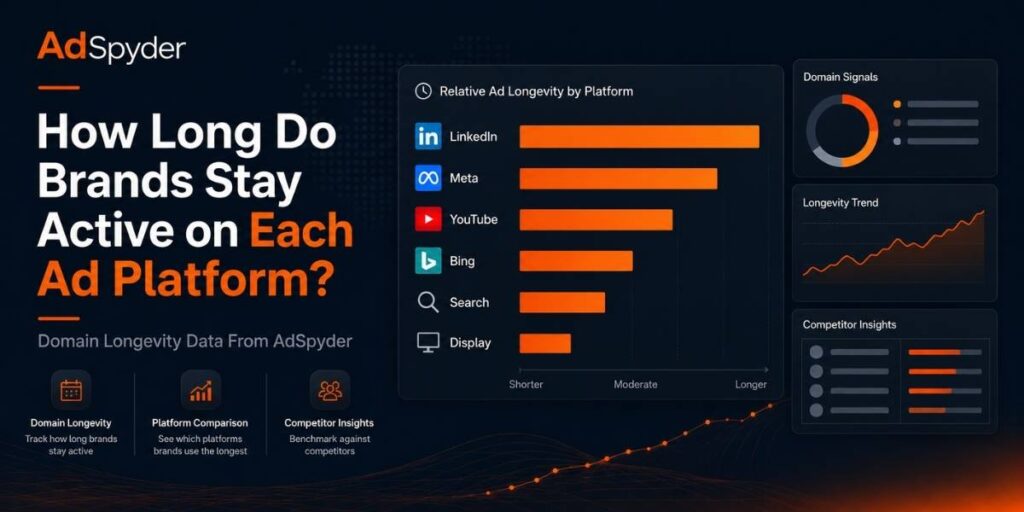
Quick answer: If you want to know how long brands run ads, AdSpyder’s observed data shows LinkedIn ads stay active longest: a 43.3-day median and 70.7% observed for 30+ days. Meta and YouTube sit in the middle, while Google Search, Bing and Display refresh much faster. Use URL Domain Analysis to compare this benchmark with a specific competitor.
Brand managers often treat every ad platform as if it follows the same campaign rhythm. The data says otherwise: some platforms keep creatives visible for weeks, while others turn over ads in days or even within the same observation date.
This AdSpyder Original compares observed ad lifespan across six platforms using median duration, mean duration and the share of ads that remain observable for at least 30 days. It measures creative persistence, not spend, CTR, ROAS or confirmed campaign end dates.
Table of contents
Brand ad platform longevity: the key data
LinkedIn median observed lifespan
LinkedIn ads observed for 30+ days
Display ads observed for 30+ days
| Platform | Median observed days | Mean observed days | Observed 30+ days | Practical pattern |
|---|---|---|---|---|
| 43.3 | 75.3 | 70.7% | Longest lifecycle | |
| Meta real-time | 4.0 | 52.4 | 29.8% | Fast testing with a long tail |
| YouTube | 5.1 | 30.3 | 22.1% | Short median, durable winners |
| Bing | 0.0 | 10.8 | 8.1% | Mostly short observed runs |
| Google Search | 0.0 | 6.5 | 4.9% | High creative turnover |
| Display | 0.0 | 0.5 | 0.2% | Fastest observed refresh |
How to read zero-day medians: a median of 0.0 means at least half of the ads had the same first-seen and last-seen date in the archive. It does not prove that every campaign was stopped within one day.
Source: AdSpyder platform analysis, June 2026. Lifespan is calculated from observed first-seen and last-seen dates.
Check whether a competitor is persistent or just testing
Enter a domain, map its platform presence and inspect the ads behind the pattern.
What does the lifespan pattern signal on each platform
LinkedIn: the persistence platform
LinkedIn is the clear outlier. Its 43.3-day median is more than ten times Meta’s four-day median, and 70.7% of ads remain observable for at least 30 days. That 30-day survival rate is 2.4 times Meta’s and more than 14 times Google Search’s.
For brand managers, the practical takeaway is simple: do not judge a competitor’s LinkedIn strategy from one weekly snapshot. Use the LinkedIn Ad Library to review messaging that remains visible across a longer buying cycle.
Meta: fast experimentation plus durable exceptions
Meta has a four-day median but a 52.4-day mean. That gap reveals a skewed distribution: many ads disappear quickly, while a smaller group remains observable for much longer.
The useful research target is not every new creative. It is the minority that survives repeated refresh cycles. Search a competitor in Facebook Ads Spy, then compare first-seen and last-seen dates before treating an idea as persistent.
YouTube: a short median with a meaningful long tail
YouTube’s median is 5.1 days, but its mean reaches 30.3 days and 22.1% of ads cross the 30-day mark. This suggests a portfolio where many videos are tested briefly and a smaller set keeps running.
Use the YouTube Ads Spy to separate one-off launches from repeatable video concepts.
Search and Display: expect frequent turnover
Google Search, Bing and Display all have zero-day medians in the observed dataset. Their means are also much lower: 6.5 days for Google Search, 10.8 for Bing and 0.5 for Display.
This does not automatically mean weak campaigns. Search advertisers can rotate copy, keywords, geographies and landing pages without abandoning the underlying offer. Review repeated themes in Google Ads Spy rather than expecting one unchanged ad to remain visible for months.
How brand managers should use ad longevity data
Ad longevity is most useful as a confidence-ranking signal. A creative observed for 60 days deserves more attention than one observed once, but duration alone cannot tell you why it stayed active.
| Observed pattern | What it may indicate | Your next check |
|---|---|---|
| Many short-lived ads | Rapid testing, local variants or frequent copy rotation | Find repeated hooks, offers and landing pages |
| A few long-running ads | A durable control creative or evergreen message | Compare its angle with newer variants |
| Long presence across platforms | Consistent category investment or an always-on acquisition model | Check whether the same offer and landing page persist |
Do not call a long-running ad a winner without performance data. AdSpyder shows persistence and creative history, not the advertiser’s private CTR, conversion rate, spend or ROAS.
How to measure a competitor’s ad platform commitment
Enter the competitor domain
Open AdSpyder URL Domain Analysis and enter the main domain, not a campaign-specific tracking URL.
Map its platform distribution
Record where the domain has an observable ad presence. Separate core channels from platforms that show only occasional activity.
Inspect creative-level dates
Open the platform-specific results and compare first-seen with last-seen dates. Look for repeated 30+ day creatives, not a single isolated example.
Classify the strategy
Label the competitor as persistent, burst-led or mixed on each platform. Compare its pattern with the benchmark instead of applying one universal duration rule.
Best practice: review the same competitors on a fixed monthly cadence. A single snapshot shows ads; repeated snapshots show commitment.
Methodology and Limitations
AdSpyder stores observed ads with platform, advertiser identifier, creative content, country, first-seen date and last-seen date. The platform benchmark compares the elapsed observation period for ads where comparable lifespan data was available.
- Median shows the midpoint and limits distortion from extreme long-runners.
- Mean shows how much a smaller long-running group pulls the average upward.
- 30+ day share makes persistence easier to compare across platforms.
- Last-seen means last observed by AdSpyder, not a confirmed stop date from the advertiser.
- Creative longevity is not identical to domain longevity. A brand can remain active while rotating individual ads.
The published comparison includes LinkedIn, Meta real-time, YouTube, Bing, Google Search and Display. Platforms without a directly comparable lifespan dataset were not forced into the table.
Competitor longevity analysis checklist
☐ Use the main advertiser domain.
☐ Record every platform with observable activity.
☐ Compare first-seen and last-seen dates.
☐ Separate one-off ads from repeated long-runners.
☐ Check whether offers, hooks and landing pages persist.
☐ Recheck monthly before calling a platform “core” or “experimental.”
FAQs for How Long Brands Run Ads
What is brand ad platform longevity?
It is the length of time an advertiser’s creatives remain observable on a platform. The strongest analysis combines creative dates with repeated domain-level activity.
Which platform has the longest observed ad lifespan?
LinkedIn leads this dataset with a 43.3-day median, a 75.3-day mean and a 70.7% 30-day survival rate.
Does a long-running ad prove that it performs well?
No. It is a useful persistence signal, but it does not prove revenue, conversions, CTR or ROAS.
Why do Google Search, Bing and Display show a zero-day median?
At least half of the observed ads on those platforms had matching first-seen and last-seen dates. This can reflect rapid turnover or observation timing; it is not proof of an exact one-day campaign.
Can I compare ad longevity for a specific competitor?
Yes. Start with URL Domain Analysis, identify the active platforms, then inspect individual ads and their first-seen and last-seen dates.
Does AdSpyder show the exact campaign end date?
No. The last-seen date is the last time AdSpyder observed the ad, not a confirmed end date from the advertiser’s ad account.
See how long your competitors stay active
Map a domain’s platform presence, inspect active and recently observed campaigns, and find the messages competitors keep using.