Business Impact / Paid ROI
Quick Answer
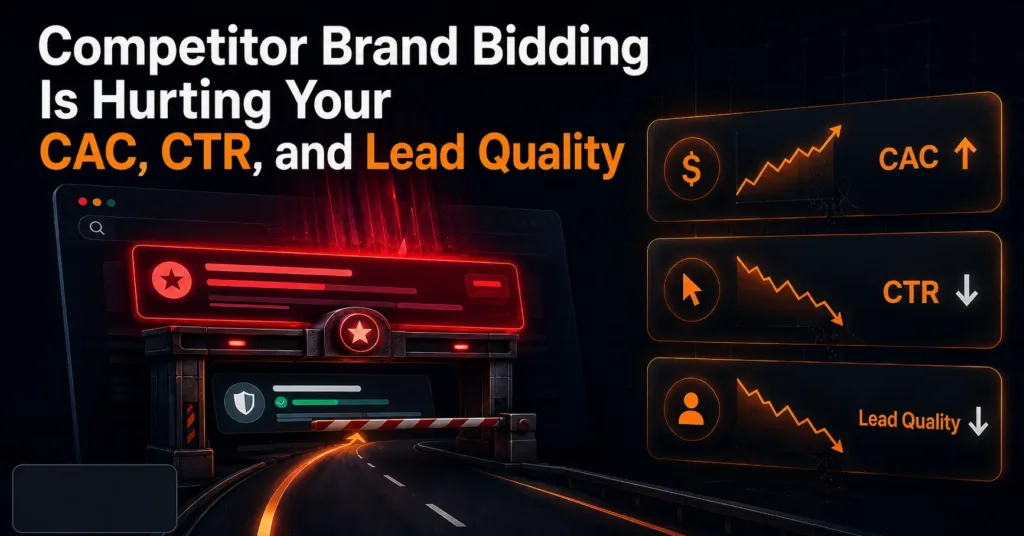
When competitors bid on your brand keywords, they intercept your highest-intent traffic, inflate your branded CPC, and dilute your lead quality simultaneously. In May 2026, the Delhi High Court made this illegal for registered Indian trademarks — ruling in Hindware Ltd. v. Google LLC that even invisible backend keyword use is trademark infringement. AdSpyder’s analysis of 8.5 million Google Search ads shows 13.1% of brand-keyword ads already come from competitors — and for brands like Netflix and Booking.com that figure exceeds 70%. Use AdSpyder’s PPC Analysis to see who is appearing on your brand searches right now — and build the evidence to act.
Your branded keywords are supposed to be your safest spend. The user already knows your name — they typed it. Conversion rates on brand terms run 3–5× higher than generic keywords. Your branded campaign should be your lowest-CAC acquisition channel.
So why is your branded CAC climbing? Why is impression share dropping on terms you’ve owned for years? Why are leads from branded campaigns converting worse than 18 months ago?
In most cases, the answer is sitting above your ads on the SERP. Competitors are bidding on your brand keywords. And in May 2026, that practice became headline news — not just a PPC irritation — when the Delhi High Court ruled it illegal for registered Indian trademarks.
This blog covers the business impact in full: what the Hindware ruling means, what AdSpyder’s data across 8.5 million ads reveals about the scale of the attack, and exactly how it inflates your CAC, kills your CTR, and leaks your lead quality before you even know it’s happening.
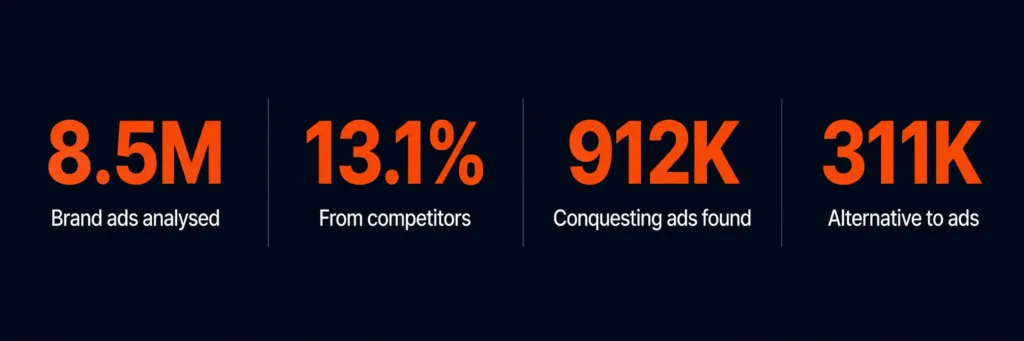
8.5M
Google Search ads analysed
Across 25 major brand keyword auctions — brand name visible in headline
13.1%
of brand-keyword ads are from competitors
A floor figure — invisible keyword-only bidding is not counted
164.7M+
Google Search ads indexed
AdSpyder platform data, May 2026
Banned
in India — May 2026
Delhi HC Hindware ruling — registered trademarks now protected
In This Article
The Ruling That Changed Everything: Hindware Ltd. v. Google LLC, May 2026
On May 22, 2026, Justice Mini Pushkarna of the Delhi High Court delivered a 163-page judgment in Hindware Ltd. v. Google LLC [CS(COMM) 591/2017]. The court permanently restrained Google from allowing competitors to use “HINDWARE” — or any deceptively similar variation — as a Google Ads keyword, and ordered ₹30 lakh in nominal damages.
The case had been running for nine years. Hindware’s competitors — Grohe India and Cera Sanitaryware — had been buying its registered trademark as a Google Ads keyword, causing sponsored competitor ads to appear above Hindware’s own organic result every time a customer searched the brand name. Grohe and Cera settled during the case. Google contested it all the way — and lost.
The ruling raises a fundamental question: brands were often not paying to acquire new customers through branded search. They were paying to defend customers they had already acquired. The consumer had already seen the billboard. Already watched the commercial. Already remembered the brand name. Yet at the final moment — the search bar — another payment was required. The court found Google had been operating a toll booth on a road the brand itself had built.
Four findings every CMO and legal team needs to know:
1. Invisible keyword use equals trademark infringement
The brand name never needs to appear in the visible ad. The court held that using a trademark as a keyword to trigger an advertisement constitutes “use in advertising” under Section 29(6)(d) of the Trade Marks Act, 1999 — regardless of whether the trademark visibly appears in the final ad text. “Invisible use of trademark to divert the traffic from proprietors’ website to the advertisers’ website shall amount to use of the mark for the purpose of Section 29.” — Justice Mini Pushkarna.
2. Google lost its safe harbour protection
Google’s defence rested on one argument: “We’re just an intermediary. We don’t control what advertisers bid on.” The court didn’t accept it — because Google runs keyword auctions, operates the bidding system where advertisers compete for specific search terms, and Google’s Keyword Planner actively suggests branded terms to advertisers. Active participation and direct revenue from each click stripped Google of Section 79 IT Act safe harbour entirely.
3. Both the advertiser and the platform face liability
Advertisers bidding on a competitor’s registered Indian trademark face direct legal exposure — not just Google. The ruling doesn’t leave competitors hiding behind platform policies. If you’re a brand that has suffered from this in India, you now have legal grounds against both the bidding competitor and the platform enabling it.
4. The precedent is binding across India
By holding that the use of a rival’s trademark as an advertising keyword can amount to infringement, the court has put competitor keyword advertising under the spotlight, potentially affecting startups, D2C brands, fintech firms and SaaS companies that depend heavily on online customer acquisition. The Delhi High Court ruling is binding precedent within its jurisdiction and highly persuasive across other Indian High Courts.
163
Pages in the judgment
₹30L
Nominal damages to Hindware
9 yrs
Google contested and lost
Sec 29
Trade Marks Act, 1999
Source: Hindware Ltd. v. Google LLC & Ors., CS(COMM) 591/2017 & 592/2017, Delhi High Court, May 22, 2026.
Important caveat
The Hindware ruling is a single-judge Delhi High Court order. It is binding within its jurisdiction and highly persuasive across Indian High Courts — but it is not a Supreme Court ruling and may be challenged on appeal. Consult a qualified IP attorney before formal legal action. Nothing in this blog is legal advice.
AdSpyder has published a full legal breakdown of the case timeline, every key finding, and what Indian brand owners should do now: Delhi HC Brand Bidding Ruling 2026: What Hindware vs Google Means for Every Indian Brand →
What the Ruling Changed for Indian Brand Owners
| Action | Before the ruling | After the ruling |
|---|---|---|
| Google trademark complaint | Ineffective for invisible keyword use — Google’s policy only restricted visible ad-copy use | Google faces legal exposure for non-action; complaint carries significantly greater leverage |
| Legal notice to competitor | Grey area — competitors could argue invisible keyword use was not trademark infringement | Invisible keyword use is confirmed infringement. Legal notice carries binding weight |
| Court injunction | Contested legal basis; typically years of proceedings with uncertain outcome | Binding precedent; interim injunction applications now on significantly stronger footing |
| Platform demand letter | Google invoked Section 79 IT Act safe harbour to dismiss liability | Safe harbour stripped where platform actively suggests trademarked keywords and profits from them |
Free Brand Audit
See who is bidding on your brand — and build evidence to stop it
AdSpyder indexes 164.7M+ Google Search ads across 100+ countries. Search your brand name and see exactly which competitors are running ads — their copy, their landing pages, their full ad history — ready to export as evidence under the Hindware precedent.
The Scale of the Attack: What 8.5 Million Brand Ads Reveal
The Hindware ruling matters because the problem it addresses is enormous. AdSpyder analysed 8,523,737 Google Search ads across 25 of the world’s most-searched brand keyword auctions — counting only ads where the brand name appeared visibly in the ad headline (the legally riskier subset). One in every eight of those ads came from a non-brand advertiser.
That’s 912,951 competitor ads appearing where your brand name should have owned the space. And this is a floor estimate: competitors who bid on your brand keyword without using your brand name in the headline are invisible to this analysis. The real-world rate of brand-keyword targeting is higher.
| Brand | Industry | Total Brand Ads | Competitor Share | Who Is Bidding |
|---|---|---|---|---|
| Netflix | Streaming | 57,001 | 72.1% | VPN providers, rival streaming services |
| Booking.com | Travel OTA | 348,582 | 69.9% | Agoda, Trivago, MakeMyTrip, Goibibo |
| Samsung | Consumer Electronics | 747,122 | 54.4% | Amazon, Croma, Trendyol — resellers |
| Nike | Footwear / Apparel | 824,734 | 47.5% | ASOS, JD Sports, Farfetch |
| Disney | Streaming / Entertainment | 373,538 | 22.3% | Alternative streaming, VPN services |
| Adobe | Design SaaS | 302,379 | 15.1% | Filmora, Wondershare — direct alternatives |
| Shopify | E-commerce SaaS | 155,535 | 13.3% | Ecwid, competing e-commerce platforms |
| Mercado Libre | Marketplace (LATAM) | 614,546 | 0.0% | Near zero — platform dominance as natural defence |
Source: AdSpyder Google Search Ads archive — 25-brand sample (8.5M ads), May 2026. Counts only ads with brand name visibly in headline.
The floor problem
These figures only capture ads where the competitor used your brand name visibly in their headline — the legally riskier behaviour. Competitors who bid on your brand keyword as a trigger but never show your name in ad copy are invisible to this dataset. The real rate of brand-keyword targeting in competitive markets is higher than 13.1%.
How Competitor Brand Bidding Inflates Your CAC
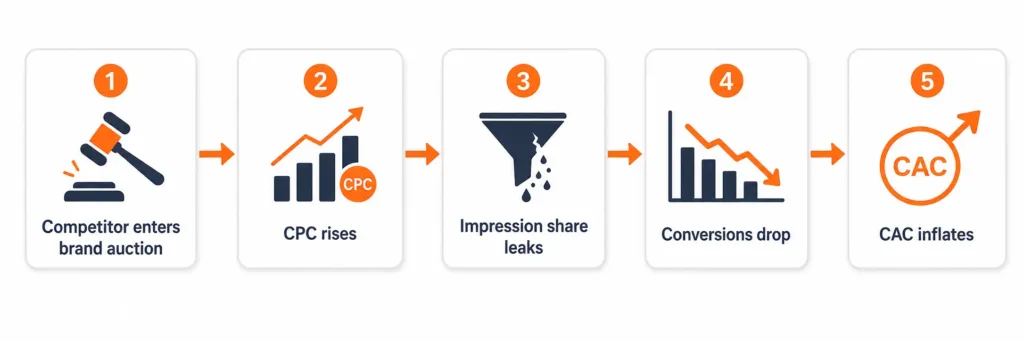
CAC inflation from competitor brand bidding follows a specific, compounding sequence. It doesn’t arrive as a single dramatic event — it accumulates quietly quarter by quarter, which is why most teams don’t catch it until the damage is already reflected in board-level numbers.
Here is the exact mechanism, step by step:
A competitor enters your brand auction
One or more competitors start bidding on your brand keyword. Google’s second-price auction now has multiple active bidders. Your cost-per-click on your own brand term rises — even if you hold the top position. You are now paying more for every click on a term you should have won cheaply.
Branded CPC climbs with no traffic quality gain
Branded keywords were cheap precisely because they had few competing bidders. Now they don’t. You’re spending more per click on traffic that is no more qualified than it was before. The searcher is the same person — it’s just a more expensive auction now because someone else decided your brand name was worth targeting.
Impression share leaks to competitor ads
Even if you raise bids to hold your position, you cannot buy back 100% impression share when multiple advertisers compete. Some percentage of your branded impressions — from users who searched your name — will go to a competitor ad. That’s direct traffic leakage from your most qualified funnel stage.
Conversions drop on branded campaigns
Some users who would have converted — who knew your brand and were searching for it — clicked a competitor ad instead. Your conversion rate on branded campaigns dips. Total branded conversions fall even if your impression volume holds steady. Revenue you already earned through brand-building is now going to someone else.
CAC rises and distorts your full-funnel model
Higher CPC plus lower conversions equals higher CAC on what should be your most efficient channel. If your attribution model uses branded campaign efficiency as a baseline, this distortion cascades into every CAC benchmark you report to the board. Teams compensate by increasing non-branded spend — which is structurally lower-intent — and the damage compounds further.
Why this is harder to see than generic keyword competition: Non-branded keyword competition is obvious in your search terms report. Brand-keyword competition shows up as an aggregate CPC increase and an impression-share gap that most teams attribute to bid strategy rather than competitive intrusion. The signal is there — it’s just being misread.
The CTR Damage Mechanism
CTR on branded keywords is normally exceptional — often 15–35% — because user intent is completely specific. They searched your name. They almost certainly mean to click on your ad.
The moment competing ads appear alongside yours, user behaviour shifts. Searchers start reading. They see “alternative to” messaging, or a coupon for 30% off, or a comparison table claiming something better exists. Even a user who ultimately clicks your ad has been exposed to doubt at the moment of highest purchase intent.
The CTR damage works in two directions simultaneously:
Direct CTR Loss
Users who would have clicked your ad click a competitor’s instead. You appear below them, or they pause on a “compare” or “alternative” ad that looks like a better deal in the moment. Those clicks — already earned through brand-building — go elsewhere.
Indirect CTR Suppression
Even if users don’t click the competitor, the competing ad introduces doubt. Brand equity built over years gets questioned in two seconds by an ad claiming to be cheaper, better, or more “official.” Some users abandon the SERP entirely — a CTR loss that doesn’t even register in your competitor’s analytics.
The language these competing ads use is measurable. Across AdSpyder’s full 164.7 million Google Search ad archive:
311K
“Alternative to” ads
341K
“vs / versus / compared to” ads
83K
“Better than [brand]” ads
3.19M
“Official Site” claims (incl. impostors)
475K
“Compare prices” discount ads
Source: AdSpyder Google Search Ads archive (164.7M ads), May 2026.
The “official site” figure is particularly important for CMOs. 3.19 million ads claim to be the official version of a brand. The actual number of legitimately official brand sites is a fraction of that. The gap is the impostor and lookalike population — ads designed to look authoritative enough to intercept your users before they reach you. In India, every one of these ads now carries specific legal exposure under the Hindware precedent.
Every one of these ads is competing for the click that should have been yours — and each one measurably suppresses your branded CTR, which in turn reduces your Quality Score on branded terms and raises the CPC you pay to maintain position. It’s a compounding loop that starts at the SERP level and ends in your CAC model.
Lead Quality Leakage: The Metric Nobody Tracks Until It’s Too Late
CAC and CTR are relatively easy to measure. Lead quality is harder — and that’s exactly why brand-bidding damage at this layer goes undetected the longest, and compounds the most before someone in a CFO review finally asks the right question.
A user who searches your brand name and clicks your ad is a late-funnel, high-intent prospect. They know who you are. They’re often returning to complete a purchase, evaluating you against a specific alternative, or ready to start a trial. This is your best lead type — low CAC, high close rate, short sales cycle.
Competitor brand bidding attacks this lead type in three distinct ways:
1. Diverting your best leads to a competitor landing page
The user who was yours ends up on a competitor’s offer page. If the competitor converts them, you’ve lost a lead at the exact bottom of your funnel — the most expensive type to replace because top-of-funnel re-acquisition spend can’t target someone who already knows your brand and consciously chose an alternative.
2. Introducing comparison doubt at the moment of highest purchase intent
Even if the user clicks your ad, seeing a competing “alternative to” or “vs” ad immediately before might shift their intent. They arrive on your page already questioning whether they should be comparing options. Conversion rate drops. The lead that reaches your sales team is slightly colder than it would have been without the competitor ad in the auction.
3. Filling your pipeline with lower-intent traffic as budget compensates
When branded campaigns underperform, growth teams increase spend on broader non-branded keywords to hit pipeline targets. That traffic is structurally lower intent. The pipeline number holds — but lead quality falls, sales cycle lengthens, and close rates drop. The root cause (brand-keyword leakage) is invisible in most attribution dashboards.
Related: Brand Hijacking in Paid Search: Signs, Risks, and How to Stop It — the five hijacking patterns AdSpyder detects across the archive and what each one means for your paid strategy.
Who Is Bidding on Your Brand Keywords — and Why It Matters Which Type
Most CMOs assume “direct competitors.” The reality in AdSpyder’s data is more complex — and your response strategy needs to be different for each type. Sending a legal notice to an authorized Amazon reseller selling your own products is a different situation from sending one to a lookalike “official site” impersonator. Classify first.
| Advertiser Type | Example (AdSpyder data) | India post-Hindware | Right Response |
|---|---|---|---|
| Direct competitor | Filmora — 2,560 ads with “Adobe” in headline | Actionable — legal notice + Google complaint | Document evidence, consult IP attorney, file under Hindware precedent |
| Impostor / “Official Site” lookalike | 3.19M ads claim “Official Site” — most from non-brand advertisers | Critical — highest priority enforcement | Google trademark complaint + legal escalation + domain takedown for clone pages |
| Unauthorized coupon / voucher site | CouponCause — 1,905 ads with “Udemy” in headline | Actionable — affiliate terms + legal notice | Cease-and-desist; affiliate programme revocation |
| Review / comparison site | 3.33M ads use “review/reviews” in headline | Generally permitted — editorial response | Maintain 95%+ impression share; engage the site editorially |
| Authorized reseller / marketplace | Amazon.in — 15,386 ads with “Samsung” in headline | Lower risk — commercial lever, not legal | Negotiate brand-keyword restrictions in reseller agreement; generally tolerate if traffic reaches your product |
Use AdSpyder’s Domain Analysis to inspect any suspicious advertiser domain — their full ad history, platforms covered, and landing page destinations — before deciding which category you’re dealing with. 1,590 distinct users have already run 3,953 domain analyses on 2,554 unique competitor domains via this tool (AdSpyder platform data, May 2026).
Related: Competitors Bidding on My Brand Keywords — What to Do Next and How to Stop Competitors Bidding on Your Brand Keywords — the full operational response playbook.
Your Industry Determines Your Risk Level
Brand-keyword competition risk isn’t random. AdSpyder’s 25-brand analysis shows a clear industry pattern that predicts how aggressively you’ll be targeted — and what your monitoring cadence and defense posture need to look like.
Highest Risk — Daily Monitoring
Streaming, Travel OTA, Consumer Electronics, Fashion
Netflix (72%), Booking (70%), Samsung (54%), Nike (48%). Multiple attacker categories simultaneously: direct competitors, regional alternatives, coupon sites, VPN providers. In India, these brands now have the clearest legal basis to act under Hindware.
Medium Risk — Weekly Monitoring
Design SaaS, E-commerce SaaS, B2B Marketplace
Adobe (15%), Shopify (13%), Alibaba (14%). Primarily “alternative to” bidding from competing tools and learning platforms. Concentrated and predictable — easier to defend once you identify the sources.
Lower Risk — Monthly Monitoring
Marketplaces, Established Productivity SaaS
Mercado Libre (0%), eBay (1.7%), Etsy (3.4%), Grammarly (4.3%). Network effects create natural brand-keyword defensibility. Primarily coupon-site bidding rather than direct competitive pressure.
| Industry (example brands) | Avg Competitor Share | Recommended Cadence |
|---|---|---|
| Streaming (Netflix 72%, Disney 22%) | ~47% | Daily |
| Travel OTA (Booking.com 70%) | Up to 70% | Daily |
| Single-brand consumer electronics (Samsung 54%) | ~54% | Daily |
| Design / E-commerce SaaS (Adobe 15%, Shopify 13%) | 10–15% | Weekly |
| Productivity SaaS (Grammarly 4%) | 4–8% | Weekly |
| Marketplaces (eBay 1.7%, Etsy 3.4%, Mercado Libre 0%) | <4% | Monthly |
Source: AdSpyder Google Search Ads archive — 25-brand sample, May 2026.
The Defense Workflow: Detect, Classify, and Act
Defending your branded keyword real estate is a five-step operational process. The first step is the one most teams skip — and it’s why the problem compounds undetected for quarters before the CFO finally asks why branded CAC is drifting.
DETECT — Search your brand in AdSpyder’s Ad Library
Go to AdSpyder’s Ad Library and search your brand name. You’ll see every advertiser running ads with your brand in the headline — their domain, ad copy, country, landing page URL, and first and last seen dates. This is the information that’s invisible in your own Google Ads dashboard. More than 56.4% of all AdSpyder Ad Library searches are already direct brand-or-domain lookups — brand monitoring is the primary reason teams use the platform (AdSpyder platform data, May 2026).
In India: under the Hindware precedent, these ad records — advertiser domain, ad copy, dates, landing page, country — constitute the evidence package required for a legal notice or Google trademark complaint.
CLASSIFY — Run Domain Analysis on every unfamiliar advertiser
For any domain you don’t immediately recognise, use AdSpyder’s Domain Analysis to see their full ad portfolio across all brand keywords they’re targeting. Classify each into: direct competitor / reseller / affiliate / coupon site / review aggregator / impostor. Your legal and commercial response is different for each — do not send a legal notice before completing this step.
DECIDE — Match your response to the advertiser type
Direct competitor running “alternative to” ads → increase your branded bid, improve Quality Score, consider counter-bidding on their brand. Unauthorized affiliate → enforce affiliate programme rules and send a cease-and-desist. Impostor using “official site” language → Google Ads trademark complaint and legal escalation. In India, the Hindware precedent applies to all categories where your trademark is registered — including invisible keyword-only use.
MONITOR — Add violators to a Competitor Tracking project
Create a Competitor Tracking project for each flagged domain. Subsequent Ad Library searches will surface any new activity from that domain. Across AdSpyder’s 8,663 active tracking projects, users monitor 3,687 distinct competitor brands — an average of 3.34 competitors per project (AdSpyder platform data, May 2026). AdSpyder is also building a real-time Brand Keyword Alert feature that will notify you the moment a new competitor ad appears on your brand keyword, closing the detection gap that causes most brands to discover violations months after they start.
MEASURE — Track branded impression share recovery in Google Ads
Your target is 95%+ branded impression share on exact-match brand terms. AdSpyder shows you who’s attacking you. Google Ads shows you whether your defense is working. Monitor both simultaneously. A rising impression share alongside falling branded CPC confirms your defense is succeeding.
Brand Protection Checklist
Free Paid ROI Audit
See how competitor ads are affecting your paid ROI
AdSpyder indexes 164.7M+ Google Search ads across 100+ countries. Search your brand name and see every competitor ad — historical and live — with the full evidence package you need for Google trademark complaints or legal action in India under the Hindware precedent.
88,000+ competitor-ad searches run · 8,663 active monitoring projects · 164M+ Google Search ads indexed
Methodology
For each of 25 major brand names, AdSpyder counted Google Search ads whose headline contained the brand name from its archive of 164.7 million Google Search ads (first-seen dates 2018–2024; 268 countries). Each advertiser was classified as the brand’s own domain or a non-brand (“conquesting”) advertiser. The 13.1% conquesting figure counts only ads where the brand name appears in the ad headline — a floor estimate, as keyword-only bidding without brand name in copy is not captured. All data: AdSpyder platform, May 2026. AdSpyder does not store CPC, bid amounts, or impression-share data for archived ads — branded CPC and CAC impact figures must be verified from your own Google Ads account and CRM.