Legal / Brand Protection — India
Quick Answer
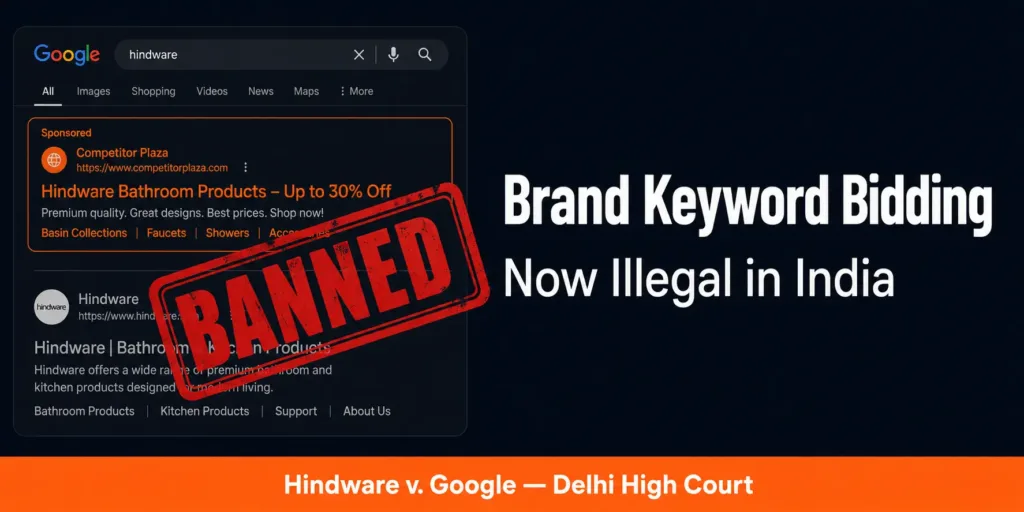
In India, brand keyword bidding is now illegal — not just for ads that visibly use your trademark, but for invisible backend keyword triggers too. The Delhi High Court ruled on May 22, 2026 in Hindware Ltd. v. Google LLC that using a registered trademark as a Google Ads keyword constitutes trademark infringement under the Trade Marks Act, 1999 — regardless of whether the brand name appears in the ad. Both the competitor bidding on your keyword and Google enabling it face direct legal liability. If a competitor is bidding on your brand keyword right now, you have legal grounds to act — but first you need to know it is happening. AdSpyder’s ad intelligence platform lets you see exactly who is running ads on your brand name across 164M+ Google Search ads — with historical evidence going back to 2008.
For more than a decade, competitor brand keyword bidding was the worst-kept secret in Indian digital marketing. Every PPC manager knew it was aggressive. Some suspected it was legally questionable. Nobody could definitively say it was illegal — courts were inconsistent, Google claimed it was a neutral platform, and brands had no clear legal weapon.
On May 22, 2026, that changed permanently.
Justice Mini Pushkarna of the Delhi High Court delivered a 163-page judgment in Hindware Ltd. v. Google LLC [CS(COMM) 591/2017] that answered three questions Indian brand owners had been asking for years: Is invisible keyword bidding infringement? Is Google liable, not just the advertiser? And does the platform’s safe harbour protection cover this behaviour?
The answer to all three: yes, yes, and no.
This is not a narrow ruling about one sanitaryware brand. The legal principles established here apply to every registered trademark in India — SaaS, D2C, fintech, edtech, e-commerce, B2B, healthcare. If a competitor bids on your registered brand keyword in Google Ads, you now have binding legal precedent to act on. The bigger challenge is knowing when it is happening in the first place — and that is exactly what this guide covers.
In This Article
What the Delhi High Court Actually Decided
The Hindware case started in 2013 when the sanitaryware brand discovered that competitors — Cera Sanitaryware and Grohe India — had purchased “HINDWARE” as a Google Ads keyword. Their sponsored ads appeared above Hindware’s own organic result every time a user searched the brand name. The users were looking for Hindware. They were being served competitor ads first.
Cera and Grohe eventually settled with Hindware. Google did not. The tech giant contested the case for nine years, arguing it was a passive intermediary whose safe harbour protection under Section 79 of the IT Act shielded it from liability. The court heard that argument, examined it in full — and rejected it on every ground.
The core question was whether using a registered trademark as a backend keyword trigger — one that never appears visibly in the ad copy — constitutes trademark “use” under Indian law. Google’s position was that it does not. The brand name is not in the ad. The consumer never sees it. No confusion can arise.
The court disagreed completely. And its reasoning matters more than its conclusion.
163
Pages in the judgment
₹30L
Nominal damages awarded to Hindware
9 yrs
Google contested the case
Sec 29
Trade Marks Act, 1999 — infringement confirmed
Source: Hindware Ltd. v. Google LLC & Ors., CS(COMM) 591/2017 & 592/2017, Delhi High Court, May 22, 2026.
The 4 Findings Every Indian Brand Needs to Know
The judgment’s legal reasoning is what makes this ruling so significant — and so durable. Here are the four core findings and what they mean in practice:
Finding 1 — Invisible keyword use is trademark infringement
Google argued that because the trademark never appears in the visible ad, there is no trademark “use” under Indian law. The court rejected this entirely. It held that using a trademark as a keyword to trigger an advertisement constitutes “use in advertising” under Section 29(6)(d) of the Trade Marks Act, 1999 — regardless of whether the brand name appears in the final ad text.
“Invisible use of trademark to divert the traffic from proprietors’ website to the advertisers’ website shall amount to use of the mark for the purpose of Section 29.”
— Justice Mini Pushkarna, Hindware v. Google LLC, May 22, 2026
What this means: A competitor does not need to write your brand name in their ad headline for infringement to exist. The keyword trigger in the backend is enough. Every brand name keyword campaign targeting a registered Indian trademark is now legally exposed — whether the trademark appears in the copy or not.
Finding 2 — Google lost its safe harbour protection
Section 79 of the IT Act protects passive intermediaries from liability for user-generated content. Google argued it was simply a platform — advertisers chose the keywords, Google played no active role. The court stripped that protection on two grounds.
First, Google’s Keyword Planner Tool actively suggests trademarked terms to advertisers during campaign setup. That is not passive hosting — it is active commercial encouragement of the infringing behaviour. Second, Google earns direct revenue from every click on keywords triggered by those trademarks. The court held that a platform loses safe harbour when it algorithmically determines who receives information and profits from that determination. As the court put it: “Google cannot be permitted to shrug off responsibility by making available a tool that leads to infringement, and then turning around to claim that the said tool was not mandatory.”
Finding 3 — Both the advertiser AND the platform are liable
Previous litigation tended to focus on the advertiser bidding on the keyword. The Hindware ruling establishes that Google — as the platform that auctions trademarked keywords, profits from each click, and actively suggests those keywords to advertisers — bears direct liability alongside the bidding advertiser. This creates two targets for enforcement: the competitor bidding on your brand keyword, and Google itself for enabling and profiting from that bidding. For Indian brand owners, this means Google trademark complaints now carry significantly more legal weight than before.
Finding 4 — Brands are forced to pay to rank for their own name
The court went further than just finding infringement — it characterized the Google keyword auction model as a structural economic harm to trademark owners. By allowing competitors to bid on your brand keyword, Google effectively forces you to bid on your own name just to appear above a competitor in results for your own brand. The court held that Google “seizes and sells” commercial value it has no lawful right to exploit. Zerodha founder Nithin Kamath, who has dealt with this on his own brand for over a decade, called this out directly after the ruling: “Whenever someone searches for ‘Zerodha,’ the traffic should rightfully come to Zerodha.”
Detect Brand Keyword Bidding
Find Out If a Competitor Is Bidding on Your Brand Name Right Now
AdSpyder indexes 164M+ Google Search ads across 100+ countries — including historical data going back to 2008. Search your brand name, filter to India, and see every advertiser whose ads have used your brand in their copy. Export the evidence package the Hindware ruling requires.
Google’s Response — and Why It Does Not Change Your Risk
After the ruling, a Google spokesperson issued the company’s first public statement: “We duly respect and operate in accordance with all local laws, and in instances where the orders are overbroad or inconsistent with our policies, we work to explain our position as per the legal process in the country.”
On the specific question of trademark keywords, the statement added: “Specifically on our Ads policy on trademark keywords, we have a clear and stated policy that does not allow competitor advertisers to use trademarked terms in the ad-text of an ad. This policy is consistently applied globally and is in accordance with the Indian trademark law.”
Google did not confirm whether it intends to appeal the judgment.
Why Google’s statement does not protect your brand
Google’s policy restricts competitors from using your trademark in their visible ad copy — headlines, descriptions, display URLs. The Hindware ruling covers a completely different, much more common scenario: invisible keyword-only bidding, where a competitor bids on your brand name as a trigger but never puts it in the ad text. Google’s existing policy does not stop this. The court’s ruling does — but only if you detect it and act on it. Most brands do not know it is happening.
There is also the question of prior inconsistency. In March 2024, the Supreme Court declined to interfere with a Delhi HC order that had allowed Google to use “MakeMyTrip” as a keyword in Google Ads, citing the absence of demonstrated consumer confusion. The Hindware ruling goes in the opposite direction. Indian courts have not reached a fully consistent position on keyword advertising, which means the law may ultimately need a Supreme Court ruling to settle definitively. For now, the Hindware precedent stands as the strongest available legal weapon — and it is binding within Delhi HC’s jurisdiction, highly persuasive elsewhere.
How Widespread Is the Problem? AdSpyder Data Across 25 Major Brand Auctions
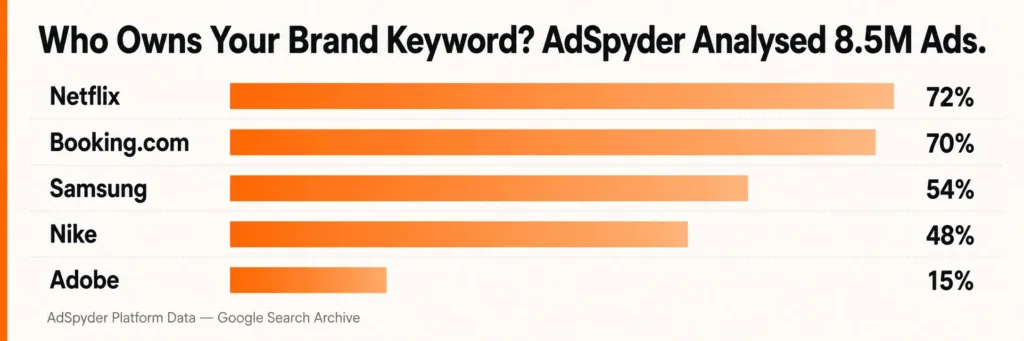
The Hindware ruling matters because the behaviour it addresses is not rare — it is industry-standard practice at scale. To understand how widespread brand keyword bidding actually is, AdSpyder analysed 8,523,737 Google Search ads across 25 of the world’s most-searched brand keyword auctions. This analysis counted only ads where the brand name appeared visibly in the ad headline — the higher-legal-risk subset that represents a floor estimate, not the full picture.
The aggregate finding: 13.1% of all brand-keyword ads in major auctions come from non-brand advertisers. For some brands, the majority of their branded paid search real estate is owned by someone else:
| Brand | Brand-headline ads analyzed | Non-brand ad share | Who is bidding |
|---|---|---|---|
| Netflix | 57,001 | 72.1% | VPN providers, rival streaming services |
| Booking.com | 348,582 | 69.9% | Agoda, Trivago, Expedia, MakeMyTrip |
| Samsung | 747,122 | 54.4% | Amazon.in, Croma, Trendyol, Hepsiburada |
| Nike | 824,734 | 47.5% | ASOS, JD Sports, Farfetch, Ajio |
| Adobe | 302,379 | 15.1% | Filmora, Wondershare, Domestika |
| Shopify | 155,535 | 13.3% | Ecwid, Fiverr, competing platforms |
| Mercado Libre | 614,546 | 0.0% | Platform dominance as natural defence |
Source: AdSpyder platform data, May 2026 — Google Search archive. 25-brand sample, 8,523,737 brand-in-title ads. Counts only ads with brand name visibly in headline.
Important data note: The 13.1% figure measures only the visible-copy subset — ads where the competitor explicitly uses the brand name in their headline. Invisible keyword-only bidding (where the competitor uses your brand as a trigger but not in copy) is not visible to this analysis. The true competition rate is higher. What AdSpyder measures is the floor — and specifically the subset that the Hindware ruling now makes actionable under Indian trademark law.
India-Specific Data: The Problem Is Worse Here Than the Global Average
AdSpyder’s India-filtered Google Search data shows brand-keyword conquesting rates that in several key categories significantly exceed the global average — making the Hindware ruling especially timely for Indian brands.
78.4%
Booking.com — India
MakeMyTrip, RedBus, Goibibo, Cleartrip in brand ads
73.8%
Nike — India
Amazon.in, Ajio, Myntra in Nike brand searches
50.2%
Samsung — India
Croma, Reliance Digital, Vijay Sales in Samsung brand searches
Source: AdSpyder platform data, May 2026 — Google Search archive, India country filter. Counts ads with brand name visibly in headline only.
The other side of this picture matters too: Indian-native platforms are well-defended on their own brand keywords. Flipkart’s non-brand competitor share is just 2.4%. Myntra is 3.3%. Amazon India is 3.0%. Brands with strong domestic platform recognition hold their own search real estate effectively.
Classify before you act
Much of the brand bidding visible in India’s Google Ads data involves authorized retailers — Amazon.in selling Samsung products, Myntra selling Nike. That is a reseller dynamic, not necessarily a trademark violation. A legal notice to a legitimate reseller selling your products is a different situation from a notice to a competitor running a “Switch from [Your Brand]” campaign. Use the six-category classification framework below before deciding your response to any non-brand advertiser.
Before and After: What the Ruling Actually Changed
Before May 22, 2026, an Indian brand facing competitor keyword bidding had two realistic paths: file a Google trademark complaint (which only covered visible ad-copy use of the trademark, not invisible keyword triggers) or pursue litigation with inconsistent results. Both paths just changed significantly.
| Action | Before May 22, 2026 | After May 22, 2026 |
|---|---|---|
| Google trademark complaint | Only effective for visible ad-copy use. Invisible keyword triggers were not covered by Google’s policy — complaint for keyword-only bidding was routinely rejected. | Complaint carries significantly greater leverage. Google faces direct legal exposure in India for non-action on registered trademark keyword use — visible or invisible. |
| Legal notice to competitor | Grey area — advertiser could argue that invisible keyword-only bidding was not trademark infringement under Indian law. Many courts agreed. | Invisible keyword use is confirmed infringement. Legal notice citing the Hindware precedent carries binding legal weight in Delhi HC jurisdiction and strong persuasive weight elsewhere. |
| Court injunction application | Contested legal basis; proceedings often took years with inconsistent outcomes between courts. | Binding precedent exists. Interim injunction applications for registered trademarks are on substantially stronger legal footing. |
| Platform demand to Google | Google invoked Section 79 IT Act safe harbour. Platforms routinely dismissed liability for keyword auction activity. | Safe harbour stripped where platform actively suggests trademarked keywords and profits from them. Google’s commercial benefit from keyword auctions is now a direct liability factor. |
If Competitors Are Bidding on Your Brand Keyword in India: 6 Response Categories
Not every advertiser appearing on your branded SERP is a trademark violator. Correctly classifying what you are dealing with before sending a legal notice matters — misdirected complaints waste legal resources and can damage genuine partner relationships. Use AdSpyder’s Domain Analysis to examine each non-brand advertiser’s full ad portfolio before deciding your response.
| Advertiser type | Example from data | India post-Hindware | First response |
|---|---|---|---|
| Direct competitor | Filmora — 2,560 ads with “Adobe” in headline; Ecwid targeting “Shopify” | Actionable — legal notice + Google complaint | Document evidence via AdSpyder export. Consult IP attorney. File Google complaint citing Hindware precedent. |
| Impostor / “official site” lookalike | 3.19M Google Search ads use “Official Site” — vast majority from non-brand advertisers | Critical — escalate immediately | Google trademark complaint + IP attorney + domain takedown for clone landing pages. |
| Unauthorized coupon / voucher site | CouponCause — 1,905 ads with “Udemy” in headline | Actionable via affiliate terms + legal notice | Cease-and-desist to site owner. Affiliate programme revocation. Google complaint for any visible trademark use. |
| Authorized affiliate violating programme terms | Registered affiliate bidding on brand keywords against programme rules | Programme enforcement first | Direct warning. Account suspension if repeated. Hindware precedent now strengthens any follow-up legal notice. |
| Review / comparison site | 3.33M ads use “review/reviews” across archive | Generally permitted — editorial defence | Claim your listing. Bid on your own “[brand] reviews” term. Maintain 95%+ branded impression share. |
| Authorized reseller / marketplace | Amazon.in — 15,386 ads with “Samsung” in headline, selling genuine Samsung products | Lower risk — commercial lever, not legal | Negotiate brand-keyword restrictions in reseller agreement. Generally tolerate if your product is reaching the customer. |
If Your Campaigns Are Bidding on Competitor Brand Keywords in India: Stop Now
The Hindware ruling creates direct legal exposure for advertisers, not just platforms. If your Google Ads campaigns include a competitor’s registered Indian trademark as a keyword — whether it appears in your ad copy or not — you are now operating in clear violation of binding Delhi HC precedent.
Immediate steps if you are bidding on competitor trademarks in India
1.
Audit your keyword lists immediately. Pull every campaign, ad group, and keyword. Identify any registered trademarks — not just obvious brand names, but also common names that competitors may have registered (check the Indian Trademark Registry at ipindia.gov.in).
2.
Remove trademarked keywords from all match types. Exact match, phrase match, broad match, and broad match modified all carry equal legal exposure under the Hindware ruling — the court ruled that keyword-only triggers constitute infringement regardless of how the match is configured.
3.
Add competitor trademarks as negative keywords. Broad match campaigns can inadvertently trigger on trademarked terms. Adding known competitor trademarks as negative keywords protects against accidental infringement as a precautionary measure.
4.
Review ad copy for any visible trademark use. If any ad headline, description, or display URL contains a competitor’s registered trademark, pause those ads immediately. This was already covered by Google’s own policy — the Hindware ruling means it now also carries direct legal liability in India.
5.
Consult an IP attorney about historical exposure. The ruling establishes infringement occurred from the moment the keyword was used. If you have been bidding on a competitor’s registered trademark for months or years, you may have existing liability for that period — particularly if the trademark owner can demonstrate traffic diversion or revenue loss.
Important: This applies to all registered Indian trademarks — not just well-known brands. A smaller competitor with a registered trademark has the same legal standing as Hindware or any large brand. The practical constraint is whether they have the resources to enforce — but the Hindware precedent dramatically lowers the barrier to doing so.
How to Detect Brand Keyword Bidding — and Build the Evidence the Ruling Requires
Most brands discover competitor brand bidding months after it starts — by which point traffic has already leaked and revenue has been lost. A manual Google search in Incognito once a month is not brand monitoring. It shows one result, in one location, at one moment — and it misses historical campaigns, international bidding, and the evidence trail that legal action now requires.
Step 1 — Search your brand name in AdSpyder’s Google Ads archive
Go to AdSpyder’s Google Ads Spy and search your exact brand name. Filter by India to see the country-specific picture. You will see every advertiser whose ads used your brand name in their headline — their domain, full ad copy, landing page URL, and first and last seen dates. Extend the search to brand + “official”, brand + “coupon”, and brand + “alternative” to catch all attack types.
Step 2 — Classify each advertiser before taking action
Run suspicious domains through AdSpyder’s Domain Analysis to see their full ad portfolio across platforms. A reseller selling your product legitimately looks very different from a direct competitor running “Switch from [Your Brand]” copy. Use the six-category framework above to decide your response before sending any legal notice.
Step 3 — Build your evidence package
For legal action under the Hindware precedent, you need: (1) advertiser domain, (2) full ad headline and description, (3) first and last seen dates, (4) destination landing page URL, (5) the country the ad ran in, and (6) your Indian trademark registration certificate. AdSpyder’s export covers items 1 through 5. The archive stores historical ad data going back to 2008 — ads that have already been taken down may still be retrievable as evidence.
Step 4 — Check cross-platform
Brand bidding rarely stays on one platform. Run your brand name on Meta, Bing, YouTube, and LinkedIn too. The same competitor often runs parallel campaigns across multiple platforms simultaneously. AdSpyder covers all 10 major ad platforms from one interface.
Step 5 — Make monitoring ongoing, not a one-time audit
New advertisers appear after complaint approvals. Seasonal campaigns spike around your own promotions. AdSpyder is building a real-time Brand Keyword Alert feature that will notify you the moment a new competitor ad appears on your brand keyword across platforms — closing the detection gap that causes most brands to discover violations only after significant traffic has already leaked. Learn what to do when you find competitors bidding on your brand →
Brand Protection Checklist — Post-Hindware India
Outside India: The Rules Are Still Different
The Hindware ruling is India-specific. In the US, EU, and UK, keyword-only bidding — using a brand name as a trigger without showing the trademark in visible ad copy — is still generally permitted under current case law in those jurisdictions. The legal standards, frameworks, and remedies differ significantly from India’s post-Hindware position.
| Market | Current legal direction | What to monitor |
|---|---|---|
| India | Post-Hindware: invisible keyword use is confirmed trademark infringement under Section 29, Trade Marks Act 1999. Both advertiser and platform liable. | Any competitor keyword bid on your registered trademark — visible or invisible. Standard now unambiguous. |
| United States | Lanham Act. Keyword bidding alone is often insufficient without confusion evidence from visible copy or landing page. Courts focus on likelihood of consumer confusion. | Ad headline and description, landing page claims, display URL, whether ads suggest affiliation with your brand. |
| European Union | Google France / Louis Vuitton (ECJ) precedent. Advertiser risk if the ad prevents average users from understanding commercial origin. Keyword-only bidding can be permitted if origin function is preserved. | Whether the ad makes commercial origin clear to an average user. Origin-function confusion is the key test. |
| United Kingdom | Interflora analysis — does the ad affect the trademark’s origin function or create confusion about affiliation? “Honest practices” standard for comparative advertising. 30,232 UK ads use “alternative to” phrasing (AdSpyder archive). | Affiliate confusion, “official” claims, and ads ambiguous about brand relationship. |
AdSpyder Brand Monitoring
Find Out Who Is Bidding on Your Brand — and Build the Evidence to Stop It
Search your brand name across AdSpyder’s 164M+ Google Search ad archive. See every advertiser — historical and active — and export the evidence package you need for a Google trademark complaint or legal action under the Hindware ruling. AdSpyder is also building real-time Brand Keyword Alerts — so you know the moment it starts, not months later.
Monitor My Brand Keyword Free →
88,000+ competitor-ad searches run · 8,663 active monitoring projects · 164M+ Google Search ads indexed
Related Reading
→ What to Do When Competitors Bid on Your Brand Keywords
→ How to Stop Competitors Bidding on Your Brand Keywords (Action Plan)
→ Brand Hijacking in Paid Search: Signs, Risks, and How to Stop It
→ Competitor Bidding Your Brand Name in Google Ads — What It Costs and How to Respond