In-House · Agency · Self-Serve · Hybrid
Quick Answer
- Choose in-house when lead generation is strategically important enough to justify permanent people, tools and management.
- Choose an agency when speed, specialist execution or missing internal capacity is the immediate constraint.
- Choose self-serve tools when your team understands the buyer and wants control over research, campaigns and learning.
- For many B2B teams, the strongest setup is hybrid: keep strategy and data ownership internal while outsourcing selected execution.
- Before buying more software, use AdSpyder’s lead generation tools framework to identify which funnel stage actually needs help.
Searching for business lead generation companies usually leads to the same decision: outsource to an agency or hire an internal team. In 2026, that choice is incomplete. B2B teams now have a third practical model—use self-serve intelligence, automation, CRM and campaign tools to operate a lean lead-generation system internally.
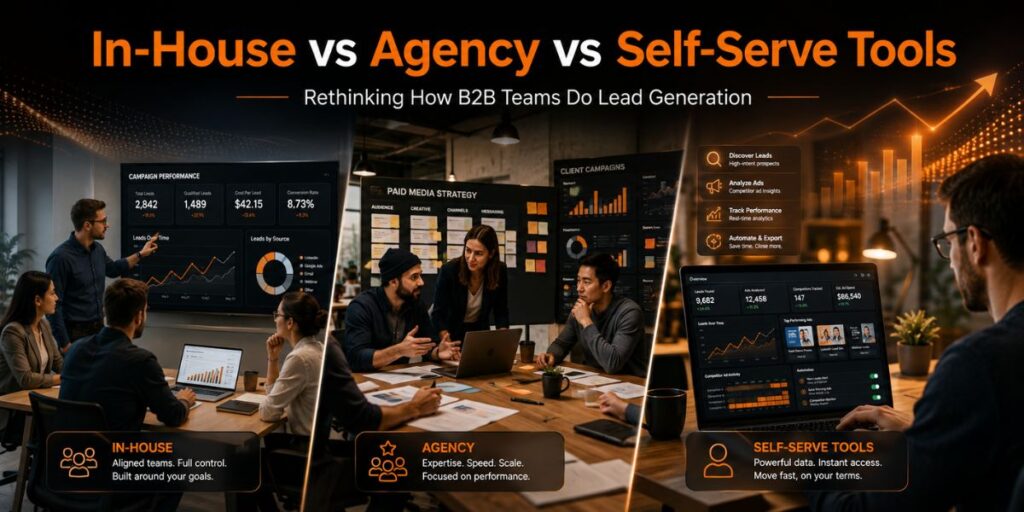
None of the three models wins automatically. Agencies buy execution. In-house teams buy ownership. Self-serve software buys leverage. The right decision depends on which capability your business is currently missing.
The Three Ways B2B Teams Actually Run Lead Generation
| Model | You Are Buying | Main Advantage | Main Risk |
|---|---|---|---|
| In-House Team | Permanent capability | Maximum control and institutional knowledge | Hiring, ramp time and fixed cost |
| Lead Generation Agency | Specialist execution | Faster access to people and processes | Less direct ownership of learning and execution |
| Self-Serve Tools | Technology leverage | High control without building a large team | Software does not replace strategy or capable operators |
Option 1: Build Lead Generation In-House
An internal model works when lead generation is important enough to become a permanent company capability. Your team owns audience research, campaign strategy, creative, outbound, CRM processes, reporting and the learning generated from every test.
The biggest advantage is learning ownership. When a campaign fails, the insight remains inside the company. When a new segment responds well, marketing, sales and product can use that information immediately.
In-house works best when you already have:
• A reasonably defined ICP and offer
• Someone accountable for demand generation
• CRM and conversion tracking
• Enough runway to hire, train and improve the system
The cost mistake is counting salaries alone. Your complete model also includes advertising, creative, contact data, CRM seats, automation, analytics and management time. AdSpyder’s lead generation ad budget framework shows why budgeting should begin with required qualified leads and sales capacity rather than an arbitrary media number.
Option 2: Hire a Business Lead Generation Company
A specialist agency can make sense when the company knows it needs more pipeline but does not yet have the people, processes or specialist knowledge to execute consistently.
The value is not merely access to another advertising account. A capable agency brings campaign operators, creative processes, prospecting infrastructure, reporting routines and experience from similar campaigns.
When an Agency Still Makes Sense
- You need to enter a new channel quickly.
- You cannot justify several specialist hires yet.
- Your team lacks campaign execution bandwidth.
- You need specialist expertise for a specific market or platform.
- Your internal sales team can close leads but cannot reliably create enough demand.
The important question is what the agency actually owns. Some manage advertising only. Others provide outbound prospecting, landing pages, creative, qualification or full-funnel execution. Compare deliverables and accepted-lead definitions rather than comparing retainers in isolation.
Option 3: Build a Lean Self-Serve Lead Generation Stack
Self-serve software changes the economics when a B2B company already has capable marketers but lacks the research and automation leverage of a larger team.
AdSpyder fits this model specifically at the paid-demand intelligence layer. Its current agency workflow supports competitor advertising research across 15+ platforms, along with domains, keywords, creative patterns and landing-page intelligence.
That means a lean team can study where competitors are active before deciding where to put budget. AdSpyder’s cross-platform lead generation research demonstrates why Google, Meta and LinkedIn should not use identical creative or demand-capture strategies.
What self-serve does not mean: buying several AI subscriptions and expecting software to invent your ICP, product positioning and qualification rules. Tools amplify a capable operating process; they do not create one automatically.
Once competitors and offers are understood, use a structured testing process instead of cloning what is already running. AdSpyder’s lead generation creative strategy recommends testing offer, proof and angle before spending time on minor visual variations.
Cost and Control: The Trade-Off Most Comparisons Oversimplify
| Factor | In-House | Agency | Self-Serve |
|---|---|---|---|
| Fixed people cost | High | Lower internally | Low–moderate |
| Initial speed | Slow–moderate | Usually fastest | Fast if skills already exist |
| Strategic control | High | Shared | High |
| Learning ownership | High | Depends on transparency | High |
| Internal execution needed | High | Low–moderate | Moderate–high |
These are structural comparisons, not universal cost benchmarks. Actual expense depends on team size, geography, channels, media spend, sales cycle and scope.
An Agency Cannot Fix an Undefined Lead
Many B2B lead-generation problems begin before channel execution. Marketing counts form fills; sales rejects them; nobody agrees on what qualified means.
Before selecting any operating model, define the difference between an inquiry, valid lead, marketing-qualified lead, sales-accepted lead, opportunity and customer.
This matters especially with native forms. AdSpyder’s lead ads comparison shows that Meta, LinkedIn, TikTok and Google can all reduce form friction, but the cheapest form completion is not necessarily the best B2B lead.
The Hybrid Model Works for More Teams Than Either Extreme
The most practical model is often neither “outsource everything” nor “hire everyone.” Keep the pieces that create long-term strategic value internally and use outside specialists where speed or expertise matters.
Example hybrid ownership model
Internal team: ICP, positioning, CRM, customer data, qualification rules and revenue reporting.
Self-serve intelligence: competitor research, ad patterns, keyword opportunities and campaign monitoring.
Agency / specialist: selected media buying, production, outbound execution or channel expertise.
Sales: qualification feedback, opportunities and customer outcome data.
This is also where managed AI-growth systems such as Gushwork fit differently: they emphasize reducing the internal burden by running more of the marketing workflow. A self-serve model deliberately makes a different trade—it keeps more of that operating knowledge and decision-making inside your team.
Choose the Model by Funnel Bottleneck, Not Company Size
| Your Bottleneck | Best Starting Model |
|---|---|
| “We know the ICP but cannot execute enough campaigns.” | Agency or specialist partner |
| “We have marketers but weak competitor intelligence.” | Self-serve intelligence |
| “Lead generation is core IP and needs tight sales feedback.” | In-house |
| “We need a new channel running quickly.” | Agency first, then reassess |
| “We need control but lack one specialist skill.” | Hybrid |
Judge All Three Models With the Same Revenue Metrics
A fair comparison requires one scoreboard. Do not let an agency report meetings while the internal team reports pipeline and the software model reports clicks.
At minimum, compare:
- Valid leads
- Qualified leads
- Cost per qualified lead
- Sales acceptance rate
- Opportunity rate
- Pipeline created
- Customers won
- Customer acquisition cost
AdSpyder’s lead generation reporting guide recommends opening reports with qualified leads, opportunities, customers and revenue rather than making impressions or raw form fills the headline result.
What a Self-Serve B2B Stack Actually Needs
Self-serve does not mean “AdSpyder alone.” A practical internal lead-generation stack contains distinct systems for distinct jobs:
Market Intelligence
Competitor ads, demand signals, offers and campaign research.
Prospect Data
Accounts, contacts and enrichment where outbound is required.
Campaign Execution
Google, LinkedIn, Meta, email or another acquisition channel.
CRM & Follow-Up
Qualification, ownership, nurture and opportunity tracking.
Automation
Move data and trigger repeatable tasks without manual handoffs.
Measurement
Connect acquisition activity with qualified pipeline and revenue.
If you are building this stack from scratch, AdSpyder’s B2B lead generation tools guide separates prospecting, paid-demand research, outreach, website conversion and CRM software instead of pretending one platform should perform every job.
Decision Checklist: Agency, In-House or Self-Serve?
☐ ICP is clearly defined
☐ Lead qualification rules exist
☐ Sales has capacity for more opportunities
☐ CRM ownership is clear
☐ Internal execution capacity is known
☐ Required specialist skills are identified
☐ Fully loaded cost is compared
☐ Data ownership terms are understood
☐ Campaign learning will be documented
☐ Agency acceptance criteria are measurable
☐ Tool stack has an accountable operator
☐ Revenue—not activity—is the final KPI
Final Verdict: Buy the Capability You Are Missing
The best business lead generation companies can accelerate pipeline when your problem is execution. An in-house team is stronger when lead generation needs to become durable company knowledge. Self-serve platforms win when you already have capable operators and need better intelligence, automation and leverage.
For many B2B businesses, the right answer will change over time. Startups may outsource to get moving, bring strategic knowledge in-house as they learn, and use software to keep the permanent team lean. Larger organizations may maintain strong internal teams while using agencies for new channels or temporary specialist work.
Do not choose based on whether “agency,” “AI” or “in-house” sounds more modern. Choose the model that fixes today’s bottleneck while preserving the capabilities you want to own tomorrow.
Already have the team? Give them better market intelligence.
Use AdSpyder to research competitor advertising, identify campaign patterns and give your in-house or agency team stronger evidence before the next test.
FAQs for Business Lead Generation Companies
What do business lead generation companies do?
Services vary. Agencies may provide prospecting, paid media, outbound outreach, landing pages, appointment setting, qualification or complete lead-generation campaign management.
Is lead generation better in-house or outsourced?
In-house offers greater control and institutional learning. Outsourcing can provide faster specialist execution. The better model depends on your internal skills, urgency, budget and how strategically important the capability is.
Can software replace a lead generation agency?
Only when your internal team can operate the workflow. Software can automate research and repetitive work, but it does not eliminate the need for positioning, campaign judgment, qualification rules and sales follow-up.
When should a company hire a lead generation agency?
An agency is useful when you need faster execution, lack an important specialist skill or cannot justify building a full internal team for the channel yet.
What is a hybrid lead generation model?
A hybrid model keeps strategic assets such as ICP, CRM, qualification and customer data internally while using agencies or specialists for selected campaign execution and self-serve tools for research and automation.
Where does AdSpyder fit?
AdSpyder fits the advertising-intelligence layer. It helps in-house teams and agencies research observable competitor campaigns, keywords, creatives and market patterns before building their own tests.