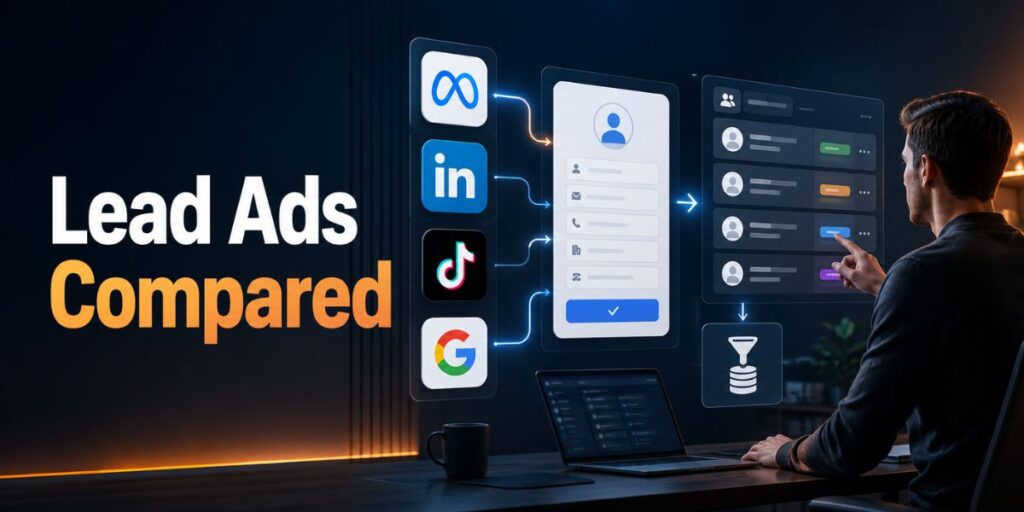
Lead Generation · Platform Comparison
Quick Answer
- Meta: best all-round option for low-friction consumer and service lead capture.
- LinkedIn: strongest when professional identity, company and job information matter.
- TikTok: useful for mobile-first, video-led discovery and fast native forms.
- Google: strongest when prospects already show clear search or purchase intent.
- Before choosing, compare real competitor offers and form journeys with AdSpyder Facebook Ads Spy.
Lead ads remove steps between advertising and enquiry submission, but lower friction does not automatically mean better leads. The right platform depends on where buying intent originates, which information you need before follow-up and how reliably the lead can move into your CRM.
Quick Comparison: Meta vs LinkedIn vs TikTok vs Google
| Platform | Friction | Data Strength | Quality Control | Best Fit |
|---|---|---|---|---|
| Meta | Very low | Contact + custom questions | CRM feedback, conversion leads, messaging | B2C, local services, education, discovery |
| Very low | Strong professional profile data | Custom questions, hidden fields, CRM sync | B2B, SaaS, enterprise, professional services | |
| TikTok | Very low | Contact + custom form questions | Form logic, CRM connection, website option | Visual products, education, apps, consumer services |
| Low | Contact + qualification questions | Conditional answers, qualifying responses, OTP | High-intent search, local and service enquiries |
Lead Ads Comparison Roadmap
What Each Lead Ad Option Actually Does
Meta Lead Ads
Meta supports Instant Forms, website forms, messaging and calling under the Leads objective. Instant Forms are the lowest-friction option because users can submit information without leaving Facebook or Instagram.
Meta becomes more useful for lead quality when the CRM sends down-funnel outcomes back through the Conversions API. Its conversion-leads performance goal is specifically designed to optimize Instant Form campaigns toward better-quality outcomes rather than raw submissions.
LinkedIn Lead Gen Forms
LinkedIn automatically pre-fills information from a member’s profile. This is valuable when job title, company, seniority, work email or professional context matters more than basic demographic information.
Forms can include up to 12 informational fields, three custom questions and up to 20 hidden tracking fields. Before creating a B2B campaign, use the AdSpyder LinkedIn Ad Library to compare how competing brands position demos, reports and consultation offers.
TikTok Lead Generation
TikTok’s Lead Generation objective supports native Instant Forms and website lead capture. TikTok also supports lead journeys through direct messaging and other messaging destinations in eligible setups.
TikTok is particularly dependent on creative-message fit. A highly engaging video can produce large form volume while still attracting weak prospects if the offer or qualification step is too broad. Research video hooks and conversion approaches with the AdSpyder TikTok Ad Library.
Google Lead Form Assets
Google lead form assets currently work with Search and Performance Max campaigns. They allow prospects to submit details directly from the advertising experience instead of requiring a separate landing-page form.
Google offers useful qualification controls such as custom questions, conditional answers, qualifying responses and OTP verification. When search intent is important, use AdSpyder Google Ads Spy to study how competitors pair keywords with offers and action-focused copy.
The Five Differences That Matter Most
1. Form Friction
Native forms reduce page loads and typing. That usually improves completion, but it can also allow lower-intent prospects to submit more easily. If lead quality falls, add one or two meaningful qualification questions instead of automatically adding a long form.
2. Quality of Available Data
LinkedIn is strongest when professional attributes matter. Google is strongest when the search itself reveals intent. Meta provides broad behavioral and engagement signals. TikTok relies more heavily on creative context and audience response.
3. Qualification Controls
Google currently provides some of the clearest built-in form qualification tools. LinkedIn combines profile fields with custom and hidden fields. Meta can optimize toward CRM-defined conversion leads, while TikTok offers native forms plus website capture when additional qualification is required.
4. CRM Handoff
Native lead ads become much more useful when submissions enter the CRM immediately. Meta, LinkedIn, TikTok and Google all support routes for CRM or marketing-platform integration, but implementation options differ.
5. Buying Intent
A Google search for a quote or demo may already show strong intent. A Meta or TikTok user may first need the ad to create interest. LinkedIn often sits between the two: the professional context may be highly relevant even if the person was not actively searching.
Costs, Speed, Control and Limitations
There is no responsible universal CPL comparison for these four platforms. Media prices are auction-based and vary by country, industry, audience, objective, competition and offer. Compare platforms using cost per qualified lead rather than whichever dashboard shows the lowest raw CPL.
| Platform | Setup Speed | Main Control | Main Limitation |
|---|---|---|---|
| Meta | Fast | Multiple conversion locations and CRM quality feedback | Very low friction can increase weak submissions |
| Fast | Professional profile data and B2B targeting | Smaller professional audience can make scale harder | |
| TikTok | Fast | Creative-led native discovery and Instant Forms | Creative quality strongly affects lead quality |
| Moderate | Search intent and detailed qualification controls | Lead form availability is limited to eligible campaigns and markets |
LinkedIn explicitly states that Lead Gen Forms do not carry an additional charge beyond the associated advertising campaign. For every platform, however, your real cost should include media, CRM handling, follow-up time and the percentage of submitted leads that sales can actually use.
Which Lead Ads Platform Is Best for Your Audience?
| Scenario | Start With | Reason |
|---|---|---|
| Enterprise SaaS demo | Professional role and company data can support qualification. | |
| Emergency or local service enquiry | The search query can reveal immediate service intent. | |
| Consumer consultation or course enquiry | Meta | Low-friction forms and messaging support discovery-led journeys. |
| Visual product or creator-led offer | TikTok | Video can create demand before a prospect reaches a search engine. |
| High-consideration B2B research | LinkedIn + Google | LinkedIn builds professional demand while Google captures active search. |
If you need ideas for matching the offer with the audience’s readiness, use these 30 lead generation hooks, offers and CTA examples as structures to adapt rather than copy.
A Simple Decision Framework
- Start with intent. Is the audience already searching, or does the ad need to create demand?
- Define required data. Decide what sales needs before accepting the lead.
- Choose the lowest useful friction. Do not remove qualification just to increase form completion.
- Connect the CRM before scaling. Preserve source, campaign, ad, form and qualification outcomes.
- Compare CPQL. Measure cost per qualified lead, not only cost per submitted form.
- Use multiple platforms only with a purpose. Each channel should contribute a different audience, intent level or stage.
CTA commitment also changes form quality. The AdSpyder lead generation CTA research explains why actions such as Learn More, Send Message, Sign Up and Book a Demo belong at different stages of the funnel.
How AdSpyder Supports the Winning Workflow
AdSpyder should not decide which platform is profitable for your business. Your CRM must do that. AdSpyder is useful before launch because it shows how competing advertisers approach different platforms, offers and conversion journeys.
- Start in the AdSpyder Ad Library and identify relevant competitors across several channels.
- Separate ads by audience, platform, funnel stage and offer rather than saving random examples.
- Use the competitor lead generation workflow to record each ad’s audience, problem, proof, offer and CTA.
- Identify whether competitors prefer forms, messaging, demos, quotes, downloads or website conversions.
- Create an original hypothesis for the platform you plan to test.
- Before scaling, run the 50-point lead generation campaign audit against tracking, qualification, creative and CRM readiness.
Important: competitor ads reveal observable messages, offers, formats and destinations. They do not reveal private CPL, lead quality, CRM outcomes or profitability.
Compare lead ads across platforms before choosing your next test
Review competitor creative, offers and conversion approaches across Meta, LinkedIn, TikTok, Google and other advertising platforms.
Frequently Asked Questions
What are lead ads?
Lead ads are advertisements designed to capture prospect information directly through a native form, website form, call or messaging journey.
Which platform has the lowest-friction lead form?
Meta, LinkedIn and TikTok all provide highly streamlined native forms. The better choice depends on the information you need and the audience you need to reach.
Which lead ads are best for B2B?
LinkedIn is usually the strongest starting point when job title, company, seniority or professional role is central to qualification. Google can complement it by capturing active search demand.
Are Google lead forms available on every campaign type?
No. Current Google documentation supports lead form assets for Search and Performance Max campaigns, subject to eligibility and market requirements.
How long does TikTok retain Instant Form lead data?
TikTok Ads Manager currently retains Instant Form lead data for 90 days, so advertisers should connect a CRM or export leads regularly.
Should CPL decide which lead ad platform wins?
No. Compare valid-lead rate, cost per qualified lead, sales acceptance, opportunity rate and customer acquisition cost before shifting budget.
Current Platform References
Meta Lead Ads · LinkedIn Lead Gen Forms · TikTok Lead Generation · Google Lead Form Assets · Platform documentation reviewed August 2026