Quick Answer
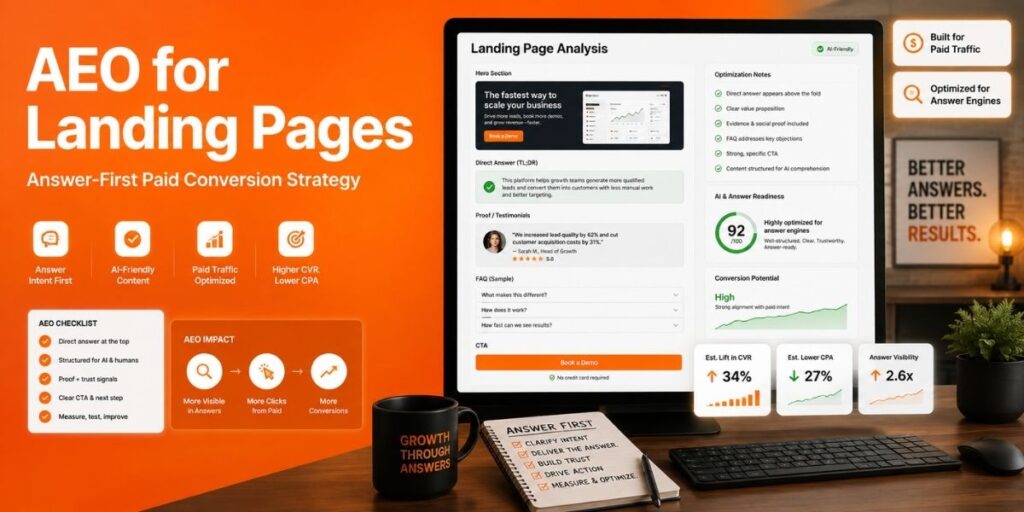
- AEO for landing pages means making the post-click page easy to understand, extract and act on.
- Answer the core question immediately instead of opening with vague marketing copy.
- Place proof beside important claims rather than hiding all trust signals near the footer.
- Use clear comparison blocks, definitions and genuine FAQs where they help buyers decide.
- Keep the ad promise, landing-page answer and CTA aligned.
- Use competitor landing-page intelligence to find patterns, then create an original page rather than copying competitors.
A paid landing page has traditionally had one main job: turn a click into a useful action. In 2026, it increasingly has a second job too—make the product, offer and evidence easy for search systems and AI-assisted discovery experiences to understand.
That does not mean stuffing a page with FAQs or writing for bots instead of customers. Good AEO for landing pages starts with the same thing good conversion copy has always needed: answer the visitor’s question quickly, support the answer with credible proof and make the next step obvious.
Inside This Guide
What Is AEO for Landing Pages?
AEO for landing pages is the practice of structuring post-click content so a visitor—and systems that summarize or interpret webpages—can quickly identify what the offer is, who it is for, how it works, why it is credible and what action comes next.
It sits at the intersection of conversion optimization, paid advertising and answer-led content. This matters more as search moves beyond ten blue links. AdSpyder’s current AI search advertising guide shows how conversational search journeys increasingly begin with detailed questions rather than isolated keywords.
| Traditional Landing Page Question | AEO Addition |
|---|---|
| Will visitors understand the offer? | Can the offer be summarized accurately? |
| Does the page persuade? | Are claims connected to visible evidence? |
| Is the CTA clear? | Is the next action explicit and contextual? |
| Does the page match the ad? | Does the page directly continue the user’s question? |
Why Paid Landing Pages Need an Answer-First Structure
Paid traffic arrives with context. Someone clicked because an advertisement promised a price, solution, comparison, trial, demo or specific outcome. Making that person decode a clever slogan before discovering the actual answer creates unnecessary friction.
AdSpyder’s 2026 analysis of 167.9 million Google Search ad destinations found that destination intent varies substantially between shopping, pricing, signup, trial and other paths. The practical lesson from its landing-page CTA dataset is simple: destination intent matters more than copying a popular button label.
Answer-First Principle
Ad question → direct landing-page answer → supporting proof → relevant detail → clear next action
The ANSWER Framework for AEO Landing Pages
State what the product does, who it helps and the relevant outcome near the top of the page.
Avoid generic language like “for everyone.” Identify the role, company type, problem or use case.
Use product evidence, customer proof, methodology, pricing details, demonstrations or relevant data.
Use descriptive headings, comparison tables, short paragraphs and clearly labelled sections.
The page should continue the same promise, audience and offer that earned the click.
Match the CTA to intent: buy, compare, try, calculate, request pricing or book a demo.
Message continuity matters enough to audit separately. AdSpyder’s competitor landing-page research found that the typical observed competitor domain had only one landing URL captured, while the 90th-percentile advertiser had four or more. That suggests stronger advertisers are more likely to segment post-click experiences instead of sending every campaign to the same generic page.
Use Direct Answer Blocks Without Making the Page Feel Like a Blog
A landing page does not need a 600-word introduction. The strongest answer block is often 40–80 words.
Weak
“Transform your business with the future of intelligent growth.”
Better
“AdSpyder helps marketers research competitor ads and landing pages across major advertising platforms so they can identify offers, CTAs and post-click patterns before launching a campaign.”
The second version gives humans and machines concrete entities, relationships and outcomes. That clarity is useful whether the visitor arrived through traditional paid search or a newer answer-led journey. The distinction between those acquisition paths is explained further in AdSpyder’s AI search vs paid ads comparison.
Put Proof Beside the Claim It Supports
AEO is not simply about producing answer-shaped text. An unsupported answer is still weak.
Useful proof blocks can include:
- Actual product capabilities
- Transparent methodology
- Customer testimonials with context
- Case-study outcomes
- Pricing or plan information
- Relevant original datasets
- Specific guarantees, limitations or eligibility conditions
Lead-generation pages should apply the same principle near forms. AdSpyder’s lead-generation form guide recommends collecting only the information needed for the next useful business action and measuring qualified outcomes rather than celebrating form submissions in isolation.
FAQs Help When They Resolve Real Buying Questions
An FAQ section can improve comprehension because it puts objections into explicit question-and-answer language. Useful landing-page questions include:
- Who is this product for?
- What does the plan include?
- Does it integrate with my platform?
- How is my data handled?
- How quickly can I get started?
- What is the difference between this option and the alternative?
Structured Data Reality Check
Do not add FAQ markup because you assume it will automatically create AI visibility or a Google rich result. Structured data should accurately represent visible page content, and Google does not guarantee a special search appearance simply because markup is present.
AEO Landing Page Examples by Intent
| Visitor Intent | Answer Near the Top | Best Supporting Block | CTA |
|---|---|---|---|
| Compare | Who each option suits | Comparison table | Try / Choose Plan |
| Pricing | Starting price + inclusions | Plan table | Start / Contact Sales |
| Problem | How the product solves it | Workflow / example | See It in Action |
| High intent | Offer + qualification | Proof + objection handling | Book Demo / Buy |
This is where paid-ad intelligence becomes useful. The competitor ads for lead generation workflow recommends recording the audience, problem, offer, proof, angle, format and CTA before deciding what to test on your own page.
How Do You Measure Whether AEO Improvements Actually Work?
Do not create an “AEO score” and optimize the page toward a number that has no business meaning.
| Layer | Useful Metrics |
|---|---|
| Paid campaign | CTR, CPC, qualified sessions |
| Landing page | Conversion rate, CTA clicks, form completion |
| Lead quality | Valid lead rate, MQL/SQL rate, CPQL |
| Business | Opportunities, CAC, revenue, gross-profit return |
| AI discovery | Relevant citations/mentions, referral sessions, assisted conversions |
A landing-page rewrite is successful when it improves the quality of the journey, not merely because a tool labels it “AI optimized.” AdSpyder’s AI performance marketing framework similarly recommends connecting campaign decisions with qualified leads, customers and revenue rather than optimizing around surface metrics alone.
7 Common AEO Landing Page Mistakes
The visitor still cannot tell what the product does.
Different intents deserve different post-click answers.
“Best,” “fastest” and “#1” need support or should be rewritten.
Twenty keyword-shaped questions do not make the page more useful.
The ad promises one outcome while the page opens with another.
Observable patterns are hypotheses—not proof of competitor profitability.
More forms completed can still produce worse economics.
For teams auditing those problems across paid media, the competitor ad audit framework explicitly recommends following the click into the landing page instead of stopping at the creative.
How AdSpyder Improves the AEO Landing Page Workflow
Your own analytics tell you what happened on your landing page. Competitive intelligence helps answer a different question: what are buyers seeing everywhere else?
AdSpyder’s Landing Page Analysis connects ads with post-click destinations and lets marketers review current and historical landing-page screenshots, messaging, CTAs and page evolution across supported advertising channels.
Practical competitor-analysis workflow
- Choose competitors selling to the same audience.
- Find the ads associated with the relevant offer.
- Open the destination page.
- Record the opening answer, proof, CTA, form and objection handling.
- Compare multiple competitors instead of copying one example.
- Create an original hypothesis for your own landing page.
You can broaden that analysis with the AdSpyder Ad Library to identify offer and message patterns before examining the destinations behind them.
Then connect the landing-page test to the wider acquisition system. AdSpyder’s SEO, AI search and paid demand framework treats paid media as the fast testing layer while organic and AI-search visibility build longer-term discovery.
AEO Landing Page Checklist
Do not optimize your landing page in a competitive vacuum.
See the ads, offers, landing pages and CTA patterns buyers are already encountering—then build a clearer, better-supported post-click experience of your own.
Frequently Asked Questions
What is AEO for landing pages?
AEO for landing pages means making the page’s main answer, entities, evidence and next action easy to understand. The goal is clearer communication for buyers while making important information straightforward for search and AI systems to interpret.
Is AEO different from landing page SEO?
They overlap. SEO includes crawlability, indexing, relevance and organic visibility. AEO places extra emphasis on answering specific questions clearly enough to be understood and summarized. Paid landing pages should still prioritize conversion intent.
Should every landing page have FAQs?
No. Add FAQs when they resolve genuine objections or repeated questions. Do not add them merely to increase word count or insert keywords.
Does FAQ schema guarantee AI visibility?
No. Structured data can help systems understand page information when it accurately represents visible content, but it does not guarantee rankings, AI citations or a rich search result.
How do I make a PPC landing page more answer-friendly?
Start with a direct description of the offer, specify who it serves, support claims with evidence, organize supporting information under descriptive headings and align the CTA with the intent behind the advertisement.
How does competitor landing-page analysis help?
It reveals observable market patterns such as offer framing, message match, proof placement, forms and CTA structures. Those patterns can inspire hypotheses, but they do not reveal a competitor’s private conversion rate, CAC or profitability.