Quick Answer
- There is no universal day when ad fatigue begins.
- AdSpyder’s May 2026 sample of 24,650 ads found 54% disappeared within 7 days.
- Only 22% remained observable for 30+ days; 9.4% reached 90+ days.
- Meta’s median observed run was 4 days; YouTube 5.1 days; LinkedIn was dramatically longer at 43.3 days.
- Creative age alone does not prove fatigue. Confirm it with frequency, CTR, CPA, CVR or ROAS trends inside your own account.
- Use competitor longevity as a refresh benchmark—not as a reason to kill a profitable ad automatically.
Ask five performance marketers when an ad becomes fatigued and you may get five answers: seven days, two weeks, frequency three, frequency five, or “whenever CTR falls.”
The problem is that most fatigue advice mixes together two different things: how long advertisers keep creatives live and when the audience actually stops responding. AdSpyder can measure the first using observed ad-history data. Your ad account must measure the second. Putting those two layers together produces a much more useful benchmark.
Important Data Distinction
AdSpyder does not have a competitor’s private CTR, CPA, ROAS, spend or conversion rate. This study measures observable creative persistence using first-seen and last-seen dates. That is a market-behavior signal—not direct proof of engagement decline.
Inside the Research
Methodology: What AdSpyder Actually Measured
This analysis uses the same May 2026 AdSpyder archive dataset behind our recent research on how long ads actually run.
The dataset contains 24,650 ads with usable first-seen and last-seen date pairs across six advertising environments:
- 4,650 LinkedIn ads
- 4,000 Meta/Facebook/Instagram ads
- 5,000 YouTube ads
- 4,500 Bing/Microsoft ads
- 1,000 Google Search ads
- 500 Display ads
| Methodology Item | Definition |
|---|---|
| First seen | First date the creative was observed in the AdSpyder archive. |
| Last seen | Most recent date the creative was observed. |
| Observed duration | Gap between first-seen and last-seen dates. |
| Data date | May 2026. |
| Excluded | Invalid date anomalies, durations above 10 years and platforms without usable date pairs in the sample. |
Important: observable duration is a floor estimate. An ad still active when sampled may continue running after its last-seen date.
Executive Findings: Most Ads Disappear Fast—A Small Minority Run for Months
54%
Observed for less than 7 days
24%
7–30 day mid-run cohort
22%
Observed for 30+ days
9.4%
Observed for 90+ days
The distribution matters more than the average. The market contains two very different behaviors: advertisers testing and removing large numbers of creatives quickly, and a much smaller group of ads that survive long enough to become evergreen controls.
That same high-volume testing pattern appears in AdSpyder’s separate 20,000-campaign creative-variant study: active advertisers rarely depend on one creative indefinitely. Creative production is a system, not a one-off launch.
Overall Creative Survival Curve
Under 7 days — 54%
7–30 days — 24%
30+ days — 22%
90+ days — 9.4%
Source: AdSpyder platform data, May 2026. The 90+ day cohort is contained within the 30+ day group.
Ad Fatigue Benchmarks Are Platform-Specific
| Platform | Sample | Median Observed Days | 30+ Days | 90+ Days |
|---|---|---|---|---|
| 4,650 | 43.3 | 70.7% | 22.3% | |
| Meta | 4,000 | 4.0 | 29.8% | 15.5% |
| YouTube | 5,000 | 5.1 | 22.1% | 7.8% |
| Bing | 4,500 | 0* | 8.1% | 4.4% |
| Google Search | 1,000 | 0* | 4.9% | 1.9% |
*A median of zero means most sampled ads were observed in a single collection window; it should not be interpreted as literal zero-day campaigns.
Meta: fast testing, but winning creatives can survive for months
Meta has one of the clearest split distributions. The median is only four days, yet 29.8% of sampled ads survived 30+ days and 15.5% reached 90+ days.
That tells marketers not to interpret age alone as fatigue. A four-day-old Meta creative deserves monitoring. A 90-day ad is not automatically “stale”; it may be an exceptional control. This is why the workflow in AdSpyder’s recent Facebook creative research study separates live-market patterns from arbitrary calendar-based refresh rules.
LinkedIn: do not apply Meta’s refresh cadence
LinkedIn is the structural outlier. Its 43.3-day median is more than ten times Meta’s observed median, and 70.7% of sampled creatives lasted at least 30 days. A six-week-old B2B ad can be completely normal rather than fatigued.
Search: analyze message patterns, not one individual ad
Google Search and Bing rotate rapidly in the observable archive. That makes persistent headline, offer and keyword patterns more meaningful than obsessing over one RSA variant. AdSpyder’s June analysis of 211M+ Google and Meta ads found that even copy-length survival patterns differ sharply by platform—another reason not to use one universal creative rule.
So When Does Engagement Actually Start to Decline?
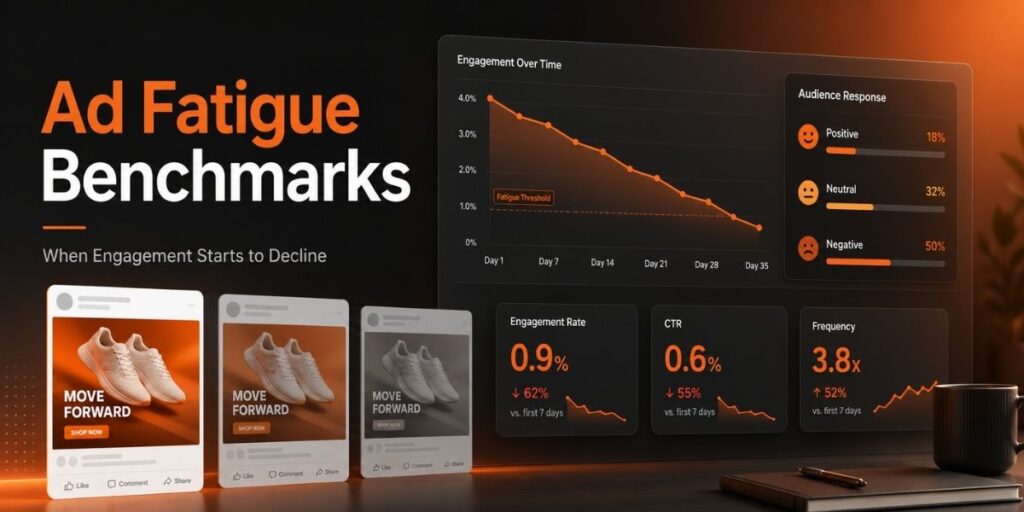
The honest answer is: when repeated exposure begins to coincide with worsening performance—not when an arbitrary number of days has passed.
Your own ad account should trigger the decision. Watch these together:
| Signal | Possible Meaning | Do Not Assume |
|---|---|---|
| Frequency ↑ + CTR ↓ | Audience may be ignoring repeated creative | That CTR alone proves fatigue |
| CPA ↑ + targeting stable | Creative or offer may be losing efficiency | Creative is the only cause |
| CTR stable + CVR ↓ | Landing page, offer or traffic quality issue | The ad necessarily needs replacing |
| CPM ↑ + reach plateaus | Audience saturation or auction pressure | Creative fatigue is confirmed |
| ROAS ↓ across several creatives | Offer, seasonality or demand may have shifted | Refreshing visuals alone will fix it |
External creative-analytics platforms use similar multi-signal approaches. Motion, for example, flags combinations such as rising frequency alongside a substantial week-over-week CTR decline rather than treating creative age alone as fatigue. Madgicx likewise emphasizes frequency in combination with CPC, CTR and conversion efficiency.
Use those as alert frameworks, not universal laws. Your baseline, audience size, funnel stage, product price and campaign objective matter more than someone else’s fixed frequency threshold.
3 Patterns the AdSpyder Data Reveals
1. Fast death and fatigue are not the same thing
An ad disappearing after three days may have been an A/B test, promotion, weak creative or simply a short observation. Calling every short run “fatigue” would overstate what the archive can prove.
2. Long-running ads prove that repetition does not automatically kill a creative
The Meta sample contained an observed creative span of 1,620 days; LinkedIn reached 1,546 days. These are extreme cases, but they demonstrate something important: a good ad can continue running long after generic fatigue timelines say it should be dead.
3. Creative diversity matters more than endless cosmetic changes
Modern Meta delivery increasingly rewards meaningfully different concepts rather than dozens of minor iterations. Recent industry analysis around Meta’s Andromeda system makes the same distinction: fatigue is a time/exposure problem; creative similarity is a structural problem. AdSpyder’s winning creative research workflow therefore recommends studying several competitor hooks and formats before building a diversified test batch.
What Marketers Should Do Next: A 4-Level Fatigue Response
CTR, CPA and conversion rate are stable. Do not refresh merely because the ad is “old.” Prepare alternatives in the background.
Frequency rises or engagement softens slightly. Compare against the previous 7–14 day baseline and scan competitor creative changes.
Frequency is rising while CTR falls and CPA worsens. Launch a meaningfully different hook, visual or proof structure while keeping the winning offer where appropriate.
Several fresh creatives decline together. Investigate audience saturation, pricing, landing page, seasonality and competitive shifts instead of producing another cosmetic variation.
Do not wait until performance collapses to start researching replacements. AdSpyder’s 20-variant AI ad testing workflow recommends archiving strong unlaunched variants so the next rotation already has pre-screened options.
For teams operating across several channels, the August 2026 cross-platform advertiser analysis is another useful reminder: creative intensity differs significantly by platform, so refresh capacity should follow channel behavior rather than a single global calendar.
How to Benchmark Your Own Competitors With AdSpyder
Market-level benchmarks tell you what is typical. Competitor-level benchmarks tell you what is typical in your category.
- Open AdSpyder Ad Analytics or the Ad Library.
- Search 5–10 direct competitor domains.
- Separate newly launched ads from 30-, 60- and 90-day creatives.
- Record hook, format, offer, proof and CTA.
- Check whether long-running ads share recurring concepts.
- Review the landing pages behind those ads.
- Build your next refresh from market patterns—not from a blank creative brief.
The current AdSpyder Ad Library lets marketers search competitor creatives across major platforms by domain, keyword, country, date, format and other filters, while first-seen and estimated-duration signals help separate new tests from persistent creatives.
Do not copy the long-running creative. Extract the pattern: pain-first hook, founder video, testimonial proof, comparison angle, free-trial offer, limited-time price, or another underlying persuasion idea.
Limitations and Methodology Notes
- Observed lifetime is not confirmed campaign lifetime. First-seen can occur after launch and last-seen can precede the actual end.
- Longevity is not profitability. Brand campaigns can remain active without direct-response economics.
- Archive data does not expose private engagement metrics. CTR, CPA, spend and ROAS must come from your own account.
- Platforms have different observation patterns. Cross-platform medians should not be interpreted identically.
- This is not an industry-normalized sample. Results reflect ads with usable date pairs in AdSpyder’s May 2026 dataset.
- Correlation is not causation. An ad disappearing does not prove fatigue caused its removal.
Those limitations are precisely why the strongest fatigue workflow combines your private performance data + competitor longevity data + new creative testing.
Ad Fatigue Detection Checklist
Do not refresh creative because a calendar told you to.
Compare competitor creative age, formats, hooks and campaign changes—then use your own performance data to decide when a refresh is actually necessary.
Frequently Asked Questions
What is ad fatigue?
Ad fatigue is a decline in advertising response that can occur when an audience is repeatedly exposed to the same creative. Common symptoms include rising frequency alongside declining engagement or worsening acquisition efficiency.
How quickly does ad fatigue happen?
There is no universal timeline. In AdSpyder’s May 2026 archive sample, median observed creative duration was four days on Meta, 5.1 days on YouTube and 43.3 days on LinkedIn. These are creative-longevity observations, not guaranteed fatigue points.
What frequency causes ad fatigue?
No single frequency applies to every campaign. Prospecting, retargeting, product price, audience size and creative quality change the threshold. Treat rising frequency as a warning only when it coincides with declining performance.
Should I replace an ad after 7 days?
Not automatically. If CTR, CPA, conversion rate and ROAS remain healthy, an arbitrary seven-day refresh can remove a winning creative. Use performance signals first.
Can competitor data predict creative fatigue?
Competitor data cannot reveal another advertiser’s private engagement decline, but first-seen and last-seen dates can show how aggressively competitors rotate creative and which concepts persist unusually long.
What should I change when an ad becomes fatigued?
Start with a meaningfully different creative concept, hook, visual, proof point or format. If several fresh creatives decline together, investigate the offer, audience, landing page and market conditions rather than endlessly changing visuals.
How does AdSpyder help monitor creative fatigue?
AdSpyder provides competitor creative history, first-seen and duration signals, ad formats, messaging and cross-platform campaign intelligence. Use that external benchmark alongside your own CTR, CPA, frequency and ROAS data to plan smarter refresh cycles.