AI Lead Generation · Lead Quality · Automation
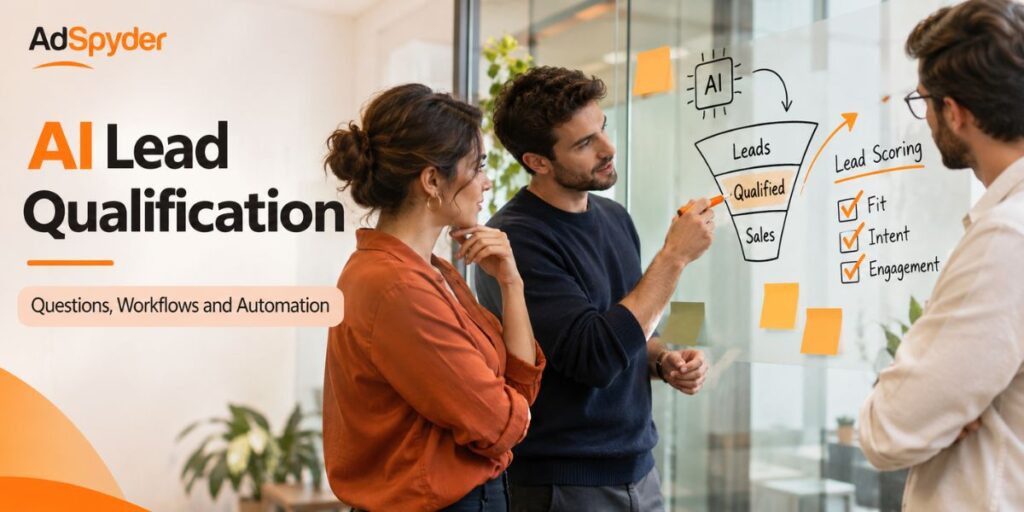
AI lead qualification is the process of using buyer fit, intent, behavior and acquisition data to decide which leads should go to sales, which need nurturing and which should be filtered out. The strongest workflow starts before the form by connecting the search query, ad promise, landing page and post-click answers.
- Separate fit from buying intent.
- Capture campaign, keyword, ad and landing-page context.
- Ask only questions that change scoring, routing or follow-up.
- Use AdSpyder Landing Page Analysis to see how competitors connect ad promises, CTAs, forms and post-click qualification.
A form submission is not automatically a qualified lead.
- A VP of Sales who searches for pricing, clicks a product-specific ad and requests a demo should not be treated like someone who downloaded a broad educational guide.
- The difference is context. AI lead qualification becomes useful when marketing and sales connect what the prospect searched, what convinced them to click, what they answered and what they did next.
Methodology and evidence note
This guide combines established lead-qualification principles with AdSpyder’s 2026 competitor-ad and landing-page research. Salesforce’s current qualification model separates engagement scoring from prospect fit, while AdSpyder adds the acquisition and post-click context that marketers can observe before a lead reaches the CRM.
Competitor intelligence is directional. Public ads and landing pages do not reveal a competitor’s private conversion rate, revenue, CPA or scoring model.
In This Guide
What Is AI Lead Qualification?
AI lead qualification evaluates whether a prospect fits your ideal customer profile and how likely the prospect is to take a meaningful buying action. AI can combine firmographic data, campaign source, website behavior, form answers and historical outcomes to prioritize the next action.
Three related terms are often mixed together:
| Term | What It Does | Primary Output |
|---|---|---|
| AI Lead Generation | Finds or attracts potential buyers. | New leads |
| AI Lead Scoring | Assigns priority or purchase probability from available signals. | Score or probability |
| AI Lead Qualification | Uses fit, intent and rules to determine the correct next action. | Sales, nurture or disqualify |
Salesforce describes qualification as combining engagement scoring with grading for prospect suitability. AdSpyder’s AI lead scoring framework adds acquisition context such as campaign, keyword, ad and landing page to that decision.
External reference: Salesforce Lead Qualification Model
AdSpyder Framework
The Five-Layer Signal-Stack for AI Lead Qualification
A reliable qualification decision should use more than one signal. The AdSpyder Signal-Stack groups qualification evidence into five layers: pre-click intent, account fit, declared need, behavioral intent and outcome feedback. Each layer answers a different question about lead quality.
Pre-Click Intent – Why Did the Person Arrive?
Capture the campaign, search term where available, ad, offer and landing page. A visitor responding to “enterprise pricing” carries different intent from someone responding to a broad awareness ad.
Account Fit – Can You Serve This Buyer Well?
Evaluate company size, industry, geography, role, technology environment or other ICP attributes that materially affect customer success.
Declared Need – What Did the Prospect Tell You?
Use form or conversational answers to understand use case, urgency, expected outcome, budget range and decision role.
Behavioral Intent – What Did the Prospect Do?
Pricing views, return visits, product exploration, demo requests and repeated high-intent actions often carry more meaning than one isolated page visit.
Outcome Feedback – Was the Qualification Actually Correct?
Feed sales acceptance, meetings, opportunities, wins and losses back into the model. AI qualification should improve from downstream outcomes rather than optimize indefinitely for form fills.
What Questions Should AI Use to Qualify Leads?
The best qualification questions are the ones that change the next action. Ask about use case, company fit, urgency, budget and buying role only when those answers affect sales priority, nurture or disqualification.
| Signal | Example Question | Decision It Supports |
|---|---|---|
| Problem | What are you trying to solve? | Use-case fit |
| Company | How large is your team or company? | ICP fit |
| Timeline | When do you want to implement a solution? | Urgency |
| Budget | Which investment range are you considering? | Commercial fit |
| Authority | What is your role in the decision? | Sales path |
For high-consideration sales, a dedicated landing page usually gives you more room to establish relevance and qualify intent than a lightweight lead form. See AdSpyder’s lead form ads vs landing pages comparison.
AI Lead Qualification Automation Examples
Automation should change the next action, not merely attach a score to the CRM record. A simple fit-intent matrix gives marketing and sales a practical starting point.
High Fit + High Intent
- Target account
- Relevant decision-maker
- Pricing or demo intent
Route → Sales immediately
High Fit + Low Intent
- Ideal account
- Early research stage
- No immediate project
Route → Targeted nurture
Low Fit + High Intent
- Strong buying action
- Outside standard ICP
- Possible edge case
Route → Human review
Low Fit + Low Intent
- Weak account fit
- No buying behavior
- Low-value action
Route → Low-cost nurture or filter
Which Metrics Show Whether AI Lead Qualification Works?
Measure qualification against downstream sales outcomes, not raw lead volume. Cost per qualified lead, sales acceptance, meeting rate, opportunity rate and revenue by acquisition source tell you whether the model is identifying prospects that actually progress.
| Metric | Formula | What It Tests |
|---|---|---|
| Qualification Rate | Qualified leads ÷ total leads | Acquisition quality |
| Sales Acceptance Rate | Sales-accepted leads ÷ qualified leads | Marketing-sales agreement |
| Meeting Rate | Meetings ÷ qualified leads | Real buyer intent |
| Cost per Qualified Lead | Ad spend ÷ qualified leads | True acquisition efficiency |
| Opportunity Rate | Opportunities ÷ qualified leads | Commercial fit |
There is no universal “good” qualification rate across every industry. Build your benchmark from your own funnel. AdSpyder’s lead quality from paid ads guide explains how to connect paid-media metrics with downstream CRM outcomes.
AdSpyder Original Research
How AdSpyder Improves AI Lead Qualification Before the Form
Most lead-qualification tools begin after the prospect becomes a lead. AdSpyder adds intelligence before that point. It lets marketers study the ads, offers, landing pages, CTAs and form strategies competitors use to attract and pre-qualify paid traffic.
AdSpyder’s May 2026 landing-page dataset provides a useful benchmark for this research:
3,953
Domain analyses
429
Domains with landing URLs
466
Unique landing URLs
781
Page observations
Source: AdSpyder URL & Domain Intelligence data, May 2026.
The data does not tell us which competitor page converts best. It does show the qualification signals marketers can observe and compare.
| Observable Signal | What to Check | Qualification Question |
|---|---|---|
| Ad Promise | Audience, pain point, offer | Who is being invited to click? |
| Landing-Page Headline | Message match with the ad | Does the page confirm visitor intent? |
| CTA | Demo, pricing, trial, contact | What commitment is expected? |
| Form | Fields and qualification questions | What information matters before sales? |
| Historical Change | New CTA, offer, proof or shorter form | Is the competitor changing its conversion hypothesis? |
Use the AdSpyder competitor ad audit to connect creative, offer and post-click experience instead of analyzing the landing page in isolation.
Landing Page Intelligence
See how competitors qualify prospects after the click.
AdSpyder connects competitor ads with current and historical landing-page views so you can study message match, offers, CTAs, forms and qualification paths before building your own funnel.
Why AI Lead Generation and Qualification Are Converging
Modern AI lead generation increasingly continues after acquisition. The system may research buyer intent, attract the visitor, capture contact information, qualify the lead and trigger the next sales or nurture action.
For example, Gushwork’s AI Search workflow combines acquisition with lead capture and optional automated qualification and follow-up.
The practical lesson is broader than any one platform: acquisition and qualification should share the same intent data. A lead should not lose all pre-click context the moment the form is submitted.
Common AI Lead Qualification Mistakes
Most qualification failures come from incomplete signals or bad incentives rather than the AI model itself. If the workflow rewards cheap leads, ignores acquisition context or never learns from sales outcomes, automation simply makes the wrong process faster.
Optimizing for CPL Alone
Cheap leads can create expensive sales waste when qualification rates collapse.
Ignoring Pre-Click Intent
Two identical forms can represent very different intent when they came from different keywords, ads or offers.
Adding Questions Without Purpose
Every field should influence scoring, routing, personalization or sales preparation.
Treating Scores as Ground Truth
A score is a prediction. Sales acceptance, opportunities and revenue must validate whether the model works.
AI Lead Qualification Checklist
✓ Defined a qualified lead using actual sales outcomes
✓ Separated account fit from buying intent
✓ Captured campaign, ad, keyword and landing-page context
✓ Asked only decision-changing qualification questions
✓ Created sales, nurture, review and filter routes
✓ Added negative-fit and disqualification signals
✓ Connected CRM outcomes back to acquisition source
✓ Compared competitor ads with destination pages
✓ Measured qualified pipeline instead of form volume alone
Improve lead quality before the prospect reaches your CRM.
Use AdSpyder to study competitor ad promises, landing pages, CTAs, forms and historical page changes. Turn public market evidence into better qualification hypotheses for your own paid funnel.
Try AdSpyder Landing Page Analysis →
Also explore Domain Analysis and the Ad Library.
FAQ
What is AI lead qualification?
AI lead qualification uses fit, intent, behavior and acquisition signals to determine whether a lead should go to sales, enter nurture, receive human review or be disqualified.
What is the difference between AI lead scoring and qualification?
Lead scoring assigns priority or purchase probability. Lead qualification combines that score with fit, business rules and prospect context to choose the correct next action.
What questions should be used to qualify a lead?
Ask about the problem, company fit, timeline, budget and buying role when those answers affect routing or follow-up. Avoid adding questions simply to collect more data.
Can AI automatically qualify leads?
Yes. AI can combine known lead signals and trigger sales, nurture or review workflows. Strategic accounts and unusual cases should still allow human review.
How does AdSpyder improve AI lead qualification?
AdSpyder improves the pre-click and post-click research layer. Marketers can analyze competitor ads, destination URLs, landing-page screenshots, CTAs, offers and historical changes to understand how competitors attract and pre-qualify traffic.
What is the best metric for lead qualification?
No single metric is enough. Track qualification rate, sales acceptance, meeting rate, opportunity rate, cost per qualified lead and revenue by source.
Does a competitor landing-page change prove better conversion performance?
No. Public landing-page history shows what changed, not why it changed or whether performance improved. Use competitor changes as testing hypotheses and validate them against your own conversion and revenue data.