Quick Answer
- Track competitor retail promotions by platform, product, price, offer and launch date.
- Do not use one promotion calendar for Google Shopping, Meta and marketplace ads—their roles are different.
- Research competitors before major sales, but also watch how quickly they change offers during the event.
- A visible discount is not always necessary; product value, price clarity and assortment can be stronger differentiators.
- Best approach: build a rolling competitor-informed promo calendar rather than repeating last year’s retail plan.
Retail campaigns rarely fail because a brand forgot Black Friday exists. They fail because the promotion was planned in isolation—without knowing when competitors started advertising, which products they pushed, what price shoppers saw on other platforms or how quickly the market changed. Retail ad intelligence turns those public competitive signals into a smarter promotion calendar.
That is especially useful in a strong but price-conscious 2026 retail market. NRF expects U.S. retail sales to grow 4.4% to $5.6 trillion this year, while July data showed shoppers continuing to respond to midsummer deals and early back-to-school promotions. Retailers have demand—but shoppers are actively comparing value. :contentReference[oaicite:0]{index=0}
Build a Smarter Retail Promo Calendar
Why Retail Promo Timing Is a Competitive Signal
A promotion date tells you more than when a sale starts. It can reveal how a retailer approaches inventory, demand creation and competitive pressure.
| Observed Pattern | What It May Suggest | What You Should Check |
|---|---|---|
| Competitor launches early | Demand-building or inventory push | Products, offer and channel mix |
| Offer changes mid-sale | Competitive response or weak initial offer | Old vs new creative and price |
| Certain SKUs dominate | Hero products or inventory priorities | Price tier and product category |
| Ads disappear quickly after event | Highly seasonal demand | Post-sale competitor activity |
Retail is also one of the more creative-intensive advertising categories. AdSpyder’s May analysis found retail and ecommerce advertisers averaging 26.9 Meta ads per advertiser in its historical sample—far above categories where businesses run only a handful of variations. The industry ad-volume study helps benchmark how aggressively your category is producing creative. :contentReference[oaicite:1]{index=1}
Four Retail Signals Worth Watching in 2026
$5.6T
NRF’s 2026 U.S. retail-sales forecast.
4.72%
year-over-year core retail-sales growth in July.
62%
of back-to-school shoppers had started by early July.
78%
expected higher back-to-school prices in 2026.
Sources: NRF 2026 annual forecast and July 2026 retail/back-to-school research. :contentReference[oaicite:2]{index=2}
Cross-Platform Promo Research: Don’t Treat Every Channel the Same
A retail promotion can look completely different depending on where the shopper encounters it.
| Platform | What Shoppers Notice | What to Research |
|---|---|---|
| Google Shopping | Image, title, price | Price bands, titles, variants, retailer |
| Google Search | Offer and intent match | Promo language, keyword and destination |
| Meta / Instagram | Creative and lifestyle context | Visual angle, UGC, offer, format |
| Amazon | Product and marketplace comparison | Sponsored products and category competition |
| Bing Shopping | Product listing to desktop-heavy audience | Whether competitors expand beyond Google |
For retailers already stable on Google, Microsoft Shopping can become an additional research and acquisition surface. The recent Google Shopping vs Bing Shopping comparison explains why Google remains the scale channel while Bing can provide a smaller, desktop-oriented opportunity in selected markets. :contentReference[oaicite:3]{index=3}
Retail Promo Pattern Research: Discount Is Only One Variable
It is easy to assume that the competitor with the biggest discount has the strongest retail ad. Large-scale ad data suggests retailers should be more careful with that assumption.
AdSpyder’s analysis of 219 million Google Search and Meta ads found value-proposition language appearing more often than discount language on both platforms. On Google Search, value propositions appeared in 20.6% of ads compared with 10.2% using discount language. The discount vs value-proposition study is useful when deciding whether every promotion needs to lead with a percentage-off message. :contentReference[oaicite:4]{index=4}
Retail research question
Before increasing your discount from 20% to 30%, check whether competitors are actually competing on discount—or on product quality, convenience, exclusivity, delivery, assortment or social proof.
Messaging also changes by campaign objective. Across 364 million ads analyzed in another AdSpyder study, price anchors, free-offer language and discounts were among the common messaging structures, while comparison-led copy was rare. Use the ad messaging angles dataset to identify what is common enough to be table stakes—and where your retail brief might differentiate. :contentReference[oaicite:5]{index=5}
Price Research Matters Before the Shopper Clicks
On Shopping ads, the competitor’s displayed price sits directly beside yours. That makes pricing intelligence part of advertising intelligence.
AdSpyder’s 2026 Shopping sample found a median advertised price of about $47 USD-equivalent, while the $10–$50 range accounted for roughly 36% of ads with parseable prices. More interestingly, only 7.4% showed an obvious two-price discount signal. :contentReference[oaicite:6]{index=6}
The Google Shopping pricing strategy study shows why a global benchmark should never replace category and country research. The same product class can sit in completely different price tiers across markets.
Your Promo Calendar Also Needs a Product-Feed Calendar
Retail campaign planning often focuses on banners, emails and social creative while the Shopping feed remains unchanged. That can be a mistake when product assortment or priority SKUs shift during a promotion.
AdSpyder’s current Shopping-title research found that 50–100 characters is the most common title range, variant detail appears frequently, and long-running ads are less likely to lead with the retailer name. The Google Shopping product-title study gives retailers a data-backed structure for seasonal feed revisions without stuffing promotional words into titles. :contentReference[oaicite:7]{index=7}
Seasonal Sale Creative: Think in Shopping Windows, Not Just Dates
The calendar date is not always the start of shopper intent. Back-to-school is a good 2026 example.
By early July, 62% of U.S. back-to-school shoppers had already started buying, and roughly one-third said they normally plan purchases around summer sales. That means a retailer waiting until August to research competitor school promotions may already be weeks late. :contentReference[oaicite:8]{index=8}
For product-led retail teams, the Shopping Ads Spy research guide explains how historical date filters can be used to compare competitor product titles, pricing, markets and ad longevity across different promotion windows. :contentReference[oaicite:9]{index=9}
Retail Social Ads Need a Different Promotion Brief
A Shopping listing can win because the right product appears at the right price. A Meta campaign usually needs more context.
- Why does the shopper need the product now?
- Is the creative product-first or lifestyle-first?
- Does the sale lead the message or support it?
- Is the ad introducing a collection or pushing one hero SKU?
- Does UGC make the offer feel more believable?
- Is the destination a PDP, collection page or dedicated sale page?
Retail teams using Meta alongside Search and Shopping can use the Facebook Ads for Retail Sales guide to map formats such as carousel, collection and dynamic product advertising to different stages of the shopping journey.
Build a Competitor-Informed Retail Promo Calendar
Do not make the calendar a list of holidays. Build it around decisions.
| Planning Window | Competitor Research | Your Output |
|---|---|---|
| 6–8 weeks before | Historical campaigns, products, price tiers | Initial promo strategy |
| 3–4 weeks before | New competitor creatives and landing pages | Creative brief + feed priority |
| Sale week | Offer changes, new SKUs, urgency | Response tests |
| 1–2 weeks after | Which competitors remain active? | Clearance / evergreen transition |
High-ticket retailers should also avoid copying fast-fashion promo mechanics blindly. A jewelry retailer, for example, may need more trust, intent capture and considered-purchase messaging. The updated Google Ads for Jewelry Retailers playbook is a useful example of adapting retail advertising to category economics rather than applying one universal sale formula.
A Practical Retail Competitor Research Workflow
Choose 5–10 brands with comparable products, price positioning and target market.
Record where each retailer appears across Search, Shopping, Meta, Amazon and other relevant channels.
Discount, free shipping, bundle, gift, loyalty benefit, financing or no promotion at all.
Which SKUs dominate each competitor’s paid presence during the window?
Check whether the destination is a sale page, category, PDP or homepage.
Choose what you will test differently instead of copying the observed campaign.
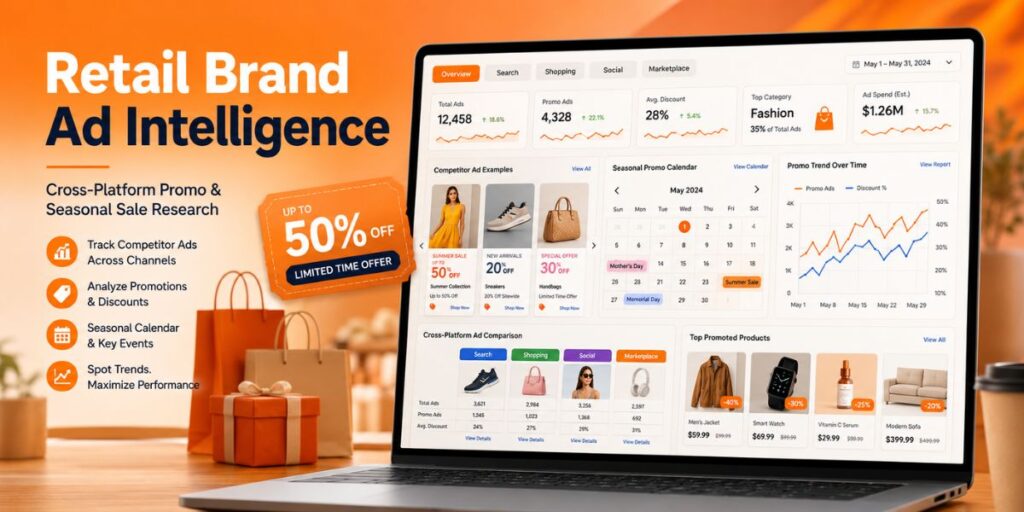
AdSpyder’s dedicated Retail Ad Intelligence workflow brings this research together across 15+ ad platforms, including Shopping, Search, Meta and Amazon, with historical competitor data, keywords and landing-page analysis. :contentReference[oaicite:10]{index=10}
Retail Promo Intelligence Checklist
Stop planning retail promotions with last year’s calendar alone.
Research competitor products, prices, ads and promotion timing across channels, then build a retail campaign around what the market is doing now.
Final Takeaway
Retail promotions should not be planned as isolated events. A promotion sits inside a competitive environment where prices, products, creative and shopper expectations can change within days.
The advantage of retail ad intelligence is not knowing exactly what a competitor will do next. It is arriving at launch with fewer blind spots: which platforms matter, when shoppers begin comparing, what competitors are promoting, how they position value and where there may still be room for your brand to look different.
FAQs for Retail Ad Intelligence
What is retail ad intelligence?
Retail ad intelligence is the analysis of competitor advertising across Search, Shopping, social and marketplace channels to understand promotion timing, products, pricing, messaging and campaign changes.
How early should retailers research seasonal promotions?
Start with historical research roughly six to eight weeks before a major campaign, then increase monitoring as competitors begin activating. Some shopping periods, such as back-to-school, begin earlier than the event itself.
Should every retail sale lead with a discount?
No. Discounts are only one advertising angle. Depending on the category, retailers may compete more effectively through product value, exclusivity, convenience, shipping, bundles, proof or assortment.
Can competitor ad intelligence show how much a retailer spends?
Observed ad activity can show creatives, timing, platforms and other public signals, but it should not be treated as a direct measure of private media spend, revenue, CPA or ROAS unless that information is publicly disclosed.
What should I track in competitor Google Shopping ads?
Track product title, image, visible price, retailer, country, first-seen and last-seen dates, assortment changes and whether particular products stay active through multiple promotion windows.
Should online and physical retailers use the same advertising strategy?
Not always. Physical retailers may need location, inventory and store-visit messaging, while ecommerce brands can optimize directly toward online checkout. Omnichannel retailers need ads that connect both journeys clearly.
How does AdSpyder help retail brands?
AdSpyder helps retail teams research competitor advertising across platforms, study Shopping product listings and prices, analyze keywords and landing pages, and compare historical campaign activity before planning their own promotions.