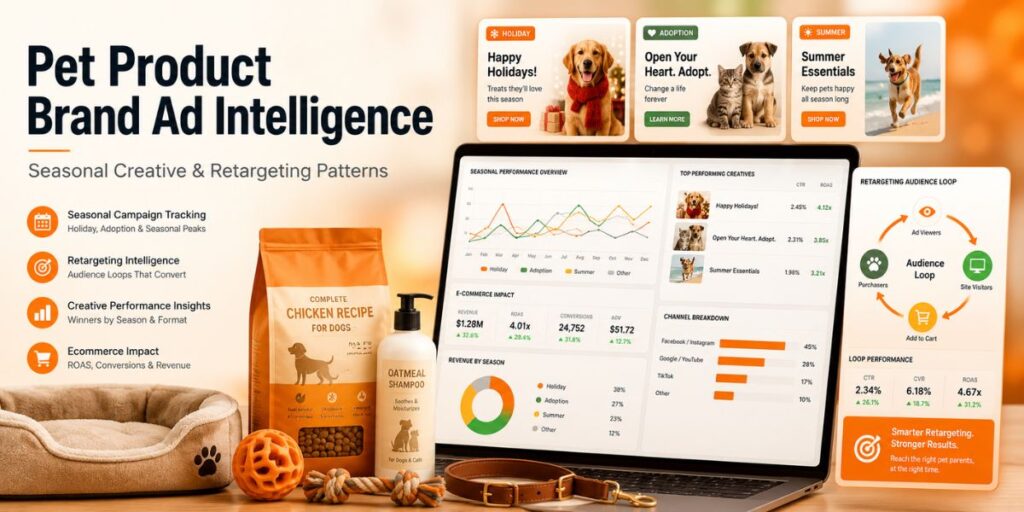
Quick Answer
- Track competitor pet ads by season, offer, product type and creative format.
- Start holiday monitoring before competitors reach peak activity, especially in Q4.
- Use adoption, wellness, travel, grooming and gifting as separate campaign themes—not one generic “pet owner” message.
- Retarget cart abandoners differently from product viewers, past buyers and subscription customers.
- Use AdSpyder to observe creative and timing patterns, then validate retargeting windows with your own conversion data.
Pet-product advertising is unusually seasonal because the buying trigger changes throughout the year. A calming product can become a travel product in summer and a fireworks-support product later. A toy can become a holiday gift. A food brand can shift from acquisition to replenishment. The useful job of pet product ad intelligence is spotting those changes early enough to build your own campaign before the market becomes crowded.
Build Your Pet Ad Calendar
Why Pet Product Ads Are Highly Seasonal
Pet ownership is large and resilient, but the reason someone buys can change dramatically by month. Current APPA data puts U.S. pet-industry spending at $158 billion in 2025, with $165 billion projected for 2026. That is not one homogeneous market—it includes food, treats, supplies, OTC products, veterinary care and services.
$158B
U.S. pet-industry spending in 2025.
$165B
projected U.S. pet-industry sales in 2026.
95M
U.S. households owned at least one pet in 2025.
71M
U.S. dog-owning households highlighted in APPA’s July 2026 report.
For marketers, the lesson is simple: a large market creates more competitors, but seasonality changes which competitors, products and messages matter at any given time. The AdSpyder pet-product workflow is built around competitor creative research, seasonal campaign ideas, multi-platform tracking and pet-focused ad generation.
Seasonal Creative Patterns Worth Tracking
Do not monitor only the week of an event. AdSpyder’s Shopping archive shows that different seasons have completely different activation curves.
| Season | Observed Ad Pattern | Pet Brand Research Question |
|---|---|---|
| Valentine’s | January–February buildup | Are competitors positioning pets as gift recipients or family members? |
| Spring | Broader Q2 activity | Do grooming, outdoor, flea/tick or travel messages increase? |
| Halloween | 63% of observed Shopping ads appeared in October | Are costumes, treats, safety lights or themed toys getting promoted? |
| Black Friday | Nearly 65% appeared in November | Which SKUs, bundles and discount depths are competitors prioritizing? |
| Christmas | October → December ramp | When do gifting creatives replace everyday product messaging? |
The useful timing signal
AdSpyder’s seasonal Shopping study found Christmas activity building from October through December, while Black Friday was much more concentrated. Pet brands should therefore monitor Christmas competitors earlier instead of treating every Q4 event as a one-week campaign.
The recent seasonal advertising analysis also found an 89% drop in Christmas-title Shopping ads from December to January. That sharp pullback creates a useful moment to study which competitors immediately switch from gifting to wellness, replenishment or New Year messaging.
Adoption and Rescue Campaigns Need a Different Creative Lens
Adoption-related messaging should not look like a normal product sale. Shelter Animals Count reported 4.2 million dog and cat adoptions in 2025. For pet brands partnering with shelters or running cause-led campaigns, track how competitors balance the mission with the commercial message.
- Donation per order
- Starter kits for newly adopted pets
- Shelter partnerships
- UGC from adopters
- New-pet education rather than discount-first creative
Retargeting Cadence: What You Can Observe vs What You Must Test
Important: a public competitor-ad archive cannot reveal whether someone used a 3-day cart audience, 14-day product-view audience or 30-day website visitor audience. Those settings are private.
What you can observe is:
- How long a creative remains observable.
- When new offer-led ads appear.
- Whether reminder-style creative follows prospecting creative.
- How often product, testimonial and discount angles rotate.
- Whether the landing page changes with the creative.
Use those signals to build your own test windows rather than guessing a competitor’s private settings.
| Audience | Starting Test Window | Creative Angle |
|---|---|---|
| Cart abandoner | First 1–3 days | Reminder, shipping, stock, proof or incentive |
| Product viewer | 3–14 days | Demo, review, benefit, comparison or FAQ |
| Past consumable buyer | Based on real replenishment cycle | Reorder, subscribe, bundle or quantity saving |
| Past accessory buyer | Longer window | Complementary product or lifecycle cross-sell |
These are testing starting points, not universal benchmarks. Adjust using your own conversion lag, purchase frequency, frequency data and customer lifetime value.
Subscription and repeat-purchase brands should treat retargeting differently from one-off accessories. AdSpyder’s pet subscription advertising guide goes deeper into retention, recurring value and creative refresh for repeat-purchase pet products.
Build a 12-Month Competitor-Informed Pet Ad Calendar
| Month | Themes to Monitor | Competitor Signal to Save |
|---|---|---|
| Jan | Wellness, routines, subscriptions | New-year bundles and recurring offers |
| Feb | Pet love, gifting, treats | Emotional vs discount-led creative |
| Mar | Spring care, grooming, outdoor prep | Product category shifts |
| Apr | Adoption, new-pet kits, spring | Cause-led and starter-kit offers |
| May | Outdoor, flea/tick, travel prep | Problem-solution hooks |
| Jun | Travel, hydration, outdoor activity | Portable and convenience products |
| Jul | Summer care, calming, hydration | Safety and comfort messaging |
| Aug | Routine reset, replenishment | Subscription/reorder creative |
| Sep | Indoor routine, wellness | Educational vs sales creative |
| Oct | Halloween, safety, themed products | Seasonal launch timing |
| Nov | Black Friday, bundles, gifting | Discount depth and hero SKUs |
| Dec | Christmas gifts, shipping deadlines | Gift creative, urgency and cutoff messaging |
Do not use this calendar as a fixed media plan. Use it as a monitoring calendar. Your real plan should change when competitor activity, product inventory, weather, purchase behavior and your own performance data change.
How to Research Pet Brand Campaigns in AdSpyder
Choose direct pet brands plus larger category leaders selling comparable products.
Look at what each brand ran during last year’s relevant seasonal window.
Prospecting, product education, offer, urgency, testimonial, replenishment or win-back.
Check whether seasonal creative leads to a PDP, bundle page, gift guide, subscription offer or category page.
A swipe file from six months ago can hide the most important change: what competitors started doing this week.
The recent AdSpyder swipe-file workflow recommends organizing competitor ads by platform, format and hook rather than saving random screenshots. For social-heavy pet brands, the newer Facebook competitor strategy guide also explains how to use repeated creative logic without copying branded assets.
Pet Product Brand Ad Intelligence Checklist
Build your next pet campaign from real seasonal evidence.
Review competitor pet ads, compare seasonal offers and landing pages, track creative changes and build your own original campaign calendar before the peak begins.
FAQs for Pet Product Brand Ad Intelligence
Why are pet product ads seasonal?
Pet needs change with weather, travel, holidays, gifting periods, grooming cycles and household routines. The same product can therefore require different positioning at different times of year.
Can AdSpyder show a competitor’s retargeting audience settings?
No. Private audience rules such as a competitor’s exact 7-day website visitor or cart-abandoner window are not publicly visible. Ad intelligence can reveal observed creative timing, offers, landing pages and campaign changes that help you form your own retargeting tests.
When should pet brands start monitoring Christmas ads?
AdSpyder’s seasonal Shopping data shows Christmas activity beginning to build in October and strengthening through December. Monitoring from October gives you more time to identify product, pricing and gifting patterns.
How often should pet brands refresh retargeting creative?
There is no universal schedule. Monitor frequency, CTR, conversion rate and incremental revenue. Refresh when performance deteriorates or when the shopper moves into a different buying stage, season or replenishment window.
What should pet subscription brands retarget with?
Use convenience, predictable delivery, savings, product consistency and reorder value. Existing subscribers should receive different messaging from first-time product viewers or cart abandoners.
Should a pet brand copy seasonal ads that competitors run repeatedly?
No. Repetition is a useful signal to investigate, but it does not prove profitability. Extract the underlying strategy—such as bundle, gifting, urgency or social proof—and create an original execution for your own brand.
Which platforms should pet brands monitor?
That depends on the category. Meta and TikTok are useful for visual creative and UGC patterns, Google Search and Shopping reveal high-intent product positioning, while Amazon is important for marketplace competition. Monitor where your real competitors are active rather than assuming one platform fits every pet brand.